




Government Roles and Responsibilities: Federal to School Level
Over the past two decades, one problem has repeatedly surfaced in Nepal’s education sector: confusion over responsibility.
After the Constitution of Nepal 2072 introduced a federal structure, state power was redistributed. Yet a practical question still remains unclear for many people: who is the real owner of a school?
Is it Singha Durbar in Kathmandu, the provincial capital, or the ward office in the village?
Many students and guardians are not certain who should solve common school problems such as teacher shortages, weak infrastructure, or delayed textbooks. Problems are visible, but the decision point for solutions is often not.
This guide explains how Nepal’s school education system operates and what each level of government is responsible for. It is based on the Constitution of Nepal, the Local Government Operation Act 2074, and education-related regulations, and it outlines both the formal division of authority and the practical overlaps seen on the ground.
Table of Content
- Government Roles and Responsibilities: Federal to School Level
- Constitutional basis for education authority
- Federal government: role and responsibilities
- Provincial government: the missing middle?
- Local government: the real power centre
- School level: where implementation happens (SMC, PTA, head teacher)
- Practical problems and the way forward
- What citizens and youth can do
- Conclusion
- Note
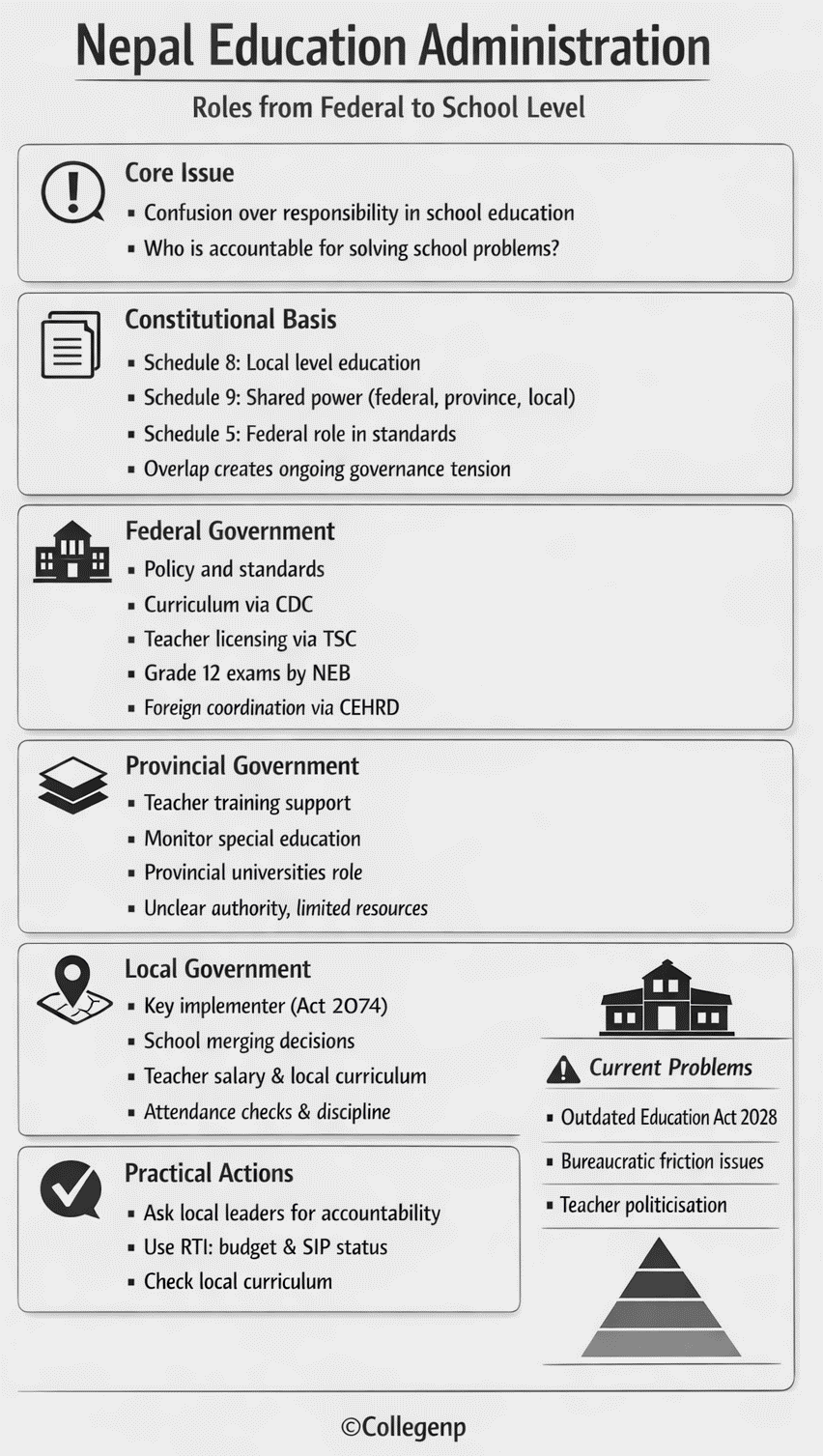
Constitutional basis for education authority
To understand school education governance in Nepal, the Constitution of 2072 is the central reference. It recognizes education as a fundamental right and distributes state powers across three levels.
The main challenge is not the constitutional text itself, but how it is interpreted and implemented.
Schedules and division of powers
The Constitution divides powers through Schedules, and much of the current confusion in education comes from how these lists interact.
-
Schedule 8 (exclusive local powers) explicitly includes basic and secondary education. This is widely understood as assigning responsibility for Grades 1 to 12 to local governments (rural municipalities and municipalities).
-
Schedule 9 (shared powers) includes education as a shared responsibility of the federal, provincial, and local levels.
-
Schedule 5 (federal powers) includes central universities, standards, and quality.
This overlap fuels tension. Local levels emphasize their mandate for school education up to Grade 12, while the federal level emphasizes its role in national policy and standards under shared powers.
More than 35,000 schools in Nepal are operating within this unresolved overlap.
Federal government: role and responsibilities
Even under federalism, key policy levers remain with the federal government. In practice, the federal role rests on four pillars.
Policy and standards
Ministry of Education, Science and Technology (MoEST) works to maintain nationwide consistency.
If learning standards differ sharply across districts, students face unequal outcomes and the system loses coherence. For this reason, the federal level prepares the National Curriculum Framework and sets minimum standards for schools.
In practical terms, Curriculum Development Centre (CDC) in Bhaktapur designs textbooks and curriculum materials.
Teacher licensing and commission standards
Even when local levels appoint teachers, federal standards apply through the commission system.
Teacher Service Commission (TSC) is responsible for licensing requirements, opening permanent teacher recruitment, and conducting examinations. This functions as a quality-control filter.
Examination management and certification (SEE and Grade 12)
Although secondary education is constitutionally linked to local authority, Grade 10 (SEE) and Grade 12 examinations are conducted by National Examination Board (NEB).
The stated rationale is recognition and certification. If 753 local levels issued separate certificates, equivalency and acceptance—especially for higher education and international use—could become complicated. The federal level therefore retains a central certification role.
Foreign coordination and scholarships
The federal level coordinates with development partners (such as the World Bank and ADB) for loans and grants, and supports scholarships for poor students through Education and Human Resource Development Centre (CEHRD).
Overall, the federal level functions as the planning and standard-setting centre, while implementation responsibilities are largely carried by lower levels.
Provincial government: the missing middle?
In practice, the provincial level remains the most uncertain actor in school education governance. It is less clearly defined than the federal and local roles, yet it often functions as a coordinator between the two.
Teacher training centres
The earlier 29 education training centres are now under provinces.
Their role includes training teachers when new curricula are introduced and strengthening leadership capacity of head teachers. Limited resources have slowed many provincial training functions.
Special education and technical streams
Provinces are responsible for monitoring technical institutions within the province (excluding colleges under Council for Technical Education and Vocational Training (CTEVT)) and for overseeing special schools for children with intellectual disabilities or disabilities.
Provincial universities
Concepts such as Gandaki University and Madhesh University reflect efforts to organize higher education within provinces.
A recurring concern is whether provinces function mainly as a channel for transferring federal funds to local levels, rather than shaping education policy aligned with regional language and culture.
Local government: the real power centre
A close reading of Section 11(j) of the Local Government Operation Act 2074 shows that local leaders hold major authority in school education.
If learning quality collapses in a local school, accountability is not only in Kathmandu. Ward chairs, mayors, and rural municipality chairpersons have direct roles and powers.
Key local powers (23 authorities under the Act)
Local governments have 23 clearly stated powers. Key examples include:
-
School opening and merging: authority to merge schools when student numbers are low (School Merging).
-
Grade 8 examination: managed at the municipal level, with certificates issued by the municipality.
-
Teacher salary and transfer: depositing conditional grant funds into teachers’ accounts and transferring teachers between schools within the municipality.
-
Local curriculum: a 100-mark local curriculum subject, allowing teaching related to local agriculture, tourism, or language.
Monitoring and disciplinary action
A major local power is monitoring. Local leaders and education section heads can visit schools, verify teacher attendance, take action, and stop salaries.
One cited example is Balendra Shah directing teachers to renounce political party membership, presented as an exercise of authority derived from the Act and Schedule 8 of the Constitution.
Own-source investment
Beyond federally funded salaries, many municipalities use their own-source revenue to support schools—for example, purchasing buses, increasing midday meal budgets, or hiring volunteer teachers.
School level: where implementation happens (SMC, PTA, head teacher)
Even strong policies fail if teaching does not happen in classrooms. Implementation ultimately depends on school-level governance and daily practice.
School Management Committee (SMC)
The SMC functions as the school’s decision-making body, including a chair and members selected through a parents’ assembly.
Key responsibilities include approving income and expenditure, recommending teachers for contract or relief appointments, and preparing the School Improvement Plan (SIP).
A common challenge is politicization. Schools with active, functional SMCs tend to sustain stronger delivery, while conflict between the SMC chair and the head teacher can severely damage school functioning.
Head Teacher (Headmaster): the executive lead
The head teacher is responsible for day-to-day leadership: assigning work, preparing schedules, and managing learning resources.
A key legal complexity remains: the head teacher carries heavy responsibility but has limited authority to take action against permanent teachers, and in such cases can only recommend action to higher bodies.
Parent-Teacher Association (PTA)
The PTA is intended to function as a watchdog body: questioning learning quality, fee practices, and child safety.
In practice, many PTAs remain limited to paperwork rather than active oversight.
Practical problems and the way forward
Several persistent issues shape today’s governance and delivery challenges in school education.
Legal vacuum: absence of a federal education act
Even after nine years under the Constitution, a new federal education act has not been enacted. The old Education Act 2028 does not recognize the federal structure.
Local levels cite constitutional authority to act, while teacher federations cite older legal protections. This legal vacuum remains a central source of conflict.
Bureaucratic friction
Education section officers often come from the federal civil service, but their day-to-day work falls under elected local leadership.
The resulting tension between officials and elected representatives has slowed education administration in many municipalities.
Politicization of teachers and protection dynamics
Learning quality is difficult to improve when political affiliation shapes classroom practice.
When local levels attempt disciplinary action, a pattern is described where central trade union protection can counter or weaken enforcement.
What citizens and youth can do
Practical steps proposed for readers include:
-
Accountability: when school problems occur, ask “Where is the mayor/chairperson?” or “Where is the ward chair?” The ward chair is described as an ex-officio member or guardian of the SMC and should be held accountable.
-
Right to information: ask the head teacher about the school budget and whether the SIP has been prepared.
-
Local curriculum: check with the municipality whether local curriculum has been implemented to protect local identity.
Conclusion
Nepal’s education structure functions like a pyramid: the lower the level, the heavier the implementation burden.
-
Federation: guide
-
Province: facilitator
-
Local level: doer
-
School: performer
The central need is not a fight over power, but a clear sense of responsibility. It is not enough that authority has moved from Singha Durbar to local areas; what matters is whether that authority is used properly so students receive quality education.
School education under federalism is presented as being in transition: the old house has been demolished, but the legal foundation of the new house is not yet strong. Strengthening that foundation is framed as a responsibility of aware citizens and the young generation.
Note
This piece is presented as being prepared purely on research and experience, without influence from any political party or ideology. The facts referenced are described as being based on the Constitution of Nepal and existing laws.







Comments 0
No comments yet. Be the first to start the conversation.