



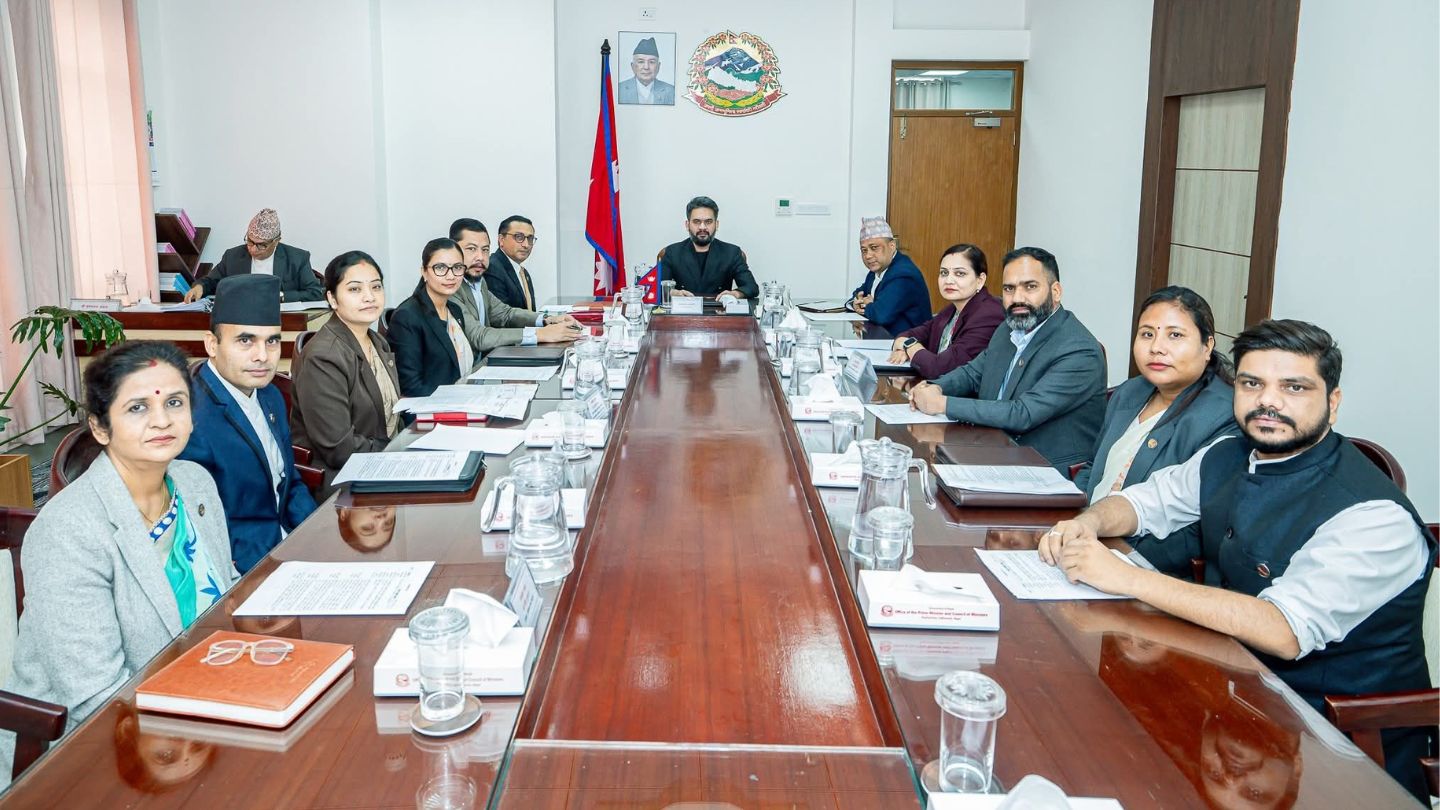
Ministry of Science, Technology and Innovation Formally Established
The government has formally established the Ministry of Science, Technology and Innovation, placing the fields of science, technology, and innovation at the center. The new ministry has been formed as per the Government of Nepal (Division of Work) Regulations, 2083, published in the Nepal Gazette following the Cabinet decision made on Baisakh 30.
The government’s decision to advance the science and technology sector through a separate ministry has been viewed in connection with the state’s long-term development strategy. At present, Prime Minister Balendra Shah himself is handling the responsibility of the ministry.
The newly formed ministry has been authorized to formulate policies, laws, and standards related to science, technology, and innovation. The responsibility for studies and research related to scientific research, space science, and astronomy will also fall under this ministry.
The government has stated that the ministry was formed with the objective of institutionalizing exploration, research, invention, promotion, and development in science and technology. The ministry will carry out work related to the collection, processing, survey, and standard-setting of data on science and technology.
Similarly, the new ministry has also been given responsibility for establishing, managing, and regulating a data system related to nuclear technology and the quality and use of radioactive materials. The ministry will also oversee the use, promotion, control, and regulation of biological and nuclear technology.
The ministry’s jurisdiction also includes ozone layer studies, solar radiation measurement and information flow, calibration and certification of scientific instruments, and work related to the use and regulation of chemical substances.
The government has also prioritized the management of nuclear energy and nuclear materials. The ministry will search for, recover, and manage nuclear materials and orphan sources. It has also been given responsibility for policy, law, standards, implementation, and regulation related to nuclear energy.
Matters related to the Nepal Academy of Science and Technology, National Forensic Science Academy, planetarium, observatory, and science museum will now also fall under this ministry.
Innovation, technology development, and industrial modernization have also been placed among the ministry’s key priorities. The ministry has been given responsibility for the development, improvement, and use of goods and services, processes, technology, and design, as well as the study, research, and application of concepts such as Industry 4.0 and Industry 5.0 in the industrial and business sectors.
The ministry has also received authority to enter into treaties and agreements and maintain contact and coordination with national and international organizations related to science and technology. As Nepal’s science and research sector has long been affected by budget shortages, policy ambiguity, and the migration of skilled human resources, it is expected that the formation of the new ministry will help achieve targeted results in this sector.
Key Takeaways
-
The government has formally established the Ministry of Science, Technology and Innovation.
-
The Cabinet made the decision regarding the formation of the ministry on 2083 Baisakh 30 (14th May 2026).
-
The ministry was established after the Government of Nepal (Division of Work) Regulations, 2083, were published in the Nepal Gazette.
-
At present, Prime Minister Balendra Shah is handling the responsibility of the ministry.
-
The ministry will formulate policies, laws, and standards related to science, technology, and innovation.
-
Studies and research related to scientific research, space science, and astronomy have been placed within the ministry’s jurisdiction.
-
The ministry will oversee the use, promotion, control, and regulation of nuclear technology, radioactive materials, and biological technology.
-
Ozone layer studies, solar radiation measurement, calibration of scientific instruments, and regulation of chemical substances have also been included among the ministry’s responsibilities.
-
Matters related to the Nepal Academy of Science and Technology, National Forensic Science Academy, planetarium, observatory, and science museum will fall under the ministry.
-
Innovation, technology development, industrial modernization, and the study, research, and application of Industry 4.0 and Industry 5.0 have been placed among the ministry’s priorities.


Comments 0
No comments yet. Be the first to start the conversation.