



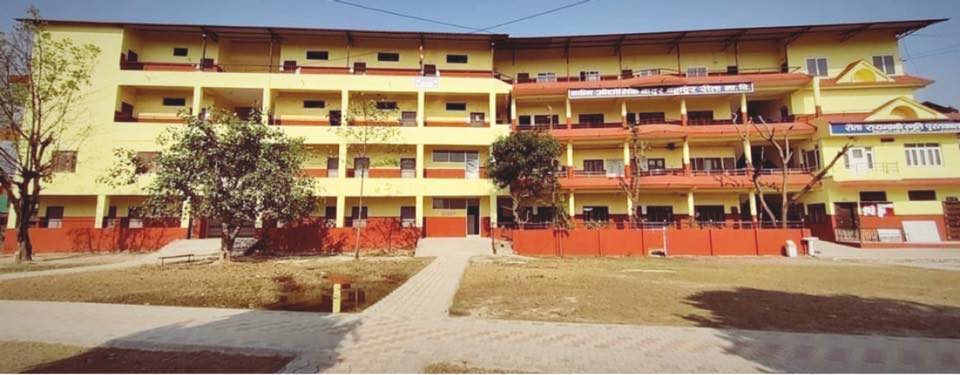
Technical Streams Strengthen Community Schools
Nabin Audhyogik Secondary School, Butwal, received permission to run Civil Engineering classes for Grades 9 to 12 in 2013/2014 AD (2070 BS). Since then, nearly 600 students have completed school-level study in that stream.
According to Principal Prem Bahadur Basnet, 48 students are admitted to Grade 9 each year. “Students’ interest in the technical stream remains high. At present, 192 students are studying from Grades 9 to 12,” he said. He added that Navin’s graduates have also made major progress in career-building.
Results and Career Outcomes
According to Principal Basnet, Susmita Pun, who studied at the school, secured first place in “Engineering Nepal.” He said four students who completed Grade 12 from the school were selected at the same time for Sub-Overseer posts and are now in government service.
Basnet also stated that a student who ranked first in the officer-level examination conducted by the Public Service Commission is also a graduate of Navin.
Other Schools Offering Technical Subjects
Like Nabin Audhyogik Secondary School, Civil Engineering is also being taught at Ramnaresh Secondary School in Dhakdhai, Rupandehi. The school said student demand there is also high.
In the computer stream, Kalika Manav Gyan Secondary School in Butwal and Farsatikar Secondary School in Shuddhodhan Rural Municipality are teaching related subjects. Kalika Manav Gyan started computer education in 2013/2014 AD (2070 BS).
Navaratna Secondary School in Butwal is teaching Crop Science under the agriculture stream. Although the quota is set at 48 students per year, the school has not been able to attract a strong student intake in Crop Science.
Progress in the Computer Stream
Kalika Manav Gyan Secondary School stated that students of Computer Engineering have also achieved strong career progress. The school’s students, who study Computer Engineering from Grades 9 to 12, have been becoming self-employed since their school years.
Kalika has repeatedly produced excellent results in the technical stream nationwide. According to Arvind Kumar Dubey, the coordinator of Kalika’s computer program, student interest in technical subjects is high.
Students who begin studying computer from Grade 9 are becoming software engineers and are engaged in their own ventures. “Students have had to return because we could not admit them. Since no additional section has been added, not everyone has been able to study,” teacher Dubey said.
Changing Learning Environment in Community Schools
With the inclusion of technical subjects such as computer, information technology, and civil engineering, community schools have begun to be recognized as centers that prepare young people for employment.
As classrooms now include computers alongside textbooks, along with project work and practical exercises, the overall learning environment has changed.
At a time when the need for technical and vocational education is increasing across the country, Nabin Audhyogik and Kalika Manav Gyan Secondary School have started an exemplary practice by operating technical streams from the secondary level.
Increased Student Retention
According to school administration, student interest in technical subjects has increased significantly in recent years. Previously, after SEE, students tended to leave in search of other schools or private colleges.
However, after technical education began, the situation changed. Principal Basnet said student continuity increased because students can study computers and technical subjects within the same school.
Employment and Part-Time Work
At Kalika, those studying computer subjects have not had to remain unemployed. “Even students who are still studying are earning 30,000–35,000 in part-time work,” program coordinator Dubey said. “We have not heard of any student having to sit unemployed.”
He said Kalika’s graduates have entered government service and have also worked in large companies. He added that operating technical education is not that easy, and that schools face challenges from lab construction to management.
Lab Costs and Practical Training
Practical materials are very expensive. Nabin Audhyogik, in collaboration with Lumbini Engineering College, conducts practice using a Universal Testing Machine. Since a single machine can cost up to 40 lakh, managing it is a challenge for the school.
Other labs and survey machines are kept within the school. Students studying Civil Engineering become familiar at the school level with machines used for tile laying, brick testing, and road testing.
In the technical stream, classes are conducted with 50 percent theory and 50 percent practical work. For practical learning, Nabin Audhyogik takes students on study visits to various cement industries and other factories.
Skills Focus and Government Policy
“Today’s students are looking for skills more than degrees,” teacher Dubey said. “After starting technical education, not only has enrollment increased, but students’ confidence and outlook toward the future have also changed.”
The government has been providing basic technical education in agriculture, computer, and civil engineering at the school level in community schools.
Because laboratories, computer labs, and project-based learning make classroom teaching practical, a policy of one technical education institution per electoral constituency has been adopted. However, schools with capacity are also granted permission beyond that standard.
Field Exposure and Digital Skills
Students studying Civil Engineering are not limited to theoretical knowledge. They have been participating in local construction work, building map studies, and field exercises related to basic infrastructure.
“Earlier, engineering felt like it was limited to books. Now, we can go to sites and understand the work. When you learn work along with studies, the future starts to look clear,” student Khanal said.
Students studying computer and IT are also advancing in digital skills. Skills in basic programming, documentation, design, and online use have kept them updated over time.
According to the school, some students who received technical education from Kalika Manav Gyan Secondary School have moved into higher technical studies, while others are working as assistant staff in private companies and technical firms. The school said students with a technical background have found it comparatively easier to search for jobs.
Support and Ongoing Challenges
The federal government has placed technical and vocational education and training as a national priority. Policies have been developed with the aim of producing skilled human resources, reducing unemployment, and narrowing the gap between education and employment.
The Lumbini Province Government has also adopted a policy to support schools operating technical streams under the education and social development sector. Schools stated that partial support for buildings, labs, and training has been coming from provincial and local levels.
However, schools said the equipment and skilled human resources required at the school level remain a challenge.
With the expansion of technical education, problems appear similar. The shortage of skilled technical teachers, lack of modern equipment, and weak direct collaboration with industry are the main challenges.
Principal Basnet said, “Policies are good, but in implementation there is a shortage of resources and human resources. If collaboration with the government and the private sector could increase, technical education would be more effective.”
Teaching Practice and Student Initiatives
In technical education, teachers provide guidelines and students use them. Program coordinator Dubey said, “Technical subjects must be taught in the same format. To do one and a half hours of practical work, the lab must be effective, and good computers are needed.”
Kalika has five labs. Practice has been conducted in AI and new software.
Students participate in seminars. An IT club has been formed. Students build apps and practice and apply them themselves.
The practices of schools including Nabin Audhyogik and Kalika show that community schools, with the right planning and commitment, can also become centers of technical education.
This effort to open pathways from study to skills and from skills to employment has presented an example not only for Butwal but also for other schools in Rupandehi. From the classrooms of these schools, it has begun to be clearly seen that investment in technical education can secure young people’s future.



Comments 0
No comments yet. Be the first to start the conversation.