




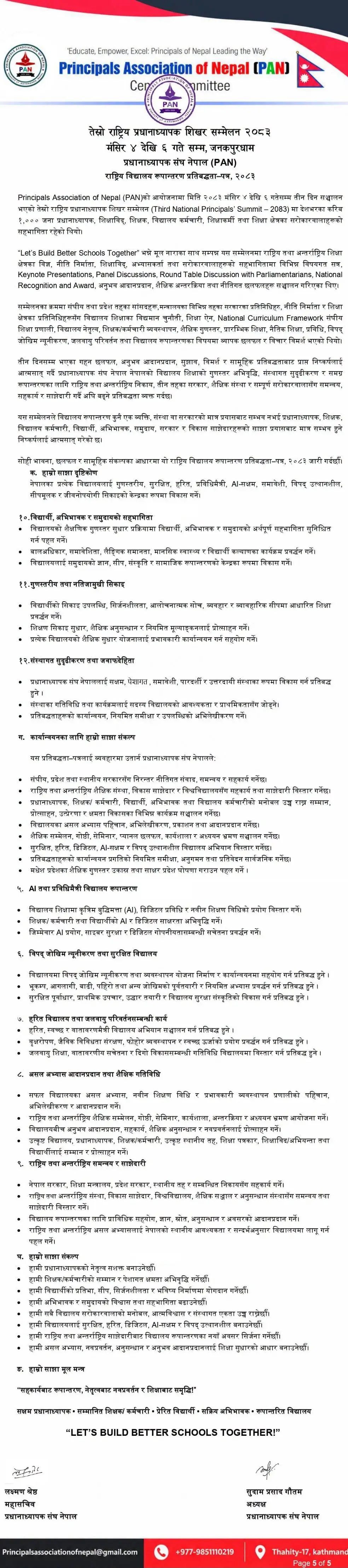
Janakpurdham. The Third National Principals' Summit 2083, organized by the Principals Association of Nepal (PAN), has concluded in Janakpurdham. The three-day summit, held from Mangsir 4 to 6, 2083, issued the National School Transformation Commitment Charter, 2083, following extensive discussions.
The summit brought together approximately 1,000 principals, education experts, teachers, school employees, and education stakeholders from across Nepal.
Held under the theme "Let's Build Better Schools Together," the summit featured round-table discussions with parliamentarians, thematic sessions, keynote presentations, and exchanges of experiences.
Participants discussed existing challenges in school education, the Education Act, the National Curriculum Framework, school leadership, Artificial Intelligence (AI) and technology, disaster risk reduction, and climate change.
The summit concluded that school transformation cannot be achieved through the efforts of any single individual, institution, or government. Instead, it requires the collective efforts of principals, teachers, students, parents, communities, governments, and development partners.
Based on these discussions and conclusions, the summit issued the National School Transformation Commitment Charter, 2083, outlining the following major commitments.
Key Commitments of the National School Transformation Charter 2083
1. Shared Vision and AI-Enabled, Technology-Friendly Schools
The summit established a shared vision to develop schools in Nepal into centers of quality, safe, green, technology-friendly, AI-enabled, inclusive, disaster-resilient, and skills-based learning.
The commitments include expanding the use of AI and digital technologies in school education, strengthening digital literacy among teachers and students, promoting responsible AI use, and increasing awareness of cybersecurity.
2. Disaster Risk Reduction and Green Schools
The Principals Association of Nepal expressed its commitment to developing disaster risk reduction and management plans in schools, improving earthquake and fire preparedness, and developing safe school infrastructure.
The charter also commits to launching a "Green, Clean, and Environment-Friendly Schools Campaign," strengthening waste management, and expanding climate education and environmental awareness.
3. Quality Learning and Stakeholder Participation
The charter calls for meaningful participation by students, parents, and communities in efforts to improve the quality of school education.
It also commits to promoting education focused on students' learning achievements, creativity, critical thinking, and practical skills.
In addition, the charter includes a commitment to implementing programs that support children's mental health and well-being.
4. Education in Madhesh Province and Implementation Commitments
PAN stated that it would maintain regular policy dialogue and coordination with federal, provincial, and local governments to translate the commitments into practice.
The association also expressed a specific commitment to improving educational quality in Madhesh Province and supporting efforts to declare the province fully literate.
5. National and International Partnerships
The charter commits to identifying and sharing good practices from successful schools, recognizing outstanding schools and teachers, and expanding cooperation with national and international educational institutions, development partners, and universities.
Shared Commitment to School Transformation
The commitment charter was signed by Laxman Shrestha, General Secretary of the Principals Association of Nepal, and Sudam Prasad Gautam, its President.
The charter adopted the following shared guiding principle:
"Transformation through Collaboration, Innovation through Leadership, and Prosperity through Education!"



Comments 0
No comments yet. Be the first to start the conversation.