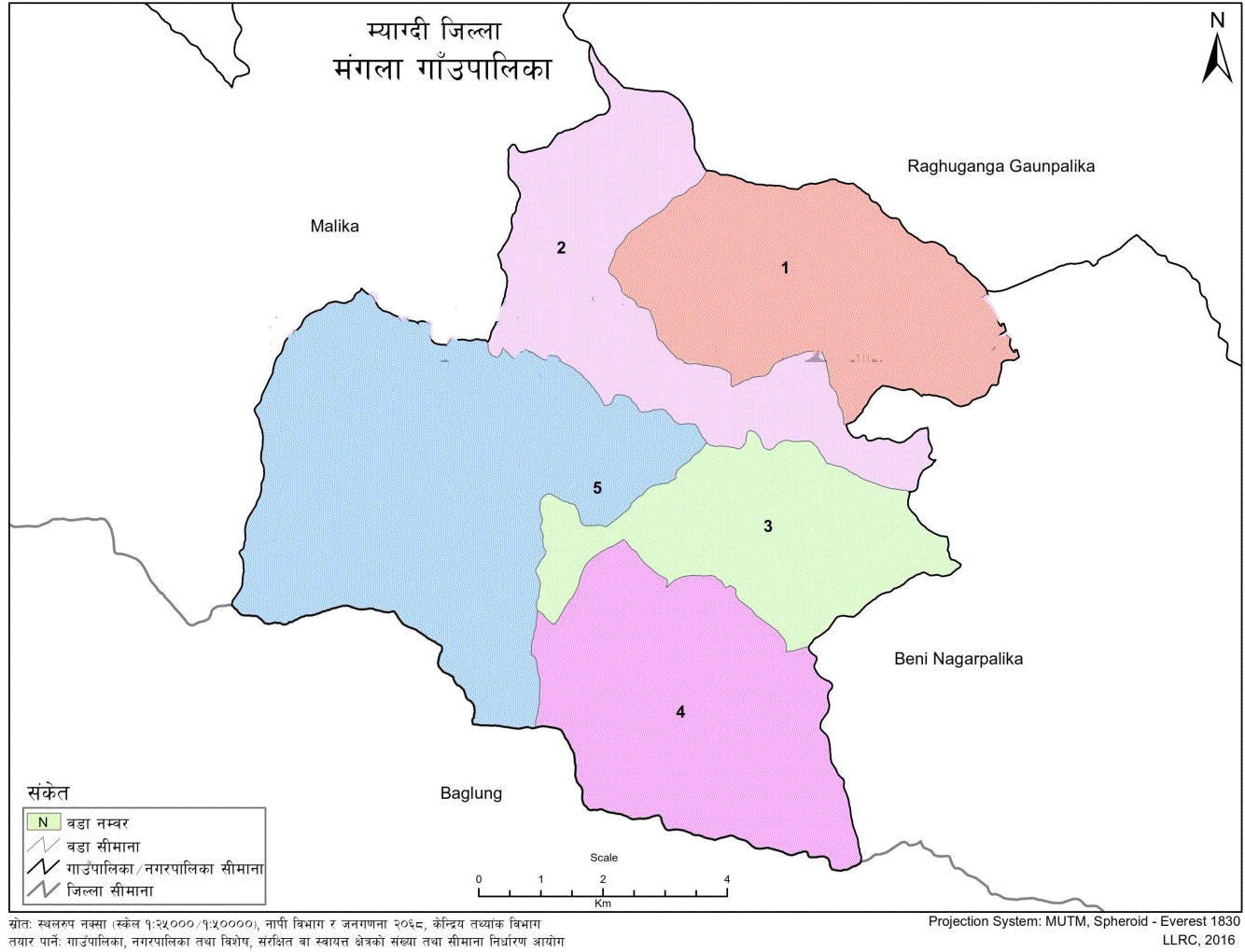
The core spirit of federalism envisioned by the Constitution of Nepal 2072 (B.S.) is to bring “government to citizens’ doorsteps.” Embracing this principle, Mangala Rural Municipality of Myagdi District has been providing various administrative, development-oriented, and social services to its citizens within the jurisdiction of the Local Government Operation Act, 2074 (B.S.).
The services delivered by Mangala Rural Municipality (Mangala Gaupalika) are not only legal procedures; they also serve as a bridge that strengthens the harmonious relationship between citizens and the state.
This profile presents an in-depth analysis of the classification of services provided by Mangala Rural Municipality, the service processes, required documents, and the challenges citizens face in accessing services.
Civil registration is one of the most basic and important functions of a local government. A citizen’s legal existence begins here.
There is a provision for free birth registration within 35 days of a child’s birth. Mangala Rural Municipality provides this service through its ward offices. After 35 days, there is a legal provision requiring the payment of a specified late fee.
Required documents: If the birth occurred in a hospital, the hospital certificate; if the birth occurred at home, the parents’ citizenship certificates and a ward-level verification (Sajamin).
If a person dies, the nearest legal heir must register the death within 35 days. This service is mandatory, particularly for property transfer and relationship verification.
A married couple must register their marriage to obtain legal recognition. Mangala Rural Municipality provides marriage registration certificates through an online system (VERPS).
Migration registration is mandatory when relocating permanently from one place to another. Similarly, administrative processes move forward only after registering a court-issued divorce decision at the local level.
The welfare role of the state is reflected in Mangala Rural Municipality’s social security programs.
Senior citizen allowance: A monthly allowance is provided to citizens who have reached 70 years of age (60 years in the case of Dalit citizens and Karnali).
Single women and widow allowance: This service is available to women who are economically poor and in need of social protection.
Disability allowance: Monthly allowances and other facilities are provided based on the nature of disability (red card, blue card).
Child nutrition allowance: An allowance is provided to children under five years of age from the Dalit community to improve nutrition.
Process: Mangala Rural Municipality currently distributes all social security allowances through the banking system, which has ensured transparency and brought “leakage” down to zero.
Among the services citizens use most frequently are different types of recommendations. All five ward offices of Mangala Rural Municipality provide the following recommendations:
Citizenship recommendation: Recommendation with Sajamin for new citizenship certificates or copies.
Relationship verification: Verification of relationships among family members for legal claims and foreign purposes.
Partition and land transfer (Nam-saari): Recommendations required to maintain land ownership records or for buying and selling.
Economic status certification: Certification of “income source” for scholarships or foreign study purposes.
Electricity and drinking water connection: Household recommendation for installing a new tap or meter.
The Local Government Operation Act assigns local levels the responsibility of managing education up to the secondary level. Through its Education Section, Mangala Rural Municipality provides the following services:
Teacher management: Position alignment, distribution of salaries and allowances, and capacity development training for teachers.
Scholarship distribution: Municipality-level scholarships for Dalit, poor, and meritorious students.
Physical infrastructure: Construction of school buildings, toilet management, and expansion of access to drinking water.
Local curriculum: Implementation of a curriculum that includes Mangala’s own geography and culture.
Inspection and monitoring: Regular monitoring to improve educational quality in schools.
To make the slogan “Healthy Citizens, Prosperous Mangala” meaningful, the municipality has made special investments in health services.
Basic health treatment: Free medicines and treatment through ward-level health posts and community health units.
Mother protection program: Safe delivery services, antenatal check-ups, and distribution of transportation expenses and nutrition allowances for postnatal mothers.
Full immunization program: Ensuring all government-specified vaccines for children.
Ambulance service: Coordination of ambulance services to take patients to hospitals in emergencies.
Village clinics and immunization centers: Delivering health services by reaching accessible local points.
The main foundation of Mangala’s economy is agriculture and livestock. Services in this sector are directly linked to people’s income generation.
Seed and fertilizer distribution: Distribution of improved seeds and organic fertilizer with subsidies.
Technical consultation: Advice on soil testing and crop protection through agriculture technicians.
Animal health: Treatment and vaccination services for diseases affecting cattle, buffaloes, goats, and poultry.
Orange farming promotion: Subsidies for orchard management and for branding Mangala’s oranges.
Cooperative coordination: Support for regulation and capacity development of local cooperatives.
To manage development works systematically, the municipality provides the following services:
Project agreements: Agreements and payments for small projects implemented through user committees.
Map approval and building construction: Map approval services to ensure safe building construction in areas undergoing urbanization.
Technical estimates and evaluation: Technical checks for roads, drinking water, and irrigation projects.
Disaster management: Immediate relief and infrastructure reconstruction in natural disasters such as landslides and floods.
As per Article 217 of the Constitution of Nepal, the Judicial Committee formed under the coordination of the Vice-Chairperson carries out judicial functions in Mangala.
Dispute resolution: Settling disputes such as boundary issues, wages and labor matters, domestic violence, and minor financial transactions through mediation.
Mediation centers: Efforts to resolve disputes locally through mediation centers in each ward.
Legal consultation: Providing citizens with information about their rights and legal procedures.
A transparent tax system has been implemented to strengthen the municipality’s internal revenue.
Integrated property tax: Tax levied based on the valuation of houses and land.
Business tax: Registration and renewal fees for small and large businesses.
Rent tax: Tax on renting out a house or land.
Recommendation fees: Minimal prescribed fees for various recommendations.
Mangala Rural Municipality has given high priority to the use of technology.
Online services: Vital event registration and social security work are conducted through online systems.
Public hearings: Public hearing programs at least twice a year to listen to citizens’ grievances and respond.
Right to information: Provision of an information officer and quarterly publication of budget and expenditure details.
Grievance handling: A “complaint box” at the municipal office and collection of citizen feedback through digital channels.
Although Mangala Rural Municipality has made significant progress in service delivery, some practical challenges still remain:
Geographical difficulty: Citizens in remote settlements still have to walk for hours to reach ward offices or the municipal center.
Digital literacy: Despite the start of online services, many citizens still depend on intermediaries due to limited knowledge of technology.
Shortage of human resources: Delays occur in performance because some technical and administrative sections do not have staff as per approved positions.
Limited budget: Citizens’ expectations are high, but grants from federal and provincial governments and internal income make it difficult to meet all demands.
For effective service delivery, citizens also have an equally important role.
Paying taxes on time.
Monitoring plans and taking interest in quality.
Registering vital events (birth, death, marriage) on time.
Protecting public property.
The local government services provided by Mangala Rural Municipality are strong foundations for improving citizens’ living standards and strengthening democracy at the grassroots level. From civil registration to judicial functions, and from agricultural subsidies to digital good governance, these efforts have established Mangala as a dynamic local government.
However, continuous improvement is necessary to make services more transparent, faster, and more technology-friendly. If both staff and elected representatives internalize the spirit of “quick service, polite speech,” Mangala Rural Municipality can become one of Nepal’s model local levels.
Source Materials:
Local Government Operation Act, 2074 (B.S.)
Constitution of Nepal 2072 (B.S.)
Mangala Rural Municipality Annual Progress Report 2080 (B.S.)
Department of National ID and Civil Registration statistics


.jpg)