



AI tools can help people generate options, test variations, and reduce routine work. Their effect on creativity is not automatically positive or negative. It depends on the task, the user’s knowledge, the design of the interaction, and whether success is measured through quality, speed, novelty, usefulness, or diversity.
Research presents a mixed but understandable picture. AI assistance has improved individual ratings or productivity in some creative tasks. Other findings point to greater similarity across outputs, weaker novelty on certain measures, or limited benefits from human–AI collaboration. These results measure different parts of the creative process rather than proving that AI always improves or harms creativity.
In this article, generative artificial intelligence refers to systems that produce or transform text, images, audio, code, or other content in response to instructions. Human creativity includes novelty and usefulness, but it also involves intention, interpretation, taste, cultural context, and responsibility. Human–AI co-creation occurs when a person uses AI assistance while retaining meaningful control over the direction and final result.
Answer Summary: AI can widen the range of ideas, support experimentation, and reduce repetitive effort. It should not be treated as an independent source of purpose, truth, or accountability. Individual gains may also occur alongside greater similarity across many outputs. A human-led process keeps intent, verification, voice, privacy, and final decisions with the person responsible for the work.
Table of Content
- What Do AI Tools and Human Creativity Mean?
- What Can AI Contribute to Creative Work?
- What Do Humans Contribute?
- What Does Research Say About AI and Creativity?
- When Does Human–AI Collaboration Fit the Task?
- A Human-Led Creative Workflow
- What Should Students and Educators Check?
- What Risks and Limitations Should Readers Consider?
- Can AI Replace Human Creativity?
- A Practical Decision Rule
Key Takeaways:
-
Creativity involves more than producing something new.
-
Faster output does not necessarily mean greater originality.
-
AI assistance can improve individual work while reducing collective diversity.
-
Human–AI collaboration does not always outperform the stronger standalone option.
-
Independent thinking and subject knowledge remain important.
-
Privacy, policy, attribution, and disclosure should be checked before use.
-
The appropriate approach may be human-only, AI-assisted, or automated for a narrow routine task.
What Do AI Tools and Human Creativity Mean?
AI-generated output and human creativity are connected, but they are not identical. A system can produce material that people judge as novel or useful without establishing that it has human intention, experience, or responsibility.
Key Terms and Creativity Measures
Creativity research uses several measures. Treating them as synonyms can produce misleading conclusions.
| Term | Meaning in this article |
|---|---|
| Generative artificial intelligence | Systems that produce or transform content in response to user instructions |
| Human creativity | The human process of forming, developing, evaluating, and communicating ideas with purpose and context |
| Human–AI co-creation | Creative work in which a person uses AI assistance while retaining meaningful direction and review |
| Novelty | How different an idea or output is from existing or expected material |
| Usefulness | Whether an idea serves its intended purpose or addresses the relevant problem |
| Originality | A broader judgment involving novelty, source influence, authorship, and context |
| Productivity | The amount or speed of output produced |
| Idea diversity | The degree of difference across several ideas or outputs |
| Creative agency | The ability to set goals, make choices, reject suggestions, revise work, and accept responsibility |
An increase in productivity does not establish an increase in originality. An output may receive stronger quality ratings while becoming more similar to other AI-assisted outputs.
Creativity Is More Than Newness
Something can be new without being useful, accurate, appropriate, or meaningful. Creative work is judged in relation to a purpose, audience, discipline, and social setting.
A visually striking design may fail to communicate its message. A new scientific suggestion may lack supporting evidence. A polished assignment may not represent a student’s understanding.
A 2024 Journal of Creativity review discusses AI as a tool that may support human creativity across learning, everyday, professional, and eminent forms of creative activity. A second review in the same journal examines interfaces designed to keep people actively involved in creative work. These papers offer conceptual and design frameworks, not proof that every AI system improves creative performance.
AI-Assisted Output Versus Human-Led Work
The central distinction is between producing material and directing a meaningful process.
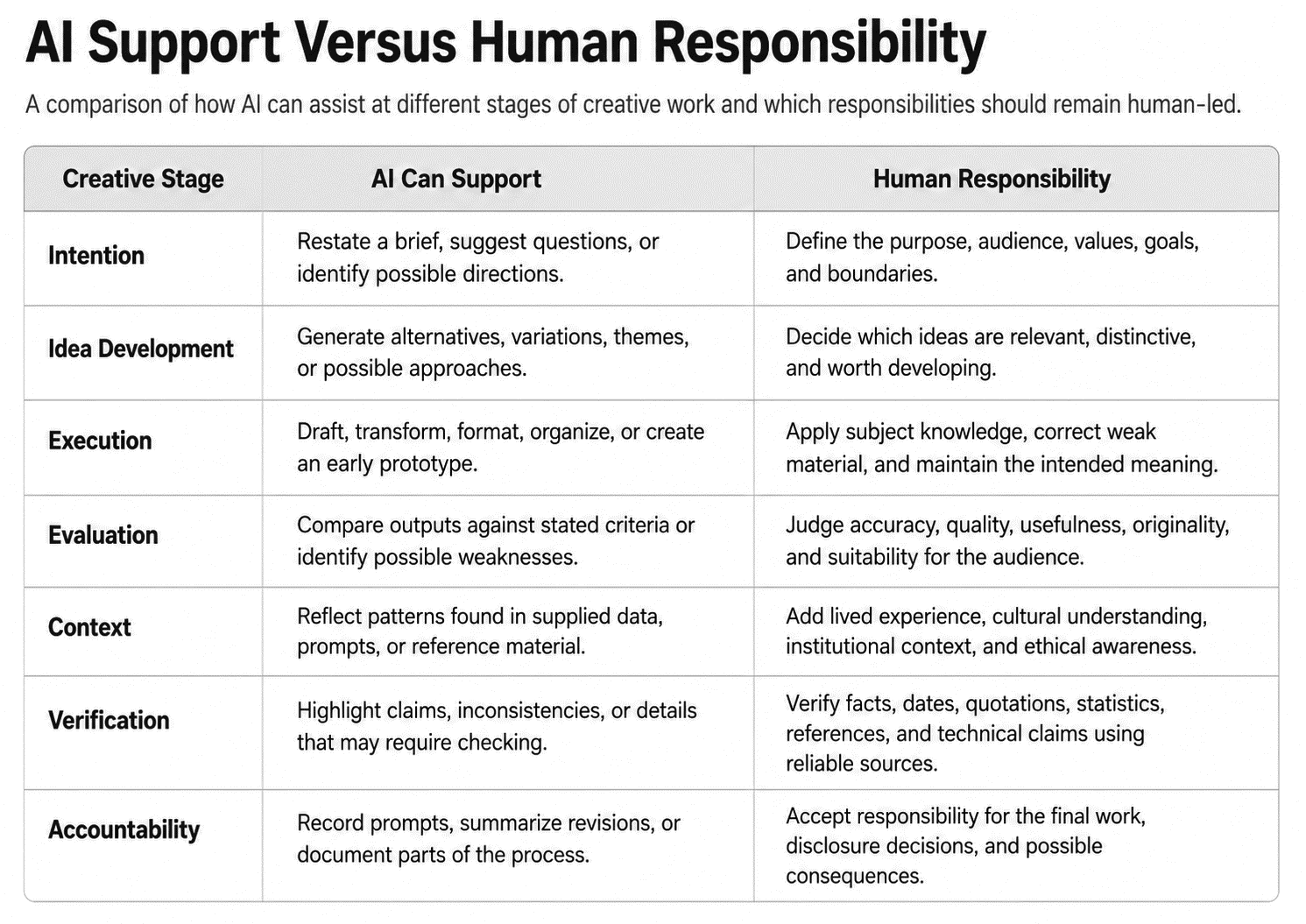
| Creative stage | AI can support | Human responsibility |
|---|---|---|
| Intention | Restate a brief or suggest questions | Decide the purpose, audience, values, and boundaries |
| Idea development | Generate alternatives and variations | Decide which directions deserve attention |
| Execution | Draft, transform, format, or prototype | Apply subject knowledge and correct weak material |
| Evaluation | Compare outputs against stated criteria | Judge accuracy, quality, meaning, and suitability |
| Context | Reflect patterns in supplied data and instructions | Add lived, cultural, institutional, and situational understanding |
| Accountability | Record instructions or revisions | Accept responsibility for the final work and its consequences |
The division changes by task. Meaningful human involvement includes being able to explain why an option was selected, what was revised, how claims were checked, and who may be affected.
What Can AI Contribute to Creative Work?
AI is most useful when a task benefits from several possible answers, rapid variation, or relief from repetitive execution. It is less reliable as an independent source of facts, purpose, or final judgment.
Idea Generation and Creative Blocks
AI can suggest themes, questions, structures, counterarguments, or visual directions. These suggestions may help a person move beyond an empty page or examine an issue from another angle.
The user should first form a rough idea, question, or set of constraints. Starting independently reduces the chance that the first generated response will define the entire direction.
Related reading: How to Use AI for Brainstorming Without Losing Your Voice.
Variations and Prototypes
AI can produce several versions of an existing idea. A writer may compare possible structures, a designer may test layout directions, a musician may examine arrangement options, and an educator may compare explanations of the same concept.
These are simplified illustrations rather than documented case studies. They show how tasks may be divided between a person and a system.
Rapid production makes comparison easier. It does not confirm that the options are original, accurate, or appropriate.
Editing and Routine Execution
Lower-risk uses often involve transforming material whose meaning and facts are already controlled by the user. Examples include:
-
reorganizing supplied notes;
-
proposing alternative headings;
-
identifying repetition;
-
changing a passage to a specified reading level;
-
producing formatting options;
-
comparing two versions against stated criteria;
-
creating a rough prototype for later human revision.
Human review is still necessary. A system may remove qualifications, alter tone, introduce errors, or misunderstand the purpose of the material.
Pattern Identification
AI can help users examine supplied material for recurring themes, contrasts, or possible connections. These patterns should be treated as leads for further examination, not as established evidence.
This use is more dependable when the source material is clearly defined and the user has enough subject knowledge to evaluate the suggested connection.
What Do Humans Contribute?
Humans contribute purpose, lived context, values, selection, interpretation, and responsibility. These roles determine whether a creative output has meaning beyond surface novelty.
Intent and Meaning
Creative work begins with decisions about what matters.
A student chooses an argument. A teacher decides what a learner needs to understand. A designer identifies whose needs a design should address. A writer decides which experiences and viewpoints belong in the work.
AI can respond to a brief, but the brief itself contains human priorities, assumptions, and values.
Related reading: The Power of Creativity in Tackling Real-World Problems.
Taste, Selection, and Rejection
Producing options is only one part of creativity. Selection requires criteria.
A person must decide whether an output is:
-
relevant to the purpose;
-
supported by evidence;
-
distinctive enough to develop;
-
suitable for the audience;
-
consistent with the intended voice;
-
respectful of cultural and ethical boundaries;
-
ready to submit, publish, perform, or present.
Rejection also matters. Accepting the first fluent response can narrow a process around familiar language and common structures.
Context, Ethics, and Accountability
Creative work affects readers, students, clients, colleagues, and communities. Human evaluation should consider consequences as well as appearance or style.
In scholarly publishing, the Committee on Publication Ethics states that AI tools cannot qualify as authors because they cannot accept responsibility for submitted work. This position concerns scholarly authorship and should not be treated as a universal rule for every creative industry.
Critical thinking, communication, subject knowledge, and adaptability remain important when people use AI-assisted systems.
Related reading: Future Skills in the Age of AI.
What Does Research Say About AI and Creativity?
Research findings differ because studies examine different tasks, populations, systems, interfaces, and definitions of success. Quality ratings, productivity, novelty, diversity, and team performance should be interpreted separately.
| Research | Task and method | Main finding | Important limitation |
|---|---|---|---|
| Science Advances, 2024 | Participants wrote short stories with access to zero, one, or five AI-generated ideas | AI access improved several individual story ratings, particularly for participants with lower measured creativity; assisted stories also became more similar | Short-story task, specific assistance design, evaluator ratings, and similarity measures |
| PNAS Nexus, 2024 | Observational analysis of more than four million artworks from more than 50,000 users on an online art platform | AI adoption was associated with higher productivity and more favorable peer evaluation, alongside mixed novelty results | Observational design, one platform, inferred adoption, published works, and computational novelty measures |
| Nature Human Behaviour, 2024 | Systematic review and meta-analysis of 106 experiments and 370 effect sizes | Human–AI combinations outperformed humans alone on average but performed worse than the stronger standalone human or AI option | Different tasks and study designs; included studies were published through June 2023 |
| Scientific Reports, 2025 | A molecular-genetics discovery task involving ChatGPT-4 | The system worked within parts of a known search space but did not reproduce fundamental discovery from scratch in the tested task | One model, one scientific field, and one bounded experimental setting |
Individual Gains and Collective Similarity
The 2024 Science Advances experiment found that access to AI-generated ideas led to stronger ratings for creativity, writing quality, and enjoyment in the short-story task. Gains were larger among participants with lower measured creativity. The AI-assisted stories also became more similar to one another.
This result does not show that AI improves or homogenizes all writing. It applies to one experiment and a particular form of idea assistance.
Its main lesson is narrower: an individual may benefit while the larger collection of outputs becomes less diverse.
Productivity and Originality Are Different
The 2024 PNAS Nexus study analyzed more than four million artworks from more than 50,000 users. The researchers associated text-to-image AI adoption with increased productivity and more favorable peer evaluations. Average content and visual novelty declined, while peak content novelty increased.
Because the study was observational, it cannot establish that AI caused every reported difference. The authors also relied on data from one platform and computational measures of novelty.
The findings show why “more work,” “more highly rated work,” and “more original work” are separate claims.
Collaboration Is Task-Dependent
The 2024 Nature Human Behaviour review combined evidence from 106 experiments and 370 effect sizes. Human–AI combinations performed better than humans alone on average, but worse than the stronger standalone human or AI performer. Creation tasks showed more favorable results than decision tasks, although outcomes varied substantially across the studies.
This comparison matters. An AI system may help a person without producing a combined result that exceeds every realistic alternative.
A Narrow Scientific-Discovery Example
A 2025 Scientific Reports study by Amy Wenxuan Ding and Shibo Li tested ChatGPT-4 in a molecular-genetics discovery task. The researchers reported that the system could work within parts of a known hypothesis and experimental space but did not reproduce fundamental discovery from scratch in that setting.
The result should not be generalized to all science or every form of creativity. It applies to one model, one task, and the study’s method of comparison.
Research limits: No single experiment settles whether AI improves creativity across writing, visual art, music, education, science, and professional practice. Each finding should remain connected to the task, population, method, outcome measure, and comparison used in the research.
When Does Human–AI Collaboration Fit the Task?
AI assistance is more suitable when the goal is clear, several acceptable answers exist, mistakes are inexpensive to discard, and a knowledgeable person can review the result.
| Use level | Conditions | Appropriate response |
|---|---|---|
| Green: generally suitable for assistance | Low-stakes idea generation, clear purpose, no sensitive data, several acceptable options, capable human review | Use AI for alternatives, comparisons, prototypes, or routine transformations |
| Amber: use with caution | Important factual claims, unclear authorship expectations, limited subject expertise, institutional rules, or possible privacy concerns | Restrict the task, verify material claims, document use, and obtain qualified review when necessary |
| Red: avoid or use only with explicit authorization | Confidential information, personal or student records, policy-restricted assessments, high-stakes decisions, or material whose use is not authorized | Keep the task human-led or use an approved system under the applicable policy |
Students
AI may support practice questions, feedback, or alternative explanations when the instructor permits it. It should not replace the reasoning or writing that an assessment is designed to measure.
Educators
AI can help compare lesson structures or explanations, but educators remain responsible for accuracy, age suitability, fairness, privacy, and the learning purpose.
Early-Career Creators
AI can assist with ideas and prototypes. The creator still needs to protect personal voice, review client expectations, check source material, and determine whether disclosure is required.
Professionals and Knowledge Workers
Routine transformation may be suitable for assistance. Confidential material, contractual commitments, public claims, and high-impact decisions require stronger controls.
A Human-Led Creative Workflow
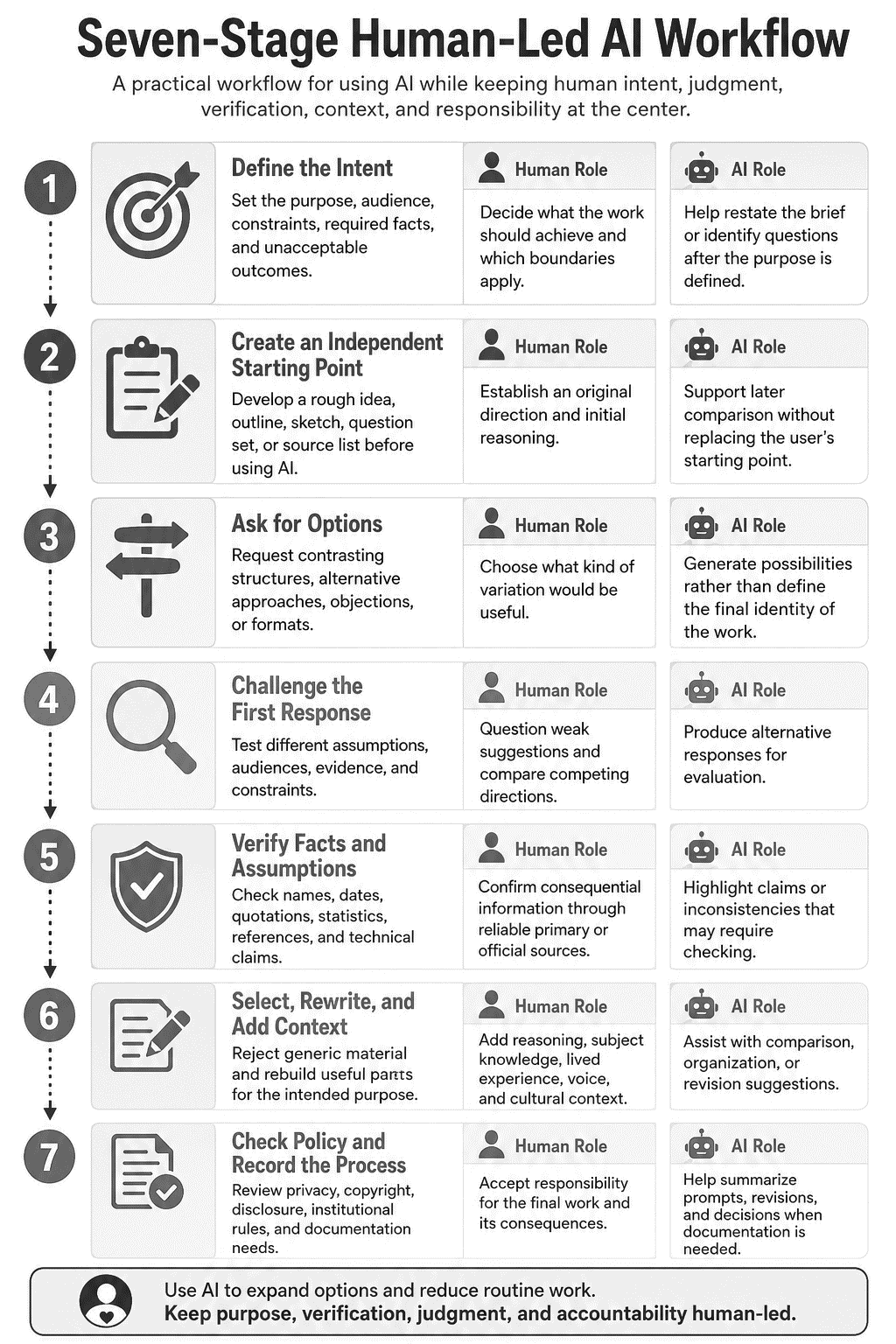
The following seven-stage process is an editorial framework rather than a universal formula.
1. Define the Intent
Write down the purpose, audience, constraints, required facts, and unacceptable outcomes.
For assessed work, identify what the task is meant to measure. For professional work, note any confidentiality, contractual, attribution, and disclosure requirements.
2. Create an Independent Starting Point
Produce a rough idea, sketch, outline, question set, or source list before requesting AI assistance.
This creates a reference point for evaluating suggestions and protects independent thinking.
3. Ask for Options, Not a Finished Identity
Request contrasting structures, overlooked questions, possible objections, or alternative formats.
Avoid asking a system to replace personal testimony or deliberately reproduce the distinctive voice of a living creator.
4. Challenge the First Response
Ask for alternatives based on different assumptions, audiences, constraints, or evidence.
Compare the results with independent sources and human feedback. Producing more options is useful only when selection remains deliberate.
5. Verify Facts and Assumptions
Check names, dates, quotations, statistics, references, technical claims, and legal statements against original sources.
Fluent writing is not evidence. Human review also has limits when the reviewer lacks the expertise needed to recognize an error.
6. Select, Rewrite, and Add Context
Reject generic material. Rebuild useful parts in language and structure suited to the purpose.
Add the subject knowledge, reasoning, experience, and cultural context that the system did not supply.
7. Check Policy and Record the Process
Before submission or publication, confirm:
-
whether the material contains confidential or personal information;
-
whether the system is approved for that material;
-
whether copyrighted content is being used with permission or under an applicable legal exception;
-
whether assistance must be disclosed;
-
whether a teacher, client, publisher, employer, or competition has set specific rules;
-
whether prompts, source checks, revisions, or important decisions should be recorded.
A brief process record can help a student, creator, or professional explain what was generated, what was rejected, what was verified, and which decisions remained human.
What Should Students and Educators Check?
Students and educators should treat AI use as a learning and policy issue, not only as a technology choice. Acceptable use depends on the purpose of the activity and the current rules of the institution, course, or assessment.
UNESCO’s guidance for AI content-generation systems in education and research promotes a human-centered approach and addresses privacy, age-appropriate use, ethical validation, governance, and policy development. The guidance was published on September 7, 2023, and its webpage was updated on January 16, 2026. It is international guidance, not one binding rule for every institution.
Before using AI for school or university work, students should ask:
-
Is AI assistance permitted for this task?
-
Which part of the work must demonstrate my own knowledge?
-
Can I explain and defend every final claim?
-
Have I disclosed assistance where required?
-
Am I sharing personal, confidential, or protected material?
Educators should make the learning goal explicit. A tool may be suitable for comparison or formative feedback but unsuitable when the task is intended to assess independent recall, reasoning, writing, or creative development.
Related reading: AI Literacy for Students: Using Tools with Care and Confidence.
What Risks and Limitations Should Readers Consider?
The main risks include similarity, factual error, bias, weak learning, privacy loss, unclear authorship, and inappropriate imitation. These issues should be addressed throughout the process rather than after the work is complete.
| Risk | Warning sign | Practical control |
|---|---|---|
| Creative anchoring | The first suggestion defines the whole direction | Begin independently and request contrasting approaches |
| Similarity | Different outputs use the same structures or phrases | Use varied sources, human feedback, and explicit rejection criteria |
| Factual error | Polished claims lack original evidence | Check consequential claims against primary or official sources |
| Bias | The output relies on stereotypes or overlooks affected groups | Examine assumptions, omissions, and representation |
| Overreliance | The user cannot explain the final reasoning | Keep core thinking, selection, and revision human-led |
| Privacy loss | Personal, student, client, or unpublished material enters an unapproved system | Remove sensitive data and review current data policies |
| Unclear authorship | Substantial generated material appears without an agreed disclosure process | Follow institutional, contractual, publisher, or competition rules |
| Style imitation | A request targets the recognizable voice of a living creator | Use general characteristics rather than reproducing distinctive expression |
Skill Development and Dependence
Long-term effects on creative skill are still being studied. A clearer immediate concern is that delegating the part of a task intended to build skill can hide a learning gap.
A student who submits analysis without understanding it has not completed the intended reasoning practice. A creator who accepts repeated suggestions without evaluating them may also become less active in making independent decisions.
A safer sequence is to attempt the task first, use assistance for comparison or critique where permitted, and then explain each important final choice.
Errors, Bias, and False Confidence
AI-generated material may contain incorrect statements, fabricated references, missing qualifications, or biased assumptions. Verification requires enough knowledge to recognize which claims need checking.
For high-stakes work, use original documents, qualified reviewers, and current official guidance. Generated output should not be the sole basis for a consequential educational, legal, technical, or professional decision.
Privacy and Confidentiality
Data handling differs across providers, account types, institutions, and settings. Before uploading student records, unpublished work, interview transcripts, client information, or personal data, review the current terms and the policy governing that material.
Do not assume that a privacy setting, private mode, or paid account automatically meets an institution’s legal, ethical, or contractual requirements.
Authorship, Copyright, and Disclosure
Copyright law differs by jurisdiction and depends on the facts of the work.
In the United States, the U.S. Copyright Office’s January 2025 report states that using AI as an assisting tool does not prevent copyright protection for human-authored expression. Purely AI-generated material, or material lacking sufficient human control over expressive elements, is not protected under the Office’s analysis. The sufficiency of human authorship must be considered case by case.
This section provides general information, not legal advice. Readers dealing with contracts, ownership disputes, registration, or commercial publication should consult current official guidance and obtain qualified legal advice when necessary.
The Authors Guild’s guidance dated May 11, 2026, advises writers to consider fact-checking, contracts, disclosure of substantial generated text, protection of confidential manuscripts, and deliberate imitation of another writer’s distinctive expression. The organization states that its recommendations are guidelines rather than rules.
Can AI Replace Human Creativity?
AI can replace selected tasks within a creative workflow, but the word “replace” can refer to several different issues.
| Meaning of replacement | Careful answer |
|---|---|
| Technical task substitution | AI can perform parts of drafting, variation, transformation, formatting, or prototyping |
| Employment substitution | Creativity studies alone cannot establish how many jobs will change, disappear, or be created |
| Loss of human agency | AI assistance does not remove the need for people and institutions to set goals, judge results, and accept responsibility |
| Cultural replacement | Producing acceptable output is not the same as replacing lived experience, social meaning, relationships, or community recognition |
AI Can Replace Parts of a Workflow
Routine or bounded production can be delegated when the risks are understood. This may include formatting, producing variations, or transforming supplied material.
Task substitution does not establish that the entire creative role has been replaced. The remaining work may include defining the problem, evaluating consequences, negotiating with other people, or deciding what the work should communicate.
Human Agency and Accountability Remain Necessary
People and institutions still decide why the work exists, which evidence is acceptable, whose interests matter, and who is answerable for the outcome.
This does not require claiming that machines can never produce highly rated output. It is a practical point about decision-making and responsibility.
The Suitable Arrangement Depends on the Task
Some tasks are better handled by people alone, especially when personal testimony, confidential information, trust, assessment, or high-stakes judgment is central.
Some narrow routine operations may be automated under clear rules.
Other tasks may benefit from human–AI collaboration when AI broadens the available options and a capable person retains control of selection, verification, context, and consequences.
A Practical Decision Rule
AI and human creativity should not be framed as a contest with one permanent winner. Outcomes depend on the task, user, interaction design, evidence standard, and measure of success.
Use AI where it expands options or reduces routine effort. Keep creative purpose, evaluation, context, and responsibility human-led.
Before using it, ask:
-
What is my intent?
-
What part of the process am I delegating?
-
How will I verify the result?
-
What must remain private, personal, or human-led?
-
Which disclosure, contract, copyright, or institutional rule applies?





Comments 0
No comments yet. Be the first to start the conversation.