



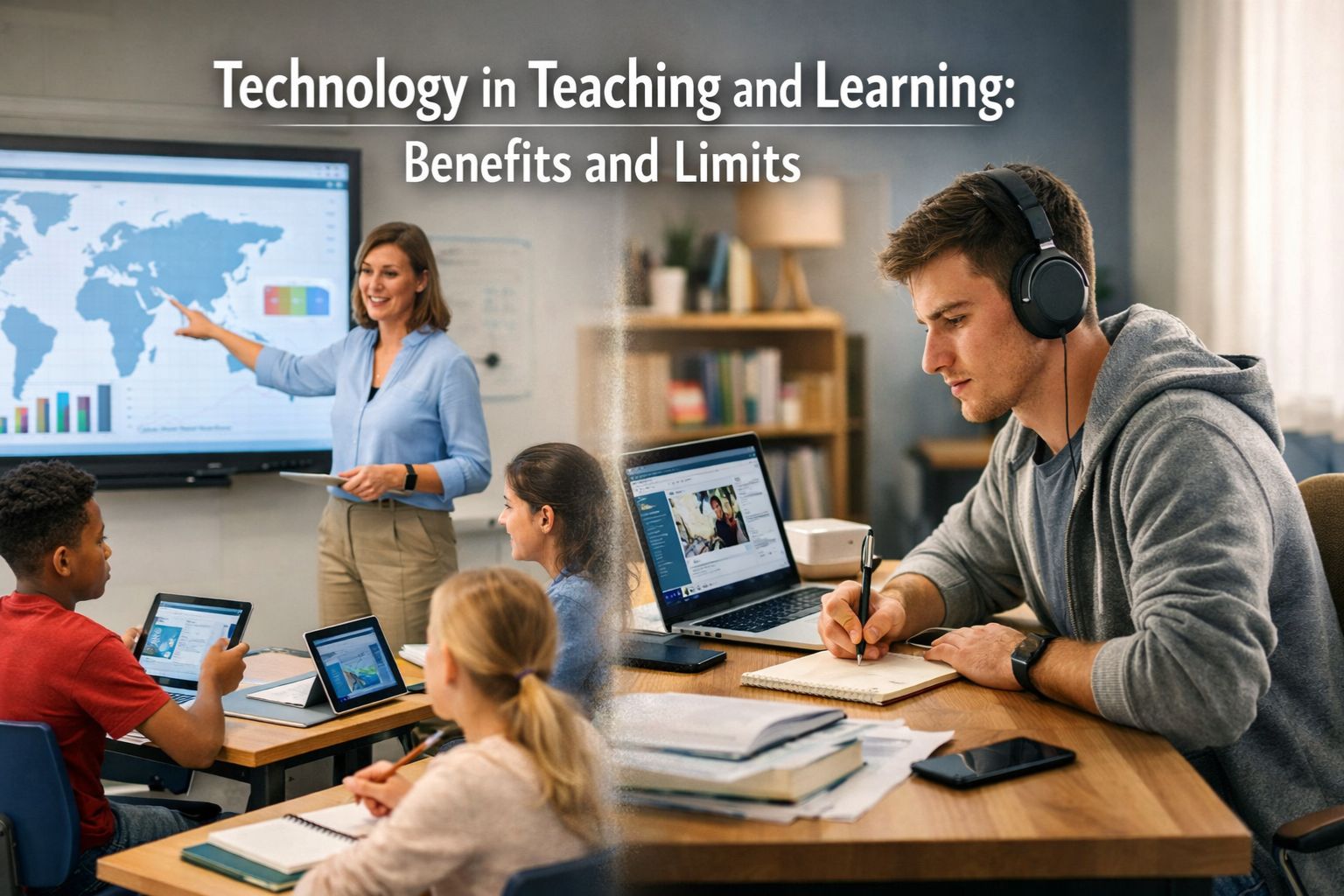
How Useful Is Technology for Teaching and Learning Today?
Technology is useful for teaching and learning, but its value depends on purpose and context rather than on the device alone. UNESCO reports that some education technology improves some types of learning in some contexts, while OECD’s recent review says the gains depend on the goals the tool supports and the choices teachers make around it.
That makes the main question narrower and more useful. The issue is not whether screens are present. The issue is whether a tool gives students better access, clearer explanation, more practice, faster feedback, or support that would be hard to provide in the same way without it. The Education Endowment Foundation’s guidance frames the matter in classroom terms by pointing to better assessment and more pupil practice, not device ownership by itself.
The topic also matters because access is still uneven. UNESCO says only 40% of primary schools worldwide are connected to the internet, and one in four primary schools do not have electricity. Those figures make it hard to speak about “technology in education” as though every learner starts from the same conditions.
Answer Summary
Technology is useful for teaching and learning when it serves a clear learning purpose, adds access, practice, feedback, or targeted support, and stays under strong teacher guidance. It is less useful when schools focus on devices without changing teaching, when access is weak, or when digital use creates distraction. The strongest evidence supports a balanced answer: technology can help a great deal in some settings, but it does not replace good teaching.
Table of Content
- How Useful Is Technology for Teaching and Learning Today?
- What does “useful” mean in teaching and learning?
- How useful is technology for access and continuity?
- How useful is technology inside daily teaching?
- How useful is technology for student learning?
- Where does technology fall short?
- What makes technology more or less useful?
- Practical scenarios
- Conclusion
Key Takeaways
-
Technology helps most when it solves a clear learning problem.
-
Access to devices does not guarantee better learning.
-
Feedback and guided practice are strong use cases.
-
Blended models often have stronger evidence than online-only models.
-
Heavy or poorly matched use can weaken focus.
-
Teacher judgment stays central.
-
Equity shapes whether a tool narrows gaps or widens them.
What does “useful” mean in teaching and learning?
Useful means that a tool helps students learn better than the best realistic alternative. In practice, that can mean stronger understanding, better recall, more chances to practice, faster feedback, broader access, or smoother continuity during disruption. It can also mean that teachers get clearer information about what students know and where they are stuck.
What counts as technology in education?
Technology in education includes both high-tech and low-tech tools. UNESCO treats technology as an input, a delivery channel, a skill area, and a planning tool, which means the discussion covers radio, television lessons, projectors, learning platforms, quiz tools, recorded lessons, computer-assisted practice, and AI-based feedback systems, not only laptops or tablets.
What should readers compare?
Readers should compare technology with the best practical alternative, not with nothing. A quiz app may help one teacher check understanding quickly, yet a short oral check, paper exit slip, or guided discussion may do the same job with less setup in another class. The fair test is whether the tool improves the learning process enough to justify the time, access needs, and attention it requires.
How useful is technology for access and continuity?
Technology is often most useful when it expands access. Digital and broadcast tools can keep teaching going during closures, reach students who are far from school, and open resources that would otherwise be hard to reach. UNESCO says digital technology has sharply increased access to teaching and learning resources, even while warning that access remains unequal.
Access to content, classes, and support
Technology helps when the main barrier is distance, time, or lack of materials. A learner in a remote setting may gain access to recorded lessons, digital libraries, or teacher support that would otherwise be missing. The World Bank also describes digital technologies as a way to support teachers, students, and the learning process more broadly.
Low-tech and blended options
Low-tech options can also be useful. UNESCO’s report does not frame useful education technology as a high-end device problem, and World Bank work in East Asia and the Pacific discusses a continuum that runs from no or low tech to higher-tech options. That matters because schools sometimes treat the choice as laptop or nothing, even when mixed models using print, recorded lessons, messaging, or broadcast can work better in local conditions.
Blended learning has stronger support than online-only learning in much of the older formal evidence base. The U.S. Department of Education review found that learners in online conditions performed modestly better on average than those in face-to-face settings, but the stronger advantage came from blended models rather than pure online delivery, and the authors warned that added time and added resources may explain part of the effect.
Why access alone is not enough
Access alone does not guarantee learning gain. OECD states that directly, and UNESCO gives a clear example from Peru, where more than one million laptops were distributed without a positive learning impact because the focus stayed on provision rather than on pedagogical integration.
That lesson appears in other work as well. UNICEF’s guide on computer-assisted learning focuses on design conditions, not hardware by itself, and the World Bank warns that many studies are still too small to predict with confidence what a nationwide program will do. In plain terms, technology can widen access without changing the quality of teaching or the quality of the task.
How useful is technology inside daily teaching?
Technology is useful inside daily teaching when it sharpens explanation, gives more practice, or improves feedback. It is less useful when it sits on top of a lesson without changing what students are asked to think about or do.
Explanation and guided practice
Technology can help teachers explain and model ideas more clearly. Recorded demonstrations, worked examples, visual displays, simulations, and short replayable explanations can help students revisit a step they missed and can free class time for questions or practice. OECD’s review also points to gains from some digital tools when they support clear educational goals rather than open-ended screen use.
Assessment and feedback
Assessment and feedback are among the clearest classroom uses. The Education Endowment Foundation points to technology that increases the accuracy of teacher assessment and the quality and quantity of pupil practice. OECD’s review adds that immediate, interactive feedback can support engagement and responsive adjustment, while also noting that teachers still need to interpret what the tool reports.
AI-based feedback may also help in some tasks, but the evidence is still conditional. OECD reports that AI tools can provide real-time and personalised feedback, yet their reliability can vary with task complexity, and teacher oversight may be needed so students do not rely on inaccurate or weak suggestions.
Teacher planning and workload
Technology can shift workload, though the direction is not always the same. A tool may save time on quiz marking, resource sharing, or routine checks, but it can also add setup, troubleshooting, and review time. The more durable gain is not “less work” in the abstract. It is better information for teaching decisions when the tool fits the lesson and the teacher knows how to use it well.
How useful is technology for student learning?
Technology is useful for student learning when it supports active learning rather than passive consumption. The strongest use cases involve guided practice, timely feedback, self-paced work at the right level, and structured collaboration.
Engagement and motivation
Digital tools can raise motivation for some learners, especially when they make progress visible and feedback quick. OECD’s 2025 review notes that immediate, personalised feedback can support motivation, including in language learning and collaborative tasks. That does not mean engagement alone is enough; a student can enjoy a task without learning much from it. Still, when motivation is linked to practice and correction, the value is clearer.
Personal pace and targeted support
Targeted support is one of the strongest cases for technology. UNICEF’s computer-assisted learning guide and the meta-analysis by Di Pietro and Castaño-Muñoz both point toward better results when tools meet students at their current level rather than forcing all learners through the same pace. That matters for less advantaged learners, whose needs are often shaped by both prior learning gaps and weaker access to outside support.
Collaboration and self-management
Technology can support collaboration and self-management, but these gains depend on structure. OECD notes that some digital tools can support dialogic learning, group problem-solving, and self-regulation through feedback and progress tracking. Those gains are more likely when teachers set clear roles, clear timelines, and clear standards for participation.
Where does technology fall short?
Technology falls short when it increases distraction, deepens inequality, or is adopted faster than the evidence. It also falls short when schools treat purchase decisions as teaching decisions.
Distraction and overload
Distraction is one of the clearest limits. OECD reports that 59% of students across OECD countries said their attention was diverted by other students using phones, tablets, or laptops in at least some mathematics lessons, and students who reported peer distraction scored lower in mathematics. A separate meta-analysis found a small negative association between heavier smartphone, social media, and gaming use and academic performance.
This does not mean all screen use is harmful. It means that purpose matters. Learning use and leisure use do not have the same relationship with outcomes, and schools need routines that protect attention rather than assuming that any digital activity is educational.
Equity, infrastructure, and affordability
Equity remains a major limit. UNESCO reports low levels of school internet connectivity at the primary level and notes that many schools also lack electricity. World Bank evidence from East Asia and the Pacific shows that unequal access during closures tracked wider gaps between urban and rural households and between students with and without suitable devices or study conditions.
Affordability also shapes usefulness. A tool that works well in a highly connected school may be a poor choice in a setting where devices are shared, internet is unstable, or teachers have little protected time for training. Under those conditions, a simpler model may be the stronger model.
Evidence limits and fast product cycles
The evidence base is not weak everywhere, but it is still uneven. UNESCO says the evidence on education technology’s added value is often limited, and the World Bank notes that many intervention studies remain small, which makes large-scale prediction difficult. That matters because products move quickly while reliable evaluation moves slowly.
What makes technology more or less useful?
Technology is more useful when it starts with a learning problem, stays under teacher guidance, and matches the subject, age group, and setting. Those three questions are stronger than asking whether a tool is new or popular.
Start with the learning problem
Start with the problem first. Is the issue weak attendance, limited access, slow feedback, uneven prior knowledge, too little practice, or disrupted learning time? Different problems call for different tools, and some problems do not need digital tools at all.
Keep teachers at the center
Teachers remain central. OECD’s review says effective education continues to depend on competent teachers who can guide students and make thoughtful choices about digital tool use. UNESCO and EEF point in the same direction by warning against input-led thinking and by focusing on classroom decisions.
Match the tool to the subject, age, and setting
Match matters because learning tasks differ. A language practice tool, a virtual science simulation, a reading support tool, and a university discussion board do not work in the same way or demand the same self-management from learners. Younger learners often need tighter routines and more guided use than older learners.
Practical scenarios
Practical usefulness becomes clearer when the tool fits a routine that teachers and students can sustain. The examples below show what that fit can look like without treating any single model as universal.
A classroom feedback routine
A quiz platform can be useful in a secondary classroom when it checks one narrow idea at the end of a lesson, shows the teacher where misconceptions sit, and leads to a short reteach the next day. In this case, the value comes from the feedback loop, not from the screen. That matches EEF guidance on better assessment and OECD’s emphasis on immediate feedback tied to instructional decisions.
A college study routine
A college student may use recorded lectures, spaced quiz tools, shared notes, and discussion boards to revisit difficult material and manage study time. This can be useful when the learner uses the tools for retrieval, review, and question-asking rather than for passive replay alone. The value is strongest when the tools support regular practice and self-monitoring.
A lower-resource school model
In a lower-resource school, a mixed model using teacher-led instruction, printed work, recorded audio or video, and one shared device for short practice may be more useful than a one-device-per-student plan that cannot be maintained. UNESCO, UNICEF, and World Bank materials all point toward fit, support, and continuity as better guides than hardware counts alone.
Conclusion
Technology is useful for teaching and learning when it is used with a clear purpose and matched to real classroom or study needs. The strongest cases are access, continuity, guided practice, feedback, and targeted support. The main limits are distraction, uneven access, weak fit, and the mistaken belief that devices by themselves improve learning. A sound evaluation starts with the learning problem, checks the local conditions, and keeps teacher judgment at the center.
Resouces Used
-
UNESCO. Global Education Monitoring Report Summary 2023: Technology in Education: A Tool on Whose Terms? 2023. UNESCO.
-
UNESCO. Technology in Education: GEM Report 2023. UNESCO Global Education Monitoring Report.
-
OECD. The Impact of Digital Technologies on Students’ Learning. 2025. OECD Education Working Papers.
-
OECD. Technology Use at School and Students’ Learning Outcomes. 2024. OECD.
-
Education Endowment Foundation. Using Digital Technology to Improve Learning. 2019. EEF.
-
World Bank. Digital Technologies in Education. World Bank Group.
-
World Bank. Using Education Technology to Improve Student Learning in East Asia Pacific: Promises and Limitations. 2023. World Bank.
-
UNICEF FLN Hub. Guidance on Evidence-Based Computer-Assisted Learning Approaches. UNICEF.
-
Di Pietro, Giorgio, and Jonatan Castaño-Muñoz. A Meta-Analysis on the Effect of Technology on the Achievement of Less Advantaged Students. Computers & Education, 2024.
-
U.S. Department of Education. Evaluation of Evidence-Based Practices in Online Learning: A Meta-Analysis and Review of Online Learning Studies. 2010. U.S. Department of Education.
-
OECD. Students, Digital Devices and Success. 2024. OECD.
-
Kuş, M., et al. A Meta-Analysis of the Impact of Technology Related Factors on Students’ Academic Performance. 2025. Education and Information Technologies.






Comments 0
No comments yet. Be the first to start the conversation.