



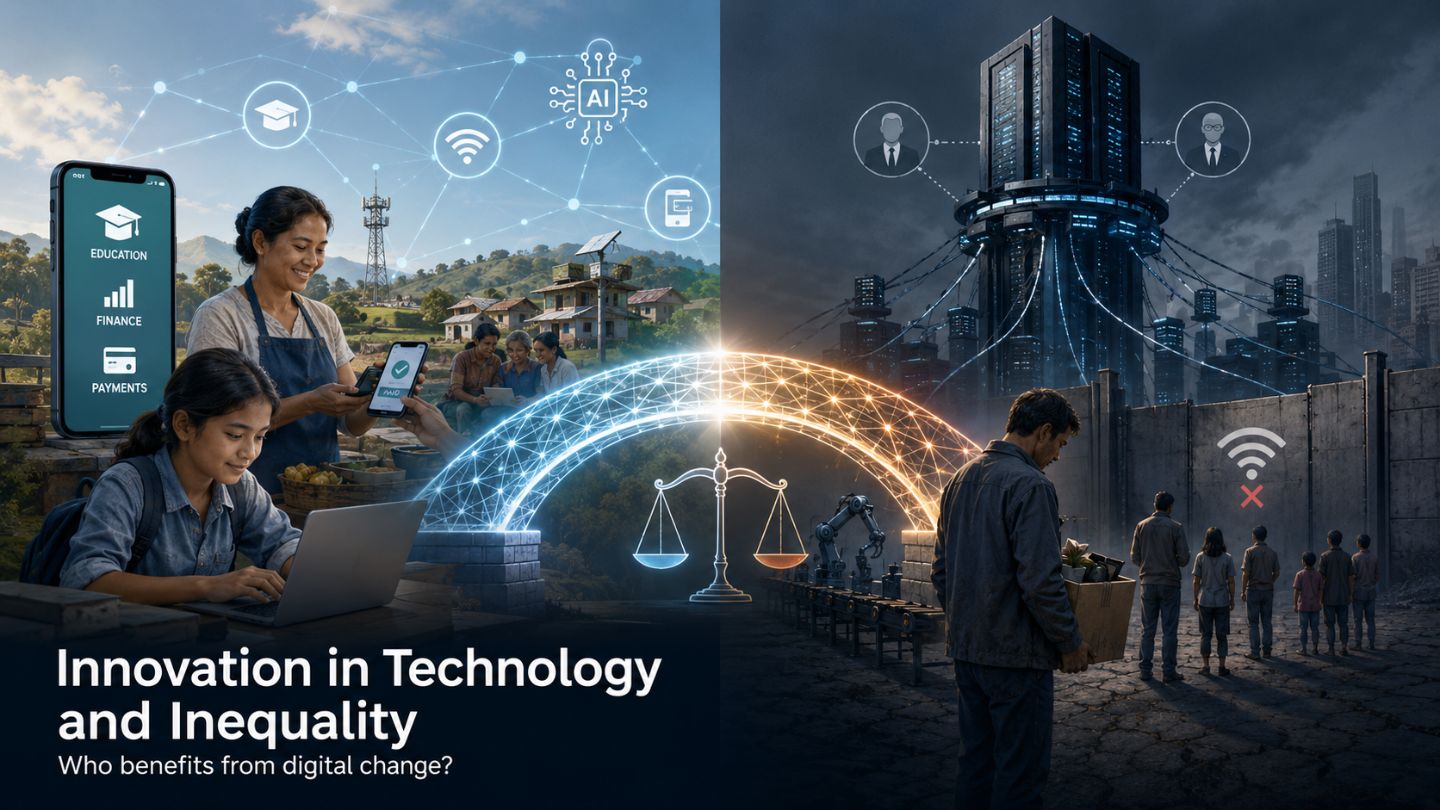
Technology is often described as a way to spread opportunity. A lower-cost smartphone can connect a rural student to lessons. A digital payment system can help a small trader reach customers. Artificial intelligence can support teachers, doctors, researchers, workers, and public agencies with faster access to information.
The same wave of technology can also deepen inequality when its benefits flow first to people, firms, and countries that already have money, skills, infrastructure, data, and bargaining power.
The central question is not whether technology is good or bad. The better question is: who can access it, use it well, shape it, and capture the value it creates?
That question matters because technology affects productivity, wages, education, health care, public services, business competition, and participation in public life. It also affects how quickly advantages build up. A person with a device, stable connection, strong skills, and safe access to digital services is in a different position from someone who has only occasional connectivity or limited confidence using online systems.
Answer Summary:
Innovation in technology can reduce inequality when it lowers costs, expands access to services, supports learning, and helps small firms and public institutions improve productivity. It can widen inequality when access, skills, data, ownership, market power, and governance are uneven. The impact depends less on invention alone and more on how widely, safely, and fairly technology spreads.
Table of Content
- What the Topic Means
- Why the Issue Matters Now
- How Technology Innovation Can Reduce Inequality
- How Technology Innovation Can Widen Inequality
- What the AI Moment Changes
- A Practical Framework for Readers
- Policy and Institutional Choices That Matter
- Bottom Line
Key Takeaways:
-
Innovation and diffusion are different.
-
Digital inequality includes access, quality, affordability, skills, and safety.
-
AI exposure is not the same as certain job loss.
-
Small firms and low-income communities often face slower adoption.
-
Data, capital, and platform power can concentrate gains.
-
Policy choices shape whether technology becomes more inclusive.
What the Topic Means
Innovation in technology and inequality refers to the way new tools, systems, and digital services change the distribution of opportunity, income, skills, information, and power.
Innovation Is Different from Diffusion
Innovation means the creation or improvement of tools, systems, methods, or processes. In technology, this may include hardware, software, networks, digital platforms, automation, data systems, or AI models.
Diffusion means the spread and practical adoption of those technologies.
This distinction is essential. A useful technology may exist but remain out of reach for many people because devices are unaffordable, internet connections are weak, services are not available in local languages, or workers lack training.
A country may have a growing technology sector while small firms, public schools, rural clinics, and low-income households remain weakly connected. The same technology can expand opportunity in one setting and reinforce privilege in another.
Inequality Includes More Than Income
Income inequality matters, but technology also affects inequality in education, health care, information access, public services, business opportunity, privacy, and civic participation.
The digital divide is not only about whether someone is online. It also concerns speed, reliability, affordability, digital skills, accessibility, trust, safety, and the ability to turn access into real benefit.
A student with a shared phone and unstable connection is not in the same position as a student with a laptop, broadband, quiet study space, digital literacy, and teacher support. A small business with no data system is not in the same position as a large firm that can use cloud tools, analytics, and AI in daily operations.
Why the Issue Matters Now
The issue matters because digital systems are now tied to everyday opportunity, from education and employment to banking, public services, health information, and emergency communication.
The International Telecommunication Union’s Facts and Figures 2025 estimates that about 6 billion people, or roughly three-quarters of the world’s population, were using the internet in 2025. About 2.2 billion people remained offline. The same release says today’s digital divides are shaped by speed, reliability, affordability, and skills, not only by basic access.
This matters because being offline, or poorly connected, can limit access to learning platforms, job applications, online payments, agricultural advice, government forms, health information, and basic communication.
The World Bank’s Digital Progress and Trends Report 2023 makes a similar point: the diffusion and adoption of digital technologies are as important as invention. The report says low-income countries, vulnerable populations, and small firms have been falling behind while AI and other advanced digital tools accelerate in higher-income settings.
AI has made this distribution question more urgent. Earlier waves of automation often affected routine physical or clerical tasks. AI can also affect writing, coding, analysis, design, customer service, administration, and professional decision-making. That makes access to skills, data, computing capacity, and institutional readiness more important.
How Technology Innovation Can Reduce Inequality
Technology can reduce inequality when it lowers barriers and gives more people useful access to knowledge, services, markets, and productive tools.
Better Access to Services and Information
Technology can help people reach services that were previously limited by geography, cost, or administrative barriers.
Mobile payments can serve people far from bank branches. Remote health consultations can support patients who cannot easily travel to specialists. Online learning can help students who lack nearby course options. Digital identity and payment systems can make public benefits easier to deliver when privacy, accessibility, and offline support are built into the design.
These benefits are not automatic. A digital public service can help people if it reduces travel, paperwork, waiting time, and informal barriers. It can also exclude people if it becomes the only channel and assumes that everyone has a device, stable connectivity, digital literacy, and confidence using online forms.
Productivity Gains for Workers, Students, and Small Firms
Innovation can spread productivity beyond large firms and wealthy regions when tools are affordable and adapted to local needs.
A small retailer using digital payments and basic inventory software may reduce losses. A farmer with reliable weather and market information may make better planting or selling decisions. A local clinic with digital records may improve continuity of care. A student may use digital tools to review lessons, translate material, practice problems, and access libraries.
For student readers, guidance on the responsible use of AI tools for exam preparation can help separate learning support from shortcuts that weaken understanding.
The key issue is whether small firms and public institutions can adopt and maintain these systems. If only large companies can afford advanced tools, technology may widen the gap between frontier firms and everyone else. If training, finance, infrastructure, and open standards support wider adoption, the same technologies can help narrow productivity gaps.
Public Systems Can Spread Benefits More Widely
Digital public systems can support inclusion when they are designed around public needs, not only administrative convenience.
Useful examples include interoperable payment systems, accessible public-service portals, digital records with privacy safeguards, and open standards that help systems work together. These can reduce transaction costs and improve service delivery.
A public service is not inclusive simply because it moved online. It becomes more inclusive when people with different levels of income, literacy, disability, language access, and connectivity can use it safely and fairly.
How Technology Innovation Can Widen Inequality
Technology can widen inequality when powerful tools are added to unequal societies without addressing access, skills, ownership, bargaining power, and accountability.
Access and Quality Gaps
The first digital divide was often described as a gap between people who were online and offline. That gap still matters. The newer divide is also about quality.
A slow or unreliable connection limits what people can do. A household may technically have internet access but still be unable to join video classes, use cloud tools, apply for jobs, complete official forms, or use online health services.
ITU’s 2025 release estimates that 5G networks covered 55 percent of the world’s population in 2025, but coverage was 84 percent in high-income countries and 4 percent in low-income countries. This shows why meaningful connectivity is about more than basic access.
Safety is part of meaningful access. People who rely on shared devices, public networks, or borrowed accounts may face privacy and security risks. Student-focused guidance on public Wi-Fi and social media safety can be useful where access depends on public or shared networks.
Skills and Bargaining Power
Technology often rewards people who can use it effectively. Workers with strong digital, analytical, communication, and problem-solving skills are usually better placed to benefit from new tools. Workers without those skills may face higher barriers even when the technology itself is available.
The International Monetary Fund’s analysis on AI and the global economy estimates that almost 40 percent of global employment is exposed to AI. It also estimates higher exposure in advanced economies than in low-income countries and warns that countries with weaker infrastructure and fewer skilled workers may struggle to benefit from AI over time.
Exposure should not be confused with certain job loss. A task may be automated, assisted, reorganized, or made more productive. The outcome depends on job design, worker training, employer choices, labor protections, and whether productivity gains are shared.
For learners thinking about technology careers, understanding the difference between data science and artificial intelligence can help clarify where skills fit in the changing labor market.
Market Power, Data, and Capital Returns
Digital markets often reward scale. Platforms with large user bases, strong data advantages, cloud infrastructure, intellectual property, and network effects can grow faster than smaller competitors.
This does not mean large technology firms are automatically harmful. They can build infrastructure, develop useful tools, and lower costs for users. The inequality concern is about concentration of power and value: who owns the data, who sets the rules, who gets paid, and whether smaller firms and workers have fair access to the tools they need.
Policy choices around competition, data portability, privacy, public procurement, open standards, and worker protections can influence whether digital markets remain open enough for wider participation.
Why Adoption Matters as Much as Invention
Invention creates possibility. Adoption determines who benefits.
The OECD’s work on digital divides notes that digital divides exist across geography, education, age, income, and firm size. It also says larger enterprises tend to be more likely than small firms to adopt technologies such as cloud computing, Internet of Things tools, big data analytics, and AI.
This is why a country can have successful technology companies while many local firms remain weakly connected to the benefits of digital change.
Bias and Weak Governance
Digital systems are built from data, rules, incentives, and design choices. If the data reflect unequal societies, the systems can reproduce or amplify unequal treatment.
This can affect hiring, credit scoring, education, insurance, health care, public-service delivery, and workplace monitoring. The risk is not only technical error. It is also that decisions become harder to question because they are hidden behind automated systems.
Good governance requires testing, transparency, accountability, appeal processes, and meaningful input from affected communities. Without these safeguards, technology can make unequal systems appear more efficient while leaving the unfairness intact.
What the AI Moment Changes
AI is not the only technology relevant to inequality, but it is one of the clearest current examples because it can affect both routine work and knowledge-based work.
AI can lower the cost of certain tasks, help generate text or code, improve translation, support research, and assist decision-making. It can also concentrate benefits among organizations with advanced data, computing capacity, skilled staff, legal resources, and market reach.
The International Labour Organization’s 2025 work on occupational exposure to generative AI found that one in four workers globally are in occupations with some exposure to these systems, while 3.3 percent of global employment falls into the highest exposure category. The ILO also says job transformation is the most likely impact for most occupations because many jobs include tasks that still require human input.
This distinction matters. A worker who receives training and has a voice in how AI is introduced may use AI to reduce repetitive work and improve output. A worker who is monitored by opaque systems, given no training, or paid less because software can perform parts of the job may experience technology as insecurity rather than support.
For students and early-career readers, the practical lesson is not to chase every tool. It is to build durable skills: literacy, numeracy, domain knowledge, critical thinking, communication, data awareness, and digital safety.
A Practical Framework for Readers
Readers can evaluate technology claims by asking who benefits, who is excluded, and who controls the system.
Who Has Access?
Access includes devices, electricity, connectivity, language, disability inclusion, affordability, and safe spaces to use technology. A service that works only for well-connected users may improve averages while excluding people with the greatest need.
Who Has the Skills?
Skills include basic digital literacy, advanced technical ability, privacy awareness, critical evaluation, and the ability to apply tools in a real setting. Training matters because the same technology can support one group and bypass another.
Who Controls the System?
Ownership shapes incentives. A public-interest platform, a private monopoly, a local cooperative, and an open-source project may distribute value differently. Data governance is part of this question.
Who Bears the Risk?
Workers, consumers, students, and communities may carry risks from surveillance, job restructuring, system errors, exclusion, or unsafe design. The groups that benefit from efficiency are not always the groups that carry the costs.
Who Can Challenge Decisions?
Technology becomes more equitable when people have ways to appeal, correct data, request human review, and participate in design decisions. Without accountability, digital systems can make inequality faster and harder to see.
Policy and Institutional Choices That Matter
The distributional effects of technology are shaped by institutions. Governments, schools, employers, civil society, and technology companies all influence whether innovation becomes inclusive.
Important policy areas include affordable broadband, rural connectivity, public access points, digital skills programs, competition policy, worker protections, social safety nets, lifelong learning, privacy rules, accessibility standards, and public-interest data governance.
Schools and colleges also have a role. Digital learning works better when it supports teaching and learning rather than replacing them with unsupported screens. Students need guidance on how to use tools responsibly, how to check information, and how to protect privacy. Workers need training that connects to real tasks, not only short exposure to software.
Employers have responsibilities as well. Introducing AI or automation without training, consultation, and clear accountability can shift risk onto workers. Introducing it with training, fair evaluation, and worker input can produce more balanced outcomes.
Bottom Line
Technology innovation does not have a fixed relationship with inequality. It can reduce inequality when it lowers costs, expands services, supports learning, improves public systems, and helps smaller firms and disadvantaged communities participate.
It can widen inequality when access is uneven, skills are concentrated, data is controlled by a few actors, market power grows unchecked, and affected people have little voice in how systems are used.
The future is not determined by technology alone. It is shaped by how societies fund infrastructure, teach skills, regulate markets, protect workers, design public systems, and share the gains from productivity.
For global readers, the main point is clear: the inequality question is not only about what technology can do. It is about who gets the chance to use it, influence it, and benefit from it.





Comments 0
No comments yet. Be the first to start the conversation.