



EHL Hospitality Business School is a private specialist institution in Lausanne, Switzerland, focused on hospitality management, service businesses and related management disciplines. Founded in 1893 as École hôtelière de Lausanne, it adopted the name EHL Hospitality Business School in 2022. Its development reflects a gradual shift from hotel-focused professional education toward applied business education, graduate study, executive education and research while retaining hospitality and service management as its central academic fields.
EHL does not operate as a conventional comprehensive university divided across unrelated disciplines. Its academic identity is more specialized. In Switzerland, it has been associated by convention with HES-SO, the University of Applied Sciences and Arts Western Switzerland, since 1998. That relationship is important to the status and awarding structure of several EHL degrees, particularly its Bachelor and HES-SO master’s qualifications.
Lausanne is the principal academic base of EHL Hospitality Business School. EHL also has an international presence in Singapore, while EHL Hotel School Passugg operates as a separate professional hospitality school within the wider EHL Group. These locations have different academic functions and should not be treated as interchangeable campuses offering identical study routes.
| Field | Details |
|---|---|
| Current name | EHL Hospitality Business School |
| Former name | École hôtelière de Lausanne |
| Founded | 1893 in Lausanne, Switzerland |
| Institutional type | Private specialist hospitality and business school |
| Main location | Lausanne, Switzerland |
| Swiss academic relationship | Associated by convention with HES-SO since 1998 |
| Principal academic focus | Hospitality management, service management and business |
| Wider EHL locations | Lausanne, Singapore and Passugg, with different institutional roles |
The former name École hôtelière de Lausanne remains relevant in historical references, alumni records and older academic material. It is not the institution’s current official name.
AACSB identifies EHL Hospitality Business School SA as a private institution. At group level, ownership rests with the EHL Foundation, which owns E.H.L. Holding SA. The organizational structure therefore includes the academic school, the wider EHL Group and related educational entities.
EHL Hospitality Business School should be distinguished from EHL Hotel School Passugg and from group-level operations. Although they belong to the same wider organization, their academic roles, programme types and institutional identities differ.
EHL traces its origins to 15 October 1893, when its first classes opened at the Hôtel d’Angleterre in Lausanne with 27 students. The institution describes itself as the world’s first hotel school. Its historical development is more significant than the claim alone: the Lausanne school has maintained a continuous connection with hospitality education while expanding its academic role considerably over time.
The association with HES-SO in 1998 marked an important change in EHL’s position within Swiss higher education. This relationship placed specified EHL degrees within the Swiss University of Applied Sciences system and connected the school’s higher-education activity with HES-SO degree structures and academic requirements.
EHL later expanded beyond Lausanne, including the establishment of a Singapore campus. Its institutional identity also changed in 2022, when École hôtelière de Lausanne became EHL Hospitality Business School. The new name more directly reflects the school’s present emphasis on hospitality management, business education and service-related disciplines rather than hotel operations alone.
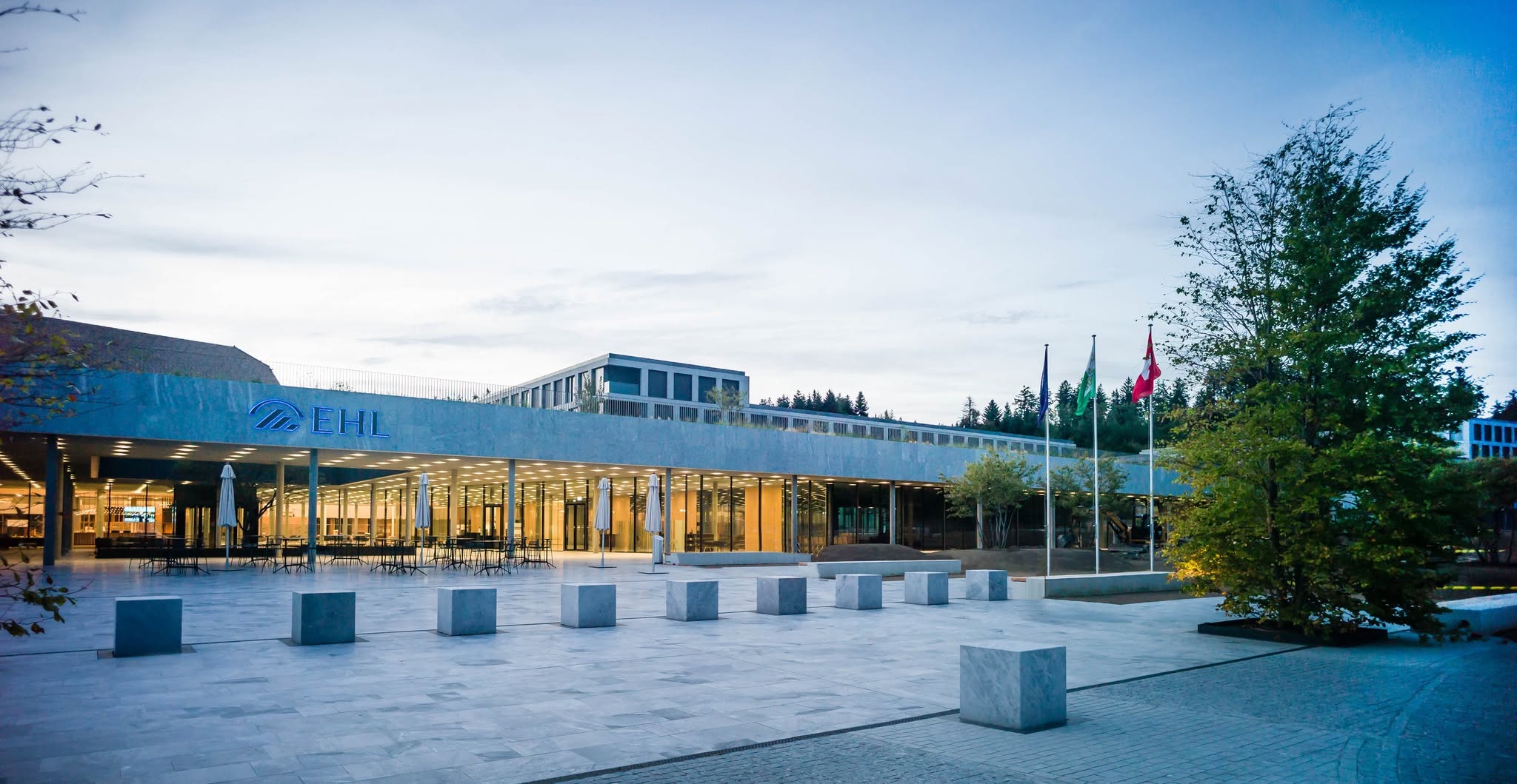
The Lausanne campus was also substantially redeveloped before reopening in its rebuilt form in 2022. The redevelopment brought academic facilities, accommodation, hospitality operations, student services and extracurricular facilities together within the main campus.
The wider EHL organization has undergone separate changes. The hospitality school in Passugg, which joined the EHL Group in 2013, adopted the name EHL Hotel School Passugg in 2025. Earlier references may use Swiss School of Tourism and Hospitality or EHL SSTH. These are historical names for the Passugg institution and should not be used as alternative names for EHL Hospitality Business School in Lausanne.
EHL combines foundation ownership, corporate group governance and school-level academic governance.
The EHL Foundation owns E.H.L. Holding SA. At group level, governance responsibilities include strategic direction, planning, budgeting and executive oversight. Operational leadership then manages the activities of the group’s educational and related entities.
Academic governance is distinct from group-level corporate governance. EHL Hospitality Business School has its own academic leadership structure, while an Academic Board oversees academic policy and quality matters.
This distinction is important because EHL Group and EHL Hospitality Business School are not identical organizational units. Group-level governance covers several activities and entities, while academic decisions concerning degree education belong to the structures responsible for the business school.
EHL is also organized differently from a multi-faculty university. It does not divide its academic work across unrelated areas such as medicine, engineering, humanities and natural sciences. Teaching and research are concentrated in hospitality management, service businesses, customer experience, finance and real estate connected with hospitality, business creativity, nutrition, quantitative methods and executive management.
Lausanne is the principal location of EHL Hospitality Business School. It serves as the main base for undergraduate teaching, HES-SO master’s education, research, student services, residential life and much of the school’s practical hospitality training.
The campus combines academic spaces with hospitality operations. Food-and-beverage outlets, accommodation and other service facilities are not separate from the educational character of the institution. They are particularly relevant to the applied learning used during the early stages of the Bachelor programme.
The campus also supports student organizations, sport and extracurricular participation alongside formal academic activity.
Accommodation forms part of the Lausanne student infrastructure. Residential options include campus housing and the NeighborWood complex, with different room and shared-living configurations.
The location of operational hospitality facilities within the academic campus reflects an important feature of EHL’s teaching model. Practical hospitality exposure is introduced alongside business education rather than being separated entirely from the academic programme.
EHL Campus (Singapore), at 3 Lady Hill Road, functions as EHL’s Asia-Pacific branch campus.
The Singapore site provides academic and student services including administrative support, IT services, career and internship assistance, student affairs provision, writing support and wellbeing resources.
Its role within the Bachelor is more specific than that of Lausanne. Singapore forms part of EHL’s international mobility structure, including study options within the undergraduate journey. It should not be described as an interchangeable location where every student completes the same full degree pathway available in Lausanne.
Singapore also contributes to EHL’s wider international education activity beyond undergraduate mobility. Its role in selected executive and doctoral arrangements places it within the school’s broader network of international teaching locations.
Passugg, near Chur in the canton of Graubünden, is home to EHL Hotel School Passugg.
The school was established in 1966 and joined the EHL Group in 2013. Its principal role is professional hospitality education, including Swiss professional programmes.
Passugg should not be treated as another name for EHL Hospitality Business School. Although it belongs to the same group and maintains academic connections with EHL, it has a different institutional role.
Pathway and study arrangements connect some Passugg education with EHL’s Bachelor structure. These connections allow movement between professional hospitality education and degree-level study without removing the distinction between the two schools.
This separation is especially important when interpreting older references, since Passugg has previously operated under different institutional names.
EHL’s academic portfolio spans undergraduate, graduate, executive and doctoral study, but the awarding authority is not identical across all qualifications.
Several core degrees are linked to HES-SO. Other programmes are delivered directly by EHL or jointly with external academic institutions.
| Academic route | Awarding structure |
|---|---|
| Bachelor in Hospitality Management | Leads to the Bachelor of Science HES-SO in Hospitality Management |
| HES-SO master’s study | Specified programmes lead to Master of Science HES-SO qualifications |
| MBA and executive education | Follow EHL or joint executive programme structures |
| Doctoral study | DBA delivered with the Drucker School and awarded by Claremont Graduate University |
The Bachelor illustrates the HES-SO relationship clearly. The standard EHL student journey includes a Preparatory Year before the formal HES-SO Bachelor sequence. The degree itself is the Bachelor of Science HES-SO in Hospitality Management.
At master’s level, EHL participates in HES-SO degree programmes including Hospitality Management and Global Hospitality Business.
The Global Hospitality Business programme also shows how EHL uses academic partnerships within degree delivery. Study is divided among EHL in Lausanne, Hong Kong Polytechnic University and the University of Houston’s Conrad N. Hilton College.
Executive education follows different arrangements. EHL offers MBA-level study in hospitality and service industries and also works with external partners on executive management education.
At doctoral level, EHL collaborates with the Drucker School of Management at Claremont Graduate University. The Doctor of Business Administration is awarded by Claremont Graduate University rather than by HES-SO.
These arrangements mean that EHL credentials need to be understood programme by programme. The EHL name does not imply that all qualifications are issued by one awarding authority or governed by one credit system.
The undergraduate route is central to understanding EHL’s academic character.
EHL presents the standard Bachelor journey as four years because it begins with a Preparatory Year. HES-SO identifies the formal Bachelor of Science HES-SO in Hospitality Management as a three-year, 180-ECTS degree.
The difference is one of scope rather than contradiction. The four-year description refers to the complete standard EHL route from initial entry, while the three-year description refers specifically to the HES-SO Bachelor sequence.
The Preparatory Year introduces students to hospitality operations and professional practice before the programme moves more deeply into management education. Practical workshops and operational exposure form part of this stage.
Later study shifts toward business and management subjects. Students move through areas including management, finance, marketing, entrepreneurship, leadership and hospitality-related business analysis.
The Bachelor also includes opportunities for specialization. Areas identified within the academic structure include Leadership & Management, Advanced Marketing & Luxury Management, Finance & Real Estate, Entrepreneurial Ventures & Corporate Innovation and interdisciplinary study.
Internships are integrated into the standard Bachelor pathway. The programme includes substantial periods of professional experience designed to expose students first to hospitality operations and later to administrative or management work.
The final part of the degree allows students to complete applied business, entrepreneurial or research-oriented work. This may take the form of a student business project or a thesis route.
EHL’s undergraduate model therefore combines operational hospitality training, academic business study, internships, specialization and project work. The structure distinguishes it from both a narrowly vocational hotel programme and a general business degree without an operational hospitality component.
Graduate education extends EHL’s academic scope beyond undergraduate hospitality management.
The Master in Hospitality Management develops advanced study within hospitality and related management areas. It is delivered within the HES-SO structure and based in Lausanne.
The Master in Global Hospitality Business combines study in Switzerland, Hong Kong and the United States. Its international structure is built directly into the programme rather than operating only as an optional exchange component.
EHL also provides executive education for experienced professionals. Its MBA activity concentrates on hospitality and service industries, while joint executive programmes connect EHL with external academic partners.
Doctoral study is delivered through collaboration with the Drucker School of Management at Claremont Graduate University. This arrangement combines EHL’s hospitality and service-management specialization with an external doctoral awarding institution.
The variety of these programmes reflects the broader evolution of EHL from a hotel school into a specialist business school while maintaining hospitality and service industries as its principal academic domain.
Research at EHL is concentrated on hospitality, services and related business questions.
Its research structure includes five institutes:
Institute of Customer Experience Management
Institute of Business Creativity
Hospitality Real Estate & Finance Institute
Institute of Nutrition R&D
Quantitas Institute
The Institute of Customer Experience Management examines questions related to customer behaviour, service interactions and experience management.
The Institute of Business Creativity focuses on creativity, organizational development and related management questions.
The Hospitality Real Estate & Finance Institute concentrates on financial and property-related issues connected with hospitality businesses.
The Institute of Nutrition R&D works on nutrition-related research with relevance to food, hospitality and applied business activity.
The Quantitas Institute contributes quantitative research and analytical methods.
Research activity includes academic publication as well as applied and sponsored projects involving external organizations. This combination is consistent with EHL’s position within applied higher education.
The EHL Innovation Hub in Lausanne adds an entrepreneurial component. It provides space, mentoring and venture-development support for projects connected with hospitality and related fields.
Together, the research institutes and Innovation Hub connect academic work with operating questions faced by hospitality and service organizations without extending EHL into unrelated research disciplines.
EHL’s main facilities are closely connected to its teaching model.
The Lausanne campus contains academic teaching spaces alongside operating hospitality facilities. Food-and-beverage operations create settings in which students can observe and practise service and operational processes.
These facilities are particularly relevant during the Preparatory Year, when practical experience forms a major part of the educational structure.
The campus also includes residential accommodation, sporting opportunities, student organization spaces and facilities supporting student services.
Research activity is supported through EHL’s institutes and project structures rather than through a broad network of disciplinary laboratories typical of a comprehensive science or engineering university.
The practical resources therefore reflect the school’s specialist role. Hospitality operations, service settings, business research units and entrepreneurial support facilities are more central to EHL than facilities associated with unrelated academic disciplines.
EHL provides services addressing academic development, professional preparation and student wellbeing.
Academic Advisory services support students in managing their academic progression and study decisions.
Career and internship services assist with professional preparation, including career counselling, CV development, interview preparation, employer engagement and recruitment activities.
Health and wellbeing resources form another part of student support.
The Singapore campus maintains its own student-support arrangements, including administrative and IT assistance, career and internship services, student affairs, writing support and wellbeing provision.
Student organizations and sports contribute to extracurricular participation at Lausanne.
These services complement the academic programme but should not be interpreted as guarantees of internship placement, employment, salary or other individual outcomes.
Residential life is most closely associated with the Lausanne campus.
EHL provides different forms of student accommodation, including campus residences and the NeighborWood complex. Available arrangements include individual and shared living formats.
Housing forms part of the broader campus experience alongside academic activity, food-and-beverage operations, sport and student organizations.
The combined academic and residential structure gives Lausanne a different role from Singapore, where accommodation and campus life follow a different model.
EHL’s campus organization reflects the practical character of hospitality education. Students encounter food service, accommodation, event activity and customer-facing operations within the same institutional setting as classroom study.
International activity at EHL extends beyond the nationality mix of its students.
The Bachelor includes international mobility opportunities, including study in Singapore.
The Global Hospitality Business master is delivered across Lausanne, Hong Kong and Houston through cooperation with Hong Kong Polytechnic University and the University of Houston’s Conrad N. Hilton College.
Executive education also uses international teaching locations and institutional partnerships.
The doctoral collaboration with Claremont Graduate University connects EHL with the Drucker School of Management in the United States.
These partnerships serve different purposes. Some form part of degree delivery, others support executive education or doctoral study. They should not be grouped together as if every partnership involved the same academic relationship.
EHL’s international activity is therefore embedded in mobility, multi-location degree delivery, executive study and institutional collaboration rather than relying solely on exchange programmes.
EHL’s academic status is supported by several separate relationships.
EHL has been associated by convention with HES-SO since 1998.
This relationship is particularly important to the Bachelor of Science HES-SO in Hospitality Management and specified Master of Science HES-SO programmes.
HES-SO should not be described as the awarding body for every qualification offered through EHL.
EHL has institutional accreditation from the New England Commission of Higher Education.
NECHE accreditation concerns the institution and is distinct from programme-specific degree-awarding arrangements.
EHL Hospitality Business School holds AACSB business accreditation.
AACSB accreditation relates to the business school and should not be extended automatically to every professional, short-course or executive activity elsewhere in the EHL Group.
EHL also participates in academic and professional associations, including EFMD and HotellerieSuisse.
Membership of an association is not equivalent to institutional accreditation, degree recognition or degree-awarding authority. These relationships should therefore be described separately.
Bachelor admission is based on both prior academic preparation and applicant assessment.
Applicants to the standard route must hold an appropriate secondary-school qualification that gives access to university-level study within the relevant education system.
EHL also requires an appropriate academic background in mathematics during secondary education.
Language proficiency is relevant because the Bachelor operates in English and French within its academic structure.
The application process includes academic records and written application material, followed by assessment stages that examine the applicant beyond school grades alone.
The selection structure includes interviews and aptitude assessment.
Direct entry into a later stage of the Bachelor is handled separately from the standard route. Applicants seeking advanced entry are therefore assessed under a different admissions pathway.
Because academic qualifications differ substantially across national education systems, EHL assesses applicants according to the requirements applicable to their credential rather than applying one universal school-leaving standard to every country.
Professional experience is built into EHL’s undergraduate education through internships.
The Career Center supports students with career counselling, CV and interview preparation, company engagement, recruitment activities and career events.
EHL also maintains an employment platform connecting students and graduates with organizations in hospitality and related sectors.
Its alumni community extends internationally and provides another connection between the institution and the hospitality, service and business sectors.
These structures demonstrate the institutional resources available for professional development. They do not guarantee employment, a particular employer, salary level or individual career result.
The distinction is important because EHL’s role is to provide education, professional exposure and career-support infrastructure rather than to assure a specific outcome after graduation.
EHL Hospitality Business School occupies a distinct position between the traditions of professional hospitality education and applied business higher education.
Its origins lie in hotel education, but its academic role now includes HES-SO undergraduate and graduate degrees, executive education, international academic partnerships, specialist research institutes and doctoral collaboration.
Its institutional structure is equally distinctive. EHL Hospitality Business School is private in legal form and belongs to a foundation-owned group. Specified degrees are connected with HES-SO, institutional accreditation is provided by NECHE, business accreditation is held through AACSB, and external universities participate in selected programmes.
The geographical structure also requires precision. Lausanne is the principal academic base. Singapore functions as a branch campus and international study location. Passugg is a separate professional hospitality school within EHL Group.
These distinctions explain EHL more accurately than broad descriptions of reputation or status. They show how the institution is organized, how its qualifications are awarded, where its teaching takes place, how practical learning is built into the academic model, and how research and professional education remain connected to hospitality and service industries.
EHL Hospitality Business School is a private specialist institution based in Lausanne, Switzerland. Its academic focus is hospitality management, service businesses and related management disciplines. It was founded in 1893 as École hôtelière de Lausanne and adopted its current name in 2022.
Yes. École hôtelière de Lausanne is the former name of the institution now known as EHL Hospitality Business School. The former name remains relevant in historical records and older references, but EHL Hospitality Business School is the current official name.
EHL is more accurately described as a private specialist hospitality and business school rather than a conventional comprehensive university. It has been associated by convention with HES-SO, the University of Applied Sciences and Arts Western Switzerland, since 1998, and specified EHL degrees are awarded within the HES-SO structure.
The principal academic location is Lausanne, Switzerland. EHL also has a branch campus in Singapore. EHL Hotel School Passugg, located near Chur in Graubünden, is a separate professional hospitality school within the wider EHL Group.
No. Lausanne is the main academic base of EHL Hospitality Business School. Singapore functions as an international branch campus and study location, while Passugg is home to EHL Hotel School Passugg, a separate professional hospitality school within EHL Group.
EHL concentrates on hospitality management, service management and related business disciplines. Its teaching and research also cover areas such as customer experience, finance and real estate connected with hospitality, business creativity, nutrition, quantitative methods, entrepreneurship and executive management.
The awarding body depends on the programme. The Bachelor of Science HES-SO in Hospitality Management and specified master’s degrees are awarded within the HES-SO system. Other qualifications follow different arrangements. For example, the Doctor of Business Administration delivered with the Drucker School of Management is awarded by Claremont Graduate University.
EHL presents the standard student journey as four years because it includes a Preparatory Year before the formal Bachelor sequence. HES-SO identifies the Bachelor of Science HES-SO in Hospitality Management itself as a three-year, 180-ECTS degree. The two descriptions refer to different parts of the same standard pathway.
Yes. The undergraduate structure combines academic business study with practical hospitality experience. The standard pathway includes a Preparatory Year with operational learning, substantial internship periods, later management study, specialization options and a final applied business or research component.
Yes. International mobility forms part of EHL’s academic activity. Bachelor students have study opportunities in Singapore, while the Global Hospitality Business master includes study in Lausanne, Hong Kong and Houston. Some executive and doctoral programmes also use multiple international locations.
EHL conducts research related to hospitality, services and business. Its research structure includes institutes focused on customer experience management, business creativity, hospitality real estate and finance, nutrition research and quantitative methods. It also supports applied projects and entrepreneurial activity through the EHL Innovation Hub.
Student support includes academic advising, career and internship services, health and wellbeing resources, career counselling, CV and interview preparation, employer engagement and extracurricular activities. The Singapore campus also provides administrative, IT, career, writing and wellbeing support.
Residential accommodation is available in Lausanne, including campus residences and the NeighborWood complex. The available arrangements include different individual and shared-living formats. Accommodation at other EHL locations follows separate arrangements.
EHL has institutional accreditation from the New England Commission of Higher Education and business accreditation from AACSB. Its association with HES-SO is separate from these accreditation relationships and is particularly relevant to specified Swiss Bachelor and master’s degrees.
EHL Hotel School Passugg belongs to the wider EHL Group, but it is not simply another name for EHL Hospitality Business School. Passugg has its own institutional identity and focuses primarily on professional hospitality education, although pathway arrangements connect some of its studies with EHL degree education.
Admission considers both academic preparation and applicant assessment. Applicants need an appropriate secondary-school qualification for university-level study, while the selection process also includes written application material, interviews and aptitude assessment. Direct entry into a later stage of the Bachelor follows a separate admissions route.
The verified institutional research does not establish an official acceptance-rate percentage for EHL. An acceptance-rate figure should therefore not be used unless supported by a defensible official source.
No. EHL incorporates internships into parts of its academic structure and provides career services, employer engagement and recruitment support. These resources support professional development but do not guarantee a particular internship, employer, salary or employment outcome.
