



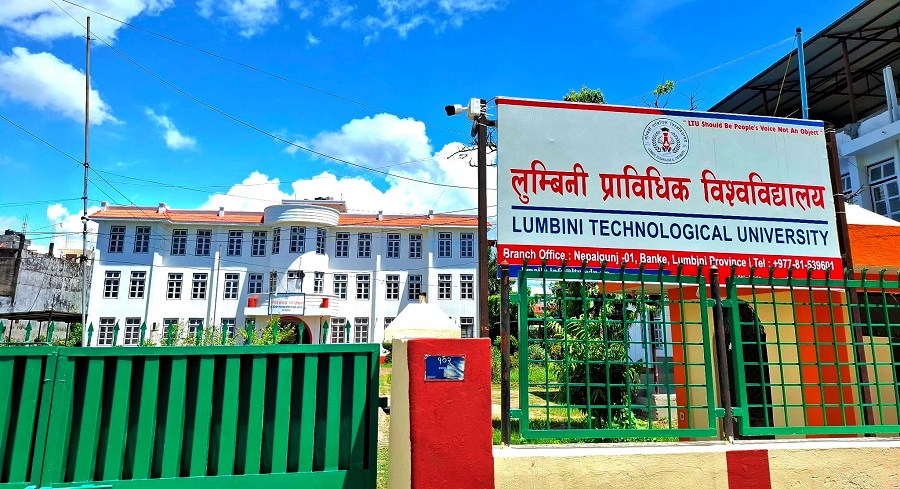
Lumbini Technological University (LTU) is a public provincial university in Banke, Nepal. It was established on 2 July 2022 (18 Ashar 2079 BS) through Lumbini Province legislation. The university focuses on technological and technical higher education, with academic programs in information technology, computer science and artificial intelligence, and engineering.
LTU’s institutional scope also refers to areas such as agriculture, forestry, and tourism. These areas form part of the university’s broader academic vision and should be distinguished from the degree programs listed in its official course catalogue.
| Field | Information |
|---|---|
| Official name | Lumbini Technological University |
| Nepali name | लुम्बिनी प्राविधिक विश्वविद्यालय |
| Abbreviation | LTU |
| Institution type | Public provincial technological university |
| Established | 2 July 2022 (18 Ashar 2079 BS) |
| Province | Lumbini Province |
| District | Banke |
| Degree levels | Bachelor’s and Master’s |
| Academic areas represented in listed programs | Information Technology, Computer Science and AI, Civil Engineering |
| Official website | https://ltu.edu.np/ |
Lumbini Technological University was established through provincial legislation with the purpose of developing higher education in technology-oriented and technical fields.
The university’s legal-document section lists the University Act 2078, LTU Statute 2079, Gazette 2079, and Regulations 2079. These documents provide the legal and institutional framework under which LTU operates.
LTU is therefore a university established under Lumbini Province law rather than a college operating under the affiliation of another university.
Readers who want broader context about higher education institutions in Nepal can also refer to Collegenp’s Nepal university system overview.
Technology and its practical application are central to LTU’s stated academic direction.
The university describes its purpose as providing higher education that combines subject knowledge with practical application. Its institutional background identifies information technology, engineering, agriculture and forestry, and tourism among the areas considered within its wider academic scope.
LTU also places research, technological development, and innovation within its institutional objectives. The university states that students and faculty are encouraged to engage in research activities and connect academic learning with practical problems.
The broader institutional scope should not be confused with the programs formally listed in the university’s course catalogue. A subject included in LTU’s long-term academic vision is not necessarily an active degree program.
LTU’s official course catalogue lists bachelor’s and master’s programs in information technology, computer science and artificial intelligence, and engineering.
The B.Tech. in IT Engineering is one of LTU’s undergraduate technology programs. The official course information states that the program has been running from academic year 2080.
The program title should be recorded as B.Tech. in IT Engineering rather than replaced with a shorter or different qualification name.
LTU lists B.Tech. in Civil Engineering at the bachelor’s level. The university’s course information states that the program has been running from academic year 2080.
Students interested in understanding the field beyond university-specific information may also read Collegenp’s civil engineering career pathway.
B.Tech. in CS & AI is listed in LTU’s course catalogue as an undergraduate program combining computer science and artificial intelligence within the program title.
Any detailed description of subjects, semester structure, eligibility, or assessment should follow the university’s official curriculum and syllabus rather than being inferred from the course name.
LTU also lists B.Tech. in IT as a separate bachelor’s program.
Students comparing information technology study options after secondary education can use Collegenp’s guide to IT courses after Grade 12 for general academic and career context.
M.Tech. in Computer Science is listed as a postgraduate program at LTU.
The university’s program information describes it as a two-year, four-semester program. Students should rely on the official curriculum when checking course structure, credit requirements, assessment, or other academic details.
LTU lists M.Tech. in Information Technology among its postgraduate programs.
The university’s program information describes it as a two-year program that is typically organized across four semesters. Detailed academic requirements should be taken from the applicable LTU curriculum and syllabus.
| Level | Program |
|---|---|
| Bachelor’s | B.Tech. in IT Engineering |
| Bachelor’s | B.Tech. in Civil Engineering |
| Bachelor’s | B.Tech. in CS & AI |
| Bachelor’s | B.Tech. in IT |
| Master’s | M.Tech. in Computer Science |
| Master’s | M.Tech. in Information Technology |
The program names above follow LTU’s official course catalogue. Older or abbreviated course labels should not be substituted where they do not match the university’s published titles.
Research forms part of LTU’s stated institutional role alongside teaching.
The university describes research as a way to address practical problems, develop knowledge, and connect academic work with wider social and technological needs. Its published institutional material also refers to external relations and knowledge dissemination as part of this work.
LTU states that its research and external-relations activities may involve collaboration with industry, government bodies, universities, research institutions, development organizations, and communities. Areas mentioned by the university include research collaboration, academic exchange, laboratory development, consultancy, publications, conferences, technology transfer, and community engagement.
These statements describe LTU’s institutional research objectives and framework rather than guaranteed opportunities available to every student or program.
LTU identifies curriculum development as part of its academic structure.
For students, the official curriculum and syllabus are the appropriate sources for detailed academic information such as subjects, semester organization, credits, assessment requirements, and program-specific learning components.
Course titles alone do not provide enough evidence to infer curriculum content. Where LTU revises a curriculum or syllabus, the revised university document should take priority over older descriptions.
LTU’s institutional material includes a Student Facilitation Center and student-affairs functions within its organizational structure.
The university describes these units as supporting areas connected with academic learning, career preparation, technical skill development, innovation, student activities, and related student services.
Specific services or activities should not be assumed solely from general institutional descriptions. Students requiring a particular facility or support service should refer to the relevant university information.
LTU was established with a wider technological education mandate than its listed degree programs alone may suggest.
Its institutional background refers to information technology, engineering, agriculture and forestry, tourism, technology application, and innovation. However, these references describe the university’s broader scope and development direction.
For publication purposes, only programs appearing in the official course catalogue or an applicable university academic document should be presented as LTU degree programs.
This distinction helps avoid treating planned, proposed, or broader subject areas as courses that the university formally offers.
Yes. Lumbini Technological University is a public provincial university established through Lumbini Province legislation.
Lumbini Technological University was established on 2 July 2022, corresponding to 18 Ashar 2079 BS.
Lumbini Technological University is based in Banke district of Lumbini Province, Nepal.
LTU lists B.Tech. in IT Engineering, B.Tech. in Civil Engineering, B.Tech. in CS & AI, and B.Tech. in IT.
LTU lists M.Tech. in Computer Science and M.Tech. in Information Technology.
Yes. The university’s listed programs include civil engineering as well as information technology, computer science, and artificial intelligence-related programs.
No. LTU’s institutional background refers to a wider range of academic areas than those represented in its course catalogue. A field should be treated as an offered degree only when it appears in the university’s official program information.
