Madan Bhandari University of Science and Technology (MBUST) is a federal university in Nepal established under the Madan Bhandari University of Science and Technology Act, 2079. The Act is dated 18 Shrawan 2079, corresponding to August 3, 2022, and the University Grants Commission (UGC) of Nepal lists MBUST among the country's federal universities. Its campus is in Chitlang, Thaha Municipality, Makawanpur District, Bagmati Province.
The university concentrates on science, technology, applied research, and research-based higher education. Its documented graduate structure covers Organic Agriculture, Forest Biomaterials Science and Engineering, Artificial Intelligence, Data Science, and Sustainable and Resilient Infrastructure. Research facilities are organized around closely related areas: Organic Agriculture, Forest Biomaterials, Digital Technology, and Sustainable and Resilient Infrastructure.
MBUST's institutional development also requires a clear distinction between two stages. The Government of Nepal established a Development Board in 2019 to prepare the proposed university, while MBUST itself became a statutory university through the 2079 Act in 2022. That distinction is central to understanding its history, legal identity, governance, and academic operation.
Key Highlights
| Area |
Verified Detail |
| Official Name |
Madan Bhandari University of Science and Technology (MBUST) |
| Institutional Status |
Federal university in Nepal |
| Legal Basis |
Madan Bhandari University of Science and Technology Act, 2079 |
| Statutory Establishment |
August 3, 2022 |
| Preparatory Phase |
Madan Bhandari University of Science and Technology Development Board established on April 23, 2019 |
| Location |
Chitlang, Thaha Municipality, Makawanpur District, Bagmati Province, Nepal |
| Governance |
Board of Trustees, with the President serving as executive head |
| Academic Orientation |
Science, technology, applied research, and research-based higher education |
| Master’s Level |
Master of Applied Science programs |
| Graduate Fields |
Organic Agriculture; Forest Biomaterials Science and Engineering; Artificial Intelligence; Data Science; Sustainable and Resilient Infrastructure |
| Doctoral Study |
PhD study in the same five broad graduate fields |
| Research Structure |
Organic Agriculture, Forest Biomaterials, Digital Technology, and Sustainable and Resilient Infrastructure research facilities |
| Graduate Study Model |
Full-time, research-based study combining core coursework with supervised research |
| Institutional Recognition |
Listed by the University Grants Commission of Nepal as a federal university |
| Research Evidence |
Peer-reviewed publications identify MBUST program and laboratory affiliations in Organic Agriculture and Forest Biomaterials-related research |
Legal identity and federal university status
Madan Bhandari University of Science and Technology derives its university status from its own establishing legislation rather than from affiliation with another degree-awarding institution. The Nepal Law Commission records the Madan Bhandari University of Science and Technology Act, 2079 as prevailing legislation, while UGC Nepal places MBUST in its federal university category.
The Act date of 18 Shrawan 2079 corresponds to August 3, 2022. This is the appropriate establishment date for the university as a legal institution. The earlier 2019 date relates to a preparatory body and should not be treated as the founding date of the statutory university.
This legal position distinguishes MBUST from a college that delivers degrees under the authority of another university. Its official academic pages present Master of Applied Science and doctoral programs under the MBUST name, consistent with its position as a university operating under its own statute.
For international readers, this distinction is significant. MBUST's standing within Nepal is grounded in federal legislation and its UGC classification. Those facts establish its place in Nepal's higher education system without relying on rankings, reputation claims, or promotional descriptions.
From the Development Board to the statutory university
The institutional history began before the university legally existed. On April 23, 2019, the Government of Nepal established the Madan Bhandari University of Science and Technology Development Board. The Board was created to prepare the foundations needed for the proposed institution, including legal preparation, academic and research planning, physical development, and identification of professionals who could contribute to the university.
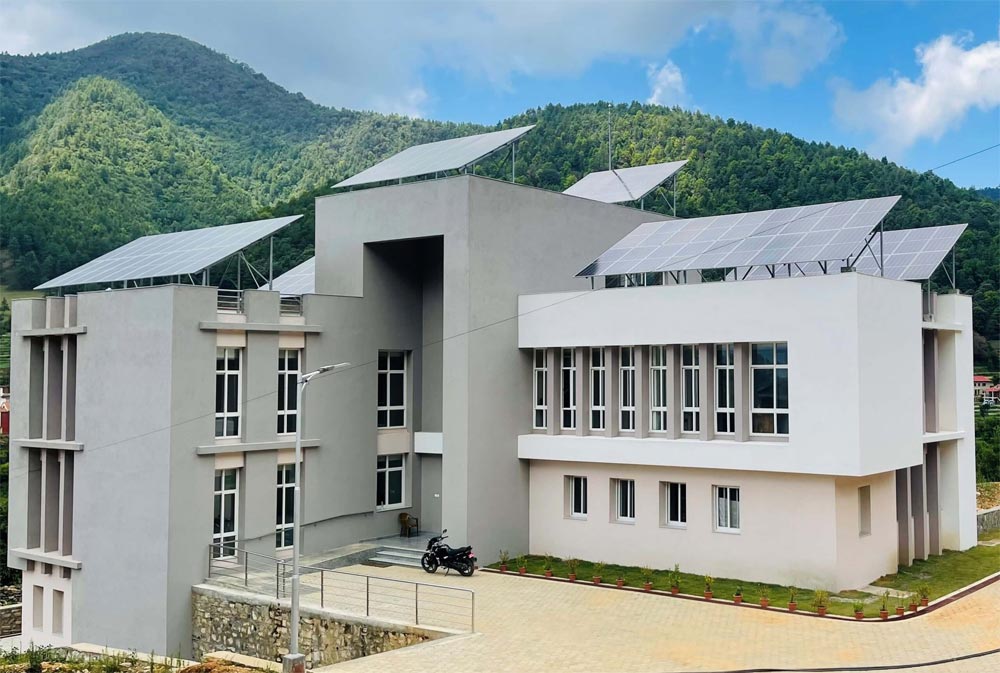
Government procurement records confirm that the Development Board was functioning before passage of the university Act. A 2021 Public Procurement Monitoring Office document identifies the Development Board as the purchaser for a grid-connected solar photovoltaic system at Chitlang, Thaha Municipality Ward No. 9, Makawanpur District. The procurement record also identifies government grant support for that project.
These records establish that institutional and physical preparation at Chitlang preceded MBUST's legal establishment. They should not, however, be used to treat every proposal from the preparatory period as a completed university facility or academic program.
The transition can be understood in three stages:
| Stage |
Date |
Institutional significance |
| Development Board |
April 23, 2019 |
Preparatory work for legal, academic, research, land, and infrastructure development |
| Statutory university |
August 3, 2022 |
Legal establishment through the Madan Bhandari University of Science and Technology Act, 2079 |
| Academic operation |
After establishment |
Graduate programs, research facilities, and scholarly affiliations documented under MBUST |
The chronology matters because referring to MBUST simply as a university established in 2019 merges a temporary preparatory institution with the later statutory university. The Development Board and the Board of Trustees are also different bodies with different roles.
Courses Offered
| Level |
Course / Program |
| Undergraduate |
Bachelor of Science in Computer Science and Technology (BScCST) |
| Master’s |
Master of Applied Science (MAS) in Organic Agriculture |
| Master’s |
Master of Applied Science (MAS) in Forest Biomaterials Science and Engineering |
| Master’s |
Master of Applied Science (MAS) in Artificial Intelligence |
| Master’s |
Master of Applied Science (MAS) in Data Science |
| Master’s |
Master of Applied Science (MAS) in Sustainable and Resilient Infrastructure |
| Doctoral |
PhD in Organic Agriculture |
| Doctoral |
PhD in Forest Biomaterials Science and Engineering |
| Doctoral |
PhD in Artificial Intelligence |
| Doctoral |
PhD in Data Science |
| Doctoral |
PhD in Sustainable and Resilient Infrastructure |
Chitlang campus and physical development
MBUST is based in Chitlang, Thaha Municipality, Makawanpur District, Bagmati Province, Nepal. The university's official contact information identifies its campus as MBUST Campus, Chitlang, Makawanpur, while government procurement records provide the more specific Thaha Municipality Ward No. 9 location. UGC records also associate the university with Makawanpur and Chitlang.
Chitlang was already serving as the physical site for university-related development during the Development Board period. Government procurement documentation from 2021 and 2022 connects the Board with infrastructure work at the location before MBUST became a statutory university.
The more durable description of the campus is therefore based on its confirmed location and documented research facilities rather than a single land-area figure or projected master-plan capacity. Different institutional materials have used different measurements or planning scopes for campus size, making such figures unsuitable as fixed institutional facts without a clearly defined basis.
The same distinction applies to proposed campus components. Development plans, projected buildings, future research centers, housing concepts, academic zones, and other master-plan elements should not be treated as completed facilities solely because they appeared in planning material.
What is clearly established is that Chitlang serves as the university's operating base and contains specialized research facilities associated with agriculture, forest biomaterials, digital technology, and infrastructure engineering.
Board of Trustees governance
MBUST operates through a Board of Trustees governance model. The Board belongs to the statutory university created under the 2079 Act and is distinct from the Development Board that handled preparations before establishment.
University governance material identifies the Board of Trustees as the university's supreme governing body and the President as its executive head. This arrangement provides the most stable description of MBUST's leadership structure because individual office-holders can change while the statutory governance model remains more durable.
The distinction between the two boards is particularly important:
-
The Development Board belonged to the pre-establishment phase and carried out preparatory work.
-
The Board of Trustees is part of the governance system of the legally established university.
-
The President serves as the university's executive head within that governance structure.
The Board of Trustees model should be reported without converting it into unsupported claims about complete political independence, uniqueness among Nepali universities, or superiority to other governance systems. Its significance lies in the structure established for MBUST itself.
Degree-awarding position and recognition
MBUST's authority as a university rests on the Madan Bhandari University of Science and Technology Act, 2079 and its recognition within Nepal's higher education system as a federal university by UGC Nepal.
The institution is therefore not presented as a college delivering another university's awards. Its academic pages identify MBUST's own Master of Applied Science and PhD programs, consistent with its statutory position as an independent university.
This national legal status is separate from external professional or international accreditation. MBUST's institutional standing should be described through its Act and UGC classification rather than converted into a claim of institution-wide international accreditation. A separate accreditation claim would require an identified accrediting body, a clearly defined institutional or program scope, and an applicable accreditation decision.
The same distinction applies to recognition outside Nepal. MBUST's statutory standing in Nepal does not automatically determine how a qualification will be treated for employment, professional practice, further study, or credential evaluation in another jurisdiction. Those decisions fall under the rules of the receiving institution, regulator, professional body, employer, or credential-evaluation system.
No ranking claim is necessary to explain MBUST's legal position. Its institutional status can be established directly from legislation and UGC classification.
Research-based graduate education
The most clearly documented part of MBUST's academic structure is graduate education. The university offers Master of Applied Science study in five fields:
Doctoral study is organized around the same five broad fields.
The Master of Applied Science is described as a two-year, full-time, research-based program. Students begin with core coursework, with the first semester providing the principal academic foundation before study moves more extensively into guided research.
This structure places supervised research within the degree rather than treating research solely as an additional activity outside formal study. Defined research themes and multidisciplinary study also form part of the graduate model.
The university's academic identity is therefore more accurately described through the connection between graduate study and research facilities than through a long list of individual subjects. Its five graduate fields correspond closely to four research groupings, with Artificial Intelligence and Data Science both situated within Digital Technology.
| Graduate field |
Related research structure |
| Organic Agriculture |
Organic Agriculture laboratories |
| Forest Biomaterials Science and Engineering |
Forest Biomaterials laboratories |
| Artificial Intelligence |
Digital Technology research facility |
| Data Science |
Digital Technology research facility |
| Sustainable and Resilient Infrastructure |
Sustainable and Resilient Infrastructure laboratories |
This organizational relationship does not imply that every laboratory represents a separate academic award. Laboratory names and degree titles serve different institutional purposes and should be distinguished.
Organic Agriculture
Organic Agriculture is represented at both Master of Applied Science and doctoral level and is supported by a dedicated research facility.
The facility includes laboratory activity related to plant protection and biocontrol, genomics and tissue culture, insect ecology and pest management, horticulture, and mushroom research. The broader research areas also include molecular biology and work related to soil and plant nutrients.
The field therefore combines graduate study with laboratory and experimental work in plant science, biological control, genetics-related techniques, crop health, soil, horticulture, and related agricultural subjects.
Independent scholarly indexing also confirms the use of MBUST's Organic Agriculture Program as a research affiliation. A 2024 paper in Studies in Mycology indexed by PubMed includes an author affiliated with the Organic Agriculture Program, Madan Bhandari University of Science and Technology, Chitlang, Thaha Municipality.
The significance of that record is specific: it confirms that the Organic Agriculture program name has been used in peer-reviewed scholarly publication metadata. It does not by itself establish a university-wide publication ranking, research impact score, or sector-wide agricultural outcome.
Forest Biomaterials Science and Engineering
Forest Biomaterials Science and Engineering is also represented at Master of Applied Science and PhD level. Its associated research facilities cover natural products, biomaterials and nanotechnology, wood science, and computational chemistry.
The laboratory structure gives the field a broader scope than timber study alone. Research activity documented under the Forest Biomaterials grouping includes work with forest-derived materials, natural products, wood science, analytical methods, biomaterials, and related computational activity.
MBUST also maintains individual research pages for facilities such as the Biomaterials and Nano-Technology Laboratory and the Natural Products Laboratory. Individual instruments and equipment inventories can change, so the more stable institutional fact is the continuing laboratory structure rather than a fixed equipment list.
External scholarly records provide further confirmation of research affiliation in this area. A 2026 PLOS One article identifies a co-author affiliated with the Forest Biomaterials Program, Institute of Applied Science, Madan Bhandari University of Science and Technology, Chitlang, Bagmati Province.
A separate 2026 PubMed-indexed publication identifies the Wood Science Laboratory and Forest Biomaterials Science and Engineering Program at MBUST. Together, these records corroborate the use of both program and laboratory identities in published research.
Digital Technology
Digital Technology serves as the research grouping associated with MBUST's graduate work in Artificial Intelligence and Data Science.
The university identifies laboratories for Artificial Intelligence, Data Science, Internet of Things, and Cyber Security within this research facility. Artificial Intelligence and Data Science are separately documented as Master of Applied Science and doctoral fields.
Internet of Things and Cyber Security require a different interpretation. Their presence as laboratory areas demonstrates research organization in those subjects, but laboratory names do not establish separate degrees under the same titles.
The distinction prevents a common error in university profiles: converting every research laboratory into an academic program. At MBUST, the documented graduate awards within this area are Artificial Intelligence and Data Science, while the wider Digital Technology research facility contains additional laboratory categories.
This structure also shows that the digital research grouping extends beyond the exact names of its graduate awards without requiring unsupported statements about the scale, equipment, output, or external accreditation of individual laboratories.
Sustainable and Resilient Infrastructure
Sustainable and Resilient Infrastructure is offered at both Master of Applied Science and doctoral level and is connected with a dedicated research facility.
The facility identifies a Material Testing Laboratory, Computational Structural Engineering Laboratory, Structural Engineering Laboratory, and Infrastructure Design and Planning Laboratory.
These laboratory names place the field within engineering research involving material behavior, structural analysis, experimental structural work, computation, design, and infrastructure planning.
The academic area should therefore be understood as an engineering-oriented graduate and research field rather than as a broad sustainability label. At the same time, the laboratory structure alone does not establish claims about national infrastructure performance, commercial deployment, or the measurable impact of MBUST research on completed infrastructure projects.
Its confirmed institutional importance lies in the combination of graduate study and specialized engineering research facilities under the same university structure.
Research organization across the university
MBUST organizes its principal research facilities into four groups:
These areas closely correspond with the university's five documented graduate fields. Organic Agriculture and Forest Biomaterials Science and Engineering each connect directly with their own research facilities. Artificial Intelligence and Data Science share the Digital Technology grouping. Sustainable and Resilient Infrastructure is supported by engineering laboratories bearing the same broad academic identity.
This relationship is a defining feature of MBUST's documented academic organization. The Master of Applied Science is built around research-based study, while the university maintains laboratories in the same subject areas in which graduate students pursue advanced degrees.
The relationship should not be reduced to numerical claims about laboratory totals, project counts, publication counts, faculty numbers, or equipment inventories. Such totals can change and can depend on how individual units or activities are counted. The named research groupings provide a more stable description of institutional organization.
External evidence of research activity
MBUST's research identity can also be seen in scholarly records outside the university's own academic pages.
A 2024 paper indexed by PubMed identifies an MBUST Organic Agriculture Program affiliation in Chitlang. A 2026 PLOS One publication identifies the Forest Biomaterials Program and Institute of Applied Science at MBUST. Other PubMed-indexed publications identify affiliations including the Wood Science Laboratory and Forest Biomaterials Science and Engineering Program.
These records establish that researchers have published peer-reviewed work using MBUST program and laboratory affiliations. They also connect external publication metadata with academic units that appear in the university's own research structure.
Publication affiliations should be interpreted precisely. They confirm institutional research participation and the use of named MBUST affiliations; they do not establish overall research quality, citation impact, comparative standing, or a fixed volume of university publications.
For an institution whose statutory establishment dates to 2022, the external publication records are particularly useful evidence that its research identity is represented beyond planning documents and institutional descriptions.
Physical and technical research infrastructure
The physical development of MBUST can be traced from the Development Board period into the university's present research organization.
The 2021 government procurement record concerning a grid-connected solar photovoltaic system establishes infrastructure activity at Chitlang before the university Act was passed. Procurement records from 2022 likewise identify the Development Board and the Chitlang site.
After statutory establishment, MBUST's research pages identify specialized facilities in agriculture, biomaterials, digital technology, and infrastructure engineering. The combination of government procurement evidence and later academic facility records supports describing Chitlang as the university's operating research and academic base.
This evidence does not justify treating proposed master-plan facilities as completed. The institutional profile is stronger when it identifies documented laboratories and research groupings rather than repeating projected capacity, construction concepts, or variable campus-area figures.
The laboratories themselves also need to be interpreted at the correct level. A named research laboratory confirms an organizational research unit; it does not establish a separate degree, a permanent equipment inventory, equal resources across laboratories, or a particular volume of research output.
Institutional boundaries and the Madan Bhandari Academy of Health Sciences
Madan Bhandari University of Science and Technology is a separate institution from Madan Bhandari Academy of Health Sciences.
UGC Nepal lists MBUST among federal universities, while the Madan Bhandari Academy of Health Sciences is identified separately as a provincial medical academy. The shared use of the Madan Bhandari name does not make the two institutions legally or academically interchangeable.
This distinction is important when considering programs, governance, institutional notices, accreditation, staff, admissions, and research information. Health-science information associated with the Academy should not be attributed to MBUST unless a specific institutional relationship is formally established.
The same care applies to claims about affiliated colleges. MBUST's statutory and academic position is that of a federal university operating its own academic and research programs. The verified institutional record does not establish a conventional external college-affiliation network under the university.
MBUST as a science and technology university
MBUST's institutional identity can be defined through a small number of well-supported characteristics.
It is a federal university legally established in 2022 under its own Act. Its physical base is in Chitlang, Makawanpur District. It is governed through a Board of Trustees structure, with the President serving as executive head. Its clearest academic activity is research-based graduate education in five applied scientific and technological fields.
The university's research facilities are not detached from those graduate fields. Organic Agriculture connects with plant, biological, genomic, horticultural, and related laboratories. Forest Biomaterials Science and Engineering connects with natural products, biomaterials, wood science, and computational chemistry. Artificial Intelligence and Data Science sit within Digital Technology research. Sustainable and Resilient Infrastructure connects with materials, structural engineering, computation, design, and planning laboratories.
Peer-reviewed publication records using MBUST program and laboratory affiliations provide separate evidence of research activity under the university's name.
Taken together, these characteristics distinguish the statutory university from its earlier Development Board phase and provide a clear account of its present institutional role: a Nepalese federal university centered on science, technology, applied research, and research-based advanced study.




