



Salzburg University of Applied Sciences is the English-language name of Fachhochschule Salzburg GmbH, commonly known as FH Salzburg. It is an Austrian university of applied sciences whose higher-education activity began with the first Fachhochschule programmes in Salzburg in 1995. University-of-applied-sciences status followed in 2004.
FH Salzburg now operates through six academic departments and four locations in the Province of Salzburg. Its subject areas extend across social sciences, business and tourism, creative technologies, design and green engineering, health sciences, and information technologies and digitalisation. The university provides bachelor and master degrees together with continuing-education provision.
Its structure reflects the applied-sciences character of the Austrian Fachhochschule sector. Teaching is organised around professional and interdisciplinary subject areas, research is application-oriented, and specialist resources range from clinical simulation facilities to experimental building and materials infrastructure. Different locations have distinct academic purposes rather than functioning as interchangeable campuses.
| Field | Institutional position |
|---|---|
| Official English name | Salzburg University of Applied Sciences |
| Legal entity | Fachhochschule Salzburg GmbH |
| Institution type | Austrian university of applied sciences |
| Academic origins | First Fachhochschule programmes began in 1995 |
| University-of-applied-sciences status | Granted in 2004 |
| Ownership | Province of Salzburg, Salzburg Chamber of Commerce and Salzburg Chamber of Labour, each holding one third |
| Academic organisation | Six departments |
| Locations | Urstein, Kuchl, Salzburg University Hospital and Schwarzach/Kardinal Schwarzenberg Hospital |
| Study levels | Bachelor, master and continuing education |
| Teaching languages | German across much of the study portfolio, with selected English-taught programmes |
| Research organisation | Six strategic research areas |
FH Salzburg belongs to Austria's university-of-applied-sciences sector. The German term Fachhochschule identifies a legally recognised form of higher-education institution in which professionally oriented study and applied research have a central role. FH Salzburg operates under the Austrian University of Applied Sciences Act and the national quality-assurance arrangements applying to this sector.
The institution's public name and legal identity should be distinguished. Salzburg University of Applied Sciences is the English institutional name, while Fachhochschule Salzburg and FH Salzburg are commonly used in German-language material. The legal operating entity is Fachhochschule Salzburg GmbH, a company with limited liability.
Ownership is divided equally among three Salzburg bodies: the Province of Salzburg, the Salzburg Chamber of Commerce and the Salzburg Chamber of Labour. Each holds one third of the company. This corporate structure exists alongside the university's academic governing bodies and does not replace academic authority.
FH Salzburg is separate from Paris Lodron University of Salzburg. It has its own legal entity, management, academic governance, locations and study provision. The distinction is significant for international readers because both institutions use Salzburg in their names but belong to different institutional structures.
As a recognised Austrian university of applied sciences, FH Salzburg provides bachelor and master degree study within the regulated Fachhochschule system. Institution-level recognition and approval of individual study programmes are separate matters: an established university can hold recognised status while a newly proposed programme still passes through programme-level approval procedures.
FH Salzburg traces its academic beginnings to 1995. Its first Fachhochschule programmes were Telecommunications Technology & Systems in Salzburg-Itzling and Forest Products Technology & Management in Kuchl. Technology and timber-related study were therefore present from the institution's earliest stage.
MultiMediaArt followed in 1996, adding media and creative study. These early disciplines established several of the subject areas that later developed into the university's broader departmental structure.
A significant institutional step came in 2004, when FH Salzburg received university-of-applied-sciences status. The Urstein campus opened in Puch near Salzburg in 2005, providing a major site for teaching, administration and central university services. Kuchl retained a distinct academic function associated with timber, construction, materials and design.
Health education expanded from 2006. Fields including Biomedical Sciences, Midwifery, Orthoptics and Physiotherapy became part of the university's academic activity, followed by further health and nursing provision. This expansion also changed the physical organisation of the institution because elements of health education are connected with clinical sites as well as university teaching spaces.
Master's-level study expanded from 2009. FH Salzburg subsequently developed further hospital-linked teaching in Schwarzach, where nursing education is associated with Kardinal Schwarzenberg Hospital.
The institution that emerged from this development is neither a single-campus university nor one built around a single specialist subject. Its academic activity is distributed among six departments and four locations whose functions reflect the disciplines taught there.
FH Salzburg combines corporate governance with statutory academic governance. Fachhochschule Salzburg GmbH is the legal operating company, while a supervisory board has responsibilities on the corporate side.
Academic authority is centred on the University of Applied Sciences Board, or FH-Kollegium, together with the Rectorate. The Board carries the academic duties assigned under Austrian university-of-applied-sciences law, while the Rectorate is responsible for overall academic management.
These functions should not be treated as interchangeable. The company provides the legal operating structure, the supervisory board carries corporate oversight responsibilities, and the FH-Kollegium performs statutory academic functions.
The university's six departments are supported by central administrative and academic-service units. These include library services, controlling and accounting, didactics and learning technologies, research and transfer, communications, information services, infrastructure and organisation, international affairs, human resources and legal affairs, quality management, study organisation and study law.
This division gives FH Salzburg both disciplinary academic units and institution-wide services responsible for functions that cross departmental boundaries.
FH Salzburg's teaching is organised through six departments. The university provides bachelor and master degrees and also maintains continuing-education provision. Full-time and part-time formats are used in different areas, while the language of instruction depends on the particular programme.
Applied Social Sciences is centred on social work and social innovation. Social work forms the principal professional field within the department, while social innovation connects teaching and research concerned with social change and professional responses to social needs.
The department is linked with the university's strategic research area Social Innovation, giving social-sector research a defined place within FH Salzburg's wider research structure.
Business and Tourism covers areas including business administration, management, entrepreneurship, retail-related study and tourism. Its academic scope also includes sustainability and circular-economy questions connected with business and service industries.
Selected provision uses part-time formats, and English-language study is available in parts of the tourism portfolio. Research associated with the department is organised under Future Service Industries.
Creative Technologies combines areas that span computing, media production, interaction and design. Academic subjects include computer animation, mobile applications and games, film, audio, communication design and human-centred technologies.
This arrangement places technical and creative disciplines within the same department rather than separating computing, media and design into wholly independent units. Its associated strategic research area is Human-Centered Technologies & Design.
Design and Green Engineering has a strong connection with Campus Kuchl and with FH Salzburg's long history in timber and forest-products study. Its academic areas include timber construction, forest products, building systems, renewable materials, process engineering and product-oriented design.
Kuchl's specialist facilities reflect these subjects through resources for materials, construction, buildings and related experimental work. The department is linked with the strategic research area Sustainable Materials and Technologies.
Health Sciences covers nursing and several allied-health professions. Established subject areas include Biomedical Sciences, Midwifery, Occupational Therapy, Orthoptics, Physiotherapy and Radiological Technology.
Its teaching differs physically from many other parts of FH Salzburg because academic activity is shared among university facilities and hospital-linked locations. Simulation spaces support controlled practical learning, while clinical teaching connects parts of the curriculum with healthcare institutions.
Research associated with the department is organised under Applied Health Innovation.
Information Technologies and Digitalisation covers technical computing, cybersecurity, mechatronics, industrial informatics and related digital systems.
The department links software-oriented study with engineering and industrial applications. It is also the institutional base for the Industrial Informatics strategic research area.
FH Salzburg operates at Campus Urstein, Campus Kuchl, Salzburg University Hospital and the Schwarzach location at Kardinal Schwarzenberg Hospital. These sites serve different academic functions and should not be understood as four copies of the same campus.
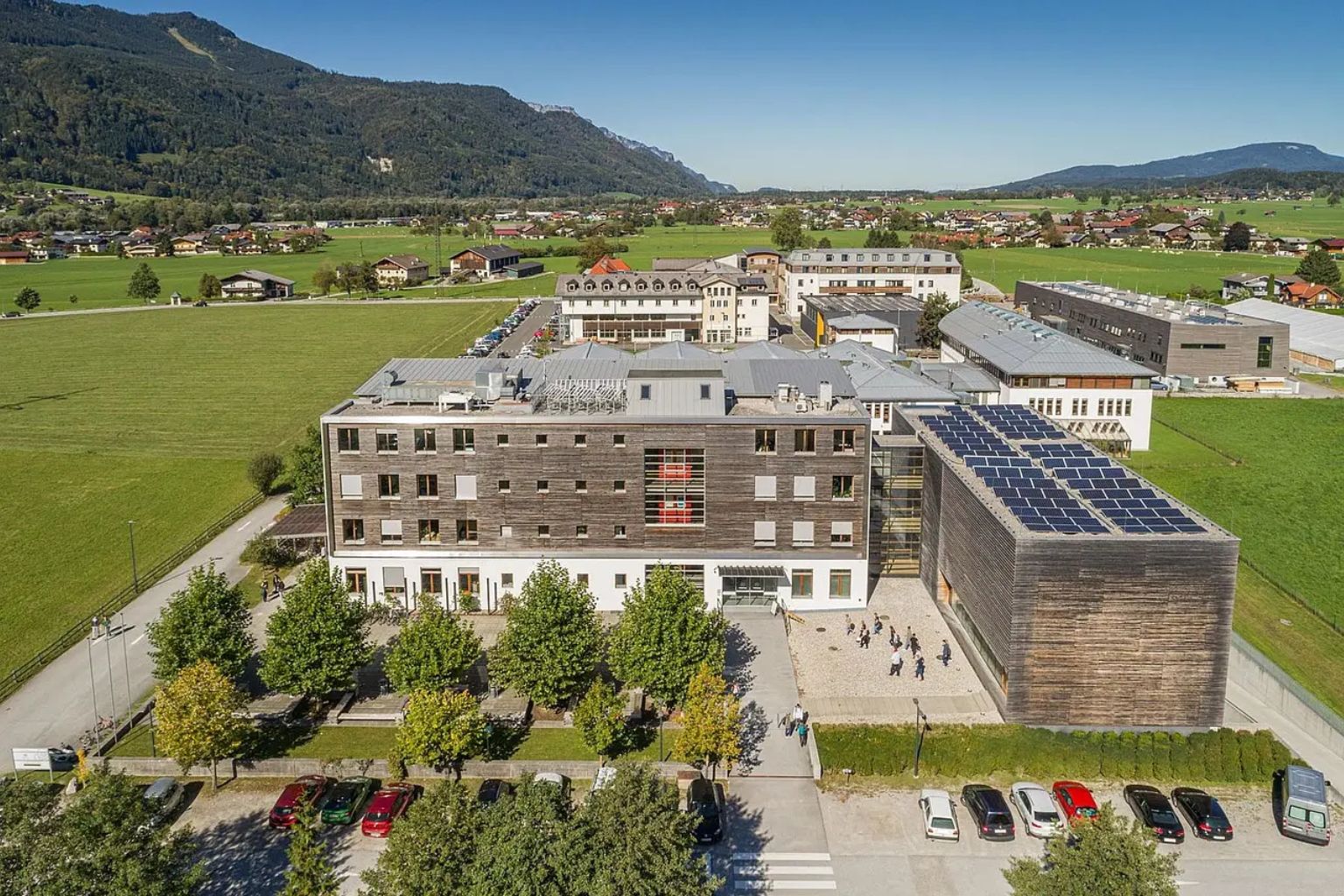
Campus Urstein opened in 2005 in Puch near Salzburg. It is one of the university's principal teaching and administrative locations and accommodates a broad range of academic and service activity.
The campus includes the Wolfgang Gmachl Library. Nearby Wissenspark and Techno-Z spaces are used for additional Health Sciences activity and also house the Research and Transfer Service and FHStartup Center. Urstein has a direct rail connection.
Campus Kuchl is closely associated with Design and Green Engineering and with the university's timber and forest-products history.
The campus building uses timber construction and passive-house principles. Academic resources support study and research involving wood, construction, materials and design, and the site has its own library.
Kuchl also houses Twin²Sim, a specialist research facility comprising a test building, façade test stand, test rooms and a multifunctional laboratory. The facility supports experimental work involving building envelopes, building services, materials and energy-related building questions.
Salzburg University Hospital functions as a specialised teaching location for Health Sciences. Practical lessons and parts of health-science teaching take place there, linking academic study with a clinical setting.
Its function differs from that of Urstein. The hospital is a discipline-specific health teaching site rather than a general campus covering the university's wider academic portfolio.
The Schwarzach location operates in connection with Kardinal Schwarzenberg Hospital and supports nursing education.
Its role extends FH Salzburg's health and nursing activity beyond the Salzburg city area and illustrates the importance of hospital cooperation within this part of the university's teaching structure.
Practice-oriented teaching is a central feature of FH Salzburg, but its form varies considerably by department. Health students may use simulation and clinical facilities, while students in engineering, design or materials-related areas may work with laboratories, workshops, technical equipment or experimental installations.
Health and Nursing SkillsLabs support practical learning in simulated clinical situations. These facilities can be used for high-fidelity simulation, virtual-reality-supported applications and work involving simulated patients. Their role extends into research as well as teaching.
Twin²Sim in Kuchl serves a different purpose. Its experimental building, façade infrastructure, test rooms and laboratory support work on building components, building services, materials and energy-related questions.
The university also maintains a Didactics and Learning Technologies function concerned with higher-education teaching and digital learning technologies. A dedicated studio supports media production for teaching and research.
Information Services provides the technical infrastructure used in academic delivery, including computer laboratories, seminar-room technology, information and communication services and audiovisual equipment.
Teaching formats are not uniform across FH Salzburg. Full-time and part-time options exist in different parts of the university, but neither format applies to every programme. The same programme-level distinction applies to teaching language, placements, laboratories, selection procedures and professional requirements.
FH Salzburg organises research through six strategic areas:
Applied Health Innovation
Future Service Industries
Human-Centered Technologies & Design
Industrial Informatics
Social Innovation
Sustainable Materials and Technologies
These research areas broadly correspond with the six academic departments, creating a direct structural connection between the university's teaching disciplines and its research organisation.
Applied Health Innovation is connected with Health Sciences. Simulation and digital clinical facilities provide resources that can serve both teaching and research, including work involving clinical scenarios and simulation methods.
Future Service Industries is associated with Business and Tourism and addresses research connected with management, tourism, service industries, sustainability and circular-economy questions.
Human-Centered Technologies & Design is linked with Creative Technologies. Its academic base spans computing, interactive systems, media and design.
Industrial Informatics is connected with Information Technologies and Digitalisation and concentrates on applied computing and engineering-related digital systems.
Social Innovation is associated with Applied Social Sciences and places research on social change and professional practice within the university's formal research organisation.
Sustainable Materials and Technologies is based in Design and Green Engineering. Its research subjects include bio-based and recyclable materials, circular resource use, building envelopes, construction systems and energy-related building technologies. Twin²Sim provides specialist experimental infrastructure for this work.
Research activity is also supported centrally through the Research and Transfer Service. The FHStartup Center provides a related route for students, alumni and researchers working on entrepreneurship and early-stage projects. Its services include idea assessment, coaching, workshops, mentoring, networking and access to project infrastructure.
FH Salzburg holds recognised university-of-applied-sciences status within the Austrian higher-education system.
AQ Austria is the national quality-assurance agency responsible for accreditation procedures for universities of applied sciences and private higher-education institutions. New university-of-applied-sciences study programmes require programme accreditation, while established institutions are subject to periodic external review of their internal quality-management systems.
These processes operate at different levels. The recognised status of FH Salzburg as an institution does not automatically settle the approval position of every newly proposed programme. Programme-level accreditation remains relevant when new study provision is introduced.
Within FH Salzburg, the Quality Management unit supports external evaluation and accreditation and maintains the university's internal quality-management processes. Quality assurance is therefore part of ongoing institutional administration rather than a single one-time recognition.
FH Salzburg operates physical libraries at Urstein and Kuchl. Their services include print and electronic resources, database access, research tools and spaces for reading and study. Although the physical library sites are concentrated at these two locations, library services support teaching and research across the university.
Information Services maintains computer laboratories, seminar-room technology and other information and communication services used by students and staff. Audiovisual equipment lending is also part of this function.
The Career Center supports students and alumni through personal career counselling, workshops, coaching and a job and career platform. It also provides access to listings for employment, internships and trainee opportunities. These services support career planning rather than constituting a guarantee of employment after graduation.
FHStartup Center provides another form of support, aimed at entrepreneurship and project development. Students, alumni and researchers can access services including coaching, mentoring, workshops, networking, idea assessment and project infrastructure. The center is connected with the broader Startup Salzburg network.
Other university services cover study organisation, international mobility, quality management and teaching development. Some services operate across the institution, while others are tied to particular departments, locations or study routes.
International work is coordinated by the International Office in cooperation with the Rectorate and individual degree programmes.
Its responsibilities include relationships with partner institutions, incoming and outgoing exchange semesters, Erasmus+ staff mobility and support for mobility projects. The university's partner network is used for student exchange, staff mobility and academic cooperation.
FH Salzburg also has programme-specific double or dual degree arrangements with international partner institutions. These opportunities are attached to particular degrees and should not be understood as university-wide options available to every student.
Exchange study and admission to a complete FH Salzburg degree follow different routes. Exchange activity is managed through mobility arrangements involving partner institutions, while degree-seeking international applicants follow the admission process for the selected degree.
Admission at FH Salzburg is organised at programme level. There is no single identical selection method for all degrees.
For bachelor-level study, applicants need an Austrian secondary-school leaving qualification or another route recognised under the applicable admission rules. For master's-level study, an appropriate bachelor qualification or equivalent prior higher education is required. Assessment of equivalence and degree-specific eligibility belongs to the responsible programme.
Study places are limited, and allocation is made through a selection process. The particular method depends on the degree. An interview, test, portfolio or other selection element used by one programme should not be assumed to apply to the university as a whole.
Applicants whose previous qualifications were earned outside Austria may need additional documentation. Depending on the programme and the country in which documents were issued, requirements can include certification, legalisation or translation.
Teaching language is also programme-specific. German is used across much of FH Salzburg's academic portfolio, while selected degrees are taught in English. Admission requirements for language competence therefore depend on the degree being entered.
FH Salzburg does not directly provide student accommodation. Residences are available at or near several university locations, including Urstein, Kuchl and Schwarzach, but they are operated by external providers. Students arrange their housing independently.
The university's multi-location structure makes the academic location of a programme important when planning accommodation and travel. A student mainly based at Kuchl has a different study location from one attending Urstein or undertaking health teaching at a hospital site.
This physical distribution is part of the institution's academic organisation rather than a secondary geographic detail. Urstein carries broad teaching and service functions, Kuchl concentrates substantial timber, building, materials and design activity, and the Salzburg and Schwarzach hospital sites serve defined health and nursing roles.
For readers from systems where the word university usually refers to a comprehensive research institution, FH Salzburg is more accurately understood through the Austrian Fachhochschule category.
It is a recognised higher-education institution providing bachelor and master study under national requirements for universities of applied sciences. Its organisation places particular emphasis on professionally oriented education, applied research and specialist teaching resources.
That institutional form does not make every programme alike. Study mode, teaching language, admissions procedures, practical components and professional requirements vary across degrees.
FH Salzburg's own structure illustrates this clearly. Clinical disciplines use hospital-linked teaching and simulation spaces; timber, materials and building subjects have specialist resources at Kuchl; computing and creative fields occupy different academic settings; and research is organised around six strategic areas corresponding broadly with the six departments.
The university is therefore best understood through the relationship between its legal status, six-department academic organisation, four specialised locations and application-oriented research and teaching.
No. Salzburg University of Applied Sciences, or FH Salzburg, is operated by Fachhochschule Salzburg GmbH and has its own management, academic governance, locations and study provision. Paris Lodron University of Salzburg is a separate institution.
Its higher-education activity dates to 1995, when the first Fachhochschule programmes began in Salzburg. It received university-of-applied-sciences status in 2004.
The university has six departments: Applied Social Sciences, Business and Tourism, Creative Technologies, Design and Green Engineering, Health Sciences, and Information Technologies and Digitalisation.
Its four locations are Campus Urstein in Puch, Campus Kuchl, Salzburg University Hospital and the Schwarzach location associated with Kardinal Schwarzenberg Hospital.
Yes. FH Salzburg provides bachelor and master study as well as continuing-education provision.
No. German is used across much of the study portfolio, while selected programmes are taught in English. Teaching language is determined at programme level.
Admission requirements and selection procedures depend on the individual degree. Bachelor applicants require an eligible secondary-school qualification or recognised equivalent route, while master's applicants require appropriate prior higher education. Study places are limited and allocation uses programme-specific selection procedures.
No. Student residences are available near several locations, but accommodation is operated by external providers and students arrange housing independently.
