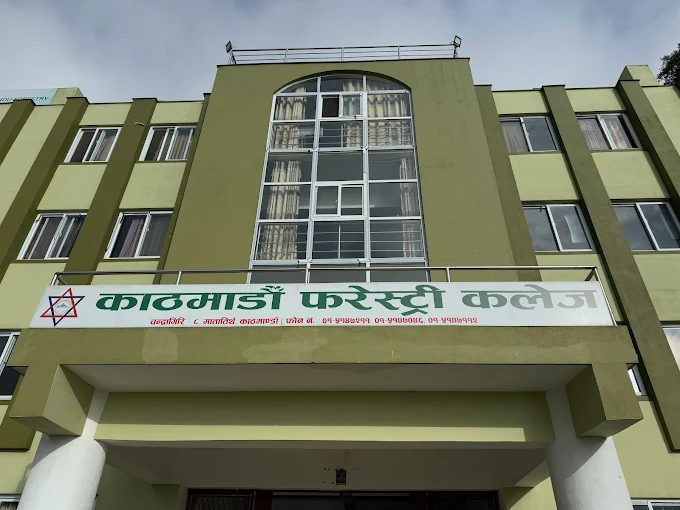
Kathmandu Forestry College (KAFCOL) is located at Chandragiri Municipality-8, Matatirtha, Kathmandu, Nepal. Established in 2005, the college focuses on forestry, natural resources management, geographical information science, and related academic areas. It operates as a public company and runs programs associated with Tribhuvan University and the Council for Technical Education and Vocational Training (CTEVT), along with an international academic collaboration for postgraduate GIS study.
KAFCOL was jointly established by the Nepal Agroforestry Foundation and professionals working in forestry and natural resources management. Its activities include academic programs, research, outreach, training, seminars, and consultancy related to forests, biodiversity, land use, livelihoods, and environmental management.
| Field | Details |
|---|---|
| College Name: | Kathmandu Forestry College (KAFCOL) |
| Established: | 2005 |
| Location: | Chandragiri Municipality-8, Matatirtha, Kathmandu, Nepal |
| Institutional Structure: | Public company |
| Academic Areas: | Forestry, natural resources management, geographical information science and systems |
| Affiliation: | Tribhuvan University and CTEVT for specified programs |
| Other Academic Link: | International collaboration for postgraduate GIS study |
KAFCOL began its academic activities in 2005 with the BSc Forestry program under Tribhuvan University. Its establishment brought together the Nepal Agroforestry Foundation, a national NGO working in agroforestry, and professionals from forestry and natural resources management.
The college later expanded its academic scope. An international partnership initiated in 2012 supported the MSc in UNIGIS Program in Geographical Information Science and Systems. In 2015, KAFCOL introduced the MSc in Natural Resource Management and Rural Development in affiliation with Tribhuvan University.
KAFCOL also runs a Diploma in Forestry under the Council for Technical Education and Vocational Training (CTEVT), Government of Nepal.
Its academic structure covers diploma, bachelor’s, and master’s levels within related areas of forestry, geospatial study, natural resource management, and rural development.
KAFCOL offers four programs across diploma, bachelor’s, and master’s levels.
| Program | Duration | Seats |
|---|---|---|
| BSc Forestry | 4 Years | 50 |
| MSc in Natural Resource Management and Rural Development | 2 Years | 20 |
| MSc in Geographical Information Science and Systems | 2 Years | 25 |
| Diploma in Forestry | 3 Years | 40 |
The BSc Forestry program is affiliated with Tribhuvan University. It has a four-year duration and 50 available seats.
Its academic coverage includes:
Forest ecology
Silviculture
Forest management
Wildlife conservation
Environmental sciences
The program concentrates on knowledge and skills related to forestry, conservation, and forest resource management.
The MSc in Natural Resource Management and Rural Development is a two-year Tribhuvan University-affiliated program with 20 available seats.
Its academic focus includes natural resource management, sustainable development, and rural livelihoods. The program combines theoretical and practical perspectives related to resource management and rural development.
The MSc in Geographical Information Science and Systems has a duration of two years and 25 available seats.
The program covers geographical information systems, spatial data, and remote sensing applications. These areas are connected with forestry and natural resources management, where geospatial information can be applied to the study of land, forests, and other natural resources.
The Diploma in Forestry is a three-year program affiliated with CTEVT and has 40 available seats.
Its subject areas include:
Forest management
Forest inventory
Tree nursery management
Forest protection
The diploma provides technical-level study in forestry and related practical areas.
Research and outreach are part of KAFCOL’s institutional activities. Its work covers biodiversity, forestry, and natural resources management, with attention to environmental and resource-management concerns connected with sustainable development.
The college also links teaching with interdisciplinary and multidisciplinary research and outreach. These activities are intended to contribute knowledge, skills, technologies, and practices related to its academic fields.
Its institutional objectives include developing networks and collaborations with relevant organizations and strengthening institutional capacity.
KAFCOL aims to become a recognized Center of Excellence in education and research related to forestry and natural resources management.
Its vision connects education and research within the same institutional direction, with forestry and natural resources management remaining central academic areas.
KAFCOL’s mission focuses on developing qualified and competent human resources through education, research, training, and outreach.
Its academic direction includes multidisciplinary and transdisciplinary work, particularly in forestry and natural resources management. The mission also connects these areas with sustainable development challenges in Nepal and beyond.
KAFCOL identifies several principles for academic and institutional conduct:
No discrimination based on belief, religion, caste-ethnicity, nationality, or gender.
Respect for inclusion, socio-cultural diversity, and plurality of views in education.
Recognition of merit and competence alongside inclusion and diversity.
Responsiveness to local and global change.
Commitment to environmental concerns and social responsibility.
Maintenance of an apolitical knowledge center.
A people-first approach involving students, faculty, staff, promoters, and the community.
These values place academic participation, diversity, environmental responsibility, and institutional neutrality within the college’s stated operating principles.
KAFCOL’s objectives cover education, research, collaboration, and institutional development.
They include:
Preparing competent human resources in forestry, natural resources management, GI Science, and relevant disciplines through education and research.
Supporting interdisciplinary and multidisciplinary research and outreach connected with teaching.
Developing knowledge, skills, technologies, and practices related to forestry and natural resource management.
Building networks and collaborations with relevant institutions.
Contributing policy feedback through academic and professional engagement.
Strengthening institutional capacity for continued academic and organizational development.
KAFCOL organizes occasional seminars and talk programs involving national and international experts working in fields related to its academic interests.
These programs provide opportunities for discussion beyond regular academic study, particularly on professional, research, environmental, and natural-resource topics associated with forestry education.
Training and consultancy are also part of KAFCOL’s activities. The subjects covered range from forest management and biodiversity to GIS applications, rural livelihoods, agroforestry, climate change, and community forestry.
Areas include:
Biodiversity and ecosystems
Sustainable forest management
Land use and land cover changes
Participatory Action Research and Social Transformation
GIS, GPS, and remote sensing applications in forestry and natural resources management
Non-Timber Forest Products Enterprise and Value Chain Development
Livelihood Improvement and Local Capacity Building
Access and Benefit Sharing from Genetic Resources and Traditional Knowledge
Livelihood Enhancement through Agroforestry Promotion
Participatory Non-Timber Forest Resource Assessment
Climate Change Impacts and Mitigation Strategies
Gender and Social Inclusion in natural resources management
Preparation of Community Forestry Operational Plans addressing second- and third-generation issues
Alternative Energy and Bio-diesel Production
These subjects connect the college’s academic areas with practical work related to forest resources, community-based resource management, rural livelihoods, environmental planning, and geospatial applications.
Scholarship provisions are available within the bachelor’s and diploma programs.
| Scholarship | Program | Provision |
|---|---|---|
| Ministry of Education Scholarship | Bachelor’s | Five eligible students |
| Academic Excellence Scholarship | Bachelor’s | 50% tuition fee waiver for the first-ranked student in every semester |
| Women Topper Scholarship | Bachelor’s | 50% tuition fee waiver for the top-ranking female student in each semester |
| Disadvantaged and Ethnic Group Scholarship | Bachelor’s | 50% tuition fee waiver for the top-ranking eligible student every semester |
| Academic Excellence Scholarship | Diploma | Full scholarship for the first-ranked student in the annual examination |
| CTEVT Scholarship | Diploma | Full scholarships for three students under the Guideline for Scholarship and Admission-2071 |
Students in the Diploma and Bachelor’s programs may also apply for scholarship opportunities offered by national and international institutions.
KAFCOL’s academic activities remain concentrated in closely related fields. Teaching, research, outreach, seminars, and consultancy cover forests, biodiversity, rural livelihoods, geospatial information, agroforestry, and environmental issues.
Its program structure provides several levels of study within these areas:
A Diploma in Forestry at the technical level
A four-year BSc Forestry program
A master’s program in Natural Resource Management and Rural Development
A postgraduate program in Geographical Information Science and Systems
This structure gives students different academic routes within forestry, natural resource management, and related disciplines.
KAFCOL may be relevant to students considering study in forestry, natural resource management, rural development, or geographical information science.
The available academic routes include:
Technical-level forestry study
Bachelor’s-level forestry education
Postgraduate study in natural resource management and rural development
Postgraduate study in geographical information science and systems
The suitable program depends on the student’s intended academic level and subject area.
College: Kathmandu Forestry College
Location: Chandragiri Municipality-8, Matatirtha, Kathmandu, Nepal
Phone: 01-5147211, 9841286201, 9841504771
Website: www.kafcol.edu.np
Kathmandu Forestry College is located at Chandragiri Municipality-8, Matatirtha, Kathmandu, Nepal.
KAFCOL was established in 2005.
KAFCOL offers BSc Forestry and Diploma in Forestry. It also runs postgraduate programs in Natural Resource Management and Rural Development and Geographical Information Science and Systems.
The BSc Forestry program is affiliated with Tribhuvan University.
The BSc Forestry program has a duration of four years and 50 available seats.
Yes. KAFCOL offers a three-year Diploma in Forestry affiliated with CTEVT, with 40 available seats.
The postgraduate programs are MSc in Natural Resource Management and Rural Development and MSc in Geographical Information Science and Systems.
Yes. Scholarship provisions include Ministry of Education scholarships, academic performance-based tuition waivers, scholarships for women and eligible disadvantaged or ethnic-group students, and scholarship provisions for Diploma students.
Its activities include research, outreach, seminars, talk programs, training, and consultancy in forestry, biodiversity, GIS, natural resources management, rural livelihoods, climate change, agroforestry, and related areas.