



Sripatum University (SPU) is a private higher education institution in Thailand. It was established as Sripatum College on 28 May 1970 and became Sripatum University on 6 November 1987. The university’s main campus is the Bangkhen campus in Bangkok, with additional campuses in Chonburi and Khon Kaen.
SPU teaches at undergraduate and graduate levels, including master’s and doctoral study. Its academic scope covers business and accountancy, law, engineering, information technology, communication and digital media, liberal arts, design and architecture, entrepreneurship, logistics and mobility, aviation, tourism and hospitality, international education, and graduate study. Academic activity is organized through faculties, schools and colleges rather than a single organizational model.
Thailand’s Ministry of Higher Education, Science, Research and Innovation (MHESI) lists Sripatum University within the country’s private higher education sector. A Higher Education Commission record also recognizes the university’s academic standing and its authority to conduct instruction and confer degrees at approved levels and in approved fields. This institutional recognition is distinct from professional accreditation or licensing attached to individual qualifications.
| Field | Institutional information |
|---|---|
| Official name | Sripatum University |
| Abbreviation | SPU |
| Country | Thailand |
| Institution type | Private higher education institution |
| Established | 28 May 1970 as Sripatum College |
| University status | 6 November 1987 |
| Main campus | Bangkhen, Bangkok |
| Other campuses | Chonburi and Khon Kaen |
| Academic levels | Undergraduate, master’s and doctoral study |
| Governing body | University Council |
| International academic unit | Sripatum University International College |
| International coordination | Office of International Relations |
| Research and quality unit | Center for Research Support and Education Quality Assurance |
| Official website | https://www.spu.ac.th/ |
Sripatum University operates as a private higher education institution within Thailand’s regulated higher education system. The Office of the Permanent Secretary under MHESI includes the university in its national higher education records, while a separate government record for private institutions identifies SPU as a private institution with its principal site in Bangkok and locations in Chonburi and Khon Kaen.
The MHESI private higher education record gives 28 May 1970 as the institution’s establishment date and identifies Sripatum Education Co., Ltd. as the licensee associated with the university. These records establish SPU’s institutional position within Thailand’s private higher education sector.
A Higher Education Commission resolution on academic standing adds an important distinction for readers outside Thailand. The resolution recognizes Sripatum University under the private higher education system and records its authority to conduct teaching and confer degrees at approved academic levels and in approved fields.
That recognition applies to the university as an institution. It should not be interpreted as evidence that every individual degree carries the same professional accreditation, licensing status or recognition from occupational regulators. Professional recognition depends on the particular qualification, discipline and responsible regulatory body.
The canonical English name is Sripatum University, abbreviated SPU. Some university pages have used alternative English transliterations, but the institutional name used in the MHESI English listing and central university identity is Sripatum University.
Sripatum University began as Sripatum College in 1970. Dr. Sook Pookayaporn founded the institution, and Princess Srinagarindra, the Princess Mother, bestowed the name “Sripatum.” The university associates the name with the idea of knowledge blooming like a lotus, a meaning that remains reflected in its institutional identity.
The college operated under its original status until 6 November 1987. On that date, it became Sripatum University following approval by the Ministry of University Affairs, the Thai government body then responsible for higher education.
Regional expansion developed alongside the change in status. The Chonburi campus was approved in 1987, and its opening ceremony took place on 19 July of that year. Its establishment extended the university’s operations into eastern Thailand.
The Khon Kaen campus followed much later. Its institutional history records the beginning of operations in the 2013 academic year as part of SPU’s expansion into northeastern Thailand.
Academic development also occurred in stages. Law, engineering and business administration were among the earlier academic fields. Liberal arts, accountancy and communication arts were added later, followed by information technology, design and architecture. Subsequent developments incorporated international education, digital media, graduate management, tourism and hospitality, logistics and aviation-related study, and entrepreneurship.
This progression explains the breadth of SPU’s present academic organization. The university developed from a college centered on established professional fields into an institution covering professional, technical, creative, managerial, digital and service-related disciplines.
Central university contact information and institutional policy materials identify three campuses: Bangkhen in Bangkok, Chonburi and Khon Kaen. These locations form SPU’s established campus network.
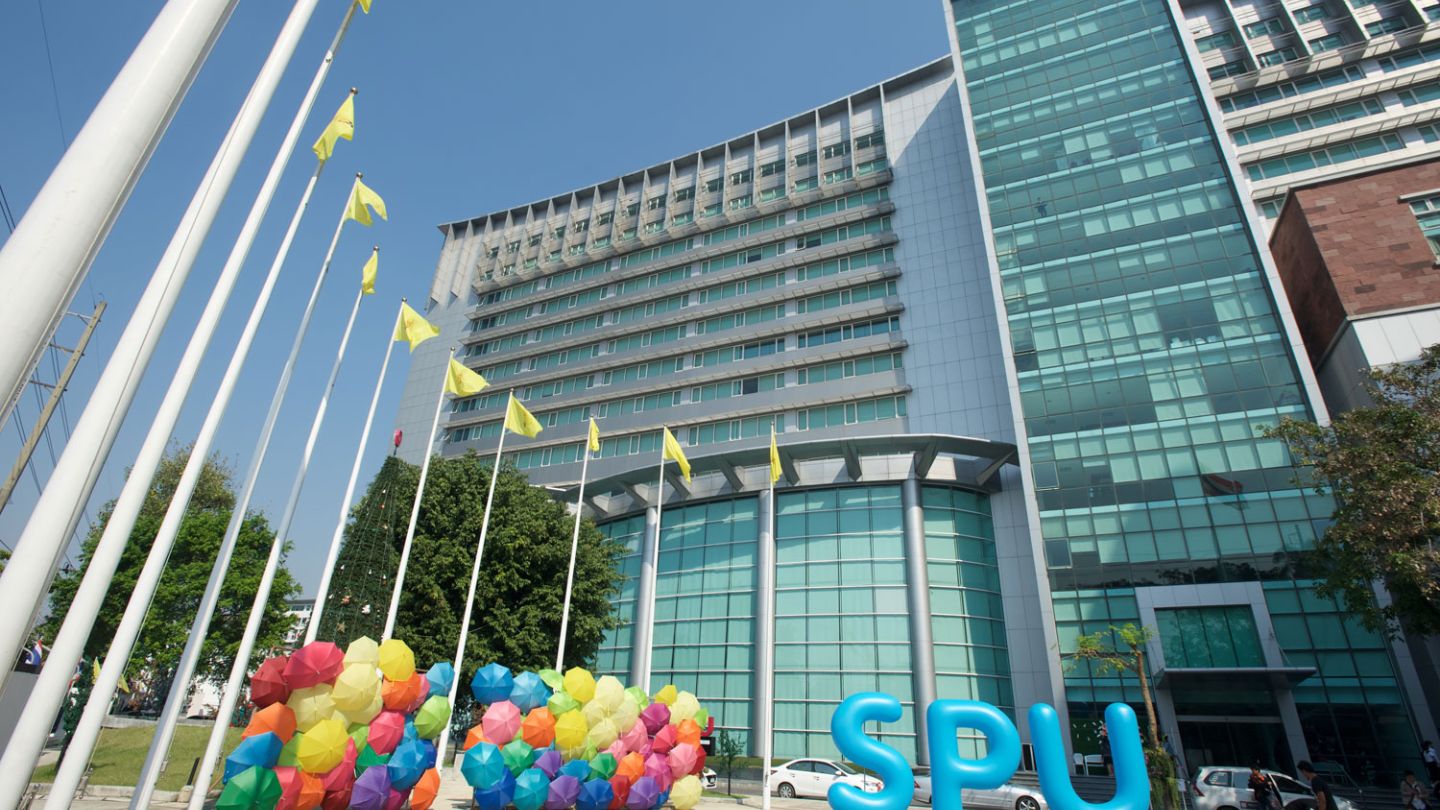
The Bangkhen campus is the university’s main campus and headquarters. Its address is:
2410/2 Phahonyothin Road, Chatuchak District, Bangkok 10900, Thailand.
The campus name and administrative district require some distinction. SPU uses “Bangkhen” as the campus name, while the postal address lies within Chatuchak District.
Central academic and administrative functions are concentrated in Bangkok, together with university-level facilities and services including the library, teaching-development functions, research support, registration, international relations and student services.
The Chonburi campus is located at:
79 Bangna-Trad Road, Khlong Tamhru Subdistrict, Mueang District, Chonburi 20000, Thailand.
Its establishment dates to the university’s expansion in 1987. The campus operates its own academic and administrative functions while remaining part of Sripatum University.
The Khon Kaen campus is located at:
182/12 Moo 4, Si Chan Road, Nai Mueang Subdistrict, Mueang Khon Kaen District, Khon Kaen 40000, Thailand.
The campus began operating in the 2013 academic year. Its organizational functions include academic administration, registration, cooperative education, student affairs and information technology within the wider SPU structure.
Older institutional pages have referred to other locations, including Phyathai. The university’s central contact pages and institutional policy materials identify Bangkhen, Chonburi and Khon Kaen as the present campus structure used for the university as a whole.
Sripatum University operates under a University Council supported by central executive, academic and administrative units. The council structure includes a president, vice president, members and a secretary.
Academic administration is distributed across specialist offices. University-level units include the Academic Affairs Office, Registrar’s Office, Office of International Relations, Finance Office, Scholarship Office, Teaching and Learning Support and Development Center, and Cooperative Education and Career Development Center.
These offices divide responsibility for academic administration, records, financial administration, international coordination, teaching support, student assistance and work-integrated learning.
Educational quality assurance is assigned to the Center for Research Support and Education Quality Assurance. Its responsibilities include internal educational quality processes, internal assessment reporting and the use of quality criteria at program level.
SPU’s administrative model consequently combines University Council oversight, central academic administration, academic-unit management and specialist centers. Individual schools, faculties and colleges manage their academic areas within this wider university structure.
Sripatum University is a multidisciplinary institution. Its central academic navigation covers business administration, accountancy, law, engineering, information technology, communication arts, digital media, liberal arts, design and architecture, entrepreneurship, logistics and mobility, aviation, tourism and hospitality, international education, and graduate study.
The university uses several organizational labels for academic units. Some disciplines are organized as schools or faculties, while others sit within colleges. This mixed structure is part of the institution’s academic organization rather than an indication that all units have identical functions.
SPU teaches at undergraduate level and maintains graduate education encompassing master’s and doctoral study. Postgraduate activity is organized through graduate structures and specialist academic units according to the discipline.
The academic areas also reflect different stages of the university’s development. Established professional subjects such as business, law, accountancy and engineering sit alongside information technology, digital media, communication, design, logistics, hospitality and entrepreneurship.
Sripatum University International College (SPUIC) is part of this academic structure. It is an academic unit within SPU, not an alternative name for the university. The distinction is important because academic arrangements, student information and administrative procedures associated specifically with SPUIC do not automatically apply to every faculty or school at Sripatum University.
The same principle applies across the campus network. The existence of a field within the university does not establish that every program in that field is delivered at every SPU campus. Academic delivery is managed by the relevant unit and location.
SPU maintains a university-level Teaching and Learning Support and Development Center. The center was established with University Council approval in 2010 to support teaching across faculties.
Its work includes academic staff development, teaching methods, assessment practices, active-learning methods, teaching-and-learning research, and the preparation of instructional materials. Lecturer training, seminars and forums also form part of its academic support role.
The center gives SPU a dedicated structure for teaching development beyond the work carried out within individual faculties. It also supports research related to teaching practice and the preparation of textbooks and other instructional resources.
Applied and workplace learning is administered through a separate unit, the Cooperative Education and Career Development Center. Cooperative and work-integrated education links academic study with supervised experience in workplaces and organizations for relevant students and programs.
The center also handles career preparation and employer coordination. These functions establish an institutional route for workplace exposure without implying a universal employment outcome or a guaranteed placement after graduation.
The balance between classroom study and practical work differs by discipline. Engineering, information technology, communication, digital media, design and aviation-related fields do not share one uniform teaching arrangement. Laboratory work, studio activity, projects, placements and other practical elements depend on the academic unit and program concerned.
Electronic academic systems complement campus-based teaching and administration. University services include e-learning, student-management functions and access to digital library resources.
Research support at Sripatum University is organized through the Center for Research Support and Education Quality Assurance.
The center works with academic staff on research development, research production, dissemination of scholarly work, research information services and academic networks. It also supports faculty members in areas connected with academic-position development.
Operational responsibilities include researcher training, coordination of applications for external research funding, monitoring of externally funded projects, assistance with publication and conference participation, management of university academic conferences, and maintenance of research-related information systems.
This central structure means that research administration is not confined to individual faculties. University-level mechanisms exist for research support, coordination and dissemination.
SPU also maintains academic conference activity through its research-support functions. These conferences serve as channels for presenting research, academic exchange and institutional cooperation.
Research dissemination is supported further through the university library and the SPU Institutional Repository, which stores academic work produced within the institution.
Quality assurance and research support sit within the same administrative center. The quality-assurance function includes internal processes and program-level criteria, while the research function handles scholarly development and research administration. These are related institutional responsibilities but should not be treated as equivalent to external professional accreditation.
Sripatum University’s central library is located in Building 11 at the Bangkok campus and occupies multiple floors. Its academic role extends beyond physical collections.
Library services include printed resources, electronic resources, research assistance, online discovery tools, resource-recommendation services and access to the institutional repository.
The Research Support Service is available to undergraduate, master’s and doctoral students as well as faculty members and staff. It assists users in locating academic information relevant to research topics and in working with electronic resources.
The library also maintains access to subscribed and open-access databases. Available resource categories include multidisciplinary materials as well as specialist sources covering areas such as science and technology and law. Its electronic collections also include books, journals, theses and open scholarly resources.
SPU-IR, the university’s institutional repository, preserves academic work produced by faculty members, students and researchers. Its collections include research papers, scholarly articles, theses, independent studies, textbooks and teaching materials.
The repository gives researchers and other readers direct access to part of SPU’s scholarly output. Together with research assistance and electronic databases, it forms an important part of the university’s academic information system.
University-level academic infrastructure includes teaching spaces, faculty facilities, the central library, electronic databases, research-support services, the institutional repository, e-learning systems, student-management systems, teaching-development support and cooperative-education services.
Specialist academic facilities are organized according to discipline rather than through a single university-wide specification. Engineering, digital media, communication, design, information technology and aviation-related study each have different practical requirements.
For that reason, facilities associated with laboratories, studios, projects or practical training are best understood at the level of the relevant academic unit. SPU’s central infrastructure is more clearly defined through university-wide services such as the library, research center, teaching center, registration systems and electronic academic services.
Digital resources connect several parts of this infrastructure. Library databases and SPU-IR support study and research, while e-learning and student-management systems support teaching and academic administration.
The Cooperative Education and Career Development Center is SPU’s dedicated unit for workplace learning and career-related support.
Its responsibilities include cooperative education, internships, student preparation, employer coordination and career-development activities. In relevant academic arrangements, students can undertake structured workplace experience while remaining enrolled in their university studies.
This function links academic programs with supervised experience outside the classroom. It also gives faculties and students a central university office through which cooperative education and workplace coordination can be administered.
The existence of this center does not establish a single employment rate, graduate salary figure or guaranteed job outcome for the university. Its institutional significance lies in the formal structure SPU maintains for cooperative education, internship coordination and career preparation.
Sripatum University organizes international activity through two distinct structures: the Office of International Relations and Sripatum University International College.
The Office of International Relations serves as the university’s central liaison for international academic relationships. Its work includes international information services, academic cooperation, visiting delegations, international documentation, student and staff mobility, exchange activity, overseas internships and study-abroad coordination.
The office also supports incoming international and exchange students. University support includes assistance with matters connected with international student administration and documentation. Decisions concerning immigration status remain the responsibility of the relevant government authorities.
International activity at SPU consequently extends beyond English-medium academic study. It includes institutional relationships, mobility programs, exchanges, overseas internships, visiting programs and liaison with organizations outside Thailand.
Sripatum University International College has a separate academic role. SPUIC belongs to Sripatum University but maintains its own academic and student-information channels. International College policies or program arrangements should not be generalized to other SPU faculties unless the university applies them more broadly.
This distinction is particularly important for global readers. The Office of International Relations coordinates international engagement at university level, while SPUIC functions as an academic unit within the institution.
SPU distributes student support across specialist offices rather than placing every function under one unit.
Student-service structures cover student affairs, activities and clubs, registration, accident-insurance administration, international-student support and counseling. Academic records are handled through the Registrar’s Office, while international students have access to the Office of International Relations.
The Wellness Counseling Center assists students with academic, personal and social concerns. Its service areas include study planning, academic difficulties, personal adjustment, relationships and mental-health concerns.
Student affairs also manages organized activities and clubs, giving students channels for participation beyond formal academic work.
Career and workplace preparation is handled through the Cooperative Education and Career Development Center. Teaching support is administered separately through the Teaching and Learning Support and Development Center. This distribution of responsibilities reflects SPU’s use of specialist offices for different parts of the student and academic experience.
The Office of International Relations maintains accommodation guidance for international students studying at the Bangkok campus.
The guidance includes examples of privately operated residences near the university. These residences should not be treated as university-owned halls merely because they appear in SPU accommodation information.
The institutional role is one of guidance: the international office helps students identify nearby accommodation options while the listed private residences remain separate from university ownership.
The name “Sripatum” has been part of the institution since its founding period. Princess Srinagarindra bestowed the name, and the university associates it with knowledge blooming like a lotus.
The lotus also appears in the university’s visual identity. The Chonburi institutional history records a lotus within a hexagonal form as part of the university emblem and identifies blue and pink as institutional colors.
SPU’s historical educational philosophy expresses the idea that education develops people who contribute to the nation. It is best understood as part of the university’s institutional identity rather than as evidence of a particular student or graduate outcome.
More concrete institutional characteristics are visible in the university’s organization: a regulated private higher education status, a three-campus structure, undergraduate and postgraduate education, a mixed system of faculties, schools and colleges, central research and teaching-support units, an institutional repository, cooperative education, international relations and distributed student services.
The university’s academic scope has also broadened substantially since its establishment as Sripatum College. Earlier professional disciplines were joined over time by information technology, creative fields, international education, digital media, logistics, hospitality, aviation-related study and entrepreneurship. That development accounts for the combination of established professional areas and newer applied disciplines found across SPU today.
Sripatum University (SPU) is a private higher education institution in Thailand. It is listed within Thailand’s private higher education sector by the Ministry of Higher Education, Science, Research and Innovation (MHESI).
Sripatum University was established on 28 May 1970 as Sripatum College. It received university status on 6 November 1987 following approval by the Ministry of University Affairs, the government body responsible for higher education at that time.
The university’s main campus is the Bangkhen campus at 2410/2 Phahonyothin Road, Chatuchak District, Bangkok 10900. Sripatum University also operates campuses in Chonburi and Khon Kaen.
Yes. Sripatum University is listed by Thailand’s Ministry of Higher Education, Science, Research and Innovation as a private higher education institution. A Higher Education Commission record also recognizes its authority to conduct instruction and confer degrees at approved academic levels and in approved fields. Professional accreditation or licensing for an individual qualification depends on the relevant program and regulatory body.
Sripatum University provides undergraduate and graduate education, including master’s and doctoral study. Its academic areas include business, accountancy, law, engineering, information technology, communication, digital media, liberal arts, design and architecture, entrepreneurship, logistics, aviation, tourism and hospitality, and international education.
Sripatum University International College (SPUIC) is an academic unit within Sripatum University. It should not be treated as another name for the university as a whole. Academic arrangements and student information specific to SPUIC apply to that unit unless SPU states that they apply more broadly.
Yes. Research support is organized through the Center for Research Support and Education Quality Assurance. Its functions include researcher development, research administration, external funding coordination, publication and conference support, academic networking and research information services. The university also maintains the SPU Institutional Repository for scholarly works such as research papers, articles, theses and teaching materials.
The university’s central library at the Bangkok campus provides physical and electronic academic resources, research assistance, database access, online discovery services and access to the SPU Institutional Repository. Its Research Support Service assists students, faculty members and staff in locating and using academic information.
Yes. The Cooperative Education and Career Development Center coordinates cooperative education, internships, student preparation, employer engagement and career-development activities. These services provide structured support for workplace learning and career preparation without representing a guarantee of employment.
The Office of International Relations coordinates international academic cooperation, student and staff mobility, exchange activity, visiting programs, overseas internships, study-abroad coordination and support for incoming international students. It also provides guidance related to international student administration and accommodation near the Bangkok campus.
Yes. Student support is distributed across several university offices. The Wellness Counseling Center assists students with academic, personal and social concerns, while other units handle registration, student activities, international support, cooperative education and career development.
The Office of International Relations provides accommodation guidance for international students studying at the Bangkok campus and identifies nearby privately operated residences. These residences should not be treated as university-owned housing unless explicitly identified as such by the university.
