



The University of Sunderland is an English higher education institution with roots in the School of Science and Art founded in Sunderland in 1860. Its later development included Sunderland Technical College, Sunderland Polytechnic and, from 1992, the University of Sunderland with authority to award its own degrees. Legally, it is a Higher Education Corporation and an exempt charity.
The University operates City Campus and the Sir Tom Cowie Campus at St Peter’s in Sunderland, with additional University campuses in London and Hong Kong. Its academic activity spans undergraduate, taught postgraduate and research degrees, as well as continuing professional development, online and distance study, and approved provision delivered through academic partners. Teaching and research cover business and law, computing and engineering, arts and media, education and social sciences, sport and tourism, medicine, pharmacy and a range of health-related disciplines.
| Institutional area | Verified detail |
|---|---|
| Official name | University of Sunderland |
| Legal form | Higher Education Corporation |
| Provider Register Number | 10007159 |
| Institutional roots | School of Science and Art founded in 1860 |
| Technical college development | Sunderland Technical College opened in 1901 |
| Polytechnic phase | Sunderland Polytechnic established in 1969 |
| Higher Education Corporation status | Formally established in 1988 |
| University status | University title and degree-awarding authority took effect in 1992 |
| Charitable status | Exempt charity under the Charities Act 2011 |
| Sunderland campuses | City Campus; Sir Tom Cowie Campus at St Peter’s |
| Other University campuses | London; Hong Kong |
| Corporate oversight | Board of Governors |
| Senior academic governance | Academic Board |
| Academic provision | Undergraduate, taught postgraduate and research degrees |
| Other study routes | Short courses, continuing professional development, online, distance and partner provision |
University of Sunderland is the institution’s legal title. It is constituted as a Higher Education Corporation, a form established through changes to higher education under the Education Reform Act 1988. Sunderland Polytechnic became formally established as a Higher Education Corporation on 21 November 1988.
Its Provider Register Number is 10007159. The University is not a private company and is not registered as a company. It is also an exempt charity under the Charities Act 2011. Members of the Board of Governors act as trustees for charity-law purposes.
The University’s authority to award degrees has a separate statutory history. The Privy Council agreed by Order in Council on 4 June 1992 that Sunderland Polytechnic could award degrees. A Privy Council letter dated 16 June 1992 approved the University of Sunderland name, with the change taking effect on 1 September 1992.
These points establish the basis of the University’s institutional recognition: it has a defined legal identity, formal corporate status and authority to award higher education qualifications. That institutional authority should be kept separate from professional accreditation attached to individual programmes.
The University’s development is better understood as a sequence of institutional changes than through a single founding date.
Its earliest documented roots are in the School of Science and Art, founded in Sunderland in 1860. A later stage began with plans for a technical college, approved in 1894. A site on Green Terrace was purchased in 1896, and Sunderland Technical College opened in 1901.
The technical college taught chemistry, mechanical and civil engineering, electrical engineering and physics. Commerce, languages and other subjects were also taught. This early academic mix connected the institution with scientific, technical and commercial education while giving it a wider academic base than a single-purpose technical school.
Sunderland Polytechnic was established in 1969. The change reflected a new institutional phase in which technical and professional higher education was brought together within the polytechnic model.
Higher education reforms in the late 1980s changed the institution’s legal status. Sunderland Polytechnic became a Higher Education Corporation in 1988. Four years later, the Privy Council approved its degree-awarding powers and the University of Sunderland title.
The main stages can be read clearly as educational roots in 1860, the opening of Sunderland Technical College in 1901, establishment of Sunderland Polytechnic in 1969, Higher Education Corporation status in 1988, and university title and degree-awarding authority in 1992. Each date marks a different part of the institution’s development.
The University has four identified University campuses: two in Sunderland, one in London and one in Hong Kong. These campuses form part of the University itself and should not be confused with colleges and other institutions that deliver Sunderland-linked qualifications through partnership arrangements.
City Campus is centred on the Edinburgh Building on Chester Road, Sunderland, SR1 3SD. The Edinburgh Building is also the University’s formal head-office address for legal notices and correspondence.
Academic activity at City Campus includes substantial health, science, art, design and performance provision. University information also places student-support and sport facilities at this location.
The campus contains different teaching and support spaces, but the location of an individual programme should be treated as a course-specific matter. A student enrolled at the University should not assume that all Sunderland-based teaching takes place at City Campus.
The Sir Tom Cowie Campus at St Peter’s is located on St Peter’s Way, Sunderland, SR6 0DD, beside the River Wear.
Subjects associated with the campus include business, law, tourism, education, social sciences, computing, engineering, film and media, together with some art and design activity.
Named academic facilities include the David Puttnam Media Centre, the Northern Centre of Photography and the David Goldman Technology Centre. These spaces connect parts of the St Peter’s campus with media production, photography, computing and engineering teaching.
As with City Campus, an individual student’s teaching location depends on the programme rather than on a general institutional division between the two Sunderland sites.
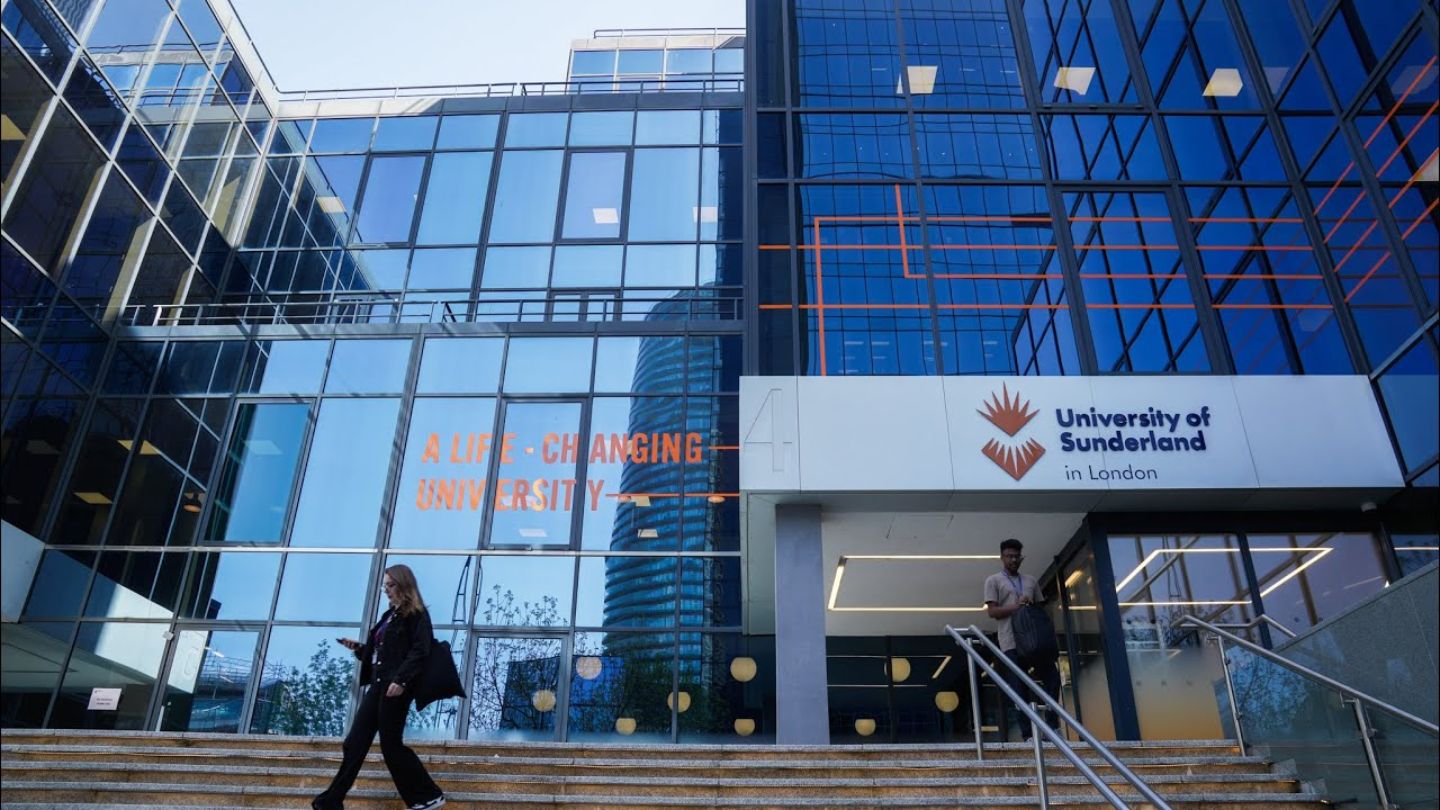
University of Sunderland in London is located at 4 Harbour Exchange Square, London E14 9GE, near Canary Wharf.
It is a campus of the University of Sunderland rather than a separate university. Areas of study associated with London include business, finance, hospitality, tourism and health-related subjects.
Programme availability at the London campus is distinct from the academic provision in Sunderland. The existence of a course or subject at one University campus should not be treated as evidence that the same provision is available at another.
University of Sunderland in Hong Kong is based at 1/F, Centre Point, 181–185 Gloucester Road, Wan Chai, Hong Kong.
Hong Kong is also identified as a University campus rather than a partner study centre. Its programmes and local study arrangements are specific to that campus.
The University’s physical presence in Sunderland, London and Hong Kong sits alongside a separate network of academic partners. Maintaining that distinction is necessary because campus ownership, teaching responsibility and access to services can differ between University campuses and partner-delivered study.
The University teaches across a wide range of academic and professional disciplines. Its subject provision includes accounting and finance, art and design, biological sciences, business and management, computer science, education and teacher training, engineering, English, events, film and media, journalism, law, medicine, nursing and midwifery, occupational therapy, paramedic science, performance, pharmaceutical and cosmetic sciences, pharmacy, physiotherapy, policing and investigation, psychology, public health, social sciences, sport and exercise sciences, tourism and hospitality, and dental education.
The subject range can be grouped more simply into business and law; computing and engineering; arts, media and performance; education and social sciences; sport and tourism; and medicine, pharmacy and allied health fields.
Academic provision includes undergraduate degrees, taught postgraduate qualifications and research degrees. Short courses and continuing professional development form another part of the University’s educational activity. Selected study is also delivered online, at a distance or through academic partners.
A subject being present within the University does not establish that every related qualification is offered at every campus, at every level or in every study mode. The formal details of an award sit at programme level.
Programme specifications play a central role in this process. They record the approved structure of individual programmes and are used for programme approval, monitoring and review. They can set out modules, learning outcomes, assessment arrangements and other formal elements of an award.
The University separates corporate oversight from senior academic governance.
The Board of Governors holds corporate responsibility. Its duties include setting the strategic direction of the University, protecting its educational character and mission, overseeing institutional activity, managing stewardship of resources and assets, approving financial estimates and carrying defined responsibilities concerning senior posts.
The Board consists mainly of independent members, together with staff and student representatives and other membership established through the University’s governance arrangements.
The Vice-Chancellor and Chief Executive is responsible for institutional leadership and management and for carrying out decisions of the Board of Governors.
Academic authority is centred on the Academic Board. It is the University’s most senior academic governance body and acts under authority delegated by the Board of Governors. Its remit includes education, teaching and learning, student experience, academic standards, research and innovation, and assurance of the standards attached to University awards.
This separation gives the University two connected lines of responsibility. The Board of Governors carries corporate accountability, while the Academic Board exercises senior academic authority over regulation, policy and standards.
Programme approval, monitoring and review sit within these formal arrangements rather than being determined independently by individual courses. Programme specifications provide the course-level record of approved academic design, while the Academic Board holds senior institutional responsibility for academic matters.
The University’s range of disciplines means that teaching cannot be reduced to one method. Its provision includes classroom teaching, laboratory work, studio-based study, clinical and professionally oriented education, research supervision, online study and distance delivery.
Teaching methods also vary by programme and location. Placements, professional practice, clinical activity and practical training apply to particular awards rather than to every student.
Programme specifications provide a more precise account of how an individual award is organised. Alongside course information, they can identify modules, learning outcomes, assessment arrangements, placement elements and professional requirements.
The physical estate reflects this variation. Teaching spaces include lecture theatres and seminar rooms as well as laboratories and studios. City Campus supports health and science teaching alongside art and design activity, while the St Peter’s campus includes specialist facilities connected with media, photography, computing and engineering.
The existence of these resources indicates the types of teaching supported at particular locations. It does not mean that every facility is used by every programme or that all students have the same pattern of study.
Research forms part of the University’s academic activity alongside taught education.
The University organises research through dedicated research institutes, the Graduate School and research-governance support. Identified areas include nursing and care, economic and social inclusion, drug discovery and development, and ophthalmic research and innovation.
These research structures indicate areas in which the University has organised specialist research activity. They are distinct from the broader list of subjects taught through undergraduate and postgraduate courses.
The Graduate School coordinates postgraduate research provision. Research-degree routes include Doctor of Philosophy (PhD), Master of Philosophy (MPhil), and PhD by Existing Published or Creative Work.
Admission to a research degree differs from entry to a taught postgraduate course. A proposed research project depends on a suitable research proposal, appropriate supervisory expertise and the University’s research-degree procedures. The presence of a related taught subject does not establish that supervision is available for every proposed research topic.
Research governance also involves the University Research Office, which covers research governance, integrity and institutional support. Research and innovation sit within the Academic Board’s remit, linking research activity with the University’s senior academic governance arrangements.
Library provision includes physical collections, digital resources, study spaces and IT facilities. Resources are distributed across University locations rather than being concentrated in a single library building.
On the Sunderland campuses, print collections are allocated according to subject needs. Students can also use study areas, IT facilities, bookable rooms, booths and pods.
University students are enrolled as Library members, although access to particular physical resources depends on study location and study mode. Students studying through overseas partners, at a distance or online do not necessarily use the same facilities as students based in Sunderland.
Academic support extends beyond access to library materials. Personal Academic Tutors provide a course-related point of contact, while the Student Success and Transition team supports students as they enter and progress through university study.
Study support also covers areas such as academic writing, critical thinking, literature searching, referencing, dissertation work and digital skills. These services sit alongside the academic teaching provided within individual programmes.
The University’s facilities are connected to the academic activity based at each campus.
At St Peter’s, the David Puttnam Media Centre supports media-related activity, the Northern Centre of Photography is associated with photography provision, and the David Goldman Technology Centre is linked with computing and engineering.
City Campus houses health and science provision as well as art, design and performance activity. Student-support and sport facilities are also located there.
Across the teaching estate, laboratories, studios, lecture theatres and seminar rooms support different forms of study. The presence of a specialist space should be understood in relation to its subject and campus rather than treated as a University-wide facility available through every programme.
Student support is divided across academic, practical, wellbeing and specialist services.
Student Enquiries acts as an initial point of contact for many practical matters. Academic support is provided through Personal Academic Tutors, transition support, library services and IT assistance.
Specialist disability support includes Student Support Plans, reasonable adjustments to teaching and learning, examination accommodations, support with Disabled Students’ Allowance applications, screening for specific learning differences, specialist study-skills support and referrals to other services.
Individual arrangements depend on a student’s circumstances and the applicable process. The existence of a support service does not establish that every request produces the same adjustment or outcome.
Student representation also forms part of institutional governance. Student representatives are included within the membership of the Board of Governors. The Students’ Union provides additional routes for peer and academic support.
Career-related assistance is provided through the Employability and Enterprise Hub. Its services include CV guidance, job-search support, placement preparation and enterprise assistance. These services support career planning and preparation; they do not constitute a guarantee of employment, placement or a particular graduate outcome.
The University’s international activity takes several forms and these should be distinguished carefully.
London and Hong Kong are University campuses. Academic partners, by contrast, are separate colleges, universities or study centres working with Sunderland through approved collaborative arrangements. The University also supports students studying online or at a distance.
Partner teaching can involve content designed and developed by the University. Some programmes can also be created by a partner and approved by the University. Approved arrangements may lead to University of Sunderland qualifications.
Applications to partner study centres are handled through the relevant centre. A student studying through a partner is not studying at City Campus, St Peter’s, London or Hong Kong simply because the qualification has a Sunderland relationship.
Library arrangements illustrate this distinction. Students at overseas partner centres can receive support from both the University and the partner’s library provision. Independent distance learners use University online services and off-campus support, while online students use support arrangements intended for remote study.
Using the term “campus” only for the University’s identified campuses prevents academic collaboration from being confused with institutional ownership or direct campus delivery.
The University provides managed accommodation arrangements for students studying in Sunderland and also provides information about private-sector alternatives.
Accommodation should be treated as location-specific. Housing arrangements connected with study in Sunderland do not automatically apply to students at the London or Hong Kong campuses or to students enrolled through academic partners.
The same principle applies to campus living more generally. Teaching spaces, libraries, specialist resources, support facilities and local services differ according to where and how a student studies.
The University does not have one entry requirement that can accurately represent every programme.
Admission conditions can differ by qualification level, academic background, programme, professional requirements, campus and study mode. English-language evidence can also vary, particularly where a course is linked to professional or regulatory requirements.
Applicants need to identify the exact award and study location before assessing entry conditions. Relevant requirements can include previous academic qualifications, English-language evidence, interviews, portfolios, professional conditions and placement or practice requirements.
Research-degree applicants have an additional consideration: the proposed topic needs appropriate supervisory expertise and must follow the University’s research-degree process.
Partner-delivered study also requires attention to the relationship between the partner institution and the University. The application route and teaching organisation may differ from those for students enrolling at one of the University’s own campuses.
The University’s institutional recognition rests on its legal and regulatory position. University of Sunderland is its legal title, it is constituted as a Higher Education Corporation, and it has authority to award degrees. It also operates as an exempt charity within the English higher education system.
Professional accreditation is a separate matter. It can apply to an individual programme, pathway, campus, mode of delivery or defined approval period.
This distinction is especially relevant in medicine, nursing, midwifery, pharmacy, physiotherapy, occupational therapy, paramedic science, teacher training and other areas where professional or statutory bodies can set additional requirements.
The University’s degree-awarding authority does not establish that every programme holds a particular professional accreditation. It also does not by itself determine whether a qualification gives access to professional registration or licensing in another country.
For students considering a regulated profession, institutional status and programme-specific professional recognition are two different questions and need to be assessed separately.
The University of Sunderland has developed through several distinct phases of higher education in Sunderland: nineteenth-century science and art education, the technical college period, the polytechnic era and university status from 1992.
Its legal identity, governance arrangements and degree-awarding authority define it as an established higher education corporation with its own academic responsibilities. The Board of Governors holds corporate responsibility, while the Academic Board oversees senior academic regulation, policy and standards.
The University combines teaching across technical, professional, creative, social science, business and health disciplines with research activity, postgraduate research supervision, libraries, specialist teaching facilities and student-support services.
Its operations extend beyond Sunderland through University campuses in London and Hong Kong, academic partnerships, distance learning and online study. These routes belong to the same institution but differ in location, delivery and access to campus-based services.
Understanding those distinctions is central to understanding the University itself. Its institutional status is common across the University, while programme structure, teaching location, admission conditions, professional recognition and access to particular facilities depend on the specific course and mode of study.
The University of Sunderland is an English higher education institution with roots in the School of Science and Art founded in Sunderland in 1860. It later developed through Sunderland Technical College and Sunderland Polytechnic before gaining university title and degree-awarding authority in 1992.
Yes. The University is legally constituted as a Higher Education Corporation and has authority to award degrees. It is also an exempt charity under the Charities Act 2011. Professional accreditation for individual courses is separate from the University’s institutional status and applies only where a specific programme has the relevant approval.
The University has two campuses in Sunderland: City Campus and the Sir Tom Cowie Campus at St Peter’s. It also operates University campuses in London and Hong Kong. These campuses are distinct from partner institutions that deliver Sunderland-linked programmes through approved academic arrangements.
The University teaches across areas including business and management, accounting and finance, law, computing, engineering, art and design, film and media, education, social sciences, medicine, nursing and midwifery, pharmacy, psychology, public health, sport, tourism and other health-related disciplines. Subject and programme availability varies by campus and study level.
Academic provision includes undergraduate degrees, taught postgraduate qualifications and research degrees. The University also provides short courses, continuing professional development, and selected online, distance and partner-delivered study.
Yes. Sunderland Polytechnic received degree-awarding authority in 1992, before the University of Sunderland name took effect on 1 September 1992. The University therefore awards qualifications under its own degree-awarding powers.
Corporate oversight is carried out by the Board of Governors. Senior academic governance is handled by the Academic Board, whose responsibilities include academic standards, teaching and learning, student experience, research and innovation, and academic policy.
Yes. Research-degree provision is coordinated through the Graduate School. Available research routes include Doctor of Philosophy (PhD), Master of Philosophy (MPhil), and PhD by Existing Published or Creative Work. Admission depends on factors including the proposed research topic, supervisory expertise and the University’s research-degree procedures.
Support includes library services, digital resources, study spaces, Personal Academic Tutors, transition support, academic writing assistance, critical thinking support, literature searching, referencing, dissertation guidance and digital-skills development. Access to physical facilities depends on a student’s campus and mode of study.
Student support covers practical enquiries, academic guidance, wellbeing and specialist services. Disability support can include Student Support Plans, reasonable adjustments, examination accommodations, support with Disabled Students’ Allowance applications, screening for specific learning differences and specialist study-skills support.
Yes. The Employability and Enterprise Hub provides services such as CV guidance, job-search support, placement preparation and enterprise assistance. These services are intended to support career planning and preparation rather than guarantee employment or placement outcomes.
Yes. In addition to its campuses in London and Hong Kong, the University works with academic partners that deliver approved Sunderland-linked provision. It also supports online and distance study. Partner institutions are separate from University campuses, and teaching arrangements and access to services can differ.
No. Entry requirements vary by programme, qualification level, academic background, campus, study mode and, where relevant, professional requirements. Some courses may also have additional conditions involving English-language evidence, interviews, portfolios, placements or professional practice.
No. The University’s institutional recognition comes from its legal status and degree-awarding authority. Professional accreditation applies to particular programmes and may depend on the course, pathway, campus, mode of delivery or approval period.
