




Branding in education is not limited to a logo, colour palette, or slogan. It includes how a school or college explains its purpose, communicates with its community, presents information, and delivers on its stated values.
When these elements are consistent, students, families, staff, and partners can understand what the institution represents. When they are not, polished design alone cannot create credibility.
Table of Content
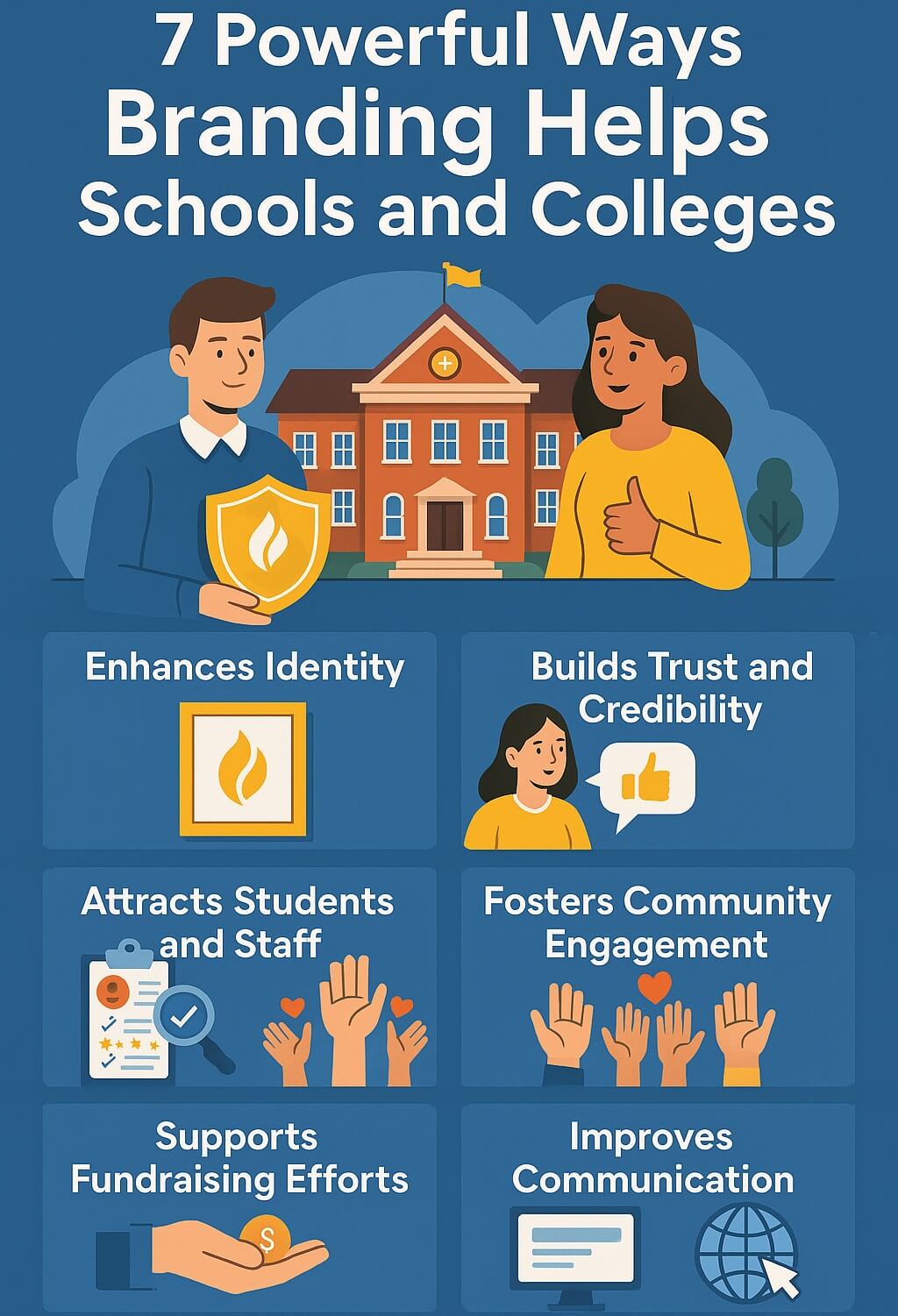
- 1. Creates a Clear Institutional Identity
- 2. Helps Students and Staff Assess Institutional Fit
- 3. Builds Confidence Through Consistent Communication
- 4. Strengthens Belonging and School Culture
- 5. Makes Everyday Communication Easier to Recognise
- 6. Supports Fundraising and Institutional Partnerships
- 7. Creates a More Credible Digital Presence
- Branding Must Reflect the Institution
1. Creates a Clear Institutional Identity
A consistent identity makes a school or college easier to recognise across its website, prospectus, social media pages, campus signage, uniforms, identification cards, forms, and official notices.
Visual elements such as logos, colours, typography, and photography should follow clear standards. However, institutional identity also needs to communicate the school’s purpose, educational priorities, values, and approach to teaching.
Design supports this message, but it should never replace accurate and meaningful information.
2. Helps Students and Staff Assess Institutional Fit
Prospective students and families usually consider several factors before choosing an institution, including academic programmes, teaching methods, student support, location, fees, extracurricular opportunities, and campus culture.
Consistent branding brings this information together in a clear and understandable way. Instead of relying on broad slogans, an institution can explain its academic approach, expectations, facilities, support services, and admissions process in specific terms.
The same principle applies to staff recruitment. Clear communication about workplace culture, professional expectations, and institutional priorities can help applicants decide whether the organisation is suitable for them.
Branding cannot guarantee enrolment or recruitment, but it can help people make better-informed decisions.
3. Builds Confidence Through Consistent Communication
Parents and other stakeholders notice when information is outdated, contradictory, or difficult to understand. Different course names across pages, incorrect contact details, and poorly structured notices can quickly reduce confidence.
Brand guidelines help institutions maintain consistent names, terminology, contact information, formatting, and tone across communication channels.
Trust, however, depends on more than presentation. It develops through accurate information, timely responses, responsible leadership, and follow-through. Clear communication can also support parental involvement in education by making expectations, activities, and opportunities easier for families to understand.
4. Strengthens Belonging and School Culture
A shared visual identity can help students, staff, and alumni feel connected to an institution. House colours, sports uniforms, event materials, publications, awards, and ceremonies can provide familiar symbols that represent the wider community.
Belonging cannot be created through merchandise or design alone. It develops when the institution’s stated values are reflected in its decisions, behaviour, student support, and everyday interactions.
Branding therefore works best alongside practical strategies for building a positive school culture, including respectful communication, consistent expectations, inclusion, recognition, and shared responsibility.
5. Makes Everyday Communication Easier to Recognise
Schools and colleges regularly publish newsletters, examination notices, event announcements, reports, presentations, emergency updates, and social media posts. Standard templates can make these materials easier to prepare and recognise.
Consistent formatting also helps readers identify whether a message comes from an official source. This can reduce confusion when information is shared across several platforms.
Effective brand standards should support accessibility as well as appearance. Institutions should use readable fonts, suitable colour contrast, descriptive headings, plain language, and mobile-friendly layouts. Important information should remain understandable even when visual elements are removed.
6. Supports Fundraising and Institutional Partnerships
Donors, alumni, community organisations, government bodies, and other potential partners need to understand an institution’s purpose, needs, governance, and proposed use of support.
Clear project summaries, annual reports, funding proposals, and impact updates can make this information easier to assess. Consistent branding gives these materials a coherent structure and helps readers connect them with the institution.
Presentation alone does not establish credibility. Funding and partnership materials should include accurate objectives, realistic plans, transparent financial information, measurable outcomes, and clear accountability. Unsupported rankings, exaggerated success claims, and vague statements about impact should be avoided.
7. Creates a More Credible Digital Presence
A website, search result, or social media page may be a family’s first contact with a school or college. Consistent branding helps visitors recognise official channels and understand how different digital platforms relate to the same institution.
The website should make essential information easy to locate, including academic programmes, admissions procedures, contact details, policies, student services, campus updates, and the date on which important information was last reviewed.
Institutions should use authentic photographs with appropriate permission. Stock images, illustrations, or AI-generated visuals should not be presented as genuine photographs of a campus, classroom, event, or student group.
Schools and colleges should also manage their digital footprint and online reputation by reviewing outdated pages, correcting inaccurate information, monitoring unofficial accounts, and responding professionally to legitimate concerns.
Branding Must Reflect the Institution
Branding can improve recognition, communication, belonging, and public understanding, but it cannot replace educational quality, effective leadership, student welfare, or reliable information.
A credible brand develops when the institution’s public statements match the experience of its students, families, staff, and wider community.
Schools and colleges do not need an elaborate identity system to begin. They need a clear purpose, accurate information, consistent communication standards, and a responsible process for reviewing what they publish. Over time, that consistency becomes part of the institution’s reputation.






Comments 0
No comments yet. Be the first to start the conversation.