



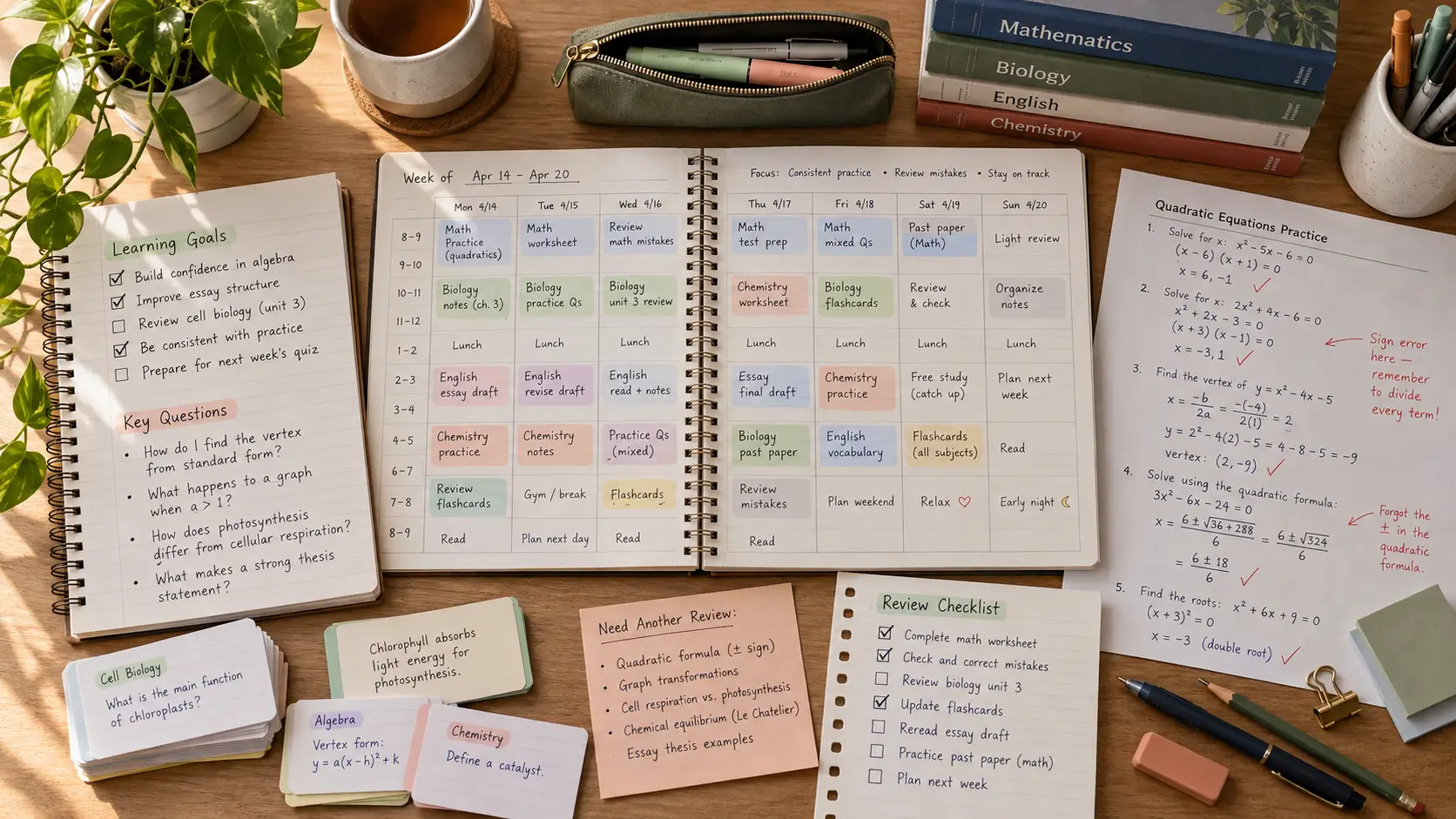
You can follow a study timetable, complete your notes, and spend hours reviewing material yet still struggle to answer questions without help. The problem may not be how much time you study. It may be that your routine does not show you what you have learned, what remains unclear, or what to do next.
A useful study system connects learning goals, available time, meaningful practice, feedback, and regular review. It helps you decide what deserves attention instead of treating every chapter, assignment, and revision session as equally important.
Research on learning supports several parts of this approach. A major review by Dunlosky and colleagues (2013) identified practice testing and distributed practice as techniques with relatively strong evidence across the learning conditions examined. But research does not establish one ideal timetable or a single combination of methods for every student.
The aim is to build a process that fits your subjects, responsibilities, resources, and current understanding—and gives you evidence to judge whether it is helping.
Answer Summary: To create a study system that works for you, identify what you need to learn, check your current understanding, and plan realistic study sessions. Use methods that match the learning task, practise without constantly consulting answers, and correct mistakes using reliable feedback. Revisit important material over time and adjust your next tasks according to what you can demonstrate independently. Keep the system simple enough to maintain when your schedule changes.
What Makes a Study System Different From a Timetable?
A timetable tells you when to study. A study system also determines what you will do during that time, how you will check your learning, and what happens afterward.
Consider a mathematics session scheduled for the evening.
A timetable might say, "Study algebra."
A study system makes the task more specific: practise solving simultaneous equations, attempt questions without looking at worked solutions, check the methods, and identify which errors need another attempt.
The difference is not the amount of planning. It is whether the activity produces useful information about your learning.
A practical study system connects six decisions:
-
Learning goal: What must you understand or be able to do?
-
Study opportunity: When can you realistically work on it?
-
Learning activity: What will you read, explain, recall, solve, or produce?
-
Feedback: How will you know whether your response is correct?
-
Review: What needs another attempt, and when?
-
Adjustment: What should change in the next session?
These decisions form a repeating process rather than a rigid daily routine.
The Education Endowment Foundation's 2025 guidance on metacognition and self-regulated learning emphasises planning, monitoring, and evaluating learning. Its recommendations primarily concern teachers supporting school pupils, but the underlying distinctions can inform how individual learners organise and review their own work.
The six-part system presented here is a practical synthesis of learning research and planning guidance. It has not been established as one independently tested programme.
1. Start With What You Need to Be Able to Do
Before creating a schedule, identify the actual knowledge or performance required.
"Finish three chapters" describes an amount of material. "Explain photosynthesis without notes" describes something you can test.
This distinction makes it easier to choose worthwhile activities.
Work Backwards From Learning Objectives
Use your syllabus, assignment instructions, examination format, or learning objectives to identify what you must demonstrate.
Different outcomes require different preparation.
In biology, you might need to recall terminology, explain a process, and interpret a diagram. In mathematics, you may need to select an appropriate method and solve unfamiliar problems. In history, an assessment might require an argument supported by relevant evidence.
Reading about these subjects is part of preparation, but reading alone does not demonstrate every required skill.
Convert broad topics into observable tasks.
For example:
|
Broad topic |
Specific learning task |
|---|---|
|
Cell division |
Explain the main stages and label a diagram without notes |
|
Algebra |
Solve selected problems independently and check each step |
|
Historical events |
Explain causes and consequences using relevant evidence |
|
Essay writing |
Develop an argument and evaluate it against the marking criteria |
|
Language learning |
Recall vocabulary and use it appropriately in sentences |
You do not need to turn an entire course into detailed tasks immediately. Start with the material you are currently learning and the requirements of upcoming assessments.
Check What You Already Understand
A study plan becomes more useful when it reflects your present knowledge.
Choose a few questions or tasks related to the learning objective. Attempt them without notes, then compare your responses with an appropriate answer key, textbook, worked solution, or marking guide.
If the subject is entirely new, first study an explanation or example. An independent attempt is more meaningful once you understand enough to engage with the task.
Look beyond whether the final answer is correct.
A wrong response may indicate missing knowledge, confused reasoning, an incorrectly selected method, or a mistake in carrying out a familiar procedure.
These difficulties require different responses.
Someone who has forgotten a definition may benefit from retrieval practice. Someone who does not understand how a formula works may need a clearer explanation and guided examples before attempting more questions.
Avoid judging mastery solely by how familiar the material feels while you read it. Understanding an explanation in front of you is not the same as reproducing or applying it independently.
2. Build Your Study Schedule Around Real Available Time
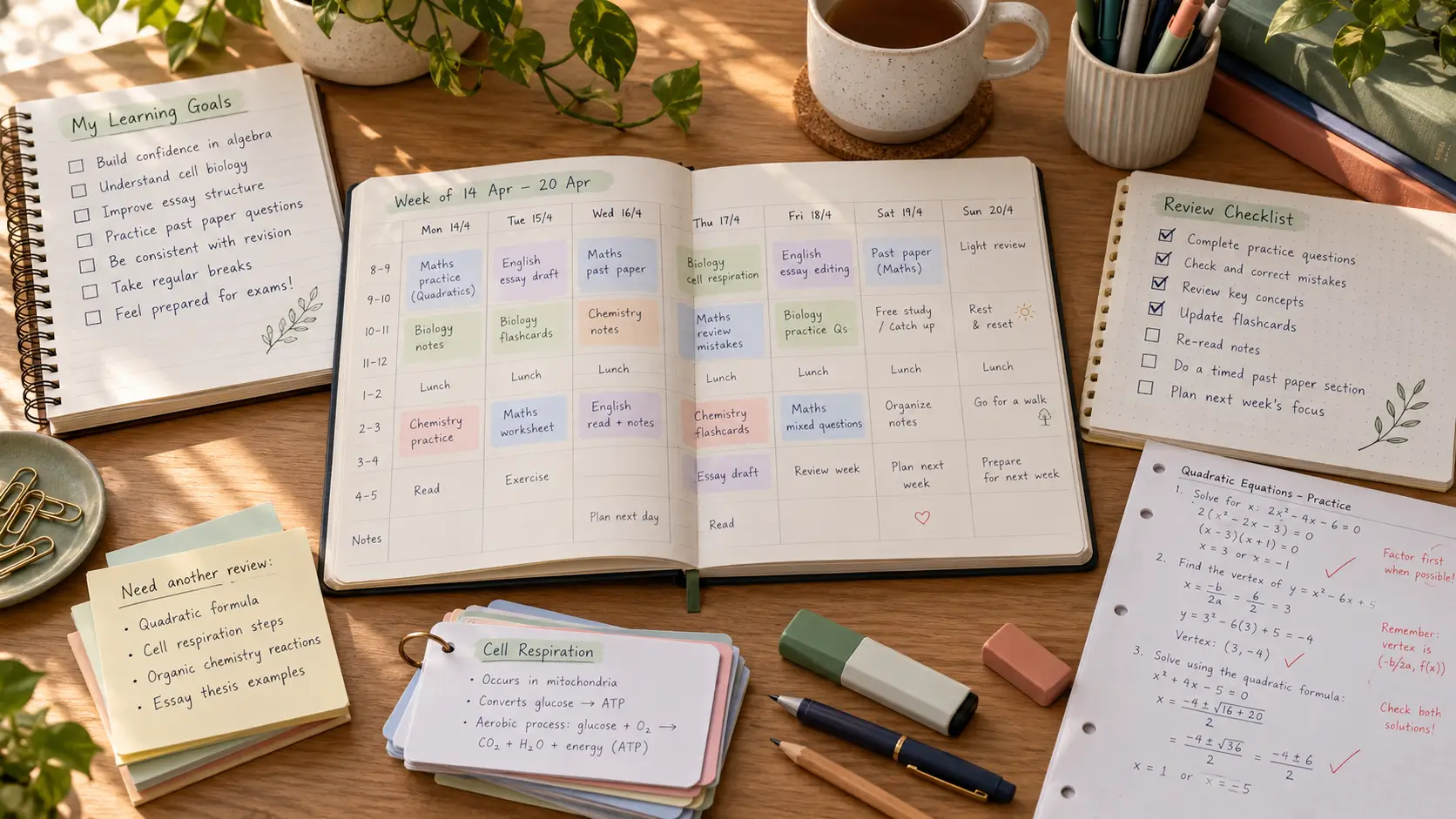
A realistic study schedule begins with commitments that already exist, not the number of hours you wish you had.
School or university classes, employment, commuting, family responsibilities, meals, rest, and deadlines all affect the time available for learning.
Cornell University's Learning Strategies Center recommends planning balanced activities, including breaks, sleep, and other responsibilities, when creating a study schedule.
Plan the Week Before Planning Individual Days
Look at the coming week and identify periods when studying is reasonably possible.
Then consider which tasks require sustained attention, which can be completed in shorter sessions, and which depend on access to resources or feedback.
For example, writing an extended essay response may require an uninterrupted period. Revisiting previously learned definitions may fit into a shorter available window.
A weekly plan can accommodate these differences without requiring every day to follow the same pattern.
Leave room for changes. A schedule filled with more work than your available time permits will require constant revision.
Give Each Session a Defined Purpose
A study block should answer three questions:
-
What am I trying to learn or improve?
-
What will I attempt during this session?
-
How will I check the result?
Instead of scheduling "revise chemistry," write a task such as "explain the reaction, complete related questions, and check the reasoning."
This also helps you estimate whether the task is suitable for the available period.
Avoid assuming that a longer session is automatically more valuable. A lengthy session spent copying familiar notes may reveal less about your understanding than a shorter session involving relevant independent practice and feedback.
Decide Which Task Comes Next
When several subjects compete for attention, use a simple priority rule.
Consider the nearest meaningful deadline, the importance of the learning objective, any unresolved errors, and the time or resources currently available.
A task needed for tomorrow's assignment may take priority over routine long-term review. However, older knowledge should not disappear from the schedule merely because it has no immediate deadline.
There is no need for an elaborate priority-scoring system. The purpose is to make a reasonable next decision rather than repeatedly reorganise the entire timetable.
For days with very limited time, retain a small fallback activity, such as revisiting an unresolved question. If this repeatedly replaces substantial study, revise the workload instead of treating the fallback as a complete substitute.
3. Choose Study Methods That Match the Task
A method is useful when it helps develop the knowledge or performance you need.
Memorising terminology, understanding an explanation, solving mathematical problems, and constructing an essay are different activities. They should not be assessed through identical practice.
Use Retrieval Practice to Check What You Remember
Retrieval practice, also called active recall, involves attempting to remember information without looking at the original material.
You might answer a question, write a definition, explain a process aloud, or reconstruct a diagram from memory.
In experiments involving prose passages, Roediger and Karpicke (2006) found that earlier retrieval testing produced better performance on delayed retention tests than repeated studying under the conditions examined. The immediate-test pattern differed, illustrating why performance shortly after studying does not tell the whole story.
Retrieval is therefore useful for learning as well as assessing recall.
However, remembering an isolated fact does not demonstrate that you can apply it in every context. Practice questions should reflect the intended learning outcome.
For a detailed explanation of this distinction, see Collegenp's article on active recall compared with passive review.
Use Explanations and Worked Examples When Understanding Is Missing
Not every difficulty should be addressed by more self-testing.
When learning an unfamiliar procedure, start with an explanation or an appropriate worked example. Examine why the steps are necessary and how they connect.
Then attempt a related problem without following the solution.
The US Institute of Education Sciences recommends combining worked examples with problem-solving exercises. Its guidance also includes deep explanatory questions and spaced learning opportunities, with different evidence ratings across recommendations.
This matters when a learner can recognise a correct solution but cannot produce one independently.
Further rereading may not resolve that difficulty. The next activity should involve attempting the relevant reasoning or procedure and checking the result.
Mix Related Problems After Learning Their Foundations
Interleaving involves mixing related problem types rather than practising every question of one type together.
In research involving college mathematics students, Rohrer and Taylor (2007) found advantages from spaced and mixed practice under the experimental conditions studied.
For example, after learning several algebraic methods, you might work through a mixed set of questions that requires deciding which method applies.
This differs from completing a long sequence where each question uses the same immediately preceding example.
Interleaving is not random switching between unrelated subjects. It is most useful when the learner has enough foundational understanding to distinguish the relevant methods.
The choice of practice should remain tied to the task, not to a belief that one technique is suitable for every subject.
4. Connect Practice, Feedback, and Spaced Review
A useful study session should lead to a decision about what to do next.
Completing questions without checking them leaves uncertainty about accuracy. Checking answers without trying again may leave misunderstandings unresolved. Correcting a mistake once does not establish that the material will remain available later.
These activities need to work together.
Use a Learn–Attempt–Check–Return Cycle
For a specific learning objective, follow a practical sequence:
-
Learn or review the necessary explanation, material, or worked example.
-
Attempt a relevant question or task without immediately consulting the answer.
-
Check your response against a trustworthy source.
-
Identify the missing knowledge, reasoning error, or procedural mistake.
-
Correct the problem and make another independent attempt when appropriate.
-
Arrange a later check of important or uncertain material.
The value of this cycle is that each attempt informs the next learning activity.
Suppose you can solve a mathematics problem after examining a worked example, but choose the wrong procedure when the problem type is not identified.
The next task should involve recognising which method applies, not simply repeating more questions where the method has already been supplied.
In other subjects, the response may differ. An incomplete explanation might call for another review of the concept followed by a fresh explanatory question.
Return to Important Material Over Time
Spaced practice means distributing learning opportunities across separate occasions rather than concentrating every repetition into one session.
A major review by Cepeda and colleagues (2006), focused on verbal-recall research, found that the relationship between spacing and later retention depends partly on the intended retention interval.
This supports returning to material over time, but it does not establish one fixed review schedule for all learners and tasks.
Use the following considerations when arranging another attempt:
-
How accurately could you retrieve or apply the material?
-
Is the topic important for future learning or assessment?
-
How long do you need to retain it?
-
Have earlier mistakes been corrected successfully?
Material you still misunderstand may need prompt clarification. Material you can retrieve correctly may be checked again after a longer interval.
For detailed scheduling approaches, Collegenp provides a separate guide to spaced repetition methods.
Make Feedback Specific Enough to Use
Feedback should identify what needs correction.
"Incorrect" tells you that the answer failed. It does not necessarily explain why.
Compare your response with a reliable solution, identify the point where the reasoning differs, and determine what knowledge or method is missing.
A simple error record can help:
|
Error identified |
Next learning action |
|---|---|
|
Cannot recall a required fact |
Relearn it, retrieve it independently, and revisit it later |
|
Does not understand a concept |
Review a clearer explanation and answer a related question |
|
Selects the wrong procedure |
Practise recognising when different procedures apply |
|
Makes repeated calculation errors |
Check intermediate steps and attempt similar problems |
|
Misinterprets an essay question |
Analyse the task instructions and marking criteria |
These are practical categories for choosing an activity, not a formal assessment of learning difficulties.
If you cannot establish why an answer is incorrect, seek appropriate help. Repeating a task without dependable feedback may leave the underlying error unchanged.
5. Measure Learning, Not Just Completed Study Hours
The strongest reason to monitor a study system is to find out whether your activities are helping you meet your learning objectives.
Hours spent studying, completed chapters, and finished revision cards show that activities occurred. They do not, on their own, demonstrate independent understanding or application.
Check Performance Without Immediate Support
Use questions or tasks that resemble the knowledge or performance you are preparing for.
Useful evidence includes whether you can:
-
Retrieve relevant information without notes.
-
Explain an idea accurately rather than repeat familiar wording.
-
Select and apply the correct method to a problem.
-
Produce a response that meets the assessment criteria.
-
Repeat the performance after time has passed.
A delayed check is particularly useful for distinguishing recently familiar material from knowledge that remains accessible later.
Record important errors as well as correct answers. A correct final answer reached through unsupported guessing provides different evidence from one supported by accurate reasoning.
Keep a Small Record of What Needs Attention
A study record does not need complicated charts or performance scores.
For each important learning objective, note the task attempted, what you could do independently, what required correction, and what you will check next.
For example, your record might use these fields:
|
Record field |
Your entry |
|---|---|
|
Learning objective |
|
|
Independent task attempted |
|
|
Result and errors |
|
|
Correction needed |
|
|
Next review or practice task |
Keep the record brief enough that it supports learning rather than becoming a separate administrative project.
Review the System, Not Only the Subject
Set aside a recurring time to look at your progress and the feasibility of your schedule.
A weekly review is a practical option, although it is not a scientifically established ideal interval.
Consider whether you are completing important tasks, correcting recurring mistakes, and demonstrating learning without immediate assistance.
Then ask whether the plan itself is workable.
If you regularly fail to complete scheduled sessions, the difficulty may be unrealistic time allocation. If you complete them but cannot answer questions independently, the learning activity or feedback may need to change.
These situations should not produce the same response.
6. Adjust the System When It Stops Working
A study system should allow for interrupted schedules, difficult subjects, and changing deadlines. A plan that cannot accommodate ordinary disruptions is difficult to sustain.
The first step is to identify what has stopped working.
If You Have Fallen Behind
Avoid transferring every missed task into an already full schedule.
Review the outstanding work and separate required deadlines, foundational learning gaps, and less urgent revision.
Prioritise tasks that have immediate consequences or are necessary for completing other work. Retain essential review where possible, but revise lower-priority commitments when time is genuinely limited.
For example, when an assessment is approaching, preparing through relevant questions and correcting known errors may be more appropriate than spending the available time reorganising notes.
Near-term preparation and long-term learning are related, but they involve different time constraints. A short preparation period cannot be assumed to provide the same retention opportunities as earlier distributed study.
If You Follow the Schedule but Cannot Recall Much
Inspect what you do during the session.
If most of the time is spent reading, highlighting, or copying, introduce an independent check that matches the learning objective.
If you can remember facts but struggle with unfamiliar applications, use relevant practice problems or explanatory tasks.
If you cannot understand the initial material, seek clearer instruction rather than repeatedly testing knowledge you have not yet established.
Increasing study hours without identifying the underlying difficulty may leave the same problem unresolved.
If Your Routine Is Too Demanding
Reduce the planned workload to match the time available.
Choose fewer essential tasks, allow realistic completion periods, and keep space for rest and existing responsibilities.
Avoid relying on regularly sacrificing sleep to finish work. Cornell's study-scheduling guidance specifically includes sleep, meals, breaks, and other activities when planning learning time.
A smaller schedule that permits meaningful practice is more useful than an extensive schedule that repeatedly cannot be completed.
If You Need More Support
Some learning barriers require help beyond independent revision.
A teacher, tutor, or learning-support professional may be able to clarify unresolved misconceptions, explain assessment expectations, or identify suitable support and accessible materials.
Bring specific examples of attempted questions and difficulties when possible.
A pattern of unresolved errors gives someone helping you a clearer starting point than a general statement that a subject feels difficult.
7. Personalise the System Without Following Learning-Style Labels
Personalisation means adapting your study system to the learning task, your current understanding, available time, resources, and support needs.
It does not require classifying yourself as a permanently visual, auditory, or kinesthetic learner.
A research review by Pashler and colleagues (2008) found insufficient evidence to support the common claim that instruction should routinely be matched to such learning-style categories. Preferences about how information is presented do exist, but they do not establish that matching a preferred format produces superior learning.
A useful choice depends on what the task demands.
Diagrams may help represent relationships that are difficult to describe using words alone. Spoken practice may be relevant when learning pronunciation. Written explanations and worked solutions may be necessary for other tasks.
These choices concern the material and required performance rather than a fixed identity as a particular type of learner.
Resources also matter.
A student using printed textbooks and a paper calendar can perform many essential activities: identify tasks, practise recall, check answers, record errors, and arrange later review.
Digital flashcards, calendars, and task applications can organise similar functions. They are options rather than requirements.
Learners who need accessible formats, additional instructional support, or different ways to demonstrate understanding should account for those needs when designing the routine.
A Practical Check Before Starting Your Next Study Week
You do not need to redesign every study habit at once.
Start with one subject or a manageable group of learning objectives. Check whether the following functions are present:
If a function is missing, address that gap before introducing more tools, complicated schedules, or additional tracking.
A simple calendar, a list of learning objectives, appropriate practice materials, and a short error record may be enough to begin.
Conclusion
A study system works as a learning process, not merely as a record of hours spent studying.
The essential decisions are what you need to learn, when you can realistically work on it, how to practise the required knowledge or skill, how to check your performance, and what to do with the results.
Retrieval practice, distributed learning, and appropriate problem-solving activities have research support, but their usefulness depends on the learning task and how they are implemented. Reliable feedback, realistic scheduling, and adjustments based on independent performance help connect those techniques to everyday study.
Begin with a manageable routine. Keep the activities that provide useful evidence of learning, revise those that do not, and let actual requirements and progress determine what deserves attention next.
References
1. Dunlosky, J., Rawson, K. A., Marsh, E. J., Nathan, M. J., & Willingham, D. T. (2013). Improving Students' Learning With Effective Learning Techniques: Promising Directions From Cognitive and Educational Psychology. Psychological Science in the Public Interest. Association for Psychological Science.
2. Roediger, H. L., & Karpicke, J. D. (2006). Test-Enhanced Learning: Psychological Science. Psychological Science, 17(3).
3. Cepeda, N. J., Pashler, H., Vul, E., Wixted, J. T., & Rohrer, D. (2006). Distributed Practice in Verbal Recall Tasks: A Review and Quantitative Synthesis. Psychological Bulletin, 132(3), 354–380.
4. Institute of Education Sciences, What Works Clearinghouse. (2007). Organizing Instruction and Study to Improve Student Learning. US Department of Education.
5. Rohrer, D., & Taylor, K. (2007). The Shuffling of Mathematics Practice Problems Boosts Learning. Instructional Science, 35(6), 481–498.
6. Education Endowment Foundation. (2025, second edition). Metacognition and Self-Regulated Learning. Education Endowment Foundation.
7. Cornell University Learning Strategies Center. Guidelines for Creating a Study Schedule. Cornell University.
8. Pashler, H., McDaniel, M., Rohrer, D., & Bjork, R. (2008). Learning Styles: Concepts and Evidence. Psychological Science in the Public Interest, 9(3), 105–119.







Comments 0
No comments yet. Be the first to start the conversation.