



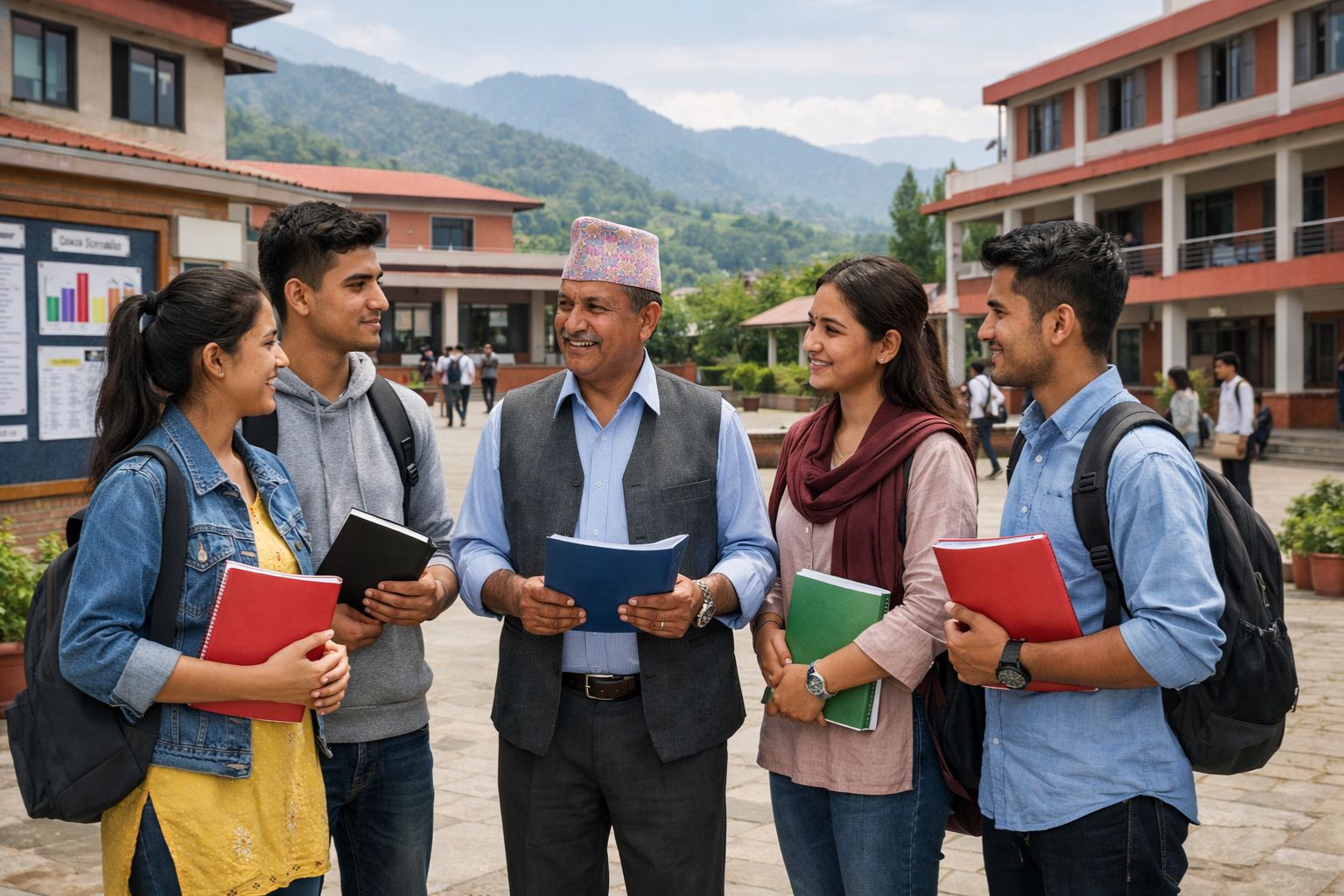
Why Community Colleges Matter in Nepal and How to Reform Them
In Nepal, the phrase “community college” usually points to what official documents describe more clearly as a community campus. That difference matters. A community campus in Nepal is a nonprofit affiliated institution established through community initiative and local resources, while its academic programmes, examinations, and degree structure remain tied to a university system. This is not a fringe model. UGC records 545 community campuses out of 1,432 campuses nationwide in 2023/24, and community campuses enroll 204,230 students, or 32.3 percent of students by campus type.
That scale turns community campuses into a national issue, not a local side note. Nepal’s higher education Gross Enrollment Ratio stands at 22 percent, which shows that access has expanded but is still far from universal. UGC also reports a Gender Parity Index of 1.3 in higher education, with female enrollment higher than male enrollment. These figures place community campuses inside two large public questions at once: who reaches higher education, and which institutions make that access durable outside major urban centers.
The pressure on the sector has also grown. The British Council’s 2025 review says nearly one in five Nepali college-age students go abroad for tertiary education and links that outward flow to domestic concerns over curriculum relevance, governance, teaching quality, and research limits. World Bank reform documents describe a system still shaped by centralized academic control, uneven financing, and a quality-assurance process that has moved ahead but not yet reached the breadth policy makers sought.
For students, families, campus leaders, and local governments, the main question is not whether community campuses matter. They do. The sharper question is whether Nepal can turn them into stronger local institutions without pretending that every campus can do everything on its own. This guide explains why community colleges matter in Nepal, where the system is falling short, and which reforms have the strongest public-interest case.
Summary
Community colleges matter in Nepal because, in the Nepali setting, they usually mean community campuses: nonprofit, locally rooted institutions linked to universities. They widen access outside major urban centers, enroll about one-third of students by campus type, and remain important for inclusion and local educational opportunity. The best reform path is not more campus expansion on its own. It is stronger quality review, fairer funding, accountable autonomy, closer labour-market alignment, digital access, and better student support.
Table of Content
- Why Community Colleges Matter in Nepal and How to Reform Them
- What does “community college” mean in Nepal?
- Why are community colleges important in Nepal?
- What is not working well enough?
- Which quality signals matter when assessing a community campus?
- How should Nepal reform community colleges?
- What can campuses do now, before larger policy shifts?
- What outcomes are realistic, and what limits remain?
- Sources Used
Key Takeaways
-
Community campuses make up 545 of Nepal’s 1,432 campuses.
-
They enroll 204,230 students, or 32.3 percent of students by campus type.
-
Nepal’s higher education GER is 22 percent, so local access institutions still matter.
-
UGC reports a Gender Parity Index of 1.3 in higher education.
-
Quality review has moved ahead, but World Bank evidence shows the QAA cycle still fell short of earlier policy targets.
-
Reform should center on quality, funding, autonomy, programme fit, digital access, and equity support.
What does “community college” mean in Nepal?
In Nepal, “community campus” is the clearer term. World Bank project documents describe community campuses as nonprofit institutions established through community initiative and resources, while affiliated institutions remain linked to university-controlled curriculum and examination systems. That makes Nepal’s model locally rooted but not fully independent in academic matters.
Community college vs community campus
A Nepali community campus is not the same as a United States community college. The United States model often brings two-year associate pathways, transfer systems, and a separate local governance tradition. Nepal’s community campuses are usually affiliated campuses under a university framework, with financing and local management shaped by community effort but degrees and examinations tied to university rules.
That distinction matters for public debate. When people import the phrase “community college” without clarifying the Nepali context, they may assume a structure Nepal does not have. A better reading is this: Nepal’s community campuses are locally anchored gateways into the national university system. Reform has to start from that reality, not from foreign labels alone.
Where community campuses fit in Nepal’s higher education map
Community campuses sit near the center of Nepal’s higher education map. UGC’s 2023/24 EMIS report records 164 constituent campuses, 545 community campuses, and 723 private campuses. Community campuses account for 38.06 percent of all campuses. They also carry 32.3 percent of enrollment by campus type, which makes them larger than a niche category and too important to be ignored in national reform.
Their provincial spread also matters. UGC data show Bagmati has the heaviest concentration of campuses overall, especially private campuses, while other provinces such as Lumbini and Koshi have substantial community-campus presence. That means community campuses remain one of the main ways Nepal extends degree study beyond the strongest private-education markets.
Why the United States comparison only goes so far
The United States comparison is useful only as a loose starting point. Nepal’s central policy issues are affiliation, accreditation, governance, public subsidy, and the fit between local campuses and university control. Those are not side details. They shape what a community campus can teach, how fast it can adapt, and what sort of accountability it faces.
Why are community colleges important in Nepal?
Community colleges matter in Nepal because community campuses widen access, keep higher education closer to local communities, and already teach a large share of the country’s students. They also connect national higher education to places where private expansion is thinner and relocation is harder.
They widen access outside major urban centers
Community campuses widen access by reducing distance as a barrier. Nepal’s higher education GER is 22 percent, so the country still needs institutions that make study possible for students who cannot move to Kathmandu or another major city. In that setting, a local campus changes whether higher education is realistic at all, especially for students balancing family duties, work, or travel constraints.
This access role is not new. UNESCO and UGC work on transition and access in Nepal shows that equity in higher education has been a public policy concern for years, with social, economic, and regional barriers shaping who gets in and who stays in. Community campuses sit directly inside that old and unfinished policy question.
They keep higher education closer to local communities
Community campuses keep higher education tied to local initiative. Because they are established through community effort and resources, they carry a civic character that differs from both state-run constituent campuses and private investment-led campuses. That civic base can support local trust, local oversight, and a stronger sense that higher education serves public needs rather than only market demand.
This local role matters more in a country with sharp regional differences. A campus that remains inside a municipality or district can help keep educational opportunity visible in places where students may otherwise see relocation or foreign study as the only route. That does not solve quality by itself, but it does widen the field of opportunity.
They are tied to women’s participation and inclusion
Community campuses also matter for inclusion. UGC’s 2023/24 data show that female enrollment is higher in community and private campuses than in constituent campuses, and the national Gender Parity Index in higher education stands at 1.3. That does not prove that every community campus is equally inclusive, yet it does place the sector inside Nepal’s major gender shift in higher education.
Distance, safety, living costs, and family expectations still affect many students’ choices. A campus closer to home may matter a great deal in whether a student enrolls or leaves study behind. That is one reason community campuses deserve more than a funding debate. They are part of the country’s equity architecture.
They already carry a large share of enrollment
A sector that teaches about one-third of students is already shaping national outcomes. Community campuses enroll 204,230 students. That means any change in their quality, retention, academic calendar, student support, or labour-market fit will have system-wide consequences, not only local effects.
This is why the community-campus debate should move past nostalgia. The point is not to praise these campuses because they are local. The point is to ask what happens to Nepal’s higher education system if one of its largest segments remains underfunded, uneven in quality, or slow to adapt.
What is not working well enough?
Community campuses matter, but the system around them is still weak in several areas. The main problems are uneven quality review, centralized governance, thin funding, programme imbalance, and the strain placed on many small campuses.
Quality assurance has moved forward, but unevenly
Nepal’s quality-assurance system is real, but coverage is still uneven. The World Bank’s IEG review says the number of HEIs completing the accreditation or QAA cycle rose from 12 in 2014 to 76 in 2020, below a target of 125. UGC’s current strategic plan sets a target of 220 QAA-certified HEIs by 2029, which shows the expansion task is still active.
The unevenness is easy to see in practice. UGC’s QAA page lists several community institutions in reaccreditation or later-cycle status, including Balkumari College, Damak Multiple Campus, Lumbini Banijya Campus, Makwanpur Multiple Campus, Janapriya Multiple Campus, and Shaheed Smriti Multiple Campus. That is good news, but it also shows a divided field: some campuses move through formal review cycles while others remain outside them.
Governance is still too centralized
Governance remains a major constraint because academic control is still concentrated at the university level. World Bank reform documents describe Nepal’s higher education agenda as one that still needs stronger governance, financing, and quality systems, while affiliated institutions remain limited in academic independence compared with what a more local model would require.
The British Council’s 2025 review reaches a similar conclusion from another angle. It notes governance and management problems, administrative delays, weak internal policy coherence, and long timelines for approval of new programmes. When local campuses cannot respond quickly to local demand, the result is drift between what students study and what their communities need.
Funding remains thin and uneven
Funding is another fault line. World Bank material on Nepal’s reform history says public funding was not linked clearly enough to performance and varied widely across institutions. A separate World Bank sector assessment notes that, in 2017/18, public subsidy per student differed sharply between constituent and community campuses. Even without fixing attention on one number, the larger point is clear: community campuses have been asked to carry public responsibilities with weaker public support.
When local donation capacity is modest, this gap shows up fast in staffing, libraries, labs, digital access, and student services. Funding weakness is not only a budget issue. It becomes a quality issue and, later, a trust issue.
Programme mix does not fully match labour demand
Programme balance remains under strain. UGC’s graduate data show management accounts for 40.48 percent of total graduates, with far smaller shares in some other fields. The British Council’s review points to curriculum relevance concerns and a gap between provision and market demand. ILO policy work also argues that higher education and training need stronger private-sector links and curriculum oversight connected to labour demand.
This does not mean management degrees lack value. It means Nepal needs a better match between programme supply, local economies, and the paths students want to follow. If campuses keep adding seats where demand is strongest socially but weaker economically, access will rise without enough gain in graduate fit.
Many campuses are too small to do everything alone
UGC reports that 505 campuses, or 35.27 percent, have 100 or fewer students. That number matters because quality systems, libraries, counselling, lab access, digital platforms, faculty development, and data reporting all carry fixed costs. A large number of small campuses can keep local access alive, but it also creates structural fragility.
UGC’s strategic plan openly signals this pressure. It says resource-scarce campuses may move toward merger and that unsustainable institutions should not keep growing without credible feasibility. The policy point is not that every small campus should close. It is that not every small campus can be expected to function as a fully self-sufficient institution.
Which quality signals matter when assessing a community campus?
Students and families need practical ways to judge a community campus. The best signals are formal quality review, a stable academic calendar, public reporting, student support, and a visible connection between programmes and real graduate pathways.
Accreditation and reaccreditation
Accreditation is the first signal because it shows that a campus has entered a formal review cycle. In Nepal, QAA and reaccreditation matter more than broad reputation alone. A campus listed by UGC as accredited or reaccredited has passed through a documented process that is visible to the public.
That signal is still incomplete on its own. A campus may hold accreditation and still need work in student support or programme fit. Even so, the absence of any quality-review track is a warning sign when students have choices.
Academic calendar, teaching, and public reporting
A second signal is whether the campus keeps a predictable calendar and shares basic public information. World Bank reform documents tie Nepal’s higher education agenda to academic reform, teaching quality, and better governance. A campus that does not publish results, notices, contact information, annual reports, or clear programme details is harder to trust.
Students should also ask a simple set of questions: Are classes running on time? Are teachers available? Are exams and results moving without long delay? Is the campus website current? These are plain signs, but they often tell more about daily academic life than branding does. This is an inference drawn from the governance and accountability issues identified in World Bank and British Council sources.
Graduate pathways and local relevance
A third signal is where students go after graduation. The World Bank’s reform record points to tracer studies and employment-linked indicators as part of Nepal’s funding reform tools. That means graduate destinations are not a side matter; they are part of institutional accountability.
For students, this suggests a practical test: does the campus show any evidence of alumni pathways, employer links, internships, or further-study routes? A campus does not need to place every graduate in a formal job to prove value, but it should be able to show that its programmes connect to real next steps.
How should Nepal reform community colleges?
Nepal should reform community colleges by focusing less on expansion for its own sake and more on quality, fair funding, accountable autonomy, programme fit, digital access, and equity support. That agenda is already visible in UGC and World Bank reform documents. The task now is to turn those goals into durable practice.
Tie grants to clear public outcomes
Public grants should follow public outcomes. Nepal’s reform history already includes formula-based and performance-based funding, so the next step is to make the criteria clearer and more consistent for community campuses. Grants should reward campuses that keep an academic calendar, move through quality review, publish public data, improve retention, and show credible graduate pathways.
The funding model should also reflect context. A remote campus serving a thin population cannot be judged by the same scale rules as one operating in a large urban market. Common standards are still needed, but they should sit alongside place-sensitive baselines. That is an inference grounded in UGC’s campus-size data and provincial spread.
Build a firmer quality cycle
Quality review should be a cycle, not a one-time event. UGC’s current plan calls for more QAA-certified HEIs and periodic appraisal of QAA-certified institutions. That direction is sound because quality tends to drift when review stops after one certification round.
A firmer cycle would pair accreditation with lighter annual review, public dashboards, and technical support for campuses still below the threshold. Students need clearer signals, and weaker campuses need structured pressure plus structured help.
Expand autonomy with public accountability
Autonomy should grow where quality and disclosure are strong. World Bank reform records show that autonomy was already part of Nepal’s higher education agenda, including academic autonomy for some institutions and programmes. That logic should continue for capable community campuses.
For Nepal, sensible autonomy means more room to update local electives, run employment-linked modules, organize teaching schedules within national rules, and partner with municipalities or employers. In return, campuses should publish audited finances, student data, and academic results. Local freedom without public accountability would weaken trust.
Align programmes with local and national demand
Programme reform should begin with demand rather than tradition. The World Bank’s NEHEP design says new academic programmes should complete market appraisal and update curriculum in consultation with employers. ILO work makes the same point in broader labour-policy terms: stronger private-sector links and curriculum oversight can raise relevance.
That does not mean each community campus should try to become a technical institute. It means each campus should ask harder questions about which programmes still fit the district economy, public-service needs, student destinations, and faculty capacity. A smaller set of well-run, relevant programmes is better than a larger set that survives on habit alone.
Share services across small campuses
Small campuses need shared systems. UGC’s data on campus size make it plain that many institutions are too small to build every service on their own. Shared libraries, visiting faculty pools, digital platforms, counselling, lab access, and internal quality-review support would give small campuses a better chance of meeting common standards.
This is also where merger pressure should be handled carefully. UGC’s strategic plan already signals that resource-scarce campuses face merger pressure. In some places, full merger may make sense. In others, shared services may be the better first step because they preserve local access while raising institutional capacity.
Treat digital access as basic academic infrastructure
Digital access is now part of academic quality, not an optional add-on. UGC’s strategic plan calls for broader access to e-resources and a digital highway linking HEIs with UGC systems. The World Bank’s NEHEP also lists digitization as a core reform area.
For community campuses, digital reform should mean stable internet, shared learning platforms, basic data systems, staff training, and fair access for students who do not have devices or steady connectivity at home. In remote settings, digital weakness quickly turns into an equity problem.
Protect equity with targeted student support
Access without support often becomes dropout. UGC’s strategic plan places equitable access at the center of its work, and the World Bank’s earlier reform design included poverty-targeted support with preference for female students. Those ideas remain relevant because Nepal’s access problem is not only entry; it is also completion.
For community campuses, targeted support may include fee relief tied to need, hostel or transport help where required, bridge support for first-generation students, and active follow-up when attendance drops. This is the kind of policy detail that turns access from a headline into a durable outcome.
What can campuses do now, before larger policy shifts?
Community campuses do not have to wait for every national reform to be settled. Even under current constraints, they can make choices that raise trust, improve student retention, and strengthen local relevance.
Run a local relevance audit
A campus can begin with a local relevance audit. Review enrollment trends, pass rates, dropouts, programme demand, student destinations, and local employer feedback over the past few years. The aim is to ask whether the present programme mix still matches district realities.
This audit is useful because it turns reform from opinion into evidence. It also gives campus leaders a stronger case when they ask the university, UGC, or local government for changes in courses, staffing, or facilities.
Publish a short public scorecard
A second step is a short public scorecard. A campus can publish enrollment by gender, first-year retention, pass rates, QAA status, calendar completion, teacher numbers, and graduate destinations where known. These are modest indicators, but they make leadership answerable to students and the community.
Public reporting also helps students compare campuses on something other than rumor. In a system where quality is uneven, even a simple scorecard improves clarity.
Build employer and alumni feedback loops
A campus should also build regular feedback from employers and alumni. ILO work on Nepal’s youth employment system recommends stronger private-sector links and curriculum oversight. That recommendation fits community campuses well because their local ties make feedback collection easier than in more distant institutions.
The best feedback is concrete. Ask employers which skills graduates are missing, which workplace habits matter most, and which tools or methods are standard in the local economy. Ask alumni which parts of the programme helped and which did not. Narrow questions produce better curriculum changes than broad praise.
Put retention at the center
Retention deserves as much attention as admissions. A campus that enrolls students but loses them early is not widening access in any lasting sense. With many small campuses in the system, early dropout can also weaken institutional viability.
A basic retention plan does not need large budgets at the start. Early attendance alerts, faculty mentoring, timetable adjustments for working students, and better communication with students and families may all help. This is an inference drawn from the community-campus model and the access logic behind it.
What outcomes are realistic, and what limits remain?
A strong reform path can raise trust, relevance, and student success, but it will not erase every structural limit. Nepal’s community campuses can become stronger local anchors, yet results will still depend on university rules, public finance, regional inequality, and continued competition from overseas study.
A realistic near-term outcome would be wider entry into QAA cycles, clearer public reporting, better academic calendars, more shared services among small campuses, and tighter links between programmes and local labour demand. Those are practical gains that fit the present policy direction.
The limits are plain as well. Some campuses will remain too small to do everything alone. Some districts will keep losing students to larger cities or foreign study. Some reforms will stall unless affiliation rules and funding systems move with them. A balanced judgment is better than a romantic one: Nepal’s higher education system is weaker without community campuses, but community campuses also need system-level repair to do their job well.
Community colleges matter in Nepal because community campuses remain one of the country’s main access routes into higher education. They bring degree study closer to local communities, carry a large share of enrollment, and help keep higher education within reach outside the strongest urban markets. Nepal does not need to choose between local access and academic quality. It needs to connect the two more carefully. The strongest next steps are fairer outcome-linked funding, firmer quality review, accountable autonomy, closer programme alignment with labour demand, shared services for small campuses, stronger digital access, and targeted support for students at risk of being left behind.
Sources Used
-
University Grants Commission Nepal. Education Management Information System Report on Higher Education 2023/024. 2024. UGC Nepal. Giwmscdnone
-
University Grants Commission Nepal. QAA Received HEIs. UGC Nepal page, accessed 2026. ugcnepal.edu.np
-
University Grants Commission Nepal. UGC Strategic Plan 2024–2029. UGC Nepal.
-
World Bank. Higher Education Reforms Project. 2021. World Bank. World Bank
-
World Bank. Nurturing Excellence in Higher Education Program-for-Results Project. 2021. World Bank. World Bank
-
Nepal’s Transnational Education Landscape. 2025. British Council Nepal. British Council
-
obs and Skills for Youth: Review of Policies for Youth Employment of Nepal. 2016. ILO. International Labour Organization
-
UNESCO Office in Kathmandu and University Grants Commission Nepal. Advancing Policy Options for Higher Education: Improving Transition and Access to Higher Education in Nepal. UNESCO listing and UN Nepal library metadata. UNESCO Digital Library
-
Implementation Status & Results Report: Nurturing Excellence in Higher Education Program for Results. 2025. World Bank







Comments 0
No comments yet. Be the first to start the conversation.