



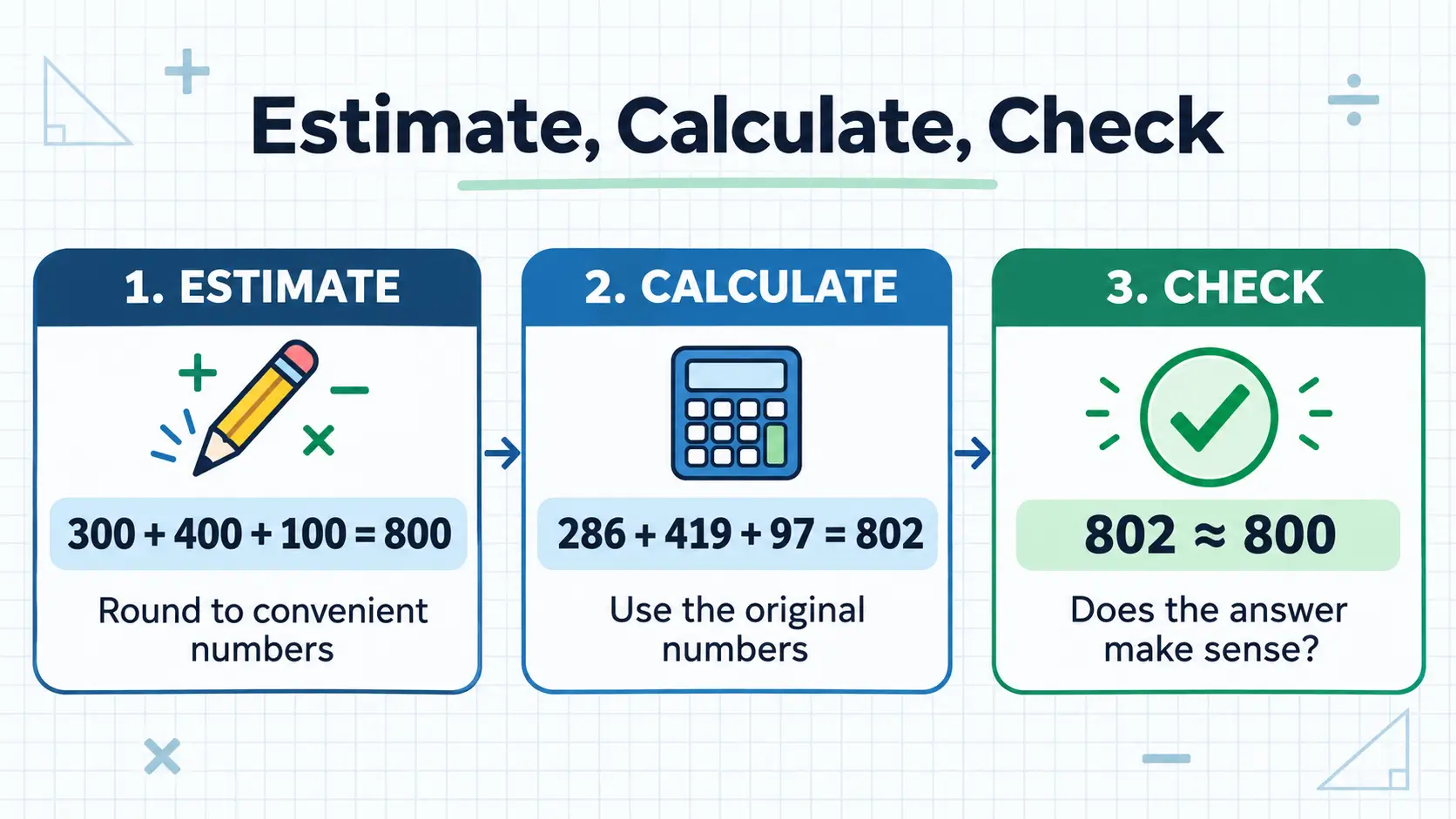
A calculation can be completed correctly on paper or entered into a calculator and still produce an unreasonable answer. Estimating the result before calculating helps you recognize mistakes involving place value, decimal points, operations, and numerical size.
To estimate answers, replace difficult numbers with simpler values, calculate an approximate result, and compare it with the answer obtained from the original numbers. If the results differ significantly, examine the calculation and the estimation method to understand why.
Consider:
Rounding the numbers gives:
The exact answer is 802, which is consistent with the estimate. An answer of 8,020 would be suspicious because it is approximately ten times larger than expected.
Estimation is useful for addition, subtraction, multiplication, division, fractions, percentages, and measurement problems. It also helps students explain why an answer makes sense instead of relying entirely on a written calculation or calculator display.
However, a reasonable estimate does not prove that an exact answer is correct. Both the numerical result and the method used to obtain it need consideration.
Answer Summary: To estimate answers and check whether they make sense, first predict the approximate size of the result. Use rounding, compatible numbers, familiar benchmarks, or mathematical bounds to simplify the calculation. Compare the estimate with the answer obtained using the original numbers. If the difference is unexpected, review the operations, place values, and estimation method. When exactness matters, verify the calculation independently and confirm that the answer fits the problem's units and context.
Key Takeaways:
-
Estimate the approximate result before calculating exactly.
-
Choose an estimation strategy that suits the numbers and operation.
-
Use place value, benchmarks, and mathematical relationships to identify unreasonable answers.
-
A plausible estimate does not establish exact correctness.
-
Investigate unexpected differences instead of assuming the calculation is wrong.
-
Check units, remainders, and practical conditions before accepting a final answer.
What Makes a Mathematical Answer Reasonable?
A mathematical answer is reasonable when its size, direction, units, and meaning agree with the information and relationships in the original problem.
Suppose you need to calculate:
Because 48 is close to 50 and 19 is close to 20, the result should be near:
The exact answer is:
This is consistent with the estimate. An answer of 91.2 would be suspicious because it is approximately one-tenth of the expected result.
Three mathematical ideas are involved.
Estimation
Estimation produces an approximate result or a plausible numerical range without requiring the full calculation.
For example:
The symbol \(\approx\) means approximately equal.
Exact calculation
An exact calculation uses the original numbers and the appropriate operations to obtain their mathematical result.
The equals sign indicates equality rather than approximation.
Reasonableness checking
A reasonableness check determines whether a proposed answer is consistent with the expected mathematical result.
For example, both 910 and 920 are close to the estimate of 1,000, but neither is the exact answer.
This distinction explains why estimation is useful for identifying implausible results but cannot replace accurate arithmetic.
The Open University's Rounding and Estimation course addresses estimating calculations, checking numerical results, and interpreting answers appropriately.
How to Estimate Answers and Check Them
A useful checking process begins before the exact calculation. Establishing an approximate answer first provides an independent expectation against which the final result can be evaluated.
Step 1: Identify the operation and expected size
Read the problem carefully and determine what needs to be calculated.
For addition involving positive numbers, the total must exceed each individual number.
For subtraction involving two positive numbers, consider their difference rather than their combined size.
For multiplication and division, examine how the factors or divisor affect the result.
For example:
Because:
the answer should be slightly greater than 40.
This prediction provides an immediate way to question an answer such as 400.
Step 2: Choose convenient numbers
Replace difficult numbers with nearby values that make mental calculation easier.
Consider:
Using 0.5 and 20 gives:
The estimated answer is approximately 10.
The original calculation gives:
The answer is consistent with the prediction.
Estimation does not require rounding every number. Sometimes retaining one original number, choosing a familiar multiple, or finding an upper and lower limit gives a more useful check.
Step 3: Compare and investigate
Compare the exact calculation with your estimate.
A substantial difference may indicate an incorrect operation, a copying error, misplaced decimal point, or unsuitable approximation.
If the results appear consistent, consider whether the answer also satisfies the problem's conditions.
The Common Core State Standards Initiative includes assessing the reasonableness of answers through mental computation and estimation, including rounding, in its Grade 3 mathematics standard 3.OA.D.8.
Estimation Strategies for Different Calculations
No single estimation method works equally well for every problem. The appropriate strategy depends on the operation, numerical relationships, and accuracy required.
1. Rounding numbers
Rounding replaces a number with a nearby value at a specified place, such as the nearest ten, hundred, or whole number.
Consider:
Using nearby hundreds:
The exact result is:
The approximation is close enough to identify a major place-value error.
A more detailed estimate using nearby tens gives:
This estimate also supports the exact answer.
The appropriate rounding position depends on the purpose. Rounding to hundreds can establish the general magnitude, while rounding to tens often preserves more detail.
2. Compatible numbers
Compatible numbers are values that work together to make mental arithmetic easier.
They are particularly useful for division.
Consider:
Instead of rounding 244 to 200, use 240 because it divides evenly by 6.
The original dividend is four greater than 240, so the quotient must be slightly greater than 40.
The exact result is:
Compatible numbers are not necessarily the nearest rounded values. Their purpose is to preserve a useful mathematical relationship while simplifying the arithmetic.
3. Benchmarks for fractions and percentages
Benchmarks are familiar values used to compare less familiar quantities.
Common fraction benchmarks include:
Consider:
Because \(\frac38\) is positive and smaller than \(\frac12\), the sum must be greater than \(\frac12\) but less than 1.
The exact calculation is:
The result fits the expected range.
The Common Core Grade 5 mathematics standard 5.NF.A.2 specifically addresses using benchmark fractions and number sense to evaluate the reasonableness of fraction calculations.
Percentages can be checked using similar relationships.
Suppose you need to find 17% of 240.
Since 10% of 240 is 24 and 20% is 48, the answer must lie between those values.
The exact result satisfies the benchmark range.
4. Upper and lower bounds
Mathematical bounds establish limits within which an answer must fall.
For example:
Since 19 lies between 18 and 20:
Therefore:
The exact answer, 912, lies within these bounds.
Unlike a rough approximation, these inequalities establish definite limits because the original values and their mathematical relationships are known.
A proposed result of 980 can be rejected without completing the original multiplication.
5. Estimating whether a result is too high or too low
The direction of rounding affects whether an estimate is likely to exceed or fall below the exact result.
For a sum of positive numbers, rounding every number upward produces an estimate that is at least as large as the original total.
Similarly, increasing both positive factors in multiplication increases the product.
Consider:
Rounding both factors upward gives:
This is an overestimate of 912.
If one factor is rounded upward and the other downward, the direction of the combined error is not automatically clear.
This distinction matters because an estimate's direction can provide additional information beyond its approximate size.
NRICH, a mathematics education project associated with the University of Cambridge, addresses overestimation, underestimation, and the assumptions behind approximations in its More or Less? activity.
Worked Examples: Checking Whether Answers Make Sense
Different operations require different checks. These examples show how estimation identifies unreasonable results and where closer verification becomes necessary.
Example 1: Addition with a plausible error
Consider:
An estimate using hundreds is:
Suppose a learner obtains 615.
The answer appears reasonable because it is close to 600.
However, the exact calculation is:
The estimate correctly identifies the expected size but does not distinguish 605 from 615.
This demonstrates why a rough estimate cannot confirm every digit of an answer.
Example 2: Subtracting nearby numbers
Consider:
Rounding both numbers to the nearest thousand gives:
But the exact difference is 4.
The difficulty is that both numbers are close together. Rounding them to the same value removes the difference being measured.
A better method is:
For subtraction involving nearby numbers, keeping the difference intact is more important than simplifying both numbers independently.
Example 3: Decimal multiplication
Consider:
An estimate is:
Suppose a calculator displays 96.04.
The result is inconsistent with the expected size.
There is also a mathematical bound. Since 0.49 is less than 0.5:
Therefore:
The correct answer is 9.604.
The decimal point has a significant effect on the result, so checking magnitude helps identify an incorrect placement.
Illustrative Mathematics includes instruction on estimating decimal products and interpreting their size through place value rather than relying on mechanical decimal-point procedures alone.
Example 4: Division with a remainder
Consider:
The compatible-number estimate is:
The exact calculation can be expressed as:
Therefore, the result is 40 remainder 4, or \(40\frac23\).
Both representations describe the same quantity, but their usefulness depends on the question.
When a quantity can be divided into fractional parts, a fractional answer may be suitable.
When dividing indivisible objects into whole groups, a quotient and remainder may better describe the situation.
The remainder must also be smaller than the divisor, which provides another mathematical check.
Example 5: Fraction addition
Suppose someone writes:
The answer can be rejected using a benchmark.
Adding a positive fraction to \(\frac12\) must produce an answer greater than \(\frac12\).
But:
The proposed result contradicts that relationship.
Using equivalent fractions gives:
This example shows how understanding fractional size can reveal an error before repeating the full calculation.
How to Verify an Answer Independently
Estimation checks approximate size. Independent verification examines whether the original calculation is mathematically correct.
Using a different method is particularly useful because repeating the same procedure may reproduce an earlier mistake.
Use inverse operations
Inverse operations allow a calculation to be checked by working backward.
Addition and subtraction are inverse operations. Multiplication and division are also inverse operations when division by zero is excluded.
For example:
Check by dividing:
For division with a remainder:
Check:
The England Department for Education's mathematics programmes of study include estimation and inverse operations as methods for checking answers.
Check how the operation affects the number
Understanding multiplication and division helps identify answers with an incorrect magnitude.
For a positive starting number:
-
Multiplication by a number greater than 1 increases the result.
-
Multiplication by a number between 0 and 1 decreases the result.
-
Division by a number greater than 1 decreases the result.
-
Division by a positive number between 0 and 1 increases the result.
For example:
But:
The general belief that multiplication increases and division decreases is incorrect.
Negative numbers require additional attention to signs and mathematical relationships.
Check the order of operations
Sometimes the arithmetic is correct but the expression being calculated is wrong.
Compare:
and:
Both calculations are valid, but the brackets change the meaning of the expression.
A rough estimate may not distinguish these results because their numerical sizes are not dramatically different.
When checking an answer, review the original expression, the intended operations, and the placement of brackets.
Why an Estimate Can Still Be Misleading
An estimation method can produce a poor approximation even when the arithmetic used in that estimate is correct.
Understanding these limitations prevents unnecessary rejection of valid calculations.
Excessive rounding
Rounding too aggressively may remove important numerical differences.
For \(1,002-998\), rounding both numbers to 1,000 gives zero, even though the exact difference is 4.
Subtraction involving nearly equal numbers is especially sensitive to this problem.
Treating every difference as an error
An exact answer does not have to equal the estimate.
For example:
while:
Both expressions are correct, but one is exact and the other is approximate.
The appropriate tolerance depends on the numerical values, the chosen approximation, and the purpose of the calculation.
There is no single percentage difference that defines a reasonable estimate for every problem.
Ignoring uncertainty in measured values
Estimation also requires care when the original numbers come from measurements.
A recorded length may already be rounded because the measuring instrument has limited precision.
Calculating with such numbers does not establish that the underlying physical quantity is known exactly.
The reported result should reflect the precision appropriate to the measurement and the requirements of the problem.
Rounding a small divisor to zero
Rounding can become particularly unsuitable when dividing by a small nonzero number.
Consider:
Using nearby compatible values:
This provides a useful approximation.
Rounding 0.19 to zero instead makes the estimated division undefined.
The lesson is to choose approximations that preserve essential mathematical relationships, not merely numbers that appear simpler.
Ignoring practical meaning
A numerical answer can be mathematically correct without being suitable as the final response.
For example, suppose an illustrative packing problem involves 26 objects, with each container holding eight objects.
The calculation is correct, but four whole containers are required.
Three containers hold only 24 objects, leaving two without space.
This is not ordinary rounding to the nearest whole number. The answer follows from the minimum number of complete containers needed.
The Open University's Checking Your Answers material addresses whether the correct calculation was performed, whether the order of operations and units are appropriate, and whether the answer makes sense in context.
Practice: Can You Identify the Reasonable Answer?
Use estimation before evaluating the exact answer in each exercise.
Question 1: Decimal multiplication
A calculation states:
Is the answer reasonable?
Answer: No.
Using nearby numbers:
The result should be near 10, not 100.
The exact calculation is:
The proposed answer is ten times too large.
Question 2: A plausible addition result
A learner calculates:
The estimate is:
Does this establish that 615 is correct?
Answer: No.
The estimate supports the general magnitude, but:
The result 615 is close to the estimate yet incorrect.
Question 3: A division estimate
Suppose someone calculates:
Would this result make sense?
Answer: No.
Because:
the original answer should be slightly greater than 40.
The exact result is:
The estimate identifies a substantial place-value error.
These exercises illustrate three distinct uses of estimation: recognizing an implausible magnitude, understanding its inability to establish exactness, and detecting a misplaced digit.
Conclusion
Estimating answers helps establish whether a calculated result has a plausible size before it is accepted.
Rounding, compatible numbers, benchmarks, and bounds provide different ways to predict the answer. The suitable method depends on the operation and how much detail must be preserved.
When an estimate and calculation disagree, examine both methods rather than assuming one is wrong. For exact verification, use inverse operations or another independent calculation.
A reliable final answer must satisfy the mathematics, the units, and the practical conditions of the problem.
References
1. Open University. Rounding and Estimation. OpenLearn. First published 2012; updated 2019. Covers rounding, estimation, calculator checking, and numerical accuracy.
2. Department for Education, England. National Curriculum in England: Mathematics Programmes of Study. Updated 2021. Includes estimation, inverse operations, and mathematical reasoning within England's curriculum.
3. Common Core State Standards Initiative. Grade 3 Mathematics Standard 3.OA.D.8. Addresses evaluating the reasonableness of answers using mental computation and estimation strategies.
4. Common Core State Standards Initiative. Grade 5 Mathematics Standard 5.NF.A.2. Addresses using benchmark fractions and number sense to estimate and evaluate fraction calculations.
5. Illustrative Mathematics and Kendall Hunt. Using Diagrams to Represent Multiplication — Lesson 7. Mathematics teaching materials addressing estimation and the reasonableness of decimal products.
6. NRICH, University of Cambridge. More or Less?. Educational activity examining overestimation, underestimation, assumptions, and the accuracy of approximations.
7. Open University. Rounding and Estimation: Checking Your Answers. OpenLearn. Discusses checking operations, calculation order, units, estimates, and contextual reasonableness.



Comments 0
No comments yet. Be the first to start the conversation.