




Have you ever looked at a maths problem and suddenly felt nervous? Perhaps your heart started beating faster, your mind went blank, or you wanted to avoid the question altogether. This experience is known as maths anxiety.
Maths anxiety is a feeling of tension, worry, or fear that arises when a person has to learn, discuss, or solve mathematical problems. It does not simply mean disliking maths, and it does not prove that someone lacks mathematical ability. However, it can make learning and performing mathematical tasks more difficult.
Research has consistently found an association between higher maths anxiety and lower mathematical performance. One explanation is that anxious thoughts compete for the working-memory resources needed to understand information and solve problems.
Maths anxiety can affect children, teenagers, university students, and adults. Studies have identified it even among children in kindergarten and the early years of primary school. If it is not addressed, it may contribute to avoidance, reduced confidence, weaker engagement with maths, and reluctance to pursue subjects or careers that involve numbers.
The encouraging message is that maths anxiety can be managed. With appropriate support, regular practice, and healthier ways of thinking about mistakes, learners can gradually become more comfortable and confident with mathematics.
Table of Content
- What Causes Maths Anxiety?
- How Does Maths Anxiety Affect Us?
- How Can We Overcome Maths Anxiety?
- Conclusion
What Causes Maths Anxiety?
There is no single cause of maths anxiety. It usually develops through a combination of experiences, beliefs, emotions, and social influences.
One possible cause is a negative experience with maths. A student may have struggled with a topic, received harsh criticism, been embarrassed after giving a wrong answer, or felt pressured to work too quickly. Over time, that experience may become connected with fear or shame.
Another cause is the belief that mathematical ability is fixed. Some people think that they are either naturally “good at maths” or permanently unable to understand it. This belief can make every mistake feel like evidence of failure rather than a normal part of learning.
Pressure can also play a role. Timed tests, comparison with classmates, high expectations, and fear of poor marks may increase anxiety. Attitudes expressed by parents, teachers, friends, or the media can also influence how learners view maths and their own abilities.
Research reviews suggest that maths anxiety is connected with several factors, including previous achievement, self-confidence, motivation, teaching experiences, family attitudes, and wider anxiety. These factors may interact differently for each learner.
How Does Maths Anxiety Affect Us?
Maths anxiety can affect the body, thoughts, behaviour, emotions, and relationships.
Physical Effects
A person may experience a racing heartbeat, sweating, trembling, tense muscles, an upset stomach, or difficulty breathing calmly. These reactions can make an ordinary maths task feel threatening.
Cognitive Effects
Maths anxiety can make it difficult to concentrate. Working memory acts like a mental workspace in which we temporarily hold and process information. When that space becomes occupied by thoughts such as “I am going to fail” or “Everyone will think I am stupid,” fewer mental resources remain for solving the problem.
Behavioural Effects
A learner may postpone homework, avoid maths classes, rush through questions, give up quickly, or avoid courses that include mathematics. This can create a harmful cycle: anxiety leads to avoidance, avoidance reduces opportunities to practise, and limited practice may make future tasks feel even more difficult.
Emotional Effects
Repeated anxiety may reduce confidence and create feelings of frustration, embarrassment, helplessness, or discouragement. A small mistake may begin to feel like proof that the learner cannot succeed.
Social Effects
Students may hesitate to ask questions because they fear being judged. They may also feel misunderstood by teachers, family members, or classmates. A supportive environment is therefore important when addressing maths anxiety.
How Can We Overcome Maths Anxiety?
There is no instant cure, but several practical approaches may help.
1. Recognise the Anxiety
The first step is to notice what happens when you face maths. Pay attention to your thoughts, emotions, and physical reactions.
Instead of saying, “I am bad at maths,” try saying, “I feel anxious about this topic, and I need more time or support.” This separates the emotion from your identity. Anxiety is an experience, not a definition of your ability.
2. Question Negative Beliefs
Negative thoughts often sound certain even when they are not accurate.
When you think, “I will never understand this,” ask yourself:
-
Which part do I understand already?
-
What is the first step I can take?
-
Have I solved a similar problem before?
-
What can this mistake teach me?
-
Who can explain the idea differently?
Replace absolute statements with realistic ones. For example:
-
“This topic is difficult, but I can learn it step by step.”
-
“Making a mistake does not mean I cannot improve.”
-
“I may not understand it yet.”
-
“Asking for help is part of learning.”
OECD findings from PISA 2022 showed that students reporting a growth mindset tended, on average, to report less maths anxiety than students with a fixed mindset.
3. Build Skills Gradually
Begin with questions that are manageable, then move towards more difficult ones. Breaking a large problem into smaller steps can make it feel less overwhelming.
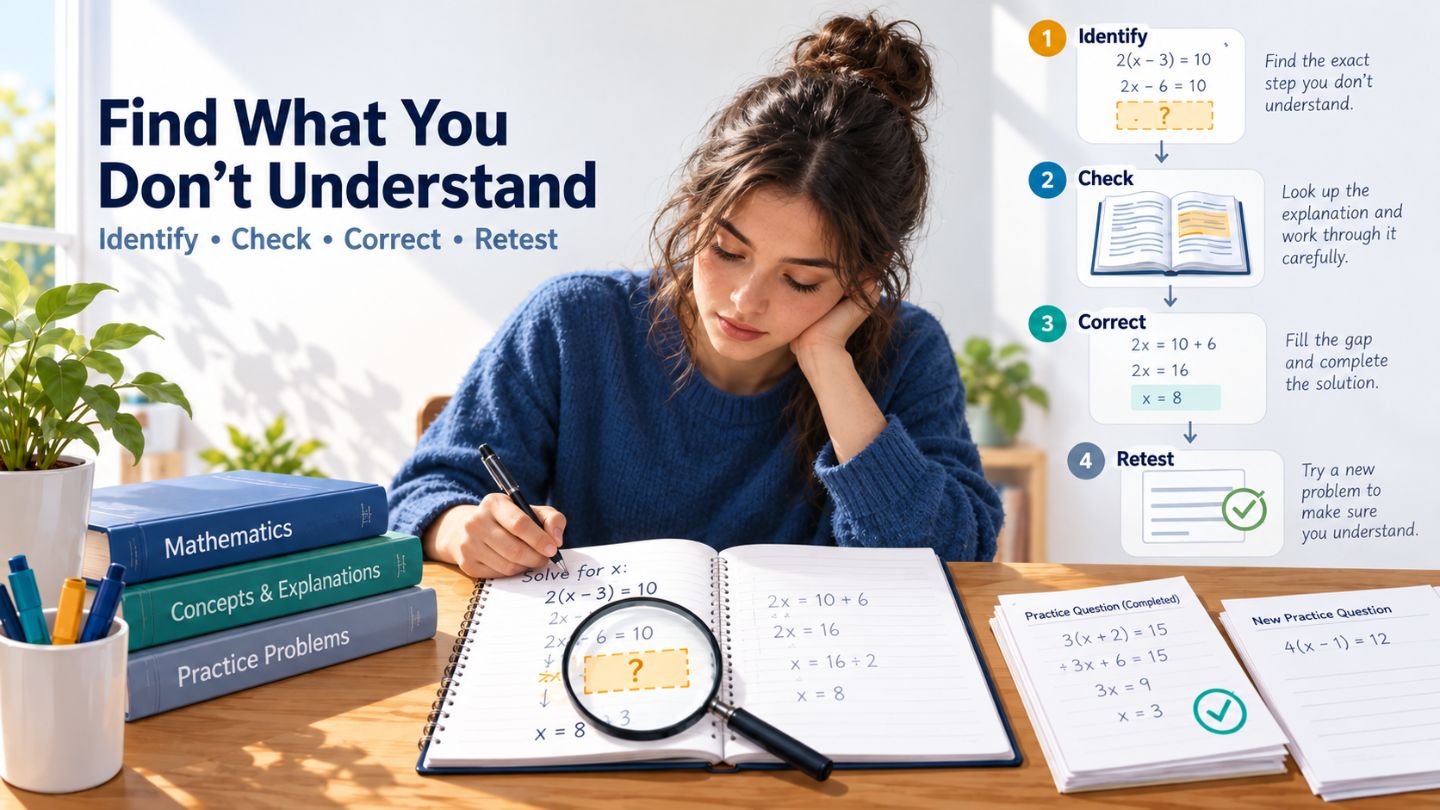
Focus on understanding the process rather than completing many questions as quickly as possible. Review mistakes carefully, identify where the reasoning changed direction, and try a similar problem again.
Regular, focused practice is usually more helpful than attempting a large amount of work just before a test.
4. Seek Support
Ask a teacher to explain a concept in another way or demonstrate an additional example. Study with a patient classmate, attend tutoring sessions, or use reliable learning materials suited to your level.
Support should help you understand the reasoning rather than simply provide the answer. A calm teacher, parent, mentor, or study partner can also help create an environment in which questions and mistakes are treated as normal.
If the anxiety is persistent, severe, or affecting other areas of daily life, consider speaking with a school counsellor or another qualified mental-health professional.
5. Prepare for Tests
Good preparation cannot remove every nervous feeling, but it can reduce uncertainty.
Start studying early, divide the material into smaller sections, practise different types of questions, and review topics that cause difficulty. During revision, practise explaining each step aloud or writing down why a method works.
Before answering a test question, read it carefully, identify the information provided, and decide what the question is asking. Start with a question you can manage if the test format allows it. This may help you settle into the task.
6. Manage the Stress Response
When anxiety rises, pause briefly. Relax your shoulders, breathe slowly, and focus on the next step rather than the entire task.
You can also use simple, realistic self-talk:
-
“I only need to begin with the first step.”
-
“It is acceptable to take my time.”
-
“One difficult question does not determine my ability.”
-
“I can return to this problem later.”
Relaxation strategies may help you regain focus, but they work best when combined with effective teaching, practice, and academic support.
7. Notice Progress
Do not measure improvement only through marks. Progress can also mean asking a question in class, attempting a problem you previously avoided, correcting an error, remaining calm for longer, or understanding one new concept.
Recognising these small improvements can strengthen confidence and make continued practice easier. Research on interventions suggests that maths-focused training and approaches addressing anxious thoughts can reduce maths anxiety for some learners, although no single method works equally well for everyone.
Conclusion
Maths anxiety is a genuine and common learning difficulty. It can affect concentration, confidence, participation, performance, and future academic choices. However, it does not mean that a person is incapable of learning mathematics.
By recognising anxious feelings, questioning negative beliefs, practising gradually, preparing effectively, seeking support, and responding calmly to mistakes, learners can begin to change their relationship with maths.
The goal is not to complete every problem without difficulty or to remove every nervous feeling. The goal is to approach mathematics with greater patience, curiosity, and confidence.
Maths is not a test of personal worth. It is a subject that can be learned one idea, one question, and one step at a time.






Comments 0
No comments yet. Be the first to start the conversation.