



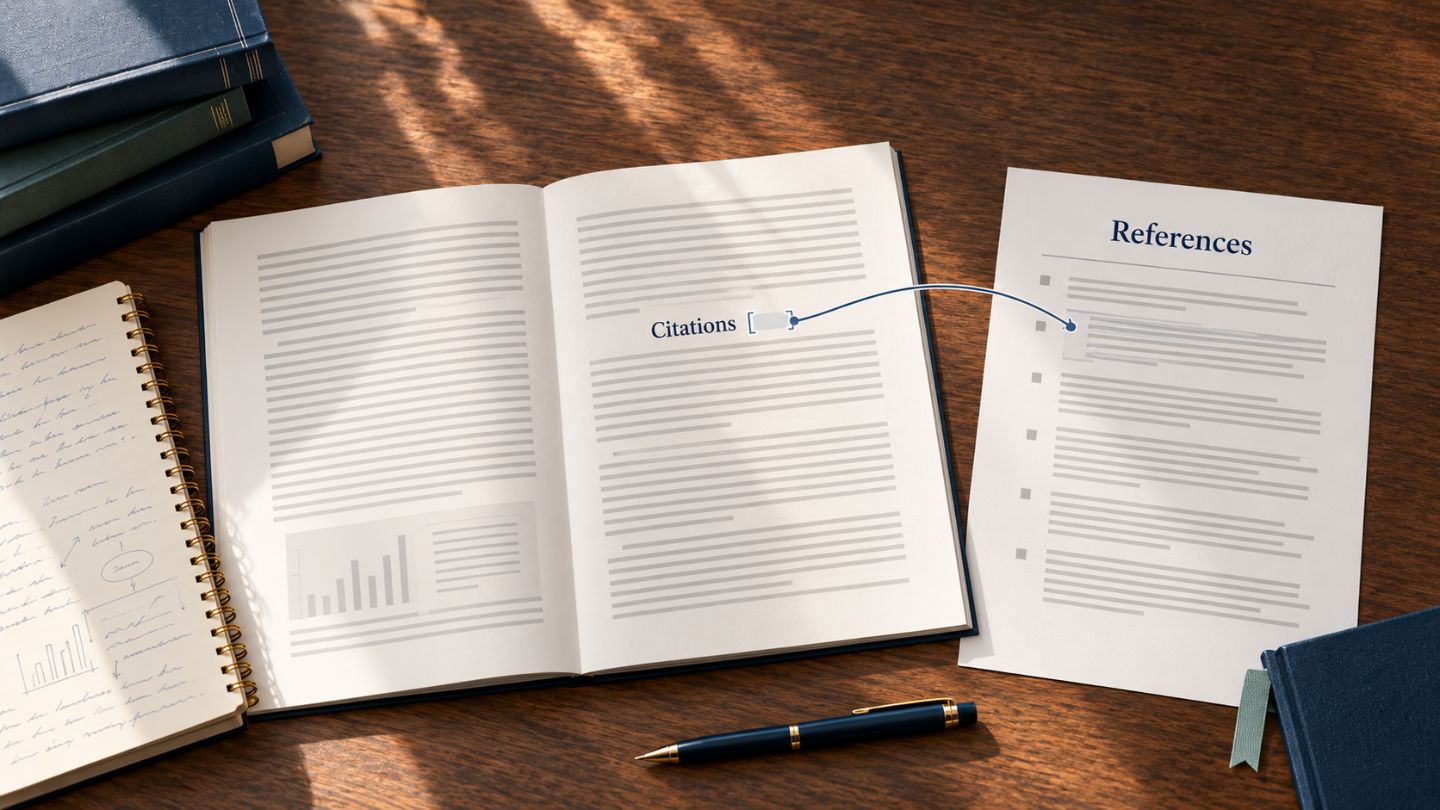
Citations and references help readers identify where information comes from, assess the evidence behind an argument, and locate the original sources. They are essential to academic writing because research builds on existing knowledge, ideas, and findings.
Whether preparing an essay, research paper, thesis, dissertation, or professional report, writers need to distinguish their own analysis from information obtained elsewhere. This involves more than inserting an author's name or preparing a list of publications at the end.
Effective referencing requires accurate source information, consistent formatting, appropriate attribution, and careful evaluation of evidence. The method also varies according to the citation style required by a university, journal, or professional organization.
Understanding these principles helps writers communicate research clearly while respecting the intellectual contributions of others.
Answer Summary: Citations identify the sources of information, ideas, quotations, and evidence used within a document. References provide the bibliographic details needed to locate those sources. Accurate citation involves choosing an appropriate referencing style, acknowledging borrowed material, checking source credibility, and ensuring that every in-text citation corresponds to the correct reference entry. Common systems include APA, MLA, and Chicago, each with its own formatting requirements.
What Are Citations and References?
Citations and references are related components of academic documentation, but they serve different purposes.
A citation identifies the source of borrowed information at the point where it appears in the writing. Depending on the citation style, it may contain an author's name, publication year, page number, or a numbered note.
A reference provides more detailed publication information, allowing readers to identify and locate the original material.
For example, a research paper may mention findings from a published study and provide an in-text citation. The corresponding reference entry identifies the study's author, title, publication, date, and other required details.
Three terms are worth distinguishing:
-
In-text citation: A brief acknowledgment of a source within the main text.
-
Reference list or Works Cited: A list identifying the works cited in the document, formatted according to the required style.
-
Bibliography: A list of sources that may include both cited works and additional materials consulted, depending on the citation system and assignment requirements.
These terms are not interchangeable in every citation style. APA generally uses a reference list, MLA uses Works Cited, and Chicago provides both bibliography-based and reference-list systems.
Why Are Citations and References Important?
Accurate citations make academic work transparent. They show which information comes from existing sources and which interpretation belongs to the writer.
Supporting Arguments with Evidence
Academic arguments require evidence that readers can examine.
A claim supported by a relevant research publication is easier to evaluate than one presented without attribution. Citations identify the material behind a statement and allow readers to assess whether the source supports the interpretation.
However, citing a publication does not automatically make a claim reliable. Writers must examine whether the evidence is relevant, accurately represented, and sufficient for the conclusion.
Avoiding Plagiarism
Plagiarism occurs when someone presents another person's words, ideas, or work as their own without appropriate acknowledgment.
It can involve copying text, reproducing distinctive ideas without attribution, or paraphrasing too closely to the original.
Proper citation establishes ownership of borrowed material. Direct quotations also require appropriate quotation formatting, while paraphrases must genuinely express the source's meaning in new wording.
For further guidance, see academic writing mistakes and how to avoid them
Helping Readers Verify Information
A reference allows readers to locate a source, examine its methodology, review the original context, and determine whether the writer has interpreted it correctly.
Complete references also make research easier to reproduce, evaluate, and extend.
Acknowledging Intellectual Contributions
Research develops through engagement with earlier scholarship.
Citations recognize the contributions of researchers, authors, organizations, and other creators whose work informs a discussion. They also help distinguish established findings from new interpretations.
When Should You Cite a Source?
A citation is generally required when writing relies on information, ideas, or material obtained from another source.
Common situations include:
-
Quoting an author's exact words.
-
Paraphrasing another person's argument or explanation.
-
Summarizing findings from a study, book, or report.
-
Presenting statistics, research results, or specialized factual claims.
-
Using another creator's tables, figures, images, or data.
-
Referring to a distinctive theory, framework, interpretation, or research method.
Common knowledge generally does not require citation. For instance, a widely established geographical fact usually needs no reference in an ordinary educational essay.
However, what counts as common knowledge depends on the subject, audience, and assignment. A specialized scientific explanation may need a source even when experts in that field consider it familiar.
When uncertain, consider whether readers would reasonably expect evidence or need to identify the origin of a claim.
The American Psychological Association's guidance on in-text citations explains how attribution applies to paraphrases, direct quotations, and other uses of source material.
Understanding Different Citation Styles
Citation styles establish consistent rules for acknowledging sources. They determine how citations appear in the text and how publication details are arranged in the reference list.
Three widely used academic systems are APA, MLA, and Chicago.
|
Citation Style |
Common Applications |
Citation Method |
|---|---|---|
|
APA |
Psychology, education, and social sciences |
Author–date citations |
|
MLA |
Literature, languages, and humanities |
Author and location, commonly page number |
|
Chicago |
History, humanities, and other disciplines |
Notes and bibliography or author–date |
APA Citation Style
American Psychological Association (APA) style uses an author–date system.
An ordinary parenthetical citation includes the author's surname and publication year. When citing a direct quotation, a page number or another appropriate location marker is generally required.
For example, an APA citation to the association's official citation guidance can appear as:
(American Psychological Association, 2024). https://apastyle.apa.org/style-grammar-guidelines/citations
APA reference entries generally include the author, date, title, and source information. The required elements depend on the publication type.
Its official guidance is based on the seventh edition of the APA Publication Manual.
MLA Citation Style
Modern Language Association (MLA) style connects brief in-text citations to entries on a Works Cited page.
Citations commonly use the author's surname and a page number when the source has relevant pagination.
Unlike APA, the publication year is not ordinarily part of the basic parenthetical citation.
If an author's name appears naturally in the sentence, the parenthetical citation may contain the page number alone.
When a source has no author, MLA uses the first element of the Works Cited entry, generally its title, to identify the work.
The MLA Style Center's in-text citation guidance explains these conventions and provides examples based on the ninth edition of the MLA Handbook.
Chicago Citation Style
The Chicago Manual of Style provides two principal citation systems.
The notes and bibliography system uses numbered footnotes or endnotes to identify sources. A separate bibliography is generally included.
The author–date system uses brief parenthetical citations containing the author's surname and publication year, with corresponding entries in a reference list.
The appropriate system depends on disciplinary conventions, publisher requirements, or institutional instructions.
The official Chicago-style citation guide explains both systems and provides examples for different source types.
How to Choose the Appropriate Style
Writers should follow the citation style specified by their instructor, university department, journal, or publisher.
When no style is prescribed, consider the conventions of the discipline and the intended publication.
Using one citation system consistently is more important than selecting a style based solely on personal preference.
How to Cite Different Types of Sources
The information required in a reference depends on the source type and citation style.
A book, journal article, webpage, and institutional report do not necessarily follow the same format.
Books
Book references generally identify the author, title, publisher, and publication year.
Some citation systems also require the edition, translator, editor, or other information when relevant.
Before preparing a reference, check the book's title page and publication details.
Use the publication year and edition of the version consulted. Different editions may contain revised arguments, updated information, or different page numbers.
Modern APA and MLA styles do not ordinarily require the publisher's city or location for standard book references.
Journal Articles
Journal article references commonly include:
-
Author names
-
Article title
-
Journal title
-
Publication year
-
Volume and issue numbers, where applicable
-
Page range or article number
-
Digital Object Identifier (DOI), when available and required
A DOI is a persistent identifier assigned to a digital object, including many scholarly publications.
Crossref recommends presenting its DOI links in a complete URL format, such as https://doi.org/ followed by the registered identifier. This allows readers to follow a persistent link to the publication.
Writers should copy the actual DOI from the publication or a reliable registration record rather than constructing one.
Websites and Online Articles
Web references require careful attention because authorship and publication details are not presented consistently across websites.
Depending on the citation style, a webpage reference may include its author or organization, title, website name, publication or update date, and URL.
Identify the author of the specific page rather than assuming that the website owner wrote it.
When no individual author is listed, the citation style may require an organizational author or an entry beginning with the page title.
A missing publication date should not be replaced with an estimated year.
Some citation styles use an abbreviation indicating that no date is available. Retrieval or access dates may also be necessary for particular types of online content.
Reports, Theses, and Institutional Documents
Reports and academic theses may require additional identifying information.
A report reference may include the issuing organization, report title, publication year, report number, and publisher or URL.
A thesis or dissertation reference may identify the awarding institution, degree type, repository, or database.
Institutional reports should be checked for the correct issuing body and document version, particularly when revised editions exist.
How to Integrate Citations Naturally
Citations should support the flow of an argument rather than interrupt it unnecessarily.
Writers can introduce sources through signal phrases, paraphrasing, and direct quotations.
Using Signal Phrases
A signal phrase identifies the source before presenting its information.
For example:
According to the American Psychological Association (2024), scholarly writing should acknowledge how previous work contributes to the writer's discussion.
This approach makes the source's role clear while connecting the reference to the sentence.
Signal phrases can also distinguish between different kinds of evidence.
Useful reporting verbs include argues, explains, reports, observes, concludes, and suggests. Choose a verb that accurately reflects what the source does.
For instance, describing a study as proving a conclusion may overstate findings that establish only an association.
Paraphrasing Without Changing the Meaning
Paraphrasing means expressing source material in original wording and sentence structure while preserving its meaning.
A sound paraphrase should:
-
Reflect the source accurately.
-
Use genuinely independent wording.
-
Avoid unnecessary copying of distinctive phrases.
-
Include the required citation.
-
Fit the argument being developed.
Changing a few words in an existing sentence is not sufficient paraphrasing.
One practical method is to read the relevant passage, identify its central meaning, write an independent explanation, and then compare the result with the original for accuracy.
The citation remains necessary because the underlying idea still comes from another source.
Using Direct Quotations
Direct quotations preserve the original wording.
They are appropriate when the exact language matters, such as when analyzing a definition, discussing a specific statement, or examining an author's interpretation.
Quotations require quotation marks or block-quotation formatting, depending on their length and the applicable style.
The citation should provide a sufficiently precise location when the style requires it.
In APA, direct quotations generally require a page number or another appropriate locator. MLA likewise uses available location information, including page numbers, to identify quoted passages.
Avoid relying on lengthy quotations when a concise paraphrase would communicate the information more effectively.
How to Prepare an Accurate Reference List
A reference list provides the publication details needed to locate cited works.
A careful process helps prevent missing entries, incorrect author information, and inconsistent formatting.
Record Source Information During Research
Create a source record when first consulting a publication.
Save the author, title, publication date, publisher or journal, and relevant identifier or URL.
For books, record the edition. For journal articles, note the volume, issue, and page range or article number.
When taking notes, separate direct quotations from paraphrases and personal observations.
This distinction reduces the risk of accidentally presenting copied wording as original writing.
Match Citations to Reference Entries
Every in-text citation that requires a reference-list entry should correspond to the correct source.
For APA and MLA, cited works generally appear in the accompanying reference list or Works Cited page, subject to style-specific exceptions.
Check author names, dates, and titles carefully. If a reference is removed or replaced during editing, examine the corresponding text citations.
Follow the Required Arrangement
APA and MLA generally arrange entries alphabetically, while Chicago's notes and bibliography system generally uses an alphabetized bibliography.
Other systems, including numbered citation styles, may arrange references according to the order in which sources first appear.
Formatting details such as capitalization, italics, punctuation, indentation, and author-name order must follow the selected style.
Check Each Entry Against the Original
Before submitting a document, compare the reference information with the actual publication.
Confirm that:
-
Author names appear correctly and in the correct order.
-
Titles match the publication.
-
Dates, volume numbers, and issue numbers are accurate.
-
Page ranges or article identifiers are correct.
-
DOI links and URLs lead to the intended sources.
-
The reference format follows the required style.
An accurate reference depends on correct source information as well as correct punctuation.
How to Evaluate the Credibility of Sources
Proper citation does not compensate for weak evidence. Writers must assess the quality and suitability of the material they use.
Examine the Author and Publisher
Identify who produced the material and whether they have relevant knowledge or institutional responsibility.
Academic publications, official documents, and research reports may offer useful evidence, but their credibility should still be assessed individually.
Peer review can provide an additional quality check, although it does not guarantee that a study is free from limitations or errors.
Assess the Evidence and Methodology
Determine how the source supports its conclusions.
For research studies, examine the methods, sample, analysis, and stated limitations where relevant.
A publication's findings should not be extended beyond the population, conditions, or outcomes it actually examined.
Consider Relevance and Currency
A source should be appropriate for the question being investigated.
Recent evidence is often necessary when discussing changing policies, technology, or current research findings.
Older publications may remain important when discussing established theories, original discoveries, or historical developments.
The goal is to use sources that are accurate and suitable for the argument, not automatically to favor the newest publication.
Common Citation and Referencing Mistakes
Several avoidable errors reduce the accuracy and usefulness of academic references.
Incomplete or Incorrect References
Missing authors, incorrect publication dates, inaccurate titles, and broken URLs can make sources difficult to locate.
Check the publication itself rather than relying entirely on citation information copied from another website.
Mixing Different Citation Styles
Combining APA author–date citations with MLA Works Cited formatting creates inconsistency.
Select the required style before drafting and apply it throughout the document.
Citing Sources That Do Not Support the Claim
A citation should support the specific statement to which it is attached.
Before adding a reference, confirm that the publication contains the relevant evidence and that the argument does not misrepresent its findings.
Citing a Secondary Source as the Original
Writers sometimes discover an important claim through a publication that discusses an earlier study.
Whenever practical, consult the original work before citing it directly.
If the original is unavailable, follow the chosen style's rules for secondary citations rather than implying that the original source was examined.
Overusing Citations or Quotations
Excessive quotations can obscure the writer's own analysis.
Likewise, repeating identical citations unnecessarily can disrupt readability.
Use enough attribution to make the origin of each borrowed idea clear. When discussing several ideas from one source, ensure the citation placement leaves no ambiguity about their origin.
Using Reference Management Software
Reference management software can help writers collect, organize, and format sources.
Applications such as Zotero, Mendeley, and EndNote support citation-related tasks, although their specific functions and integrations differ.
Zotero, for example, allows users to save bibliographic records, organize materials into collections, and insert citations and bibliographies through supported word processors.
Such tools can reduce repetitive formatting work, particularly in documents containing numerous sources.
However, automated references still require verification.
Imported records may contain incomplete author names, incorrect publication details, or formatting errors. Zotero's own documentation advises users to review bibliographic metadata after importing it.
Reference software assists with documentation; it does not establish whether a source is credible or whether the evidence supports a particular argument.
The writer remains responsible for these judgments.
A Practical Citation Checklist
Before submitting an academic document, review the citations and references separately from the main text.
-
Have all borrowed ideas, findings, quotations, and relevant data been acknowledged?
-
Are paraphrases written independently without changing the source's meaning?
-
Do direct quotations follow the required formatting and location rules?
-
Does each citation identify the correct publication?
-
Are reference entries complete and consistent?
-
Do DOI links and URLs direct readers to the intended material?
-
Are source claims represented accurately?
-
Has the required citation style been followed throughout?
-
Have automatically generated references been checked against original sources?
This review should take place after the main content has been edited, since revisions can introduce or remove citations.
Conclusion
Mastering citations and references requires accurate attribution, careful source evaluation, and consistent documentation.
Effective referencing allows readers to distinguish original analysis from borrowed material and examine the evidence behind a writer's conclusions.
The essential practices are straightforward: identify sources while researching, cite borrowed information where it appears, prepare complete reference entries, and check the finished document against the required style guide.
These habits support clear, responsible academic writing and make research easier to examine and build upon.





Comments 0
No comments yet. Be the first to start the conversation.