



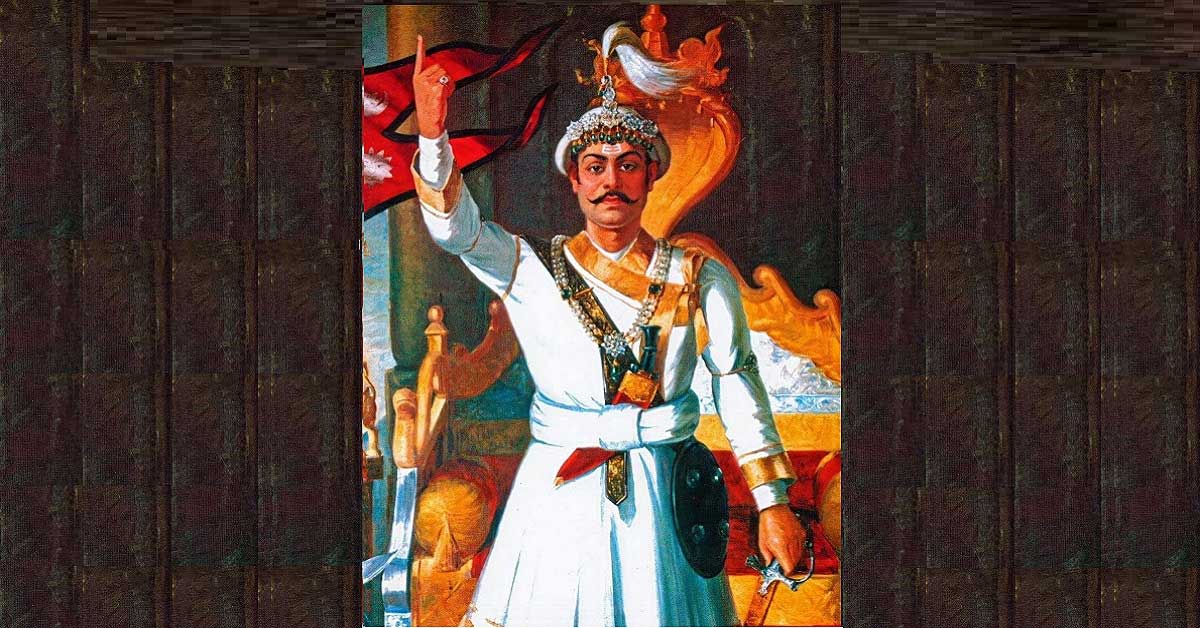
Prithvi Jayanti and Nepal’s National Unity
Prithvi Narayan Shah, born on BS 1799 Poush 27 as the successor of the Gorkha state, is the pioneer of Nepal’s unification in the modern era. Although National Unity Day used to be observed on the occasion of the nation-builder’s birth anniversary, there was a declaration at the republican national level that Prithvi Jayanti would not be observed. In recent days, there has again been a renewed effort to remember Nepal’s creator. In reality, the primary element is the country.
Those who have sacrificed, undertaken hardship, and shown dedication for the making of Nepal should not have their remembrance blocked by a political system. In truth, in any nation-state, the “nation-builder” stands above any “ism” and any system. Prithvi Narayan is an immortal national personality whom Nepal and Nepalis must remember as the pioneer of national unification and as the campaigner who built Nepal out of fragmentation.
National Unity Day (Rastriya Yekata Diwas) and Prithvi Jayanti should be celebrated every year in schools and universities as well, with various analytical seminars, in a grand manner. Nations that gained independence from colonial rule celebrate Independence Day; we have the tradition of celebrating National Unity Day and Prithvi Jayanti.
For Nepal and Nepalis, the guidance Prithvi Narayan suggested in Nepal’s context is more important than philosophers such as Socrates, Plato, Aristotle, Marx, and Lenin. If we do not show respect to our values, traditions, nation-builders, statesmen, creators, literature, writers, and martyrs, who will? If, in the name of a new Nepal, we forget all values, traditions, nation-builders, statesmen, creators, literature, writers, and martyrs, or if society becomes indifferent to them, how will our pride, prosperity, identity, existence, and unity remain?
Every country has distinct politics, geography, history, and culture. Across the world, history begins with kings; this is a universal general characteristic found in history. Prithvi Narayan can be compared with India’s Samudragupta, Italy’s Cavour, Garibaldi, and Mazzini, and Germany’s Bismarck. All are campaigners of unification and nation-builders of their respective nations.
Although Prithvi Narayan and Samudragupta carried out political unification through military victories, Samudragupta was focused on imperial expansion, whereas Prithvi Narayan was focused on building a sovereign nation-state. Cavour, Garibaldi, and Mazzini were democratic and ideological leaders of Italy’s unification, while Prithvi Narayan sought to build the nation through a monarchical medium. Both Bismarck and Prithvi Narayan used realist politics, diplomacy, and military power, but Bismarck built a modern nation based on industry. Even though the historical contexts differ, the shared objective of these statesmen was national unification.
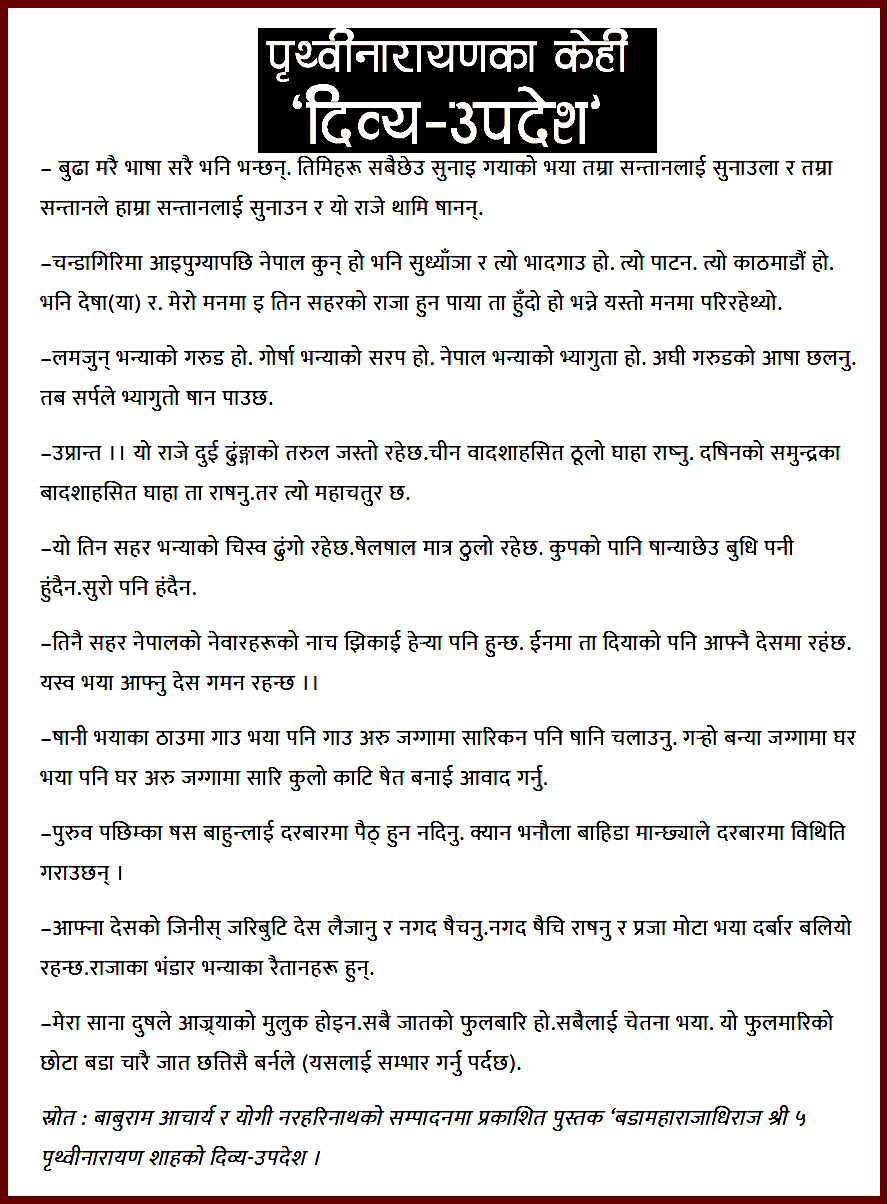
While observing Prithvi Jayanti and National Unity Day, it is relevant even today to discuss the still-relevant Divyopadesh for Nepal and Nepalis. According to Nayaraj Pant, when the manuscript was first found, it had no name. Baburam Acharya gave it the name “Lecture of Prithvi Narayan Shah.” The person who named it “Divyopadesh” is Yogi Naraharinath. Nayaraj Pant, however, named it “Advice of Shri 5 Prithvi Narayan Shah.”
Prithvi Narayan’s intention was not only the expansion of the state; he is a nation-builder. The statements he suggested through Divyopadesh are still relevant today in the context of Nepal’s broader national interest, social, economic, political, foreign policy, and good governance.
Therefore, Prithvi Narayan is respectfully remembered as Nepal’s far-sighted ruler, and he should be. Divyopadesh is considered the foundation of Nepal’s early political philosophy and political practice. When analyzing Divyopadesh, two different perspectives are seen regarding its long-term impact and its approach to borders. Some scholars have taken it as Nepal’s “first constitution,” which provides strategic guidance necessary to protect national identity and sovereignty. This text urges national unity, self-reliance, and caution toward neighboring countries. The approach of adopting balanced diplomacy between powerful neighboring nations still appears relevant in Nepal’s foreign policy today. Based on the main ideas of Divyopadesh, Prithvi Narayan’s characteristics can be explained as follows.
His greatest contribution: Nepal’s unification
His greatest contribution is the unification of Nepal. When he was the king of Gorkha, there were the states of Kantipur, Lalitpur, and Bhaktapur in the middle of Nepal. To the east were three states named Makwanpur, Chaudandi, and Vijaypur, and to the west, on the banks of the Gandaki River, there were twenty-four and twenty-two states including Kaski, Parbat, Palpa, and Gorkha; therefore, they were called the Baise states. It is Prithvi Narayan alone who deserves the credit for initiating the re-unification of a vast, divided Nepal by using long-term strategy, military power, diplomacy, and economic blockade against dozens of small states (the Baise-Chaubise principalities, the Sen states of the east, and the Malla states of the Kathmandu Valley).
Unification established Nepal as a sovereign, organized nation with a centralized governing system. This text presents a clear vision of how to transform small states in a fragmented condition into a unified nation-state. Although some scholars have considered Shah’s unification campaign expansionist, this campaign was historically indispensable for the construction of modern Nepal.
Balanced foreign policy as a basis of progress
The prosperity and progress of any nation also depend on a successful foreign policy. In the then context, the nation-builder emphasized the need to determine a balanced and an unbalanced foreign policy. Describing Nepal as a yam between two boulders, he is seen expressing the idea that balanced diplomacy should be adopted toward the north and the south.
“Maintain deep relations with the Emperor of China; maintain relations with the Emperor of the sea of the Dapins as well. But he is very shrewd; he is suppressing Hindustan and has remained in the Sarjimi. If Hindustan awakens, it will be difficult, so he will come seeking forts and alliances. Watching the circumstances, strengthen the forts, and place check-posts along the routes. One day that force will come.”
“Do not go and attack; make a measured strike.”
The idea of making the country self-reliant
He put forward the idea that, to strengthen the state treasury, the economy should be developed based on agriculture, herbs, and mines.
“Take the goods and herbs of your own country out of the country and do not let cash leave; keep cash within.”
“Even if there are villages in the places where mines exist, relocate the villages elsewhere and continue the mining.”
“Even if there are houses on difficult land, relocate the houses elsewhere, cut canals, make fields, and cultivate.”
People as the foundation of the state
Since the people are the foundation of the state, he is seen pointing out the need to protect the people and ensure just governance. Unlike the declaration attributed to France’s Louis XVI, “I am the state,” this not only differs but also appears democratic.
“Give authority to the one whom the people are pleased with.”
“If the subjects are strong, the palace remains strong.”
“The king’s treasury is the subjects.”
Nepali national unity and the rise of nationalism are linked to Prithvi Narayan’s reign. According to S.D. Muni, Prithvi Narayan completed the geographical and political unification of the country and tried to create a feeling of unity among the people. This text presents a clear vision of how to transform small states in a fragmented condition into a unified nation-state. Although some scholars have considered Shah’s unification campaign expansionist, this campaign was historically indispensable for the construction of modern Nepal. In this context, one of Prithvi Narayan’s sayings is relevant.
“This country was not earned by my small hardship; it is a garden of flowers of all castes. Let everyone become aware.”
Firm stance against injustice and corruption
“Do not allow injustice to happen in the country. Those who spoil the state are the ones who give bribes and the ones who take bribes. There is no sin even if the wealth of these two is confiscated. They are the great enemies of the king.”
This saying clearly shows Prithvi Narayan Shah’s firm policy against corruption and his commitment to good governance. According to him, both bribe-givers and bribe-takers are harmful to the nation; therefore, the state must be strict against them. This quotation is not only universal and timeless in importance but also indisputable.
Deep faith in national culture
The nation-builder had profound faith and love for national culture. Culture is a broad perspective: traditions, art, dance, values, beliefs, customs, conditions, economic policy, politics, food practices, and everything humans have developed all fall within culture. He emphasized not only providing equal opportunity to the cultures of all ethnic groups within the nation but also their preservation.
Relevance for the new generation
Nepal’s new youth generation (Gen Z) is close to international ideologies through social media. Inspired by various concepts, they appear attracted toward development, but it is not certain that all those ideas always match Nepal’s specific social, cultural, and historical context. The energy and awareness of the new youth generation are powerful foundations of change, but those forces need to be directed toward nation-building.
Divyopadesh is not a rigid document; rather, it is a realistic and future-oriented guiding principle based on Nepali originality. Divyopadesh mentions how Nepal’s sovereignty, strengthening of the economy, and preservation of cultural heritage can be ensured. Therefore, for the new youth generation, the study of this text appears indispensable.
In Divyopadesh, the approach to governance is presented as a combination of classical political theory and practical administrative reality. Embracing the concept of a Hindu state, his effort was to establish the Gorkhali language and hill culture as a thread of national unity. Although the governing system was semi-feudal in nature, for Nepal, which was in a geopolitically sensitive situation, it provided socio-political stability.
Without such unification, in the colonial era Nepal could have easily fallen under foreign powers. Although some critics today consider his policies and strategies imperialist, those policies clearly show deep concern for national unity, cultural integrity, and sovereignty. Those who hold differing views argue that excessive reliance on such traditional principles can obstruct the process of modernization and create obstacles to the development of inclusive and democratic practice.
In the view of some critics, since the historical context of Divyopadesh is based on military victory and centralization, some have considered it a process more oppressive than unification. Viewed in a broader historical context, Divyopadesh is a foundational document of the Nepali state system. In evaluating it, rather than applying its principles exactly as they are, it is necessary to reinterpret and transform them according to contemporary needs.
Prithvi Narayan created a shared foundation for Nepali identity and political unification. The concepts of cultural protection, strategic independence, and good governance expressed in that text remain politically important in modern Nepal as well. His diplomatic foresight and nationalist thinking have made Prithvi Narayan an unforgettable historical figure of Nepal.







Comments 0
No comments yet. Be the first to start the conversation.