




Colleges and universities can use artificial intelligence responsibly by linking each proposed use to a legitimate educational or operational purpose, assessing its risks before approval, protecting institutional and personal data, assigning accountable decision-makers, and monitoring the system after deployment.
This task extends beyond deciding whether students may use a generative AI tool. Artificial intelligence may appear in learning platforms, research software, analytics, admissions processes, student-support services, administrative systems, security products, and features added to software already under contract.
Institutional policy development remains uneven. UNESCO’s 2025 higher-education survey received 400 responses from UNESCO Chairs and UNITWIN Networks across 90 countries. Nineteen per cent of respondents said their institutions had a formal AI policy, while 42% said guidance was under development. UNESCO reported a 38% response rate, so the findings describe the responding network institutions rather than the entire global higher-education sector.
Responsible adoption therefore requires more than an acceptable-use policy. It involves governance, system inventories, risk classification, data protection, procurement review, assessment design, research integrity, accessibility, AI literacy, human accountability, incident management, appeals, and continuing review.
Answer Summary: Responsible AI in higher education is a repeatable institutional practice. A college or university should define why an AI system is needed, record where and how it is used, classify its risks, apply proportionate safeguards, and keep qualified people accountable for consequential decisions. It should also set clear teaching and research rules, examine vendors and embedded features, provide accessible alternatives, monitor outcomes, and withdraw systems whose risks cannot be controlled.
Table of Content
- What Responsible AI Means in Higher Education
- Start With Institutional Values and Learning Outcomes
- Create Cross-Functional AI Governance
- Build an Inventory of AI Systems and Use Cases
- Classify Risk Before Approval
- Protect Privacy, Security, and Confidential Information
- Review Vendors and Embedded AI Features
- Set Clear Rules for Teaching, Learning, and Assessment
- Build AI Literacy for Each Role
- Protect Research Integrity
- Keep People Accountable in High-Impact Decisions
- Design for Equity, Accessibility, and Inclusion
- Monitor Performance, Incidents, and Outcomes
- Responsible AI Use-Case Matrix for Higher Education
- A 12-Month Institutional Action Plan
- Practices Colleges and Universities Should Avoid
- Responsible AI Checklist for Institutional Leaders
- Purpose, Accountability, and Review Define Responsible Use
Key Takeaways:
-
Begin with educational purpose rather than product availability.
-
Record systems, pilots, integrations, and embedded AI features.
-
Apply stronger safeguards as impact and data sensitivity increase.
-
Keep accountable people in charge of consequential decisions.
-
Review vendors, contracts, accessibility, data use, and exit conditions.
-
Give students and staff role-specific rules and training.
-
Monitor outcomes, complaints, incidents, and material system changes.
What Responsible AI Means in Higher Education
Responsible AI in higher education is an institutional approach that aligns AI use with educational purpose, human rights, academic standards, accountability, privacy, fairness, transparency, security, accessibility, and proportionate safeguards.
Artificial intelligence is an umbrella term rather than one uniform technology. Generative systems produce text, images, audio, code, or other content. Predictive systems estimate possible outcomes. Recommendation systems suggest actions or resources. Automated systems perform defined processes, sometimes with an AI component.
These systems do not present identical risks. A writing assistant used with public information differs materially from a system that influences admission, final grades, employment, discipline, or student welfare.
UNESCO’s Recommendation on the Ethics of Artificial Intelligence identifies proportionality, safety, privacy, accountability, transparency, human oversight, fairness, sustainability, and multi-stakeholder governance as core principles. It also states that AI systems should not displace ultimate human responsibility and accountability.
Apply the Purpose Test
An institution should define the problem before evaluating a product.
Decision-makers should ask:
-
What educational or operational outcome is intended?
-
Is AI necessary for that outcome?
-
Can a non-AI process meet the need with less risk?
-
What evidence would show that the use is helping?
-
Could it weaken learning, service quality, academic judgement, or human relationships?
-
Who receives the benefit, and who carries the risk?
Using AI to prepare draft practice questions for faculty review has a different purpose and impact from allowing a system to decide whether a student should progress.
Apply the Proportionality Test
Safeguards should reflect possible harm, data sensitivity, scale, the affected population, reversibility, and the difficulty of explaining or challenging an outcome.
The NIST AI Risk Management Framework organizes risk work around four functions: Govern, Map, Measure, and Manage. NIST describes the framework as voluntary and suitable for use across sectors. Colleges and universities must therefore adapt it to their responsibilities, resources, and legal settings rather than treat it as a universal compliance standard.
Translate Principles Into Institutional Controls
Ethical principles become operational when they lead to decisions, records, named owners, and review.
| Principle | Institutional question | Practical control | Accountable owner | Evidence to retain |
|---|---|---|---|---|
| Educational purpose | What legitimate outcome does the use support? | Written purpose and evaluation criteria | Academic or service owner | Use-case proposal and evaluation plan |
| Proportionality | Are AI and its risks justified by the need? | Alternatives analysis and risk classification | Use-case owner and review body | Risk assessment and approval decision |
| Privacy and security | What information enters or leaves the system? | Data classification, access controls, and retention limits | Privacy and security leads | Data-flow record and security review |
| Fairness and inclusion | Could groups face different barriers or outcomes? | Accessibility review, user testing, and alternatives | Accessibility and equality functions | Test findings and remediation record |
| Transparency | What do affected people need to understand? | Plain-language notices and disclosure rules | Academic, service, or communications owner | Notices and guidance |
| Human accountability | Who can accept, reject, or change the output? | Named decision-maker and escalation route | Responsible institutional officer | Decision and review record |
| Auditability | Can the institution reconstruct what occurred? | Logging, version records, and documentation | System and records owners | Audit trail and change history |
| Sustainability | Is resource use proportionate to institutional value? | Comparison with lower-resource alternatives | Procurement and service owner | Options and usage assessment |
This model turns abstract commitments into controls that can be assigned, documented, monitored, and revised.
Start With Institutional Values and Learning Outcomes
Responsible adoption should begin with the institution’s mission, academic standards, and intended learning outcomes.
An AI system may produce polished output or shorten a task without strengthening education. Academic teams should examine whether an AI-supported activity helps students demonstrate the knowledge, reasoning, creativity, professional judgement, or practical ability that a programme is intended to develop.
This distinction matters in assessment. When an assignment evaluates independent analysis, AI should not replace that analysis. Another assignment may intentionally evaluate whether students can question, verify, disclose, and improve machine-generated material.
Evidence about AI-supported learning varies by system, learner, discipline, task, instructional design, available support, and measured outcome. Institutions should not claim that AI consistently improves learning, access, fairness, productivity, or efficiency without evidence from the relevant use.
Academic teams examining this issue in greater depth can review how AI affects student learning outcomes and compare the reported benefits with the limitations of different learning designs.
A useful approval rule is:
Approve an educational use when the institution can explain how it supports the intended learning outcome and how that effect will be evaluated—not merely because its output appears useful.
Create Cross-Functional AI Governance
AI governance should involve the functions that own educational, technical, legal, ethical, financial, accessibility, and operational risks.
It should not sit solely with an information technology team, academic-integrity office, or temporary committee. A central body can coordinate decisions, but named offices and individuals should remain responsible for actions and outcomes.
Establish Policy Layers and Decision Rights
A workable structure may include:
-
An institution-wide baseline covering purpose, accountability, data, procurement, prohibited practices, and reporting.
-
Domain guidance for teaching, research, admissions, student services, human resources, communications, and administration.
-
Programme, course, and assessment rules defining permitted, restricted, prohibited, and disclosure-required use.
-
Operational procedures for approval, testing, monitoring, incident response, complaints, appeals, and retirement.
This arrangement provides institutional consistency while allowing justified differences between disciplines and services.
Define Who Owns Each Decision
| Role | Main accountable decisions | Functions to consult | Records required |
|---|---|---|---|
| Governing body or executive sponsor | Institutional risk boundaries, resources, and oversight | Academic, technology, legal, student, and governance functions | Strategy decisions and risk reports |
| Provost or academic leader | Teaching, assessment, academic standards, and faculty guidance | Faculty, quality assurance, students, library, and learning design | Academic rules and assessment decisions |
| Technology leader | Infrastructure, integrations, technical ownership, and continuity | Security, privacy, procurement, and system owners | Architecture and service records |
| Security and privacy leads | Data handling, access, retention, security risk, and incidents | Legal, records, system owners, and affected services | Data-flow, privacy, and security reviews |
| Research office or ethics function | Research disclosure, integrity, data, and funder requirements | Researchers, libraries, ethics bodies, and legal staff | Research guidance and review decisions |
| Procurement and legal functions | Vendor review, contracts, intellectual property, and exit terms | Technology, accessibility, privacy, finance, and service owners | Evaluation and contract records |
| Accessibility and equality functions | Disability access, inclusion, alternatives, and unequal effects | Students, staff, procurement, and service owners | Accessibility findings and remediation |
| Faculty or service owner | Local use, communication, output checking, and monitoring | Relevant specialist functions | Local guidance, evaluations, and incident records |
| Student and staff representatives | Practical effects, clarity, fairness, and barriers | Governance and service owners | Consultation and feedback records |
Governance should specify who recommends, who approves, who operates, who monitors, and who can pause a system. Without these distinctions, responsibility can disappear between committees and departments.
Build an Inventory of AI Systems and Use Cases
An institution cannot govern systems it does not know are in use.
The inventory should cover more than separately purchased AI products. It should include:
-
public AI services used for institutional work;
-
institutionally licensed tools;
-
AI features inside learning, office, library, security, or administrative products;
-
predictive and recommendation systems;
-
departmental pilots;
-
custom systems and models;
-
integrations connected to institutional data;
-
consultants and contractors using AI;
-
research applications processing protected information.
Higher-education procurement guidance from EDUCAUSE treats acquisition broadly, including new AI-enabled products, existing systems with added AI functions, custom solutions involving institutional data, third parties that use AI, and institution-developed models.
For each entry, record:
-
purpose and intended users;
-
responsible owner;
-
vendor or developer;
-
data entered, generated, inferred, or transferred;
-
system integrations;
-
affected population;
-
approval and risk status;
-
contract and renewal dates;
-
monitoring measures;
-
next review date;
-
suspension or retirement conditions.
The aim is visibility and control. Reporting procedures should let staff disclose emerging uses and request guidance before a pilot becomes an unmanaged institutional service.
Classify Risk Before Approval
Risk classification separates routine assistance from uses that can materially affect education, employment, welfare, rights, or opportunities.
The assessment should consider:
-
impact on individuals;
-
data sensitivity;
-
number and characteristics of affected people;
-
degree of automation;
-
reversibility of the outcome;
-
explainability and the ability to challenge the result;
-
quality and relevance of supporting evidence;
-
accessibility and possible unequal effects;
-
security and integration risk.
| Tier | Illustrative uses | Data limits | Approval | Human review | Monitoring |
|---|---|---|---|---|---|
| Low | Formatting, brainstorming with public material, drafting non-sensitive text | No confidential or sensitive information | Local owner under institutional rules | User checks the output | Periodic local review |
| Medium | Student-facing chatbots, formative feedback, summarization, administrative drafting | Approved data categories and managed services | Documented owner and specialist review | Qualified staff validate outputs and escalation | Accuracy, access, complaints, and incident review |
| High impact | Admissions screening, final grading, discipline, hiring, welfare flags, progression, or resource allocation | Strict minimization and formal authorization | Senior approval with academic, privacy, legal, and equity review | Accountable person makes and can change the decision | Continuing assurance, appeals, audit, and reapproval |
| Unacceptable or unjustified | Uses with disproportionate harm, no defensible purpose, or no meaningful oversight | Not permitted | Reject or discontinue | Not applicable | Record the rejection or retirement |
This table is an institutional planning model rather than a universal legal classification.
A high-impact label does not mean a use should proceed after additional paperwork. An institution may reject it when the purpose is weak, the evidence is inadequate, the outcome cannot be explained, or the risks cannot be controlled.
Protect Privacy, Security, and Confidential Information
Data controls should be applied before prompts, files, records, or integrations are transferred to an AI service.
Students and staff should not enter confidential or sensitive material into a public tool unless the institution has approved both the service and the specific use.
Restricted information may include:
-
identifiable student or staff records;
-
disability, health, welfare, counselling, or disciplinary information;
-
examination questions and protected assessment material;
-
confidential research or participant data;
-
unpublished manuscripts and institutional intellectual property;
-
legal or commercially sensitive documents;
-
passwords, credentials, and security configurations.
Distinguish Public Tools From Managed Services
A public chatbot and an institutionally managed service may use similar technology but operate under different contractual and technical conditions.
A managed service may provide different identity controls, retention settings, contractual restrictions, administrative functions, or logging. Institutions must verify these conditions rather than assume that an educational or enterprise licence resolves every privacy and security concern.
The review should document:
-
permitted data classifications;
-
processing and storage locations;
-
access to prompts, files, logs, and outputs;
-
model-training or service-improvement use;
-
retention and deletion conditions;
-
cross-border transfers;
-
incident responsibilities;
-
intellectual-property conditions;
-
records needed for review, audit, or appeal.
When an AI output contributes to an institutional decision, the responsible office should retain enough information to reconstruct that decision under the applicable records policy.
Review Vendors and Embedded AI Features
AI procurement should be a cross-functional risk decision rather than a feature comparison.
An existing supplier also needs review when it activates an AI function, changes a model, adds another processor, alters data use, or modifies the service in a way that changes institutional risk.
| Review area | Questions to answer before approval |
|---|---|
| Purpose and evidence | What problem does the system address, and what evidence supports this use? |
| Data | What information is collected, generated, retained, inferred, or shared? |
| Model improvement | Can institutional prompts, files, or outputs be used to improve a model or service? |
| Security | How are identity, access, encryption, logging, vulnerabilities, and incidents managed? |
| Other processors | Which additional organizations receive or process institutional information? |
| Location and jurisdiction | Where is information processed, and what local requirements may apply? |
| Performance | How was the system evaluated for the intended task and population? |
| Fairness | What evidence exists about unequal errors, exclusion, or group effects? |
| Accessibility | Has the service been tested with relevant assistive technologies and affected users? |
| Intellectual property | What rights apply to inputs, outputs, modifications, and derived material? |
| Transparency and audit | Can the institution examine relevant decisions, records, limitations, and changes? |
| Service changes | How will material model, feature, or policy changes be communicated? |
| Continuity and exit | Can institutional information be exported and deleted when the service ends? |
| Cost and proportionality | Are continuing costs and resource demands justified by the expected value? |
The review should produce a recorded decision, named owner, contract controls, monitoring plan, and exit conditions.
Set Clear Rules for Teaching, Learning, and Assessment
Students and faculty need assignment-level clarity rather than a general statement that AI is allowed or prohibited.
Course and assessment instructions should explain:
-
permitted uses;
-
restricted or prohibited uses;
-
disclosure requirements;
-
acknowledgment formats;
-
process evidence students should retain;
-
accessibility arrangements;
-
procedures when instructions are unclear;
-
how suspected misuse will be reviewed.
QAA’s evidence-based generative AI toolkit addresses assessment validity, alignment with learning outcomes, transparent categories of permitted use, disciplinary AI literacy, staff support, and the limitations of detection-led approaches. It is sector guidance rather than legislation and must be adapted to the institution’s context.
Students may also need practical guidance showing how to use AI tools for exam preparation without cheating. Such guidance should supplement, not replace, course-specific rules.
Combine Secure and Open Assessment Where Appropriate
Programmes may need both controlled assessments and tasks in which appropriate AI use forms part of the learning outcome.
Secure assessments can provide evidence that students independently possess essential knowledge or skills. Open assessments can evaluate whether students can use AI critically, document their process, identify errors, and defend their decisions.
The correct balance depends on programme outcomes, discipline, accreditation, accessibility, available resources, and local policy. One assessment format should not be applied automatically across every course.
Use AI Detection Cautiously
An AI-detection score should not be treated as conclusive proof of misconduct.
A fair process should consider:
-
the submitted work;
-
assignment conditions;
-
available drafts or version history;
-
notes or other process evidence;
-
the student’s explanation;
-
corroborating evidence;
-
the institution’s established decision and appeal procedures.
Detection output may prompt further review, but it should not replace academic judgement or due process.
For broader discussion of assessment, privacy, access, and detector limitations, readers can consult the positive and negative impact of AI in education.
Build AI Literacy for Each Role
AI literacy should help people decide whether, when, and how a system should be used. It is not limited to prompt-writing.
Students need to understand:
-
permitted and prohibited use;
-
disclosure and attribution;
-
verification of facts, citations, calculations, and code;
-
privacy and prompt hygiene;
-
bias and unequal performance;
-
the difference between assistance and substitution;
-
responsibility for submitted work.
Collegenp’s guide to AI tools for students and their ethical use provides student-focused examples of these practices.
Faculty and instructional designers also need knowledge of assessment design, intended learning outcomes, disciplinary practice, accessibility, and evidence of student learning.
Researchers need guidance on disclosure, authorship, source checking, research data, reproducibility, ethics review, and publisher or funder requirements.
Leaders, technology staff, procurement teams, privacy officers, and professional services require training matched to their decision authority.
Minimum institutional literacy should cover:
-
system capabilities and limitations;
-
output and source verification;
-
data classification;
-
privacy and security;
-
accessibility and fairness;
-
disclosure and documentation;
-
escalation and incident reporting;
-
accountable decision-making.
Training should include practical decisions relevant to each role. A procurement officer, lecturer, researcher, student adviser, and system administrator do not need identical training.
Protect Research Integrity
AI use in research must preserve human responsibility, traceability, confidentiality, attribution, and reproducibility.
Researchers should verify AI-generated references, summaries, calculations, code, translations, and interpretations before relying on them.
Institutional rules should address:
-
disclosure of substantive AI assistance;
-
authorship and responsibility;
-
confidential and unpublished material;
-
personal and sensitive research data;
-
participant consent and ethics approval;
-
source and citation verification;
-
intellectual property and licensing;
-
retention of prompts, versions, or outputs where necessary;
-
publisher, funder, journal, and professional requirements.
One disclosure format will not fit every discipline, funder, or publisher. Researchers should follow the most specific applicable requirement and retain enough information to explain how AI contributed to the work.
AI systems should not be named as authors when they cannot accept responsibility for the accuracy, integrity, or consequences of the research. Human researchers remain responsible for the work they submit or publish.
Keep People Accountable in High-Impact Decisions
AI should not be the sole basis for decisions that materially affect a person’s education, employment, welfare, rights, or opportunities.
High-impact areas include:
-
admissions and enrolment;
-
final grading and progression;
-
misconduct and discipline;
-
scholarships and resource allocation;
-
student welfare and intervention;
-
recruitment, performance review, and promotion;
-
risk scoring or prioritization.
Meaningful human oversight requires more than approving a system-generated recommendation. The reviewer needs authority, time, relevant information, competence, and the ability to reject or change the result.
For each high-impact use, the institution should document:
-
the purpose and necessity of the system;
-
evidence supporting the intended use;
-
the origin, quality, and relevance of the data;
-
testing for errors and unequal effects;
-
the accountable human decision-maker;
-
the explanation available to affected people;
-
the complaint and appeal route;
-
review, suspension, and retirement conditions.
A person affected by a consequential decision should have a practical way to obtain an explanation, request human review, correct inaccurate information, and challenge the outcome where institutional rules or applicable law provide that right.
This article provides general institutional information, not legal advice. Education, employment, privacy, equality, accessibility, procurement, consumer, and automated-decision requirements differ between jurisdictions and must be checked locally.
Design for Equity, Accessibility, and Inclusion
Providing access to the same AI product does not by itself ensure equitable participation or outcomes.
Institutions should examine differences in:
-
disability access;
-
compatibility with assistive technologies;
-
language and cultural performance;
-
device and internet availability;
-
paid and free service functions;
-
prior digital and AI literacy;
-
disciplinary relevance;
-
availability of training and support;
-
errors and effects across groups.
Accessibility should be evaluated during design and procurement rather than after deployment. Testing should involve people who use relevant accessibility features and people likely to be affected by the service.
A meaningful non-AI alternative may be needed when AI use would:
-
exclude a student or employee;
-
require access to a paid product;
-
create an accessibility barrier;
-
require inappropriate data disclosure;
-
conflict with an approved accommodation;
-
prevent fair demonstration of the intended outcome.
Equity monitoring should examine participation and outcomes rather than only whether accounts were distributed equally.
Students and staff who need an accessible introduction to fairness, bias, privacy, and responsibility can review the ethics of AI for students.
Monitor Performance, Incidents, and Outcomes
Approval begins the assurance process; it does not end it.
Institutions should monitor whether a system:
-
achieves its documented purpose;
-
produces sufficiently accurate and useful outputs;
-
affects learning or service quality;
-
creates different effects across groups;
-
generates complaints, appeals, or unexpected behaviour;
-
changes after model, vendor, or integration updates;
-
encourages over-reliance or unapproved workarounds;
-
remains necessary and proportionate.
Student-facing chatbots and automated communications require defined knowledge boundaries and escalation to qualified staff. Information about deadlines, eligibility, fees, discipline, or welfare should not depend on unverified generated output.
Institutions should provide an accessible reporting route for:
-
privacy or confidentiality exposure;
-
harmful or discriminatory output;
-
inaccurate institutional information;
-
security concerns;
-
accessibility failures;
-
improper AI-supported decisions;
-
suspected contract or policy violations.
The responsible team should have authority to pause a system, restrict a feature, correct affected records, notify relevant people, investigate causes, and retire a use whose risks cannot be controlled.
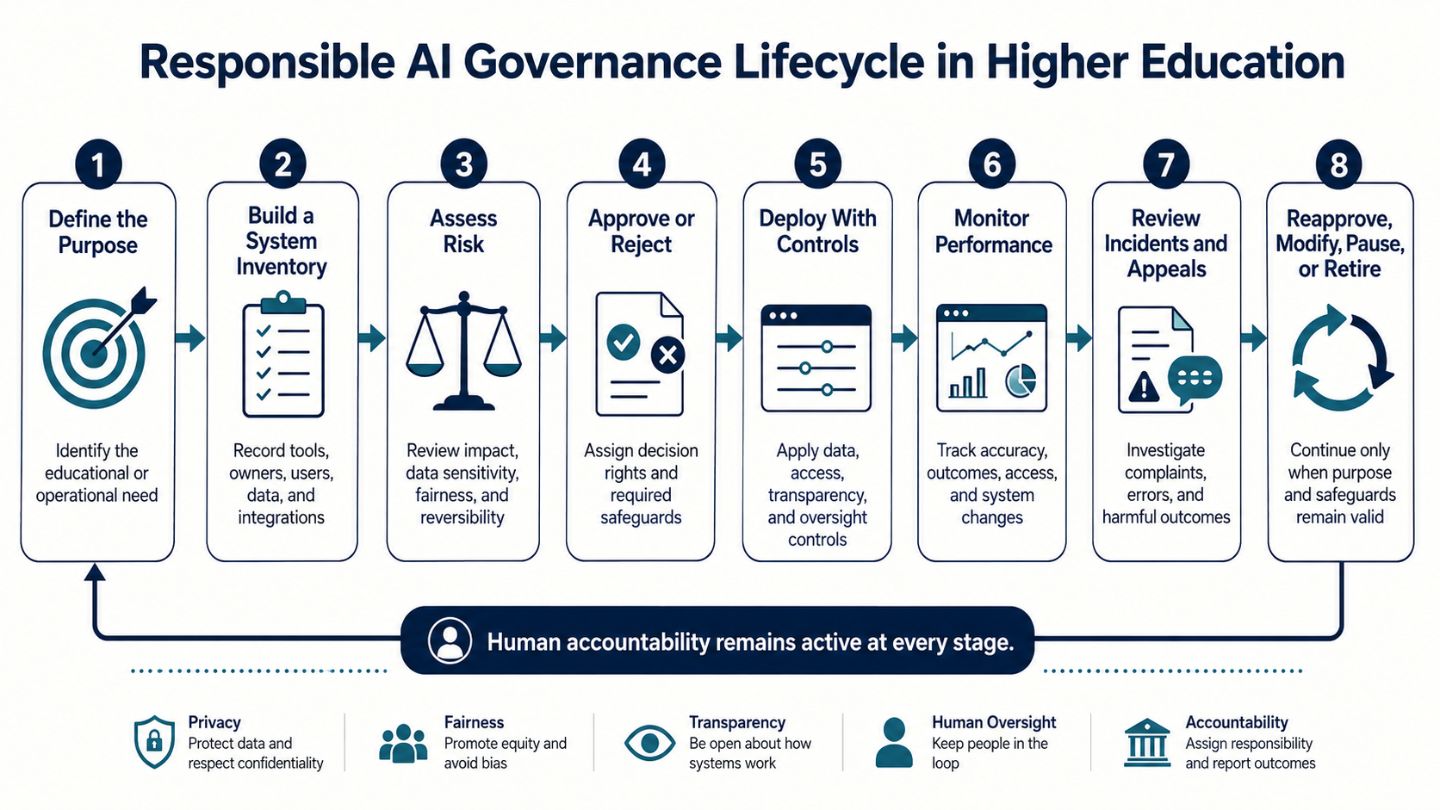
A practical lifecycle is:
Purpose → Inventory → Risk assessment → Approval → Deployment → Monitoring → Incident and appeal review → Reapproval, modification, or retirement
Responsible AI Use-Case Matrix for Higher Education
The following matrix distinguishes common use cases by possible value, risk, and minimum institutional controls.
| Use case | Possible value | Main risks | Minimum controls | Suggested status |
|---|---|---|---|---|
| Drafting non-sensitive administrative text | Preparation of an initial draft | Errors, unsuitable tone, accidental disclosure | Approved service, human editing, no restricted data | Usually low risk |
| Formative learning feedback | Additional practice and timely guidance | Incorrect advice, dependency, unequal access | Faculty design, output checks, disclosure, alternatives | Controlled use |
| Student information chatbot | Access to routine information | Incorrect deadlines, eligibility, or support advice | Restricted source base, staff escalation, logging, regular review | Medium risk |
| Research summarization | Initial orientation to material | Fabricated references, missing evidence, confidentiality | Source verification, data controls, documented use | Medium risk |
| Admissions screening | Administrative support | Exclusion, bias, weak explanation, legal risk | Formal validation, data minimization, human decision, explanation, appeal | High impact |
| Final grading | Limited organizational support | Invalid judgement, hidden bias, loss of academic responsibility | Academic authority, verified criteria, audit, appeal | High impact |
| Welfare or risk identification | Possible early support signal | False flags, privacy intrusion, serious consequences | Specialist review, strict data limits, intervention protocol | High impact |
| Academic-misconduct detection | Investigative signal | False accusation and due-process harm | Not sole evidence, corroboration, fair procedure, appeal | Restricted use |
| Hiring or staff evaluation | Workflow or information support | Discrimination, opacity, inappropriate profiling | Employment review, validated criteria, human decision, challenge route | High impact |
| Automated institutional communication | Wider access to routine responses | Incorrect or misleading official information | Approved source base, scope limits, escalation, content review | Medium risk |
These classifications are institutional planning guidance. They do not replace local legal review or a formal impact assessment.
A 12-Month Institutional Action Plan
A phased plan lets an institution establish authority and visibility before moving to wider use.
| Phase | Main actions | Primary owners | Deliverables | Evidence of progress |
|---|---|---|---|---|
| First 90 days | Appoint accountable leaders, form a governance group, issue interim sensitive-data rules, begin the inventory, and open a reporting channel | Executive sponsor, academic leader, technology, privacy, and security leads | Governance mandate, interim rules, initial inventory, reporting route | Named owners, recorded decisions, systems entered |
| Months 3–6 | Approve risk tiers, establish policy layers, introduce procurement review, publish assessment templates, and begin role-based literacy | Governance body and domain owners | Risk method, policy structure, procurement gate, training plan | Completed reviews, guidance issued, participation records |
| Months 6–12 | Run controlled pilots, evaluate accessibility and equity, review high-impact uses, gather feedback, and examine contracts | Use-case owners and assurance functions | Pilot reports, review findings, remediation plans, revised guidance | Purpose measures, incident information, feedback, decisions |
| Ongoing | Reassess material changes, review policies, examine incidents, and reapprove or retire systems | Governance body and accountable owners | Review records, correction notices, retirement decisions | Timely reviews, resolved incidents, current inventory |
A six-month review cycle may suit fast-changing operational guidance, but it is not a universal rule. Material regulatory, security, vendor, accessibility, model, or academic-integrity changes should trigger earlier review.
Practices Colleges and Universities Should Avoid
Institutions should avoid:
-
buying or activating a system before defining its purpose;
-
treating a written policy as a complete governance system;
-
allowing sensitive information to enter unapproved tools;
-
assuming an existing contract covers a newly activated AI feature;
-
using AI as the sole decision-maker in a high-impact case;
-
treating a detector score as proof of misconduct;
-
deploying a student-facing chatbot without escalation and content review;
-
assuming account access guarantees equitable outcomes;
-
claiming learning, productivity, or financial gains without suitable evidence;
-
leaving a pilot without an owner, review date, or end condition;
-
copying another university’s rules without examining local context;
-
allowing committee approval to replace named accountability;
-
retaining a system when its purpose, performance, or proportionality can no longer be demonstrated.
Responsible AI Checklist for Institutional Leaders
Before approving or continuing an AI use, confirm that:
-
The educational or operational purpose is documented.
-
A reasonable non-AI alternative has been considered.
-
The system and use case appear in the institutional inventory.
-
An accountable owner has been named.
-
The risk level has been assessed.
-
The affected population has been identified.
-
Data flows, access, retention, and model-improvement use are understood.
-
Privacy, security, records, and intellectual-property requirements have been reviewed.
-
Vendor changes, additional processors, audit rights, and exit terms have been considered.
-
Accessibility testing includes affected users.
-
Possible unequal effects have been assessed.
-
Students and staff receive role-specific guidance.
-
High-impact decisions remain under meaningful human authority.
-
Explanation, complaint, and appeal routes are available where needed.
-
Performance and outcomes will be monitored.
-
Incident response and pause authority are defined.
-
A review or retirement date has been set.
Purpose, Accountability, and Review Define Responsible Use
Responsible AI in higher education is not measured by the number of tools an institution purchases or how quickly it adopts them.
It is demonstrated through legitimate purpose, proportionate safeguards, accountable ownership, suitable evidence, transparent rules, accessible alternatives, and continuing review.
Colleges and universities should preserve room for teaching, research, and operational experimentation while setting firm boundaries around confidential information and high-impact decisions. International frameworks can inform this work, but they do not replace jurisdiction-specific law, accreditation conditions, professional requirements, or institutional consultation.
The operating model is repeatable: identify the purpose, record the use, classify the risk, assign responsibility, apply the controls, monitor outcomes, provide routes for challenge, and modify or withdraw the system when the evidence no longer supports it.





Comments 0
No comments yet. Be the first to start the conversation.