




Last Reviewed: July 5, 2026
Problem-solving-based learning is an active learning approach in which students learn by working through a meaningful problem before receiving every explanation, rule, or answer. Instead of treating a problem as an exercise after teaching, this approach uses the problem as the starting point for inquiry, discussion, research, solution-building, and reflection.
The phrase “problem-solving-based learning” is easy for general readers to understand. In academic and teaching-center sources, the closest established term is problem-based learning, or PBL. This article uses problem-solving-based learning as the reader-friendly phrase while connecting it to the more widely used PBL model.
The main idea is simple: the problem comes early. Students examine a situation, identify what they already know, decide what they still need to learn, investigate possible explanations, compare possible responses, and present a reasoned answer.
The teacher remains central to the process. The teacher designs the problem, sets limits, asks guiding questions, checks progress, supports group work, corrects misunderstanding, and connects the activity to learning goals.
Answer Summary: Problem-solving-based learning organizes teaching around a meaningful problem that drives inquiry, discussion, research, solution-building, and reflection. It is closely related to problem-based learning. It may help students practice reasoning, collaboration, and application of knowledge, but it does not guarantee better results. Its value depends on problem design, learner readiness, teacher guidance, assessment quality, and subject context.
Table of Content
- What Problem-Solving-Based Learning Means
- Is It the Same as Problem-Based Learning?
- How the Learning Process Works
- What Makes a Good Problem?
- Benefits and Evidence Limits
- McMaster and the Development of PBL
- Where It Works Well
- How to Assess Learning Fairly
- Common Mistakes to Avoid
- Implementation Checklist for Educators
- Final Thoughts
Key Takeaways:
-
Problem-solving-based learning starts with a meaningful problem.
-
It is closely aligned with problem-based learning, the more established academic term.
-
The teacher guides the process rather than disappearing from it.
-
Strong problems need clear learning goals, realistic limits, and room for reasoning.
-
Evidence on learning outcomes is mixed, so claims should remain cautious.
-
Direct instruction still matters, especially for beginners.
-
Assessment should measure reasoning, evidence use, subject knowledge, and reflection.
What Problem-Solving-Based Learning Means
Problem-solving-based learning means organizing learning around a problem that requires inquiry, reasoning, and application. It is different from a routine exercise where the teacher first demonstrates a method and students repeat it.
Cornell University’s Center for Teaching Innovation defines problem-based learning as a student-centered approach in which students learn by working in groups to solve an open-ended problem. Cornell also notes that the problem is presented first and drives the motivation and learning.
In a routine exercise, students usually know which formula, rule, or example to follow. In problem-solving-based learning, students first meet a situation that is not fully explained. They must define the issue, identify missing information, choose relevant concepts, and justify their response.
A useful way to understand the method is to ask: What problem will make students need the lesson? If the problem is only added after teaching, the activity may still be useful, but it is not fully problem-driven.
This does not mean every classroom task must become a large project. A problem-solving-based activity can be short, focused, and carefully guided. What matters is that the problem gives the learning a clear purpose.
Is It the Same as Problem-Based Learning?
Problem-solving-based learning and problem-based learning overlap heavily. “Problem-based learning” is the more established academic term, while “problem-solving-based learning” is a clearer phrase for readers who are searching for learning through problem solving.
For a general education article, the safest framing is this: problem-solving-based learning is a practical way to describe learning through structured problem solving, while problem-based learning is the recognized educational model behind much of the research and teaching guidance.
It is also important not to confuse problem-based learning with project-based learning. Both may use real-world problems, group work, inquiry, and student choice. However, they are not always identical.
A simple distinction helps. Problem-based learning usually begins with a problem that students must understand and respond to. Project-based learning often leads to a product, presentation, performance, or extended project. Worcester Polytechnic Institute notes that there are no universally agreed distinctions between problem-based and project-based learning, but describes project-based learning as often broader in scope and duration in practice. Its explainer on project-based learning is useful for understanding this comparison.
This distinction matters because the acronym PBL is often used for both problem-based learning and project-based learning. If a teacher, student, or institution uses the term PBL, the context should make clear whether the focus is a problem, a project, or both.
How the Learning Process Works
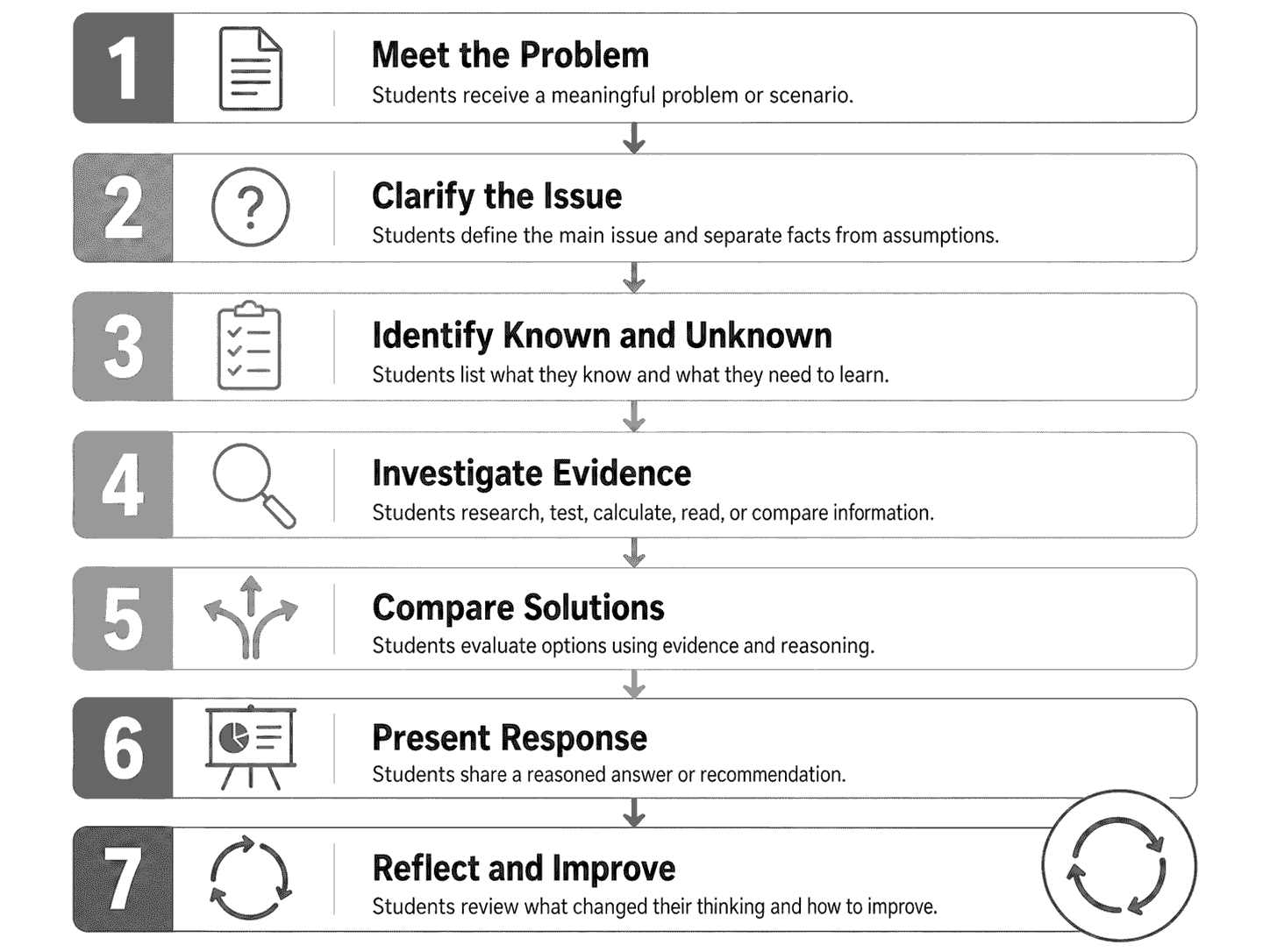
A practical problem-solving-based lesson usually follows a clear sequence. Without structure, the activity can become discussion without learning depth.
First, students meet the problem. This may be a short case, data set, design challenge, community issue, scenario, or question with more than one possible response.
Second, students clarify the problem. They define terms, identify the main issue, and separate known facts from assumptions.
Third, students list what they know and what they need to learn. This step reduces guesswork. Students may discover that they need a scientific concept, mathematical method, historical source, stakeholder view, technical skill, or definition before they can respond well.
Fourth, students investigate. They may read, research, calculate, test, compare sources, analyze evidence, or discuss possible explanations. This is also where direct instruction can support the task. A teacher may pause the activity to explain a concept students genuinely need.
Fifth, students develop and compare possible solutions. They should explain why one option is stronger than another, what evidence supports it, and what limitations remain.
Sixth, students present and reflect. Reflection should cover both the answer and the process: What did we misunderstand at first? Which evidence changed our thinking? What would we do differently next time?
This sequence helps keep the activity focused on learning rather than loose discussion. It also gives teachers clear moments to observe understanding, correct misconceptions, and connect student work with the intended learning outcomes.
What Makes a Good Problem?
A good problem is not simply a difficult question. It is a learning design tool that connects the lesson to inquiry, evidence, and decision-making.
A weak prompt might say, “Discuss pollution.” It is too broad. A stronger classroom prompt might ask: “A town wants to reduce plastic waste in school lunches without increasing meal costs. What practical plan would you recommend, and what evidence would support it?” This is a sample teaching scenario, not a claim about a real town or school.
A useful problem usually has four features.
It connects to a real or realistic situation. Students should see why the issue matters beyond a worksheet.
It requires subject knowledge. The answer should not depend only on opinions or personal preference.
It allows more than one reasonable path. Students should have room to compare alternatives and defend their reasoning.
It includes enough structure for assessment. The teacher should be able to judge the quality of the problem definition, evidence, reasoning, and final response.
The level of openness should match learner readiness. Beginners often need shorter problems, clearer resources, and more guidance. Advanced learners may handle more uncertainty, longer inquiry, and less teacher direction.
Benefits and Evidence Limits
Problem-solving-based learning may support useful learning habits when it is carefully designed. Students may practice critical thinking because they must evaluate evidence and compare options. They may build collaboration skills when group work is well structured. They may strengthen self-directed learning because they have to identify what they need to know. They may also see how academic knowledge applies outside exams.
These benefits should be stated carefully. A 2016 review by Elaine H. J. Yew and Karen Goh reported that studies comparing problem-based learning with other approaches were generally consistent in showing stronger longer-term knowledge retention and application of knowledge. The same review also noted that research was still inconclusive about which PBL components most affect learning. The article, Problem-Based Learning: An Overview of its Process and Impact on Learning, is useful for understanding both the promise and the limits of the method.
A later PLOS ONE meta-analysis focused on first-year medical students reached a more cautious result. It found no significant difference between PBL and conventional methods in the included studies for critical thinking or knowledge assessment, problem-solving, and self-directed learning. The study on the effectiveness of problem based learning in first-year medical students is important because it shows why outcome claims should not be overstated.
The practical lesson is not that problem-based learning always works or never works. The evidence suggests that design, subject, learner readiness, assessment, teacher facilitation, and implementation quality matter. A careful article should not claim that problem-solving-based learning automatically improves grades, creativity, confidence, retention, or career success.
Readers interested in active learning more broadly may also find Collegenp’s article on Active Learning: How It Improves Student Retention useful, especially for understanding why participation alone is not enough without clear learning design.
McMaster and the Development of PBL
Problem-based learning is strongly associated with medical education. McMaster University states that its work in problem-based learning began in its medical school in 1969. The university describes the McMaster model as involving students who work through open-ended problems in small groups with guidance from a tutor. McMaster’s overview of its teaching innovations provides useful historical context.
This history is useful because it shows the original spirit of PBL. Learners faced complex cases before all answers had been given. They identified learning needs, found information related to the problem, discussed findings with peers, and worked with tutor guidance.
The McMaster example also shows why facilitation matters. PBL is not simply giving students a difficult case and stepping away. The tutor or teacher helps keep inquiry connected to learning outcomes, checks misunderstanding, and supports the group process.
Where It Works Well
Problem-solving-based learning works well when the subject requires judgment, application, and evidence-based reasoning. It is especially useful when students need to connect concepts rather than memorize isolated facts.
In science, students may examine environmental data and decide what evidence is needed before recommending a response.
In mathematics, they may compare ways to model cost, distance, probability, or risk.
In social studies, they may evaluate policy choices from different stakeholder perspectives.
In business, they may analyze a supply-chain issue, customer-service problem, or budgeting constraint.
In teacher education and workplace training, learners may use problem-based tasks to practice decision-making in realistic conditions.
The method should be used with care in health, legal, engineering, and safety-related contexts. Student scenarios can support learning, but real decisions in these fields require qualified supervision, professional standards, and reliable evidence.
Problem-solving-based learning should not replace foundational instruction too early. Beginners may need vocabulary, worked examples, demonstrations, reading support, and guided practice before they can handle open-ended cases productively.
For comparison with memorization-heavy learning, Collegenp’s article on Rote Learning vs Hands-on Learning may provide useful context.
How to Assess Learning Fairly
Assessment should match the purpose of the activity. If the goal is reasoning, the grade should not depend only on whether students reach the teacher’s preferred answer.
A strong rubric can assess problem definition, subject knowledge, use of evidence, quality of reasoning, teamwork, communication, and reflection. It should also clarify how much weight belongs to the process and how much belongs to the final response.
Teachers should separate individual learning from group performance. A group presentation may show that the team produced a response, but it may hide whether every student understood the concept. Short individual reflections, exit tickets, oral checks, or individual quizzes can help.
Peer assessment may be useful, but it should be structured. Without clear criteria, peer scoring can become popularity scoring or unfair group judgment.
Feedback should be specific. Instead of saying “good work,” the teacher can say, “Your team identified three possible causes, but your recommendation needs stronger evidence,” or “Your solution is practical, but you did not discuss the main limitation.” This kind of feedback teaches students how to improve their thinking.
Teachers planning assessment can also connect the activity with clear goals. Collegenp’s article on Learning Objectives vs Learning Outcomes is relevant here because problem-solving tasks should still be tied to what learners are expected to know or do.
Common Mistakes to Avoid
The first mistake is using a problem that is too broad. Students need challenge, not confusion.
The second mistake is treating the teacher as passive. In problem-solving-based learning, the teacher facilitates actively through questions, checkpoints, resources, and feedback.
The third mistake is assessing only the final presentation. The learning process should also be assessed.
The fourth mistake is using “real-world” language without real constraints. A problem becomes more realistic when learners consider time, cost, evidence, stakeholders, ethics, or trade-offs.
The fifth mistake is making unsupported claims about outcomes. It is not safe to say this method guarantees better grades, deeper learning, employability, creativity, or confidence. Those outcomes depend on many factors.
The sixth mistake is ignoring learner readiness. If students lack basic knowledge, an open-ended task may create frustration instead of productive inquiry.
Implementation Checklist for Educators
Start with one topic where application matters. Do not redesign an entire course at once.
Write a problem that connects directly to the learning objective. Decide what students should already know and what they can discover during the task.
Prepare a short resource list, but avoid giving so many sources that inquiry becomes copying.
Set group roles only when they support the task. Roles such as facilitator, recorder, evidence checker, and presenter can help, but they should not become rigid.
Build in checkpoints. Misunderstandings should not continue for too long.
Use a simple structure: problem brief, known facts, learning questions, investigation, solution options, final response, and reflection.
Review both content and process after the activity. Ask students what helped them learn, where they struggled, and what evidence changed their thinking.
Revise the next task based on what happened. Problem-solving-based learning improves when teachers treat lesson design as an iterative process.
For related learning-method context, readers may also review Collegenp’s article on Question-Based Learning, which connects naturally with inquiry, questioning, and student-led investigation.
Final Thoughts
Problem-solving-based learning is a practical way to connect learning with inquiry, reasoning, and real or realistic situations. Its value comes from structure, not novelty. A meaningful problem gives students a reason to learn, but teacher guidance, clear goals, evidence use, and fair assessment make the approach educationally sound.
The most accurate framing is to connect problem-solving-based learning with the established term problem-based learning. That helps readers understand the method without treating it as a separate guaranteed solution. Used carefully, it can support active learning and thoughtful application. Used poorly, it can become busy work. The difference depends on design, facilitation, and honest expectations.





Comments 0
No comments yet. Be the first to start the conversation.