




Question-based learning is an approach where questions guide the learning process. Learners answer, refine, and reflect on questions to build understanding, while feedback explains why an answer is correct, incomplete, or wrong.
For teachers, tutors, instructional designers, and self-learners, question-based learning is useful because it moves learning beyond passive reading, listening, or watching. A learner has to recall ideas, test assumptions, explain reasoning, and revise answers.
This does not mean every lesson should become a quiz. Question-based learning works only when questions are purposeful, the difficulty is appropriate, and feedback helps learners understand the reason behind the answer. Without those conditions, questions may become guesswork, pressure, or exam practice rather than learning.
This article explains what question-based learning means, how it differs from inquiry-based learning and Socratic questioning, how it connects with retrieval practice, and how teachers or self-learners can use it responsibly.
Answer Summary:
Question-based learning, or QBL, uses questions as the structure of learning. A learner answers a question, receives feedback, refines the answer or question, and applies the idea in a new situation. It works most reliably when questions match learning goals, every learner has a chance to respond, and feedback explains the reasoning behind the answer.
Table of Content
- What question-based learning means
- Why questions support learning
- How QBL differs from related learning methods
- How question-based learning works
- Question-based learning examples
- What makes a strong QBL question?
- When QBL works well
- When QBL can fail
- How to use QBL in a lesson or study session
- QBL template for teachers and self-learners
- What to avoid in question-based learning
- Conclusion
Key Takeaways:
-
Question-based learning uses questions to guide learning, not only to test memory.
-
QBL needs clear goals, useful feedback, and fair participation.
-
Inquiry-based learning is broader; QBL is more question-centered.
-
Retrieval practice can be part of QBL when learners recall ideas from memory.
-
Pure question-based learning is a narrower model built around questions and feedback.
-
Poor questions can confuse learners or create unnecessary pressure.
-
QBL works better when learners revise, reflect, and transfer ideas to new situations.
What question-based learning means
Question-based learning is a learning approach in which questions organize the path through a topic. A lesson, discussion, study session, or digital module begins with a meaningful question, uses answers to reveal understanding, and uses feedback to improve the next response.
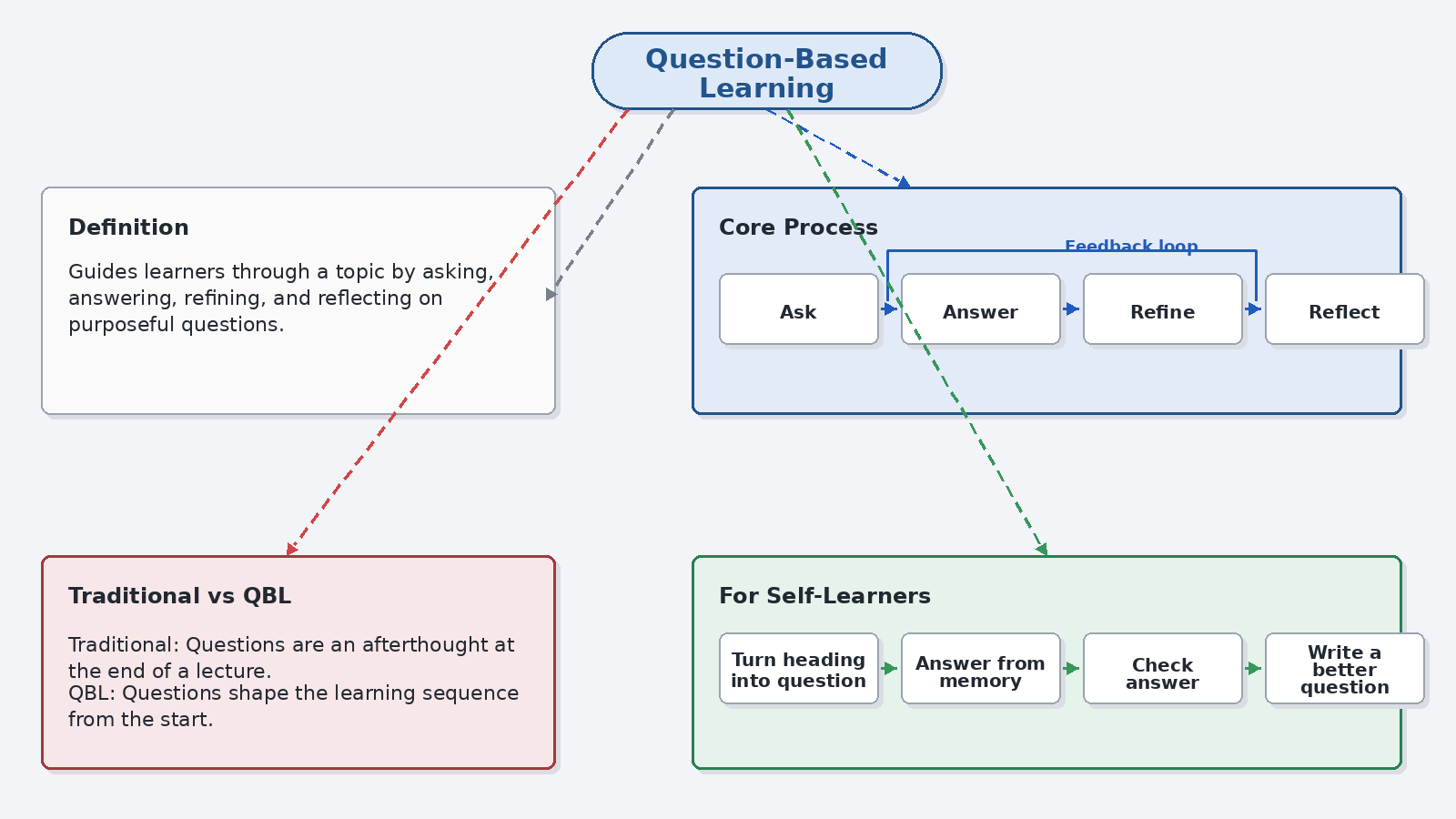
A simple definition is this: question-based learning guides learners through a topic by asking, answering, refining, and reflecting on purposeful questions.
This is different from asking a few questions at the end of a lecture. In QBL, questions are not an afterthought. They shape the learning sequence. A teacher may begin with a question, ask learners to attempt an answer, give feedback, and then ask a follow-up question that deepens or transfers the idea.
For self-learners, the same pattern applies. A learner may turn a textbook heading into a question, answer from memory, check the answer, and write a better question for the next study session. This makes study more active and helps the learner notice what is clear and what still needs work.
QBL is closely related to active learning methods, but it has a more specific focus: using questions to structure thinking, feedback, and reflection.
Why questions support learning
Questions support learning because they require learners to do something with knowledge. Instead of only seeing information, learners have to retrieve, explain, compare, predict, or apply it.
The Cornell Center for Teaching Innovation explains active learning as involving students in thinking, discussion, investigation, creation, problem-solving, decision-making, and explanation. QBL fits this wider active-learning approach because learners must respond before the teacher or learning material gives the full explanation.
Questions also connect with retrieval practice. The Washington University in St. Louis Center for Teaching and Learning defines retrieval practice as recalling facts, concepts, or events from memory to support learning. Low-stakes questions can help learners recall what they know before rereading notes or checking the answer.
For students who want a memory-focused study method, retrieval practice in daily lessons is a related strategy.
Feedback matters here. A question without explanation may show that a learner is right or wrong, but it may not teach much by itself. A question followed by clear feedback can show why an answer works, where it is incomplete, and how the learner can improve.
How QBL differs from related learning methods
Question-based learning overlaps with several teaching and study methods. The difference matters because each method has a different purpose.
Inquiry-based learning is broader. The Australian Government Department of Education describes inquiry-based learning as an approach focused on investigation and problem-solving, where teachers begin with scenarios, questions, and problems instead of presenting answers first. QBL can be part of inquiry-based learning, but inquiry may also involve experiments, research projects, fieldwork, data collection, or open-ended investigation.
Socratic questioning is a dialogue method. It uses probing questions to examine assumptions, evidence, reasoning, and implications. It is useful when the goal is critical thinking, interpretation, ethics, debate, or argument. Socratic questioning can be used inside QBL, but QBL can also use written prompts, quizzes, case questions, polling, peer questions, and digital practice.
Retrieval practice is a memory strategy. It asks learners to recall information from memory. QBL may include retrieval practice, but it usually goes further by adding explanation, feedback, refinement, and transfer.
Pure question-based learning, or pQBL, is narrower than general QBL. A 2024 paper in Education Sciences defines pure question-based learning as learning material that consists only of questions with constructive formative feedback. In pQBL, the learning content is placed inside the feedback rather than presented first as a separate lecture or reading. This is a specific design model, not a universal replacement for all teaching.
| Method | Main focus | Suitable use |
|---|---|---|
| Question-based learning | Questions organize the learning path | Lessons, tutoring, self-study, feedback-based quizzes |
| Inquiry-based learning | Investigation and problem-solving | Projects, research tasks, STEM inquiry, real-world problems |
| Socratic questioning | Dialogue that tests reasoning | Ethics, interpretation, debate, critical thinking |
| Retrieval practice | Recalling information from memory | Flashcards, low-stakes quizzes, review sessions |
| Pure QBL | Learning material consists only of questions and feedback | Digital modules or tightly designed question-first courses |
How question-based learning works
A strong QBL cycle usually has six parts: purpose, question, attempt, feedback, refinement, and transfer.
First, the teacher or learner sets a learning purpose. For example: “Learners should be able to explain why plants need light for photosynthesis.” The purpose prevents random questioning.
Second, the activity begins with a question that creates a reason to learn. “What is photosynthesis?” may check recall. “Why does a plant kept in darkness stop producing enough sugar?” asks for explanation.
Third, learners attempt an answer before receiving the full explanation. This matters because the first answer reveals prior knowledge, misconceptions, and uncertainty. The answer does not need to be perfect.
Fourth, feedback explains the reasoning. “Correct” or “wrong” is not enough. Better feedback explains what makes the answer correct, what is missing, or why a tempting answer is misleading.
Fifth, learners refine the answer or question. A learner might ask, “Did I confuse oxygen and carbon dioxide?” or “Does this process work the same way in algae?” This revision step is where deeper learning often begins.
Sixth, learners transfer the idea to a new situation. A question about a plant in darkness can lead to a question about greenhouse lighting, crop growth, or ecosystems. Transfer helps prevent QBL from becoming memorization of one prompt.
Question-based learning examples
Question-based learning can be used in classrooms, online courses, tutoring, exam preparation, and self-study. The format changes, but the basic pattern remains the same: question, attempt, feedback, refinement, and application.
Classroom example
In a science lesson on evaporation, a teacher could begin with this question:
“Two wet towels are placed in the same room. One is spread out on a chair. One is folded into a pile. Which dries first, and why?”
Students first write a prediction. They then discuss possible factors such as surface area, airflow, temperature, and humidity. After collecting a few responses, the teacher explains the science and asks a transfer question:
“Why do clothes dry faster on a windy day even when the temperature is the same?”
This is not a research case study. It is a practical classroom example showing how QBL changes the order of learning. Learners meet the problem first. The explanation then has a clear purpose.
Student-generated question example
Student-generated questions can also support QBL when they are reviewed carefully. In a study on an elementary photonics course, students wrote multiple-choice questions that were revised by the instructor and used in an educational game and part of the exam. The study reported that students who authored questions performed better on the multiple-choice part of the exam than a traditionally taught control group, without reducing their comparative performance in problem-solving. The study is available through arXiv.
This finding should not be stretched into a general promise that student-generated questions always improve results. The practical lesson is narrower: writing a good question asks learners to think about the concept, possible wrong answers, and explanation. Instructor review matters because weak questions can reinforce confusion.
What makes a strong QBL question?
A strong QBL question is aligned with the learning goal, answerable at the learner’s level, and useful for feedback. It should help learners think about the target idea, not distract them with tricky wording.
Different question types serve different purposes:
-
Recall questions ask learners to bring information back from memory.
-
Concept questions check whether learners understand meaning.
-
Application questions ask learners to use an idea in a new situation.
-
Diagnostic questions reveal misconceptions.
-
Metacognitive questions ask learners to reflect on how they are thinking.
For example, a recall question may ask, “What is formative feedback?” A concept question may ask, “Why is feedback more useful when it explains the reason behind an answer?” An application question may ask, “How would you use QBL in a language class?”
A strong question sequence usually mixes these types. Too many recall questions can become mechanical. Too many open-ended questions can overwhelm beginners. Too many trick questions can damage trust. The aim is not to make every question hard. The aim is to make every question useful.
QBL fits within wider evidence-based learning strategies when it is used with a clear purpose, low-stakes practice, and feedback.
When QBL works well
Question-based learning works well when learners have enough background knowledge to attempt an answer but still need support to refine their understanding.
It is useful for opening a lesson, checking understanding, preparing for complex topics, supporting retrieval, starting discussion, and helping learners explain reasoning. A teacher may use QBL to introduce a science concept. A trainer may use case questions in professional learning. A language learner may turn vocabulary into self-testing prompts. A coding learner may ask, “What will this function return, and why?” before running the code.
QBL is especially useful when feedback is quick, specific, and explanatory. The learner should not only know whether the answer was right or wrong. The learner should understand the reason.
Support also matters. Beginners often need examples, sentence starters, guided options, and gradually increasing difficulty. Without enough support, questions can feel confusing rather than productive.
When QBL can fail
Question-based learning can fail when questions are vague, too easy, too difficult, or disconnected from the learning goal. It can also fail when teachers use questions mainly to catch learners out.
Unequal participation is another risk. If a teacher asks a question aloud and calls on one confident student, only one learner may receive the main thinking benefit. Written responses, polling, pair discussion, and small-group question generation can give more learners a chance to think.
QBL can also create pressure if every question feels like judgment. Low-stakes formats reduce that risk. Learners should understand that an incomplete answer is useful information for learning, not a personal failure.
The method also has limits. QBL can support active learning, retrieval, feedback, inquiry, and reflection, but it does not automatically create motivation, critical thinking, or achievement. Outcomes depend on question quality, learner readiness, feedback, classroom culture, and the subject being taught.
How to use QBL in a lesson or study session
Start with one clear outcome. Avoid a broad goal such as “learn climate change.” A clearer outcome is: “Learners can explain the difference between weather and climate using evidence.”
Next, create a short question sequence. A useful sequence may include one recall question, one reasoning question, one misconception question, and one transfer question. Keep the sequence small enough that feedback is possible.
Ask learners to answer before showing the explanation. This can happen silently, in pairs, through a polling tool, in a notebook, or during guided discussion. The first attempt gives the teacher useful information.
Give feedback that explains the reason. “Correct” is not enough. “Correct because the example refers to a long-term pattern, not a single day’s condition” teaches more.
End with reflection. Ask learners which answer they revised, which question changed their thinking, or what new question they now have. This keeps QBL from becoming only a quiz routine.
QBL template for teachers and self-learners
This template can be used for a short classroom activity, tutoring session, digital module, or self-study routine.
| Step | Question to ask |
|---|---|
| Learning outcome | What should the learner explain, solve, or decide? |
| Opening question | What question creates a reason to learn? |
| First attempt | How will every learner answer before the explanation? |
| Feedback | What explanation will clarify why the answer works? |
| Follow-up | What misconception or deeper layer should come next? |
| Transfer | How will learners apply the idea in a new situation? |
| Reflection | What should learners revise or ask next? |
For self-learners, the same template can be shorter:
-
Turn a heading into a question.
-
Answer from memory before rereading.
-
Check the answer against the source.
-
Write one better answer.
-
Create one follow-up question for tomorrow.
For example, instead of highlighting a page about supply and demand, ask: “Why does price usually rise when demand increases and supply stays the same?” After answering, ask a transfer question: “What might happen if both supply and demand increase?”
Students who want broader study support may also compare this method with effective learning strategies for college students.
What to avoid in question-based learning
Avoid turning QBL into constant testing. If learners feel judged every time they answer, they may stay silent.
Avoid clever but unhelpful questions. A question can sound interesting and still fail if it does not support the learning goal.
Avoid using only open-ended questions with beginners. Open questions can be useful, but learners may need structure before they can reason independently.
Avoid unsupported claims. QBL is not a guaranteed path to higher marks or deeper thinking. It is a learning design approach that depends on question quality, feedback, learner readiness, and support.
Avoid using student-generated questions without review. The photonics study used instructor-revised student questions. That detail matters because poor questions can reinforce misunderstanding.
Conclusion
Question-based learning changes the role of questions. Questions do not appear only at the end of a lesson. They become the path through the lesson.
Used carefully, QBL can activate prior knowledge, reveal misconceptions, support retrieval, invite discussion, and make feedback more useful. Used poorly, it can become confusing, stressful, or shallow.
For teachers and self-learners, the main task is not to ask more questions. It is to ask clearer questions at the right time, give useful feedback, and make sure learners have a fair chance to think, answer, revise, and apply.





Comments 0
No comments yet. Be the first to start the conversation.