




Problem-based learning, often shortened to PBL, is a teaching method where students begin with a meaningful problem before receiving a full explanation of the topic. Instead of listening to a lecture first and applying the material later, learners examine a problem, identify what they already know, decide what they need to learn, research evidence, and return with a reasoned response.
The key idea is that the problem is not an activity added after teaching. In PBL, the problem drives the learning process. Cornell University’s Center for Teaching Innovation describes problem-based learning as a student-centered approach where students learn by working in groups to solve an open-ended problem.
PBL can support inquiry, reasoning, collaboration, self-directed learning, and application of knowledge. It still needs careful design. A weak PBL task can become an unclear group activity with little learning value. A strong one connects the problem, learning goals, student support, evidence use, and assessment.
Answer Summary:
Problem-based learning starts with a problem rather than a lecture. Students clarify the problem, identify knowledge gaps, research evidence, discuss findings, and explain or defend a response. PBL is useful when the goal is reasoning, inquiry, collaboration, and application. It works best with clear outcomes, structured facilitation, credible sources, and assessment that checks both individual learning and group process.
Table of Content
- What Is Problem-Based Learning?
- How the PBL Process Works
- A Verified Example: Maastricht University’s PBL Model
- Benefits of Problem-Based Learning
- Limits and Risks of PBL
- Problem-Based Learning vs Project-Based Learning
- How to Design a Good PBL Activity
- How to Assess Problem-Based Learning
- Where PBL Works Well
- Practical Classroom Scenario
- Common Mistakes to Avoid
- Final Takeaway
Key Takeaways
-
Problem-based learning starts with a problem, not a lecture.
-
Students learn by identifying knowledge gaps and investigating evidence.
-
The teacher acts as a facilitator, not only as a content presenter.
-
PBL can support critical thinking, collaboration, and applied learning.
-
It requires structure, scaffolding, time, and clear assessment.
-
It is different from project-based learning, although both may use the acronym PBL.
-
It should be used when the learning goal requires inquiry, reasoning, and application.
What Is Problem-Based Learning?
Problem-based learning is a student-centered approach in which a real or realistic problem becomes the starting point for learning. The problem may be a case, scenario, professional dilemma, design challenge, scientific puzzle, community issue, clinical situation, business decision, or classroom question.
The defining feature is that the problem is open enough to require inquiry. Students cannot answer it by recalling one definition or copying one fact. They must clarify the situation, ask questions, gather information, compare explanations, and justify their response.
This makes PBL different from ordinary problem solving at the end of a lesson. In traditional instruction, students often receive information first and solve a problem later to show what they understood. In PBL, the order is reversed. Learners meet the problem first, then learn the content because they need it to make sense of the situation.
PBL also belongs to the broader family of active learning and student-centered teaching. It asks students to take part in the learning process instead of receiving information passively. Student-centered does not mean teacher-absent. PBL still needs careful planning, facilitation, and feedback.
How the PBL Process Works
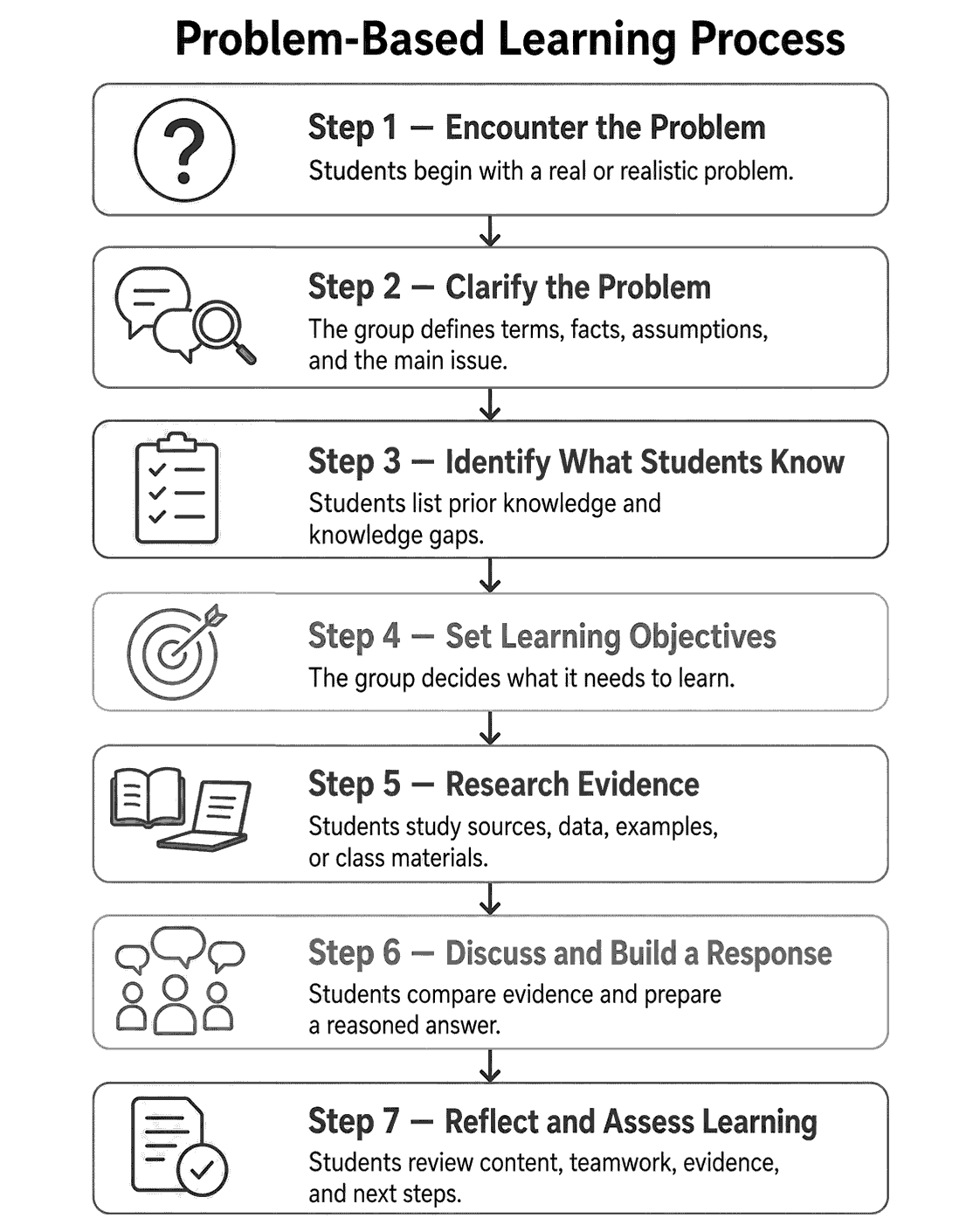
Most PBL models follow a clear cycle: students encounter a problem, clarify it, identify what they know, set learning objectives, research evidence, discuss findings, and reflect on both the answer and the process.
First, learners encounter the problem. The teacher introduces a situation that is meaningful enough to create curiosity but not so vague that students cannot begin. A biology class might investigate why a local water sample shows signs of contamination. A business class might examine why a product failed in a new market. A teacher-education class might analyze a classroom case where only a few students participate.
Second, students clarify the problem. They define unfamiliar terms, separate facts from assumptions, and agree on what the problem actually asks. This step matters because groups often rush to solutions before understanding the case.
Third, students list what they already know and what they need to know. This creates learning objectives. A strong PBL activity should make students ask, “What knowledge would help us explain or respond to this problem?”
Fourth, students research independently or in smaller groups. They may read assigned sources, examine data, review class materials, consult credible references, or test possible explanations. The teacher may provide guiding questions, short instruction, a source set, or checkpoints.
Fifth, the group reconvenes. Students share evidence, compare explanations, test assumptions, and decide how they would respond to the problem. The final output may be a written analysis, presentation, recommendation, diagnosis, report, concept map, or reflection.
Finally, students reflect. They consider what they learned, which evidence was strongest, how the group worked, and what they would change next time. Reflection is important because PBL is not only about finding an answer. It is also about improving inquiry, reasoning, communication, and judgment.
A Verified Example: Maastricht University’s PBL Model
Maastricht University provides a useful institutional example because it publicly describes a structured PBL model. The university states that PBL involves seven steps followed in groups of 10 to 15 students: discuss the case, identify questions, brainstorm prior knowledge, analyse and structure results, formulate learning objectives, study independently, and discuss findings.
This example is useful because it shows that PBL is not the same as telling students to “figure it out.” Maastricht’s model includes a shared process, tutor guidance, group discussion, independent study, and return discussion. The structure gives students room to investigate while keeping the learning focused.
The lesson for other schools is not to copy one institution exactly. Different subjects, ages, course lengths, and class sizes need different designs. The broader lesson is that PBL works better when learners know the process, expectations, roles, and assessment criteria.
Benefits of Problem-Based Learning
The main value of PBL is that it helps learners connect knowledge with use. Students do not only memorize a concept; they practice deciding when the concept matters, what evidence is relevant, and how to explain their reasoning.
One benefit is engagement. When the problem appears before the explanation, learners have a reason to ask questions. The problem creates a need for knowledge rather than treating knowledge as something to memorize without context.
A second benefit is critical thinking. Students must interpret information, compare explanations, evaluate sources, and defend their reasoning. This is why PBL often appears in discussions about critical thinking in education, especially in higher education and professional training.
A third benefit is collaboration. Many PBL tasks require learners to listen, divide responsibilities, challenge assumptions, and build a shared answer. This can support collaborative learning, but collaboration does not happen automatically. Students need clear roles, discussion norms, and teacher monitoring.
A fourth benefit is self-directed learning. Students identify what they do not know and search for useful information. This skill is valuable in fields where knowledge changes and professionals must continue learning after formal education.
A fifth benefit is transfer. When students learn through a realistic problem, they may find it easier to apply concepts outside the classroom. This is one reason PBL is often used in professional education, including medicine, nursing, business, engineering, public health, law, and teacher education.
Evidence should be stated carefully. A 2025 systematic review and meta-analysis in medical education found that PBL was more effective than conventional teaching methods for enhancing critical thinking among medical students. That finding should not be stretched into a universal claim for every subject, grade level, or classroom.
Limits and Risks of PBL
Problem-based learning is not automatically better than direct instruction. It can fail when learners lack the background knowledge needed to make progress.
Beginners may need vocabulary, examples, short explanations, or guided resources before they can investigate a problem productively. Without this support, students may spend too much time guessing, searching weak sources, or following the wrong path.
Time is another limitation. A problem that takes five minutes to introduce may require hours of research, discussion, feedback, and assessment. If a course has heavy content coverage requirements, teachers need to decide where PBL adds value and where a direct explanation is more efficient.
Assessment can also become difficult. Standard tests may not fully capture reasoning, collaboration, source evaluation, communication, or reflection. But if teachers assess only the final group product, individual learning can be hidden.
Group work brings its own risks. Some students may dominate, some may withdraw, and some may contribute less than others. This can create frustration unless the teacher sets clear roles, checkpoints, and accountability measures.
The safest conclusion is that PBL is useful when it is well designed and aligned with the learning goal. It should not be presented as a guaranteed method for better grades, stronger motivation, or improved achievement in every classroom.
Problem-Based Learning vs Project-Based Learning
Problem-based learning and project-based learning overlap, but they are not the same. The confusion comes partly from the shared acronym PBL.
Problem-based learning usually starts with a problem or case. The main goal is to investigate, reason, explain, diagnose, recommend, or decide. The final output may be a report, explanation, presentation, recommendation, or reflection.
Project-based learning usually centers on creating a product, performance, or public deliverable over time. Students may design, build, publish, present, or implement something. Worcester Polytechnic Institute notes that there is no universally agreed distinction between project-based and problem-based learning, but one practical difference is that project-based learning often allows more variation in project length, process, and final results.
| Criterion | Problem-Based Learning | Project-Based Learning |
|---|---|---|
| Main driver | A problem or case that creates learning questions | A project, product, or performance that organizes learning |
| Main goal | Inquiry, reasoning, explanation, decision-making | Creation, design, presentation, or public output |
| Typical output | Explanation, diagnosis, recommendation, report, reflection | Product, prototype, campaign, exhibition, presentation |
| Main risk | Confusion if learners lack guidance or background knowledge | Product work may overshadow conceptual learning |
| Suitable use | Professional cases, evidence-based reasoning, decision-making | Extended design, production, or public-facing work |
A simple way to distinguish them is to ask: Is the learning journey mainly organized around investigating a problem, or around producing a project? If the problem drives the learning questions, it is closer to problem-based learning. If the product drives the timeline and work process, it is closer to project-based learning.
How to Design a Good PBL Activity
A good PBL activity begins with clear learning outcomes. Before writing the problem, the teacher should know what students should understand, practice, or demonstrate by the end.
The University of Illinois Center for Innovation in Teaching & Learning notes that strong PBL problems should motivate students to seek deeper understanding, require reasoned decisions, connect to content objectives, and include enough complexity to support group work when groups are used.
A useful PBL design usually includes these elements:
-
Clear learning outcome: Decide what students should learn before writing the problem.
-
Realistic problem: Use a situation that resembles a genuine academic, professional, or social issue.
-
Open-ended but bounded prompt: Avoid problems with one obvious answer, but do not make the task too broad.
-
Scaffolding: Provide guiding questions, source sets, vocabulary, checkpoints, or short instruction where needed.
-
Group roles: Assign roles such as facilitator, recorder, source checker, skeptic, and reporter.
-
Evidence rules: Tell students what counts as a credible source and how to separate evidence from assumption.
-
Aligned assessment: Assess the thinking and learning process, not only the final answer.
For example, instead of asking environmental science students to “solve climate change,” a teacher might ask them to analyze why one neighborhood floods after moderate rainfall and recommend evidence-based responses. The second version is more bounded, more realistic, and easier to assess.
How to Assess Problem-Based Learning
Assessment in PBL should check both the final response and the quality of thinking behind it. A group answer alone is not enough.
Teachers can assess individual learning through short quizzes, written reflections, oral questioning, source notes, or individual explanation sheets. This helps confirm that each student understands the content rather than relying on stronger group members.
Group assessment can focus on the final report, presentation, recommendation, concept map, or response plan. A rubric should examine the clarity of the problem definition, quality of evidence, reasoning, feasibility of response, and connection to learning outcomes.
Process assessment is also useful. Peer feedback, self-assessment, participation records, and group check-ins can reveal whether students shared responsibility and listened to each other. These tools should be used carefully so that peer ratings do not become popularity scores.
A balanced PBL assessment plan may include:
-
Individual content check
-
Group product or presentation
-
Reflection on learning and evidence
-
Peer or self-assessment
-
Teacher observation or checkpoint feedback
The goal is not to grade everything. The goal is to make sure the assessment matches what the PBL activity is supposed to teach.
Where PBL Works Well
PBL works well when the learning goal involves application, judgment, analysis, decision-making, or professional practice. It is useful when students need to connect concepts to situations that do not have simple answers.
In medical education, students may work through patient cases. In business, they may analyze market, operations, or ethical problems. In engineering, they may work with design constraints. In teacher education, they may examine classroom scenarios. In public health, they may analyze community risk, prevention, or policy cases. In humanities courses, they may study historical, ethical, or interpretive dilemmas.
PBL can also work with younger learners, but the task must be age-appropriate. Younger students usually need shorter cycles, clearer roles, limited resources, and more teacher guidance.
PBL may be less suitable when students are completely new to a topic and need basic vocabulary or procedures first. In that situation, a blended approach can work better: teach a short foundation, then use a focused problem to deepen understanding. This also supports student-centered learning without removing necessary structure.
Practical Classroom Scenario
Consider a college-level public health class. Instead of beginning with a full lecture on disease transmission, the instructor gives students a short case: a worker has moved between two health facilities and later receives a diagnosis that raises public health concerns.
Students must identify what they need to know. Their learning questions may include possible transmission routes, exposure risk, contact tracing principles, workplace policy, reporting responsibilities, and public communication.
The instructor does not ask students to act as experts without evidence. The group reviews credible sources, separates confirmed facts from assumptions, and prepares a response plan. The final answer must include what the group knows, what remains uncertain, and which actions would require professional or official confirmation.
This scenario shows how PBL can turn abstract content into a reasoning task. It also shows why facilitation matters. Without source guidance and clear boundaries, students could make unsupported claims or become confused by details beyond the course level.
Common Mistakes to Avoid
The first mistake is using a weak problem. A vague prompt such as “Discuss pollution” is not enough. A stronger prompt includes context, constraints, stakeholders, and a clear reason to investigate.
The second mistake is confusing activity with learning. Students can be busy without learning much. Every task should connect back to the intended outcome.
The third mistake is giving too little support. PBL should challenge students, not abandon them. When students lack background knowledge, the teacher should provide scaffolding.
The fourth mistake is grading only the final group answer. This can hide individual learning and uneven participation. Assessment should include evidence of individual understanding.
The fifth mistake is treating PBL as the right method for every lesson. It is one teaching approach among many. It works better when paired thoughtfully with direct instruction, practice, feedback, discussion, and reflection.
Final Takeaway
Problem-based learning is most useful when a problem can genuinely drive inquiry, reasoning, and application. It is a strong option for lessons where students need to evaluate evidence, work with uncertainty, collaborate, and explain decisions.
It is not a shortcut and not a universal solution. A good PBL activity needs a clear learning outcome, a realistic problem, enough structure, credible sources, teacher facilitation, and aligned assessment.
The goal is not to make every lesson problem-based. The goal is to use PBL when it helps learners think more carefully, ask better questions, and apply knowledge in a meaningful context.





Comments 0
No comments yet. Be the first to start the conversation.