




A father in Dalian, China, told anthropologist Vanessa Fong that he brought snacks and drinks to his studying son so the boy would not waste time walking to the refrigerator. Another parent compared entry into a college preparatory high school to imprisonment, telling a daughter, “Think of yourself as having entered a jail.”
These accounts, reported in a 2010 Harvard Graduate School of Education article, reveal a troubling possibility: even ordinary acts of parental care can become organized around competitive achievement. The problem is not necessarily a lack of love. It is what happens when love becomes difficult to separate from the expectation of educational success.
Meritocracy promises that ability and effort should determine opportunity. Educational elitism assigns exceptional value to membership in prestigious institutions. Their combination creates a peculiar moral hierarchy: everyone is encouraged to compete, but only a narrow range of outcomes receives the highest recognition. When families begin treating admission to an elite university as the defining measure of success, education risks becoming less an exploration of possibilities than a prolonged effort to secure social status.
The story of Liu Yiting, widely known in China through the bestselling book Harvard Girl, illustrates how institutional prestige can lend authority to extreme parental expectations. Published by her parents in 2000 after her admission to Harvard, the book described a demanding upbringing that included harsh endurance exercises intended to develop discipline. As the Harvard education article reported, the family's methods became part of a widely circulated success story.
The troubling implication is that admission to a prestigious institution can make almost any preceding sacrifice appear justified. A university acceptance letter becomes evidence not merely of a student's achievement but, supposedly, of the wisdom of every parental decision that preceded it. Yet a successful outcome does not establish that every method used to obtain it was necessary, reasonable, or beneficial.
These examples should not be mistaken for a description of Chinese parenting as a whole. Fong's research concerned particular families during China's one-child era, when educational attainment was closely connected to hopes for social mobility and future family security. Parents' choices reflected economic concerns and obligations that extended well beyond institutional prestige.
That distinction matters. Families facing uncertain employment prospects or limited resources may regard education as one of the few credible routes to greater security. Intense educational investment can arise from legitimate concern about a child's future. The difficulty begins when that concern leaves little room for the child's changing interests, independent judgment, or emotional needs.
Fong documented parents and grandparents depleting savings for tutoring and making substantial personal sacrifices so their children could concentrate on education. Such devotion could create a powerful sense of obligation. A child might experience another lesson, another examination, or another prestigious application not simply as an opportunity but as something owed to the people who had invested so much.
The burden need not be communicated through open hostility. It can emerge through reminders of sacrifice, expressions of disappointment, or the repeated suggestion that a particular educational outcome will secure the family's future. Gratitude, ordinarily a source of connection, can become difficult to distinguish from the obligation to succeed.
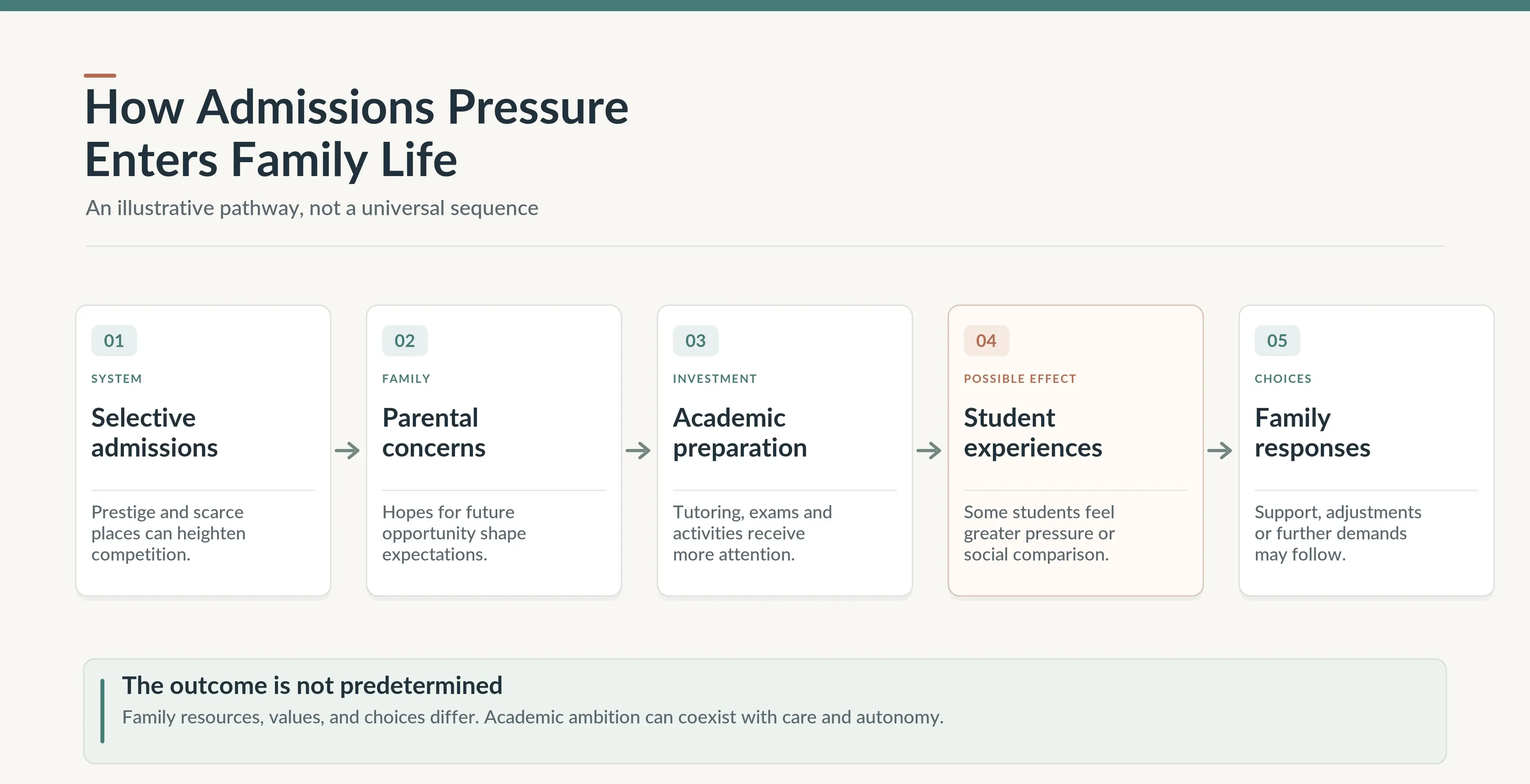
This reveals a broader mechanism through which educational competition can enter family life. Universities establish selective admissions systems. Parents interpret what those institutions reward and attempt to prepare their children accordingly. Academic results, extracurricular activities, personal development, and even leisure may come to be evaluated for their contribution to a future application.
No admissions officer needs to supervise the household. Families can internalize institutional expectations and reorganize daily life around them. What eventually appears on an application as an individual's achievement may therefore represent years of financial investment, parental organization, and opportunities that other applicants did not have.
Academic competition also exists within a growing market for educational assistance. Alongside conventional tutoring and examination preparation, commercial services such as TriadEssay advertise academic writing and coursework-completion services. These forms of assistance raise different questions.
Tutoring can help students understand difficult subjects and develop independent skills, whereas submitting work completed by someone else as one's own can violate academic integrity requirements. Such services illustrate the commercial opportunities surrounding academic performance, although their existence alone does not establish why individual students seek them or whether elite admissions pressure influences their decisions.
Sociologist Yi-Lin Chiang's Study Gods: How the New Chinese Elite Prepare for Global Competition, published in 2022, reveals another contradiction within educational meritocracy.
Drawing on research involving students at two elite Beijing secondary schools, Chiang examined a peer hierarchy in which students admired for seemingly effortless academic excellence occupied a particularly prestigious position. High achievers who visibly worked hard were respected differently, while students who invested considerable effort without producing strong results could occupy the lowest positions.
This complicates the reassuring idea that competitive education consistently rewards hard work. Within the hierarchy Chiang studied, achievement mattered, but so did the appearance of natural ability. Exceptional results seemed more impressive when they appeared to require little effort.
The distinction has consequences for how students understand themselves and one another. Academic performance becomes more than evidence of learning. It can become a measure of intelligence, social standing, and perceived personal worth. Students may learn to judge their own abilities through comparisons that offer limited recognition for persistence, improvement, or circumstances beyond their control.
There is another contradiction. Families are encouraged to believe that prestigious admissions reflect individual merit, yet the institutions distributing those opportunities do not necessarily evaluate applicants independently of socioeconomic advantage.
Research by economists Raj Chetty, David Deming, and John Friedman, published in The Quarterly Journal of Economics, found that children from families in the highest-income 1% were more than twice as likely to attend an Ivy-Plus college as children from middle-class families with comparable SAT or ACT scores.
The researchers defined Ivy-Plus institutions as the eight Ivy League universities, Stanford University, the Massachusetts Institute of Technology, Duke University, and the University of Chicago.
Importantly, the study did not attribute the entire attendance gap to admissions decisions. Approximately two-thirds reflected differences in admission rates among applicants with comparable test scores, while the remainder reflected differences in application and enrollment patterns.
The researchers identified preferences for children of alumni, the weight assigned to nonacademic credentials, and athletic recruitment as major sources of the high-income admissions advantage.
These findings do not mean academic ability is irrelevant or that every affluent applicant receives preferential treatment. They demonstrate something more specific: at the highly selective private institutions studied, family income was associated with substantial attendance advantages that test scores alone could not explain.
That evidence challenges the idea of elite admissions as a straightforward verdict on individual effort. When families interpret rejection entirely as a failure of preparation, motivation, or parental sacrifice, broader inequalities can disappear from the explanation. A student may be encouraged to take personal responsibility for an outcome shaped partly by institutional practices and unequal access to opportunity.
Parents' concern about prestigious universities is not, however, entirely imagined. Institutional reputation can influence employment opportunities.
In her 2011 study, Ivies, Extracurriculars, and Exclusion: Elite Employers' Use of Educational Credentials, sociologist Lauren Rivera examined hiring practices at elite professional service firms. She found that employers placed considerable value on prestigious university affiliations, sometimes attributing superior qualities to graduates regardless of their academic performance after admission.
The findings concern a particular segment of the labor market, not employers universally. Nevertheless, they help explain why some families view educational prestige as more than a matter of personal pride. Where influential employers use institutional reputation as a signal of talent, parents may reasonably fear that attending a less prestigious university could restrict certain opportunities.
Understanding that anxiety does not require accepting every response to it.
The broader problem is that families make decisions within a competitive system that none of them controls individually. Additional tutoring, stronger academic credentials, and carefully selected activities may improve one student's relative position. But every family cannot gain the same comparative advantage.
As more applicants accumulate similar credentials, the qualifications needed to stand out may become more demanding. Families can find themselves investing increasing amounts of time and money simply to remain competitive. What appears to be an individual commitment to educational excellence can become a collective escalation of expectations.
The costs are not distributed equally. Affluent families may be able to purchase specialized preparation, arrange extracurricular opportunities, and absorb the financial risks of competitive admissions. Families with fewer resources must make choices within tighter constraints. Students experience the pressure differently depending on the support, opportunities, and expectations available to them.
A credible response therefore requires more than advising parents to reduce pressure.
Universities have a responsibility to examine admissions preferences that reproduce inherited advantages and to evaluate whether their selection practices identify the abilities and qualities they claim to value. Employers should consider applicants' demonstrated competencies rather than relying excessively on university reputation. Schools can recognize different forms of achievement without presenting a small group of institutions as the only meaningful destinations.
Parents also have choices, even within an imperfect system. They can distinguish high expectations from conditional approval, support demanding academic goals without treating every setback as a family crisis, and allow children to develop interests that do not immediately strengthen a résumé or application.
None of this requires dismissing academic ambition. Students can benefit from rigorous education, sustained effort, and the pursuit of difficult goals. Prestigious universities can offer valuable opportunities. The problem arises when a worthwhile opportunity becomes the sole acceptable destination, or when a child's achievements become the primary measure of the family's success.
Children need room to work hard, encounter disappointment, reconsider their ambitions, and discover abilities that standardized measures or selective admissions processes may overlook. Their interests and aspirations can change without making the resources devoted to their education meaningless.
The deepest danger of educational elitism is not simply that competition becomes intense. It is that families may begin treating institutional recognition as confirmation of a child's value. Under those conditions, even genuine affection can become entangled with relentless expectations.
Education should help young people acquire knowledge, develop judgment, and make informed choices about their futures. It should not require them to spend childhood proving that their lives deserve recognition from a famous institution.







Comments 0
No comments yet. Be the first to start the conversation.