



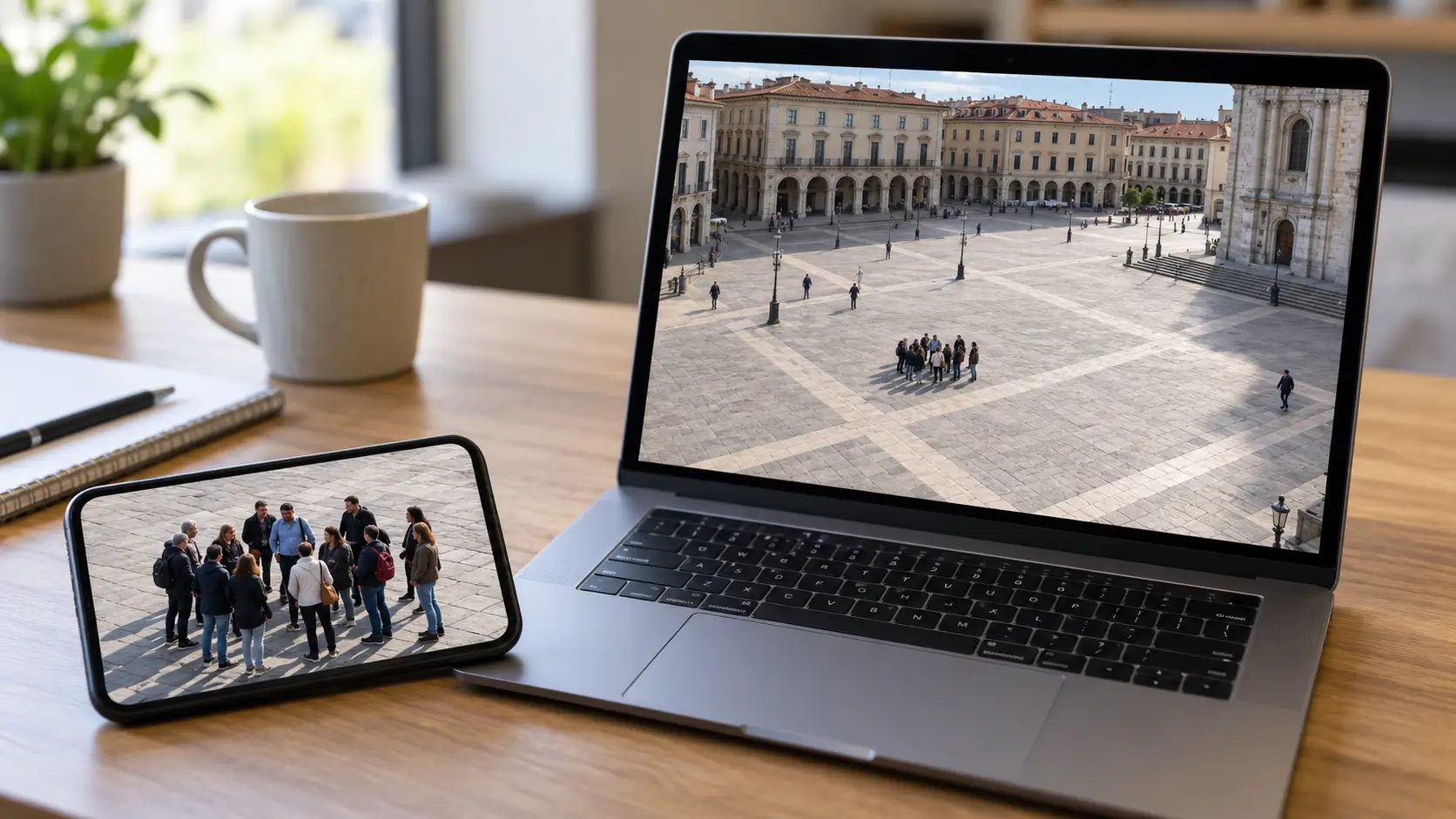
A photograph can show something that genuinely happened and still support a false story. A video can accurately record someone's actions while leaving viewers with an incorrect understanding of the event.
The misleading information does not necessarily come from fabricated images, artificial intelligence, or digital manipulation. It can come from an inaccurate caption, an old recording presented as new, a carefully selected camera angle, or important moments missing from a video.
In March 2023, footage showing water moving violently in a swimming pool circulated with claims that it depicted an earthquake near New Zealand. The recording was genuine, but AFP Fact Check traced the same footage to an April 2015 upload associated with Nepal's earthquake.
The video itself was not the central problem. The misleading information was the date and location attached to it.
This distinction matters when evaluating social media posts, news reports, forwarded messages, educational materials, and videos of public events. Visual evidence can help establish what happened, but it does not automatically confirm everything people say about it.
Answer Summary: Real images and videos can mislead when their original context is missing, changed, or selectively presented. An authentic recording does not independently verify its caption, date, location, or the interpretation attached to it. Cropping, incomplete video sequences, misleading narration, and unrepresentative scenes can create false impressions without fabricating the underlying footage. Readers can assess such claims by examining the source, searching for earlier appearances, checking surrounding footage, and comparing the explanation with independent evidence.
Key Takeaways:
-
A genuine photograph or video does not automatically confirm the story attached to it.
-
Old footage can be misrepresented as evidence of a newer event.
-
Cropping and selective editing can remove information needed for accurate interpretation.
-
One recorded moment may not represent an entire event or establish someone's intentions.
-
Reverse image searches and longer recordings help investigate different kinds of misleading context.
-
When evidence is insufficient, a claim should remain unverified rather than be treated as either confirmed or false.
What Makes a Real Image or Video Misleading?
A genuine image or video becomes misleading when the explanation attached to it encourages a conclusion that the recording does not adequately support.
The central distinction is between what the camera captured and what viewers are told the recording means.
An authentic photograph may establish that a particular scene existed, provided its origin and authenticity have been adequately verified. It does not automatically establish when the scene was photographed, why people were present, or whether the image represents a wider situation.
Similarly, a video may accurately record someone's movements without establishing the reason for those movements.
The UK House of Commons Library distinguishes genuine images shared with incorrect context from digitally manipulated and artificially generated content in its 2026 guidance, How to Verify Images and Videos.
These problems require different kinds of investigation. Detecting whether an image is fabricated is one task. Determining whether a genuine image supports its accompanying explanation is another.
Authenticity, context, and representativeness
Three questions help distinguish an accurate visual record from a potentially misleading presentation.
Authenticity: Was the underlying scene genuinely recorded, rather than fabricated?
Context: Does the accompanying description accurately identify the people, time, location, circumstances, and sequence of events?
Representativeness: Does the selected image or excerpt reasonably support the wider conclusion being made?
These questions address different kinds of evidence.
A photograph can be authentic and correctly dated while providing an incomplete representation of an event.
A video can show a genuine interaction but lack the surrounding information necessary to understand it.
Even a recording that has not been digitally altered can become misleading when paired with an inaccurate explanation.
The distinction is particularly important when a caption moves beyond observable facts.
A photograph showing people gathered outside a building establishes their visible presence. Without other evidence, it does not necessarily establish why they gathered, whether everyone present shared the same purpose, or what happened outside the captured frame.
The photograph may be accurate. The broader conclusion remains unsupported.
How Genuine Images and Videos Create False Impressions
Misleading visual content often changes the relationship between recorded evidence and the story presented to viewers.
The methods vary, but each involves a difference between what is visible and what the accompanying claim establishes.
1. Real footage presented with the wrong date or location
An old recording can be presented as evidence of a newer event, especially when both events involve similar circumstances.
A video of earthquake damage, for example, may appear consistent with reports of another earthquake. Without checking its source, viewers may have no obvious reason to question the date or location in the caption.
The swimming-pool footage investigated by AFP demonstrates this problem.
On 22 March 2023, AFP published a fact-check concerning a video circulating with claims that it showed an earthquake near New Zealand's Kermadec Islands.
AFP reported finding the same footage in a YouTube video uploaded on 25 April 2015.
That earlier upload identified the scene as the Summit Hotel in Kathmandu during Nepal's earthquake. AFP also compared visible features of the swimming pool with other images associated with the hotel.
The investigation established that the footage was not newly recorded during the claimed March 2023 New Zealand event.
The difference between the recording and the claim can be expressed in three parts:
|
Visible evidence |
Attached claim |
What verification established |
|---|---|---|
|
A swimming pool with water moving violently during an apparent earthquake. |
The footage showed an earthquake near New Zealand in March 2023. |
AFP traced matching footage to an April 2015 upload associated with Kathmandu, Nepal. |
The video did not need artificial alteration to support the false impression.
The change occurred when an older recording was given a new explanation.
This method is often called miscaptioning or false-context misinformation. The same underlying footage may circulate repeatedly because its visible content remains compatible with more than one event description.
An earlier upload does not necessarily identify the original camera recording. However, evidence that footage existed years before a claimed event can directly contradict the assertion that it was filmed during that later event.
2. Cropping that conceals relevant information
Cropping changes which parts of a photograph remain visible. It can improve composition, but it can also remove details needed to understand the scene.
A tightly framed photograph showing a few people in a gathering may create a different impression from a wider photograph showing the surrounding area.
Neither image necessarily contains fabricated material.
The difference is the amount of relevant information available to the viewer.
Cropping becomes problematic when the excluded area substantially changes the interpretation encouraged by the published image.
For example, if a photograph is used to support a claim about the size or behavior of an entire gathering, the selected frame must be adequate for that purpose.
A narrow view of one group cannot independently establish what everyone else was doing.
Cropping is not inherently deceptive. Newsrooms regularly select and frame photographs for clarity and presentation.
The Associated Press permits limited photographic adjustments, including cropping, under its published visual standards. Those standards reject changes that substantially alter the original scene and caution against visual presentations that misrepresent events.
The distinction is whether editing preserves the relevant meaning.
A crop that removes irrelevant empty space may leave the evidentiary value unchanged. A crop that excludes information contradicting the caption may substantially distort the viewer's understanding.
This also explains why genuine source footage can produce a misleading edited image. The visible material remains real, but the published selection no longer conveys the necessary context.
3. Short video clips that omit what happened before or afterward
A short video can accurately show an action while excluding the circumstances necessary to interpret it.
The missing context may concern what happened immediately before the recording began, what occurred after it ended, or what other participants were doing outside the frame.
This problem is especially significant when viewers are encouraged to infer someone's intentions from a brief movement or reaction.
A documented example occurred during the Group of Seven summit in Italy in June 2024.
A circulating clip was described as showing then-U.S. President Joe Biden wandering away from other leaders.
Reuters examined a longer recording of the event and footage captured from a different camera angle.
The additional footage showed that Biden was interacting with paratroopers during a skydiving demonstration.
Reuters concluded that the circulating characterization lacked context.
The important distinction was not whether the visible movement occurred. It was whether the short excerpt supported the explanation attached to it.
The longer footage provided information that the selected clip did not convey.
The case demonstrates two useful verification methods.
First, a longer recording can reveal what happened immediately before and after a selected moment.
Second, footage from another camera angle can show participants or activities outside the circulating frame.
Neither method automatically proves every interpretation of an event. Together, however, they can reveal why a short excerpt supports a narrower conclusion than its caption suggests.
A similar problem can occur in interviews, speeches, classroom recordings, public meetings, or videos of disputed interactions.
A sentence may be accurately recorded but separated from qualifications that change its meaning. A visible reaction may be genuine but directed toward something outside the selected frame.
The relevant question is whether the excerpt gives viewers enough information to understand the event being described.
4. One genuine moment treated as evidence of an entire event
An authentic photograph documents a selected scene. It does not automatically establish how typical that scene was.
A photograph showing a crowded section of an event cannot independently establish attendance across the whole venue.
A video showing one person's behavior does not establish how everyone present behaved.
The same problem arises when one image is used to make general claims about a community, institution, profession, or population.
This is a question of representativeness.
The recording may accurately document an occurrence while providing insufficient evidence for a broader pattern.
An important distinction is the difference between establishing that something happened and establishing how widespread it was.
A single recording may be adequate evidence that a particular incident occurred, depending on its reliability and context.
Determining whether the incident was common, exceptional, representative, or part of a wider pattern generally requires additional evidence.
This limitation is not evidence that the recorded incident was unimportant. It means the recording should not be asked to establish more than it can reasonably demonstrate.
5. Captions, subtitles, and voiceovers that add unsupported claims
A caption can change how viewers interpret a recording without changing the recording itself.
It may identify a location, assign a motive, describe a cause, or present an allegation as an established fact.
Subtitles and voiceovers can create similar problems.
An inaccurate subtitle may misrepresent what someone said. A translated caption may omit qualifications or introduce a meaning that is not supported by the original speech.
Narration can also describe circumstances that are not visible in the video.
These additions should be assessed as separate factual claims.
A recording may establish that a person spoke certain words. It does not independently confirm every explanation added by the publisher.
The distinction is particularly important when the caption concerns someone's intentions, responsibility, identity, or conduct.
Such conclusions may require independent evidence beyond the visual material.
6. Illustrative imagery presented as evidence
An authentic photograph can be relevant to a subject without documenting the specific event being discussed.
News organizations, educational publishers, and content creators sometimes use archive images or stock footage to illustrate a general topic.
This practice is not necessarily misleading when the material is clearly identified.
The problem arises when an illustrative image is presented in a way that suggests it documents the particular event described in the accompanying report.
The Associated Press addresses this concern in its visual standards, cautioning against generic imagery that readers may mistake for photographs or footage of a specific story.
Labels such as "archive footage" or "illustrative image" can clarify the intended purpose.
However, the label must be accurate, and its placement should make the distinction understandable.
An illustrative photograph can help readers visualize a subject. It should not be treated as independent evidence that the particular event occurred.
Why Real Images Can Make Unsupported Claims Seem Convincing
Images can influence how people understand information because they provide visual detail that may make a statement easier to process or imagine.
That detail is not necessarily evidence for the statement.
Researchers Eryn J. Newman and Norbert Schwarz examined the relationship between images and claims in their 2024 review, Misinformed by Images: How Images Influence Perceptions of Truth and What Can Be Done About It.
Their analysis distinguishes different roles images can play, including supporting a claim, presenting a selective account, appearing in an unrelated context, or attracting attention without supplying evidence.
The review discusses effects on attention, comprehension, memory, and judgment.
This distinction matters because an image can be relevant to a subject without demonstrating the specific claim attached to it.
A photograph of a recognizable location may make a report about that place easier to visualize.
It does not establish that the alleged event occurred there on the stated date.
Likewise, a photograph showing a particular person does not independently establish that the person made a statement or performed an action described in an accompanying post.
Research does not establish that every photograph automatically increases belief.
In a 2024 experiment involving 98 participants, Claudine Pulm, Anne Gast, and Jan Rummel examined whether photographs unrelated to the truth of accompanying statements affected participants' judgments.
Their study, published in Consciousness and Cognition, did not reproduce the previously reported tendency for such photographs to increase perceived truth, either immediately or after 48 hours.
The findings do not establish that images have no influence on belief. They demonstrate that the effect cannot be assumed across every task, situation, or population.
For readers, the useful distinction is between visual relevance and evidentiary support.
Before treating an image as confirmation, ask whether it provides evidence for the particular statement or merely makes the statement easier to picture.
How to Verify the Context of an Image or Video
Verifying visual material means investigating whether the recording supports the specific explanation attached to it.
An ordinary reader does not need to carry out a lengthy forensic investigation for every post. A focused examination can identify important contradictions or reveal that the available evidence is insufficient.
Identify the exact claim
Begin by separating what is visible from what the accompanying post asserts.
Read the caption carefully.
Does it claim that the recording shows a recent event, a particular location, an identifiable person, or a specific cause?
Which details can be observed directly, and which depend on the publisher's explanation?
If a video is described as showing an incident from today, the date is an essential part of the claim.
If a photograph is used to support an allegation, the identity of the person and the interpretation of the scene require appropriate evidence.
Also examine who published the material.
A traceable source can provide useful information about how the recording was obtained. An anonymous or reposted video may still be genuine, but locating its earlier history can be more difficult.
Search for earlier appearances
Reverse image search helps investigate whether a photograph or recognizable video frame appeared online before the claimed event.
Tools such as Google Lens, TinEye, and Bing visual search can assist with finding matching or similar images.
For videos, a distinctive still frame can be searched as an image.
The purpose is not merely to find another copy. It is to examine whether an earlier appearance contains conflicting information about the recording's date, location, or circumstances.
WITNESS Media Lab's verification resources describe methods for examining online video, including source tracing and searches using video imagery.
A useful result may be an earlier publication, an archive entry, or a report identifying the same scene.
In AFP's swimming-pool investigation, matching footage published in 2015 contradicted the claim that the recording showed an event in 2023.
This illustrates when reverse searching is especially useful: investigating footage presented as new or associated with a different event.
Find a longer recording or another camera angle
Reverse image search cannot resolve every kind of misleading context.
If the dispute concerns the meaning of someone's behavior, a longer recording may be more informative than an earlier upload.
Look for an extended version of the event rather than another repost of the same short excerpt.
Examine what occurred before the selected scene and what happened immediately afterward.
If possible, compare footage captured from a different camera position.
This was central to Reuters' examination of the 2024 G7 summit video. The additional footage provided context that the circulating excerpt did not convey.
Different recordings should still be evaluated for their own reliability.
Several accounts sharing the same clip do not provide independent confirmation merely because the video appears in several places.
Compare the details with independent evidence
The claimed time and place should be consistent with available evidence.
Visible signs, buildings, landmarks, language, or distinctive surroundings can help establish where footage was recorded.
However, individual clues have limitations.
A recognizable building may support a location claim without establishing the recording date.
A visible timestamp may provide a lead, but it should not automatically be treated as reliable without corroboration.
For significant claims, compare the recording with independently published reporting, official information where relevant, and other credible documentation.
The goal is to determine whether independent sources support the specific event description rather than merely repeat the same viral claim.
Readers who need a broader source-checking process can consult Collegenp's article on information verification skills.
Decide what the evidence establishes
An investigation does not have to produce an absolute true-or-false answer.
A more useful approach distinguishes three outcomes.
|
Assessment |
Meaning |
Appropriate conclusion |
|---|---|---|
|
Supported |
Reliable evidence corroborates the claim and relevant context. |
Describe what has been established without extending the conclusion beyond the evidence. |
|
Contradicted |
Reliable evidence conflicts with an essential part of the claim. |
Reject or correct the contradicted claim while preserving accurate details. |
|
Unresolved |
The available material is insufficient to establish the claim. |
Avoid presenting the claim as confirmed or definitively false. |
The distinction between contradicted and unresolved is important.
If footage appeared online years before the event it supposedly depicts, the claimed recording date is contradicted.
If the source cannot be located and the surrounding circumstances remain unclear, the claim may remain unresolved.
A lack of confirming evidence does not independently establish fabrication.
Likewise, the absence of contradictory evidence does not establish that a caption is accurate.
What Verification Tools Cannot Prove
Verification tools help investigate visual evidence, but their results have limits.
Understanding those limits prevents one uncertain claim from being replaced by another.
An earlier online upload does not necessarily establish the recording date
A reverse image search may identify the earliest searchable appearance of an image or video.
That appearance is not necessarily the original recording.
The file may have been shared privately or published elsewhere before the located upload.
An earlier publication can establish that the material existed by a particular date. It does not automatically identify when the camera recorded it.
Similarly, failing to find a matching image does not prove that the material is new or authentic.
Search tools cannot be expected to find every photograph or video ever recorded.
Missing metadata does not prove manipulation
Digital files may contain metadata describing details such as the device used, the recorded timestamp, or location information.
This information can assist verification when it is available and reliable.
However, metadata may be removed or changed during ordinary editing and sharing.
The House of Commons Library cautions that metadata is not a reliable standalone method for determining a file's origin.
A missing timestamp is not proof that an image was fabricated.
A visible or embedded timestamp should also be assessed alongside other evidence rather than treated as independently conclusive.
Content Credentials do not establish the truth of a caption
Content Credentials are designed to provide information about the documented history of digital material.
The Coalition for Content Provenance and Authenticity (C2PA) develops technical specifications for this approach.
Its official documentation explains that provenance information can help establish the origin, history, and authenticity of digital content.
However, provenance information alone cannot determine whether the content depicts a truthful account of an event.
A valid credential may help establish information about the file and its documented handling. It does not independently verify the interpretation, caption, or narration accompanying that file.
C2PA also cautions against assuming that media without Content Credentials is inherently less trustworthy.
Confirming that footage is genuine does not confirm its story
Artificially generated imagery and genuine footage shared with incorrect context are distinct problems.
A recording can be authentic while its date, location, or accompanying explanation is false.
Determining that a video was not artificially generated does not establish that the video documents the event described in its caption.
The investigation must address the actual claim being made.
How to Share and Publish Visual Content Without Distorting Its Meaning
Responsible visual communication requires accurate captions, relevant context, and a clear distinction between evidence and illustration.
The same principles apply to journalism, educational assignments, presentations, and everyday social media use.
For students and researchers, a photograph should be described according to what it documents.
An image of a general subject should not be presented as evidence of a specific event unless its connection to that event has been established.
When an image comes from an earlier publication, the source and relevant context should be retained.
For publishers and content creators, selecting photographs and shortening videos are ordinary editorial activities.
The responsibility lies in ensuring that those selections preserve the meaning supported by the available evidence.
Before publishing, consider whether the caption identifies the scene accurately, whether an excerpt omits relevant context, and whether the selected material supports the broader claim.
Archive footage and illustrative images should be labeled clearly.
Subtitles and narration should preserve the meaning of recorded speech rather than introducing unsupported conclusions.
For classroom presentations, Collegenp's guide to media literacy for students provides additional guidance on evaluating sources and using online information responsibly.
What if misleading footage has already been shared?
When reliable evidence shows that a shared image or video was misrepresented, the correction should identify the specific error.
It is not enough to describe the recording as fake when the footage itself is genuine.
For example, an appropriate correction to the swimming-pool claim would explain that AFP traced the footage to material associated with Nepal's 2015 earthquake rather than the claimed 2023 New Zealand event.
Providing the relevant fact-check allows others to examine the supporting evidence.
When the context remains uncertain, the correction should reflect that limitation instead of replacing one unsupported interpretation with another.
Care is especially important when visual claims involve identifiable individuals, allegations, or matters that may affect someone's reputation.
A genuine recording should not be used to establish intentions, responsibility, or broader patterns without sufficient supporting evidence.
Conclusion
Real images and videos can become misleading when the context attached to them is inaccurate, incomplete, or selectively presented.
A genuine recording may establish that a particular scene occurred. It does not automatically confirm when or where the event happened, why someone acted in a particular way, or whether the selected moment represents a wider situation.
The most useful distinction is between the visual evidence and the explanation attached to it.
Checking the original source, examining longer recordings, comparing independent evidence, and recognizing the limits of verification tools can help readers reach more accurate conclusions.
When those checks cannot establish the context, uncertainty remains a legitimate conclusion.
The goal is not to distrust every photograph or video. It is to understand what visual evidence can establish and where additional information is necessary.
References
1. Brooks, Campbell. (2026). How to Verify Images and Videos. UK House of Commons Library. Published 5 May 2026.
2. Mishra, Devesh. (2023). Clip of Swimming Pool Shaking from Quake Filmed in Nepal 2015, Not New Zealand 2023. AFP Fact Check. Published 22 March 2023.
3. Reuters Fact Check. (2024). Fact Check: Clip of Biden 'Wandering Off' at G7 Summit Lacks Context. Published 21 June 2024.
4. The Associated Press. Telling the Story: News Values and Principles. Official editorial standards on visual accuracy, cropping, and the responsible use of photographs and video.
5. Newman, E. J., & Schwarz, N. (2024). Misinformed by Images: How Images Influence Perceptions of Truth and What Can Be Done About It. Current Opinion in Psychology, 56, Article 101778. DOI: 10.1016/j.copsyc.2023.101778.
6. Pulm, C., Gast, A., & Rummel, J. (2024). A Picture Corrects a Thousand Words – The Effect of Photos on Veracity Feedback. Consciousness and Cognition, 125, Article 103758. DOI: 10.1016/j.concog.2024.103758.
7. WITNESS Media Lab. Verification Resources. Resources and guidance for examining online video and its original context.
8. Coalition for Content Provenance and Authenticity (C2PA). C2PA Explainer, Specification 1.4. Official documentation explaining digital provenance, Content Credentials, and their limitations.






Comments 0
No comments yet. Be the first to start the conversation.