




Why School Education Has Not Improved in Nepal
Nepal’s Constitution (2072) has established education as a fundamental right. It includes a constitutional provision that education up to the secondary level should be free and compulsory. However, despite investments made over past decades, policy changes, and national and international efforts, Nepal’s public school education has not achieved the expected level of improvement.
Many people describe this only as a lack of budget. But is the problem really only money? If we look at the Ministry of Education’s data, billions of rupees are spent in this sector every year. Even so, why is the gap between public and private schools becoming deeper? Why are most students and parents being forced to look for alternatives to community schools?
To find answers to these questions, we need serious research and discussion on multiple dimensions of the education system—politics, policy, human resources, infrastructure, and teaching methods.
Table of Content
- Why School Education Has Not Improved in Nepal
- Policy Uncertainty and the Complexity of Federal Implementation
- Teacher Management and Politicization
- Problems in Budget Distribution and Allocation
- Outdated Curriculum and Learning Methods
- Weak Monitoring and Evaluation System
- Dual Education System: Private and Community Schools
- Socio-Cultural Challenges and Dropout Rates: An Invisible National Crisis
- Practical Solutions
- Conclusion
Policy Uncertainty and the Complexity of Federal Implementation
After Nepal issued the federal democratic republican Constitution in 2072, major changes were also expected in the education sector. Schedule 8 of the Constitution gives local governments exclusive authority over basic and secondary education. However, a large “policy gap” can be seen between this constitutional provision and real implementation on the ground.
Legal Vacuum and the Legacy of 2028
The irony is that even though the country has been under a federal structure for almost a decade, the education sector is still guided by the Education Act of 2028. The 2028 Act was created for the Panchayat system and the early period of decentralization, and it cannot address today’s federal context, technology, and global competition.
Because the federal education law has been delayed, local governments have attempted to create their own education laws. However, they have repeatedly faced legal disputes, with claims that their laws conflict with federal legislation. This has created extreme confusion among local representatives and staff about what should and should not be done.
Power Struggles and Disputes Over Jurisdiction
At present, there is visible conflict over authority among the federal ministry, provincial ministries, and local levels. The tendency of the federal government to keep everything under its control in the name of “national standards,” and the tendency of local levels to seek full independence in the name of “constitutional authority,” has weakened coordination.
This has directly affected schools. For example, in teacher post adjustment and allocation, the push-and-pull between the center and local levels has resulted in some schools having too few teachers compared to the number of students, while in other places there are too many teachers but fewer students.
Leadership Instability and Policy Immaturity
Frequent leadership changes in the Ministry of Education (transfers of ministers and secretaries) are another major obstacle. Every new minister or secretary wants to introduce their own new program, leaving earlier plans incomplete.
Any long-term education plan needs continuity of at least 5 to 10 years to be completed, but in Nepal it is unfortunate that the average lifespan of policies often does not even reach 2 years.
Teacher Management and Politicization
The greatest strength of school education—and also its weakest link—is the teacher. Teachers have been developed more as “jobholders” or “political workers” rather than as professional practitioners, which has shaken the foundation of public education.
Professional Duty Versus Political Loyalty
Most teachers in government schools in Nepal are active workers of political parties or office-bearers of affiliated organizations. A significant part of teachers’ influence is spent on political mobilization.
During elections or party programs, their presence often becomes more visible than in the classroom with students. Because teachers have higher political access, principals cannot easily assign work or ensure accountability. As a result, “politics” becomes dominant in schools rather than “teaching.”
Lack of Transparency in Transfers and Promotions
When a capable teacher works hard but does not receive a promotion or a transfer to a convenient location due to a lack of political connections, their motivation collapses. Hardworking and honest teachers feel ignored, while those who rely on flattery and political access keep receiving better facilities.
Instead of making teaching a respected profession, this system has turned it into a space where power-brokering becomes normalized.
Ineffective Training and Weak Skill Transfer
Billions from the education budget have already been spent on teacher training in Nepal. Teachers attend 10–15 day trainings in expensive hotels and centers. But that training does not reach the classroom.
A belief has developed among teachers that “training is only a way to get a certificate and receive allowances.” Unless training is linked to student learning outcomes and strictly monitored, it will not have real value.
Problems in Budget Distribution and Allocation
There is a shortage of budget in the education sector, but the distribution system of the existing budget has become an even bigger problem. We spend only around 4 percent of GDP or 11 percent of the national budget on education, while there is a view that developing countries should increase this figure up to 20 percent.
Heavy Administrative and Recurrent Expenses
More than 85 percent of Nepal’s education budget is spent only on salaries and allowances for teachers and staff. The budget for essential capital expenses needed for school improvement—such as building labs, improving buildings, introducing technology, and supporting research—is extremely low.
This means we are paying teacher salaries, but not providing the educational tools and materials needed to teach effectively.
Digital Divide and Resource Inequality
On one hand, a few schools in cities discuss smart boards and online classes. On the other hand, students in remote villages study in winter in schools without proper roofs, sitting on cold floors with blackboards as the main tool.
This inequality between accessible and remote areas mocks the slogan of “quality education for all.”
Budget Freezing at the Local Level
In many local levels, education budgets have been found to be frozen or diverted to other sectors through end-of-fiscal-year spending. Because local education sections are not skilled in planning and implementing budgets effectively, even the limited allocated budget has not been properly utilized.
Outdated Curriculum and Learning Methods
Nepal’s education problem is not limited to the curriculum alone. It is even more centered on delivery methods and the ways learning is assessed.
Distance Between Curriculum and Real Life
The current curriculum appears to prepare students as if they are meant to become “factory workers.” Rote learning is its backbone.
For example, a Grade 10 student may know world geography or history, but may have no knowledge about mobilizing local resources, modern farming, or basic market management. The curriculum emphasizes turning students into machine parts rather than nurturing creativity.
Blind Obsession With “English” and Its Impact
In the name of competing with private schools, community schools are forcefully implementing “English-medium” instruction. Neither are teachers proficient in English, nor is the student environment supportive.
As a result, students are forced to memorize in English without understanding the subject content. Their logical capacity becomes constrained. Over time, they can neither write English properly nor develop a strong foundation in their own language.
Exams as the Final Standard
In Nepal’s education system, scoring an “A-plus” is treated as the definition of being intelligent. Practical knowledge, emotional development, and social responsibility are not measured anywhere.
When a year’s learning is judged only through a 3-hour paper-pencil exam, student stress increases and unhealthy competition grows around “passing the exam at any cost.”
Weak Monitoring and Evaluation System
Making rules and policies is not enough. A strong mechanism is required to ensure implementation. But after federalization, Nepal’s education monitoring system has become almost collapsed.
Dissolution of District Structures and Institutional Gaps
The former “District Education Offices” and “Resource Centers” under them were largely ignored at the beginning of federalization. After those structures were removed, there was no one to monitor daily school activities, teacher attendance, and teaching quality.
Although local levels were given this responsibility, they often fail to conduct fair monitoring due to the influence of their own teachers, staff, and elected representatives.
Data Manipulation
The data sent to the Ministry of Education’s IEMIS (Integrated Educational Management Information System) is often inflated. Schools show higher enrollment rates and retention rates to receive more budget or to appear better.
However, field inspections often reveal that the real number of students is much lower. If the data itself is incorrect, how can the resulting policies and plans be correct?
End of Accountability
In community schools, everyone has responsibility, but no one has accountability. If students fail in a classroom, the teacher’s salary is not stopped, and the principal’s benefits are not reduced.
This culture of negligence has made people feel no need to put in extra effort for education quality.
Dual Education System: Private and Community Schools
This is the biggest and most structural problem in Nepal’s education reform. Having two separate education systems within one country creates a deep class divide in the future.
A Source of Social Discrimination
For today’s parents, sending children to a private school has become an issue of “status.” Policymakers, education experts, teachers, and big business owners in positions of power do not send their children to community schools.
Because of this, the problems in public education do not affect them personally. For them, government schools are seen only as places for the children of the poor and laborers. As a result, the urgency and sincerity needed for policy-level reform is missing.
The Starting Point of Migration
Private schools charge higher fees and provide somewhat better education, but there is a dangerous side to this. From an early age, they plant the idea in students’ minds that “there is no future in Nepal, and good students must go abroad.”
In this way, the country faces a double burden: community schools producing unemployed graduates and private schools producing human resources that leave the country.
Therefore, small and cosmetic changes are not enough for Nepal’s school education reform. The only practical solution today is to fully free education from party politics, strengthen local levels with resources and skilled human power, add skill-based and locally grounded learning into the curriculum, and move toward a single public education system.
Otherwise, schools will continue producing degree-holding unemployed individuals, but will never be able to produce capable and responsible citizens needed by the nation.
Socio-Cultural Challenges and Dropout Rates: An Invisible National Crisis
Nepal’s education landscape shows a paradoxical picture—primary level enrollment is above 95 percent, but by the time students reach the secondary level (Grade 10 or 12), this rate drops sharply.
This dropout problem is not just a statistic buried in Ministry files. Its roots are deeply embedded in Nepal’s social structure and economic hardship.
a) The Cycle of Poverty and the Opportunity Cost of Education
For low-income families in hill and rural areas, education is still seen as a long-term investment, while surviving today’s hunger and daily needs is an immediate necessity.
For many parents, a child of school-going age is not only a student but also a “working hand” to care for livestock, look after younger siblings, or support farm work. When a child goes to school, parents worry about the economic loss or increased workload due to the child not working at home. In economics, this is called “opportunity cost.”
Even with free education provisions, hidden costs like bags, notebooks, pens, and school uniforms make education expensive for the poorest families.
b) Household Labor and the Sacrifice of Childhood
In rural areas, especially among Dalit, marginalized, and poor communities, children carry a heavy burden of household labor. Data suggests that during farming seasons (planting or harvesting), school attendance drops by 30 to 40 percent.
Children are not only taken into wage labor, but are also forced to walk long distances to collect firewood and grass from forests and to carry water. Their bodies and minds become so exhausted that even when they reach school, they cannot learn.
Eventually, as they fall behind in learning, they develop feelings of inferiority and permanently leave school.
c) Midday Meal Program: The “Joke” of 15 Rupees and the Question of Quality
The government introduced the midday meal program to bring students to school and retain them. But its implementation is disappointing.
With only 15 to 20 rupees allocated per student, what quality of meal is possible in today’s inflation? In many schools, this budget has become only a way to complete paperwork and distribute low-quality food.
Although it is scientifically true that cognitive development cannot happen on an empty stomach, the lack of nutritious food is affecting students’ physical and mental growth. A pattern has emerged where students come only for meals but do not focus in class. This creates “quantity,” but “quality” is never achieved.
d) Geographic Barriers and Lack of Health Services
Nepal’s difficult geography is also a major cause of dropouts. In some remote districts, children must walk 1 to 2 hours on steep and risky trails to reach school.
During the rainy season, landslides and swollen rivers prevent children from attending school for weeks. Such gaps cause them to miss the curriculum and gradually lose motivation to return.
In addition, frequent illness due to poor health and nutrition prevents students from attending school, creating further harm for public school learners.
Therefore, improving school education cannot be achieved only by changing “teachers” and “books.” Interventions are also needed in the economic and cultural structure of society.
Until parents’ economic conditions improve and they can truly feel that “education is a tool to escape poverty,” these invisible challenges will continue hollowing out the education system.
For solutions, it is essential to significantly increase the midday meal budget, connect local agricultural production with school meals, and introduce programs such as social security allowances that support extremely poor families while keeping children connected to education.
Practical Solutions
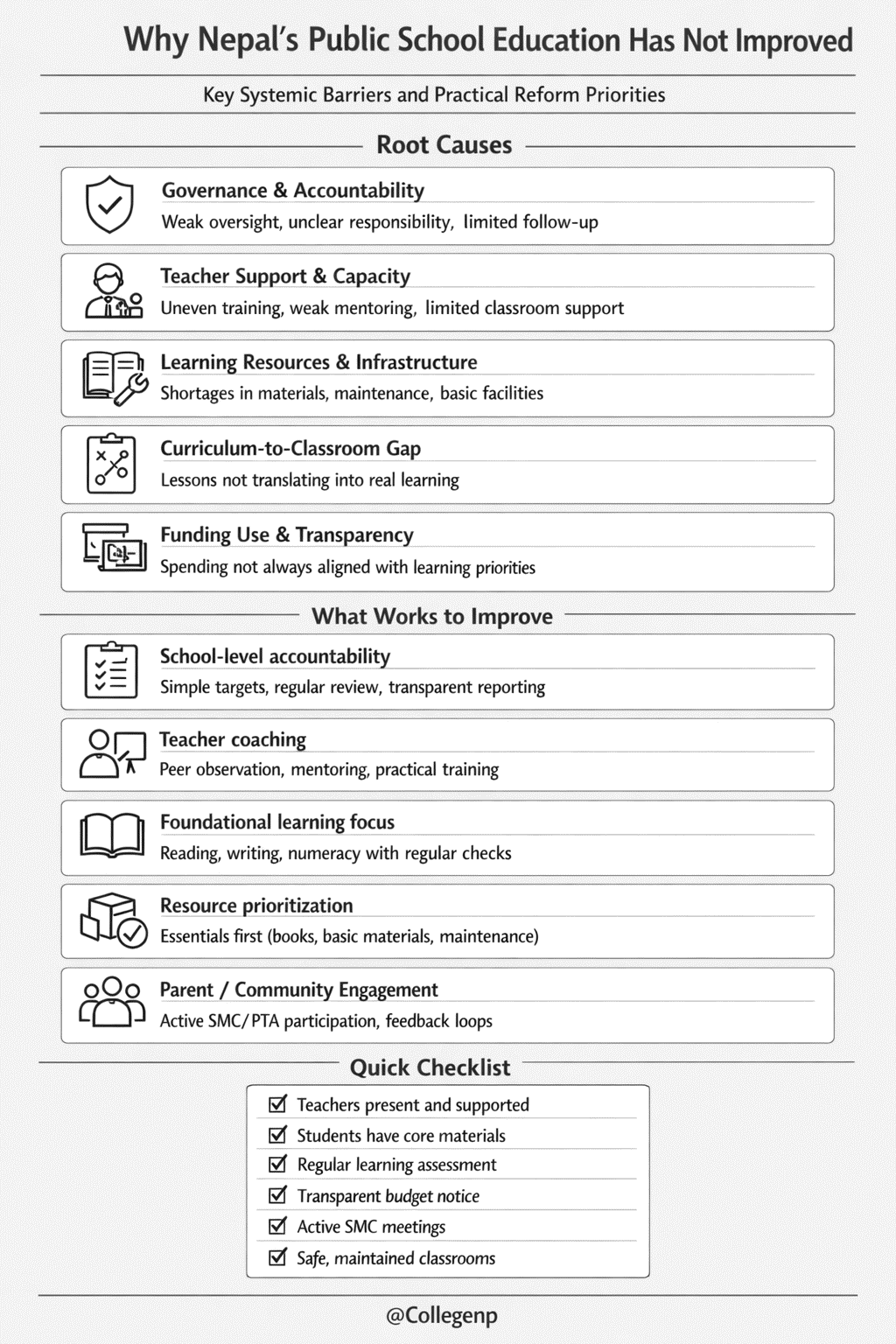
Identifying problems alone is not enough. Concrete and practical steps are required for reform.
a) Complete Depoliticization of Education
Strict rules must be created so that if teachers are found holding membership in any political party or carrying party flags, they are immediately dismissed from service. Teacher qualification testing must be conducted fairly and regularly through the Teacher Service Commission.
b) A Results- and Accountability-Based System
Every teacher and principal should have a performance contract. If student learning levels do not improve within a fixed period, salary and benefits should be reduced, or departmental action should be taken. A system should be established to reward those who perform well.
c) Technology and Practical Education
Modern education cannot run only on blackboards and chalk. High-speed internet, multimedia classrooms, and science laboratories must be made mandatory in schools.
Along with studies up to Grade 10, students must be taught at least one technical skill for skill development.
d) Active Community Engagement in School Management
School Management Committees should not include only politicians. They should include active parents and education experts. Local governments should regularly conduct education audits.
e) Budget Increase and Proper Mobilization
At least 20 percent of the national budget must be allocated to education. Without sufficient budget for infrastructure development beyond salaries, public schools cannot transform.
Conclusion
The main reason Nepal’s school education has not improved is not the lack of resources alone, but the absence of strong commitment and the shortage of effective management.
As long as education is treated as an election vote bank and teachers are viewed as political workers, no change is possible.
Parents must now become more aware. They must pressure the government to improve school quality, and they must also become active themselves.
Today’s children are the pillars of tomorrow’s nation. If the foundation of these pillars remains weak, the vision of a prosperous Nepal will remain incomplete.
Education is not only a degree. It is the foundation of civilization and development. To improve it, change must begin today—from ourselves, and from the school in our own ward.
(This article has been prepared based on in-depth research, data analysis of the current educational condition, and experts’ experiences. It does not support any political party or side, but only presents pathways for reform in the interest of students and the nation’s future.)




Comments 0
No comments yet. Be the first to start the conversation.