Forbes College is a higher education institution established in 2017 at Bharatpur Metropolitan City–2, Kshetrapur, Chitwan. Situated near QFX Jalma Hall, the college provides bachelor-level education in computer science, hospitality and tourism, and business administration.
Its academic structure combines university curricula with laboratory work, projects, internships, presentations, case studies, and industry-linked training. The BSc (Hons) programs are affiliated with Asia Pacific University of Technology & Innovation (APU), Malaysia, while the Bachelor of Business Administration is affiliated with Far-Western University. The campus also provides subject-specific laboratories, classrooms with educational technology, a library, transportation, scholarships, career counselling, and practical training facilities.
| Area | Details | Academic Link |
|---|---|---|
| Established | 2017 | Bachelor-level institution |
| Location | Bharatpur–2, Kshetrapur, Chitwan | Near QFX Jalma Hall |
| Computer Science | BSc (Hons) in Computer Science (Cyber Security) | Asia Pacific University of Technology & Innovation |
| Hospitality and Tourism | BSc (Hons) in Hospitality and Tourism | Asia Pacific University of Technology & Innovation |
| Management | Bachelor of Business Administration (BBA) | Far-Western University |
| Student support | Scholarships, transportation and career counselling | College-based services |
Forbes College focuses on three broad academic areas: computing, hospitality and tourism, and business management. Its programs are organised around classroom learning as well as applied work through laboratories, projects, internships, simulations, presentations, and research activities.
The college’s computing provision covers areas such as cyber security, data analytics, and digital forensics. Its hospitality and tourism offering includes hospitality innovation, aviation management, and event management. The BBA program adds a management pathway covering finance, marketing, operations, entrepreneurship, business communication, and organisational studies.
This combination gives students at the same institution access to different academic routes while retaining a shared emphasis on practical work and professional preparation.
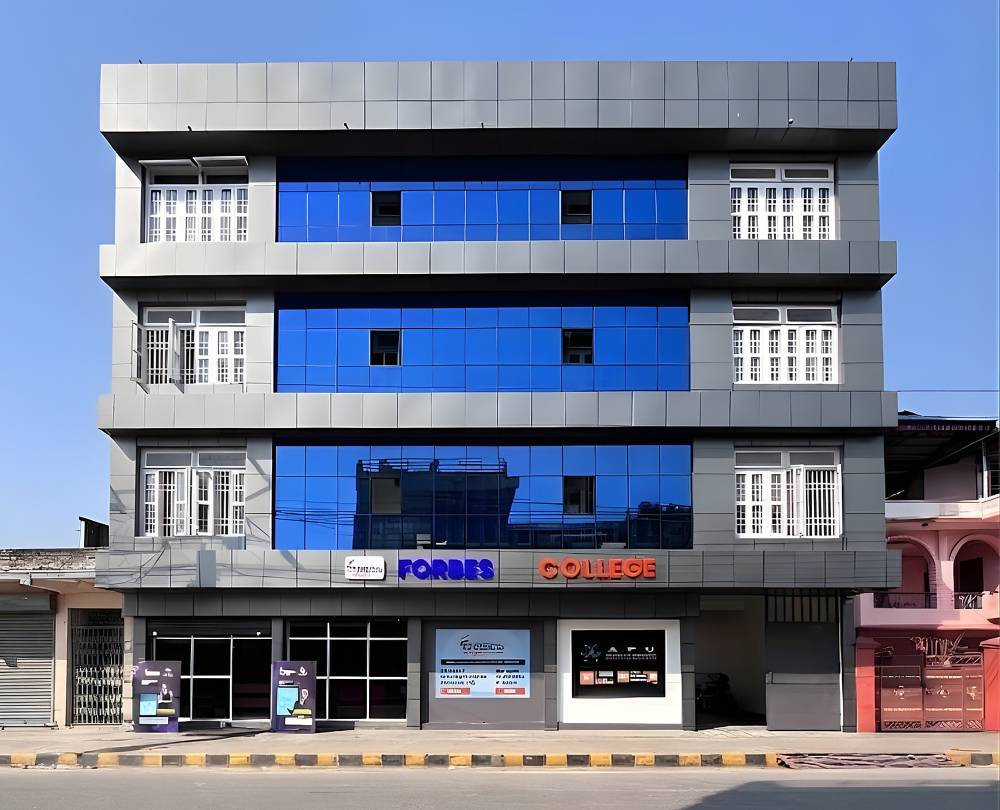
The college is located in Kshetrapur, Bharatpur Metropolitan City–2, Chitwan, near QFX Jalma Hall. Its location places the institution within the Bharatpur metropolitan area, where students attend regular classes, laboratory sessions, presentations, projects, and practical training activities.
Forbes College runs programs linked with two universities.
The BSc (Hons) in Computer Science and BSc (Hons) in Hospitality and Tourism are affiliated with Asia Pacific University of Technology & Innovation (APU), Malaysia. APU is registered under Malaysia’s Ministry of Higher Education under the Private Higher Education Act 1996 and is part of the APIIT Education Group.
The Bachelor of Business Administration is affiliated with Far-Western University. Its curriculum covers foundational business subjects before moving into functional management, strategic studies, specialisation courses, internship work, and a final project.
The computer science program includes study areas in cyber security, data analytics, and digital forensics. The detailed Cyber Security pathway is a three-year, 120-credit program with classes scheduled from Sunday to Friday, from 7:00 AM to 1:00 PM.
The first stage builds a base in computing concepts, networking, databases, programming, mathematical reasoning, systems analysis, computer architecture, and security technologies. Students study subjects such as Python Programming, Introduction to Networking, Introduction to Databases, Integrated Computer Systems, and Introduction to Security and Forensic Technologies.
The second stage moves into software and network administration, computing theory, Java development, web applications, data structures, research methods, switching and routing, and practical cyber security exercises. Elective areas include Ethical Hacking and Incident Response and Implementation of Secure Systems.
Students undertake at least 16 weeks of internship or industrial training. The final stage includes project management, algorithmics, software security, database systems, cyber security investigations, vulnerability assessment, penetration testing, and an individual Cyber Security project.
This sequence allows students to move from computing fundamentals to specialised security work. The final-year project requires them to define a practical problem, investigate it, and develop a technical response using the knowledge gained across the program.
The BSc (Hons) in Hospitality and Tourism includes study areas such as hospitality innovation, aviation management, and event management. The Hospitality Innovation pathway is a three-year, 120-credit program. Classes are scheduled from Sunday to Friday between 7:00 AM and 1:00 PM.
The first year introduces the hospitality and tourism sector alongside business communication, accounting, statistics, computer applications, entrepreneurship, cultural heritage, events management, and human resource management.
The second year places greater attention on operational and supervisory work. Students study international cuisine, food and beverage service, hygiene and sanitation, front office management, housekeeping management, customer service, tourism economics, business research, legal aspects of hospitality and tourism, and computer reservation systems.
During the final year, students study marketing for hospitality and tourism, travel and tour services, hospitality leadership, hotel innovation, and current issues in tourism. An individual project allows students to investigate a selected topic in global hospitality and tourism management.
The program includes 24 weeks of industrial training during the third year. This extended placement is intended to connect academic study with working practices in hospitality and tourism settings.
The Bachelor of Business Administration is affiliated with Far-Western University. It covers business management through an eight-semester structure and combines theoretical study with case work, simulations, internship activities, research, and project assignments.
The opening year introduces microeconomics, macroeconomics, business mathematics, business management, accounting, computer applications, English, and sociology. The second year covers business communication, law, statistics, finance, marketing, human resource management, organisational behaviour, and psychology.
The third year moves into business ethics, research methods, corporate finance, international business, operations management, strategic management, entrepreneurship, banking and insurance, management information systems, and the Nepalese business environment.
The final year includes taxation, international finance, project management, service marketing, quantitative techniques, marketing or finance specialisations, and a field report or final project.
The program also includes career-oriented activities such as résumé preparation, interview preparation, networking, case studies, and internship exposure.
Practical work is integrated differently across the college’s three academic areas.
Computer science students have access to collaborations involving Cisco Networking Academy, EC-Council Academia, and AWS. These links complement subjects in networking, system administration, security, cloud infrastructure, ethical hacking, and incident response.
The college also has an association with Deer walk Training Center (DTC). Computing facilities include computer, networking, and digital laboratories where students can work on programming, systems, networking, and security-related tasks.
Hospitality students use training kitchens, bakery facilities, restaurant spaces, and other practical settings connected with food production and service operations.
The college has hospitality training links with Radisson Hotel Kathmandu, Meghauli Serai–A Taj Safari Hotel, and Soaltee Westend Resort Chitwan. Other hospitality names associated with its practical training network include Wyndham, JW Marriott, Rotana, and Intercontinental.
These connections support the applied components of the hospitality curriculum, including cuisine, food and beverage service, front office operations, housekeeping, customer service, events, and hotel management.
Students are encouraged to take part in research activities and present their work. Research methods appear within the computer science, hospitality, and BBA curricula, while final projects require students to study a defined issue independently.
Visiting professors from universities in Nepal also conduct classes. This provides students with academic interaction beyond their regular classroom schedule without replacing the core teaching structure.
The campus has facilities designed for its computing, hospitality, tourism, and management programs.
Available facilities and academic resources include:
Library resources
Computer laboratory
Network laboratory
Digital laboratory
Basic and advanced training kitchens
Bakery laboratory
Restaurant training space
Classrooms with LCD projectors
Transportation service
Research and presentation support
Career counselling
Visiting professor sessions
The laboratories and practical spaces correspond with the subjects taught. Computing students use technical laboratories, while hospitality students work in kitchens, bakery facilities, and service-oriented training areas.
Forbes College provides freshman scholarships to deserving students. Scholarship decisions are based on previous academic achievement and the entrance examination conducted by the college.
Career support includes counselling for employment preparation, résumé development, interview preparation, networking, and job-placement assistance. The college also promotes a learn-and-earn environment and provides internship opportunities within relevant programs.
Transportation is available as a general student service. Academic support is provided through laboratory access, classroom technology, visiting faculty sessions, research activities, project supervision, and presentation practice.
The college’s mission centres on expanding lifelong learning opportunities and developing practical and scientific skills, social values, leadership, and entrepreneurship. Information technology is positioned as an important part of its approach to education and institutional development.
Its vision is directed toward education in emerging disciplines and the preparation of knowledgeable and conscientious professionals who can contribute to Nepal’s social and economic development.
Principal Hari Sharan Pathak presents the college as an institution concerned with both academic progress and personal development. His message gives particular attention to individual learning, practical experience, career preparation, and the role of faculty members in supporting students.
He also identifies classrooms, laboratories, kitchens, restaurants, and computer labs as central parts of the learning environment. The message reflects the college’s intention to connect academic study with practical skills required in students’ selected fields.
Forbes College has developed an academic setting in which computing, hospitality, tourism, and business students use different forms of practical learning.
A cyber security student may work through programming exercises, network administration, system security, vulnerability assessment, and a final technical project. A hospitality student may combine management subjects with cuisine, food service, front office, housekeeping, tourism, and industrial training. A BBA student moves through accounting, economics, finance, marketing, management, research, specialisation, and field-based work.
This subject-specific organisation is one of the clearest characteristics of the college. Each academic route has its own laboratories, practical components, projects, or internship requirements rather than relying only on lecture-based instruction.
Forbes College is located at Bharatpur Metropolitan City–2, Kshetrapur, Chitwan, near QFX Jalma Hall.
The college was established in 2017.
The college offers BSc (Hons) in Computer Science, BSc (Hons) in Hospitality and Tourism, and Bachelor of Business Administration.
The BSc (Hons) programs are affiliated with Asia Pacific University of Technology & Innovation, Malaysia. The BBA program is affiliated with Far-Western University.
The detailed Cyber Security and Hospitality Innovation programs each have a duration of three years and carry 120 credits.
Yes. The Cyber Security program includes at least 16 weeks of internship or industrial training, while the Hospitality Innovation program includes 24 weeks of industrial training during the third year.
Freshman scholarships are provided to deserving students based on previous academic achievement and the college entrance examination.
Facilities include computer, network and digital laboratories, training kitchens, a bakery laboratory, restaurant space, classrooms with LCD projectors, and library resources.
Hari Sharan Pathak is the principal of Forbes College.