Gyanodaya Multiple Public Campus (ज्ञानोदय बहुमुखी पब्लिक क्याम्पस, खजुरा, बाँके) is a community-owned, non-profit campus in Khajura Rural Municipality, Banke, Lumbini Province, Nepal. Established in 2008 AD (2065 BS), the campus was set up to expand access to higher education for local students, including learners from low-income households in the surrounding area. It is affiliated with Tribhuvan University and approved by the University Grants Commission.
The campus offers bachelor’s and master’s level study in education and management. Its current academic offerings are Bachelor of Education (B.Ed.), Bachelor of Business Studies (BBS), and Master of Education (M.Ed.). Alongside academic delivery, the campus reports facilities and support services such as a library, computer lab, counseling, scholarships, sports, multimedia, and extracurricular activities.
Established in 2008 AD (2065 BS)
Community-owned, non-profit service-oriented campus
Located at Khajura Bazaar, Ward No. 3, Khajura Rural Municipality, Banke
Affiliated with Tribhuvan University
Approved by the University Grants Commission
Offers B.Ed., BBS, and M.Ed. programs
Academic fields in operation: Education and Management
Scholarship support is available, including support for economically backward students
Reported facilities include library, computer lab, multimedia, classrooms, conference hall, journal, sports, counseling, tours, and ECA
Source enrollment record shows 458 students across BBS, B.Ed., and M.Ed.
Chairperson: Purna Bahadur Bhandari
Campus Chief: Charitra Shah
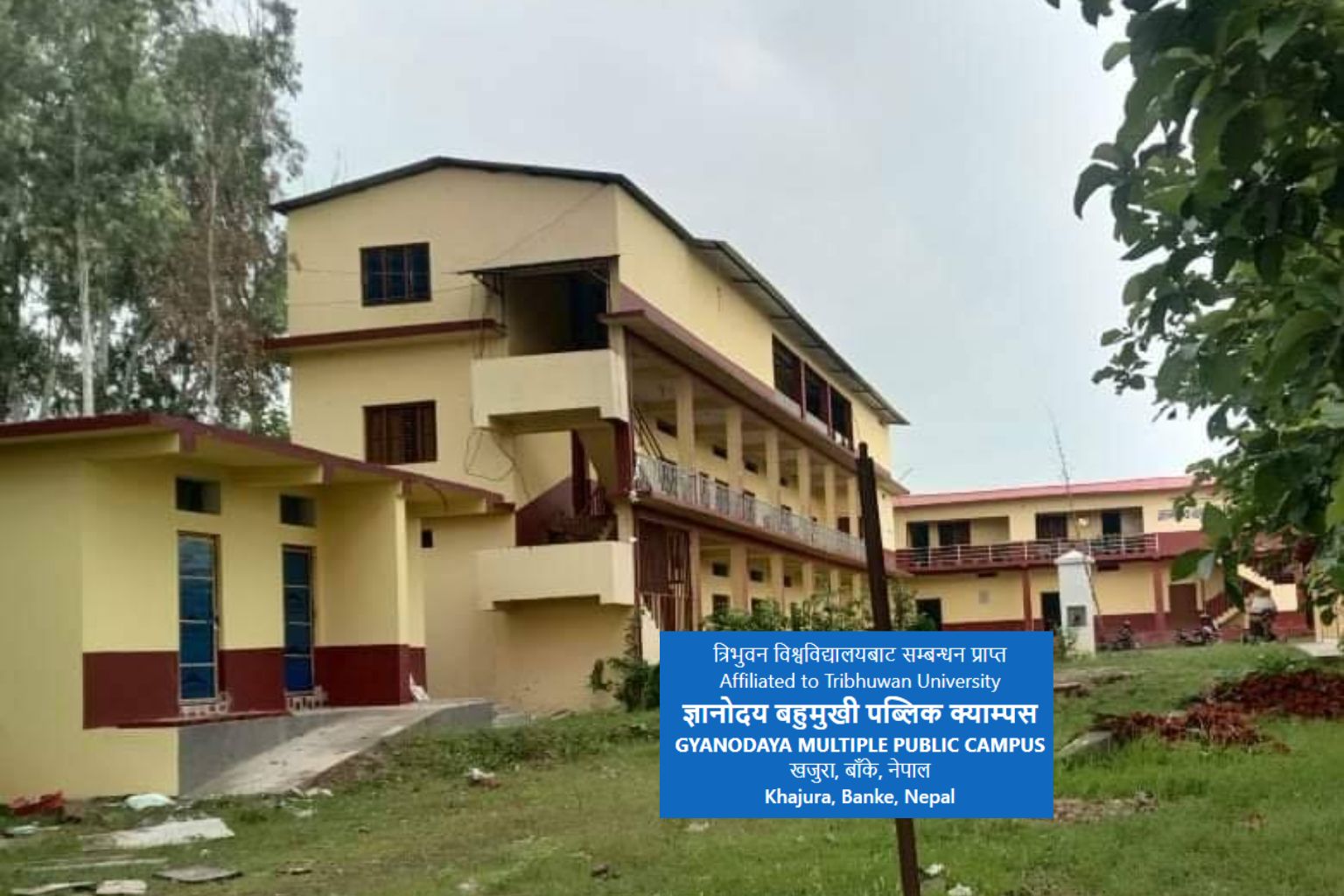
Gyanodaya Multiple Public Campus was established with community participation and a service-oriented purpose. The campus was formed to create accessible and convenient higher education opportunities in the Khajura area of Banke District. Its institutional foundation is tied to a public-service model rather than a commercial one.
The campus began its B.Ed. program in 2065 BS under the Faculty of Education. It added the BBS program in 2070 BS under the Faculty of Management and started the M.Ed. program in 2080 BS under the Faculty of Education. This progression shows a gradual expansion from undergraduate teacher education to management study and later to postgraduate education.
The campus also identifies itself as a non-profit community educational institution. A distinctive institutional point in the available record is that, if the campus closes for any reason, its movable and immovable property is to become the property of the Government of Nepal.
The campus runs programs in two academic areas: Education and Management.
Faculty of Education
Faculty of Management
The B.Ed. program under Tribhuvan University follows a four-year annual structure. It is designed around communication skills, professional core courses, specialization study, and teaching internship or practicum.
The BBS program is a four-year annual management degree under the Faculty of Management. Its structure combines foundation courses, core business studies, concentration-area courses, business research methods, and a final project in the fourth year.
The M.Ed. program is a two-year, four-semester postgraduate program under the Faculty of Education. It includes core professional courses, specialization study, teaching practice or practicum, and thesis writing.
Admission to bachelor-level programs generally begins after the campus publishes its admission notice.
Applicants for B.Ed. and BBS submit the prescribed form with the required academic documents.
Depending on program or campus policy, bachelor admission may include an entrance examination, merit-based selection, or both.
Selected bachelor applicants complete admission by submitting the required documents and paying the prescribed fees.
Admission notice for M.Ed. is published by the concerned campus, department, or faculty authority.
M.Ed. applicants submit the prescribed application form and academic records.
Admission to M.Ed. may include an entrance examination and selection on the basis of the published result or merit process.
Registration, examinations, and results follow Tribhuvan University rules, guidelines, and the applicable academic calendar.
For bachelor admission (B.Ed. and BBS)
Academic Transcript (Grade Sheet) of Class 12 / +2 or equivalent
Character Certificate from the previous institution
Migration Certificate, if applicable
Transfer Certificate (TC)
Citizenship Certificate or Birth Certificate copy
Passport-size photographs
Entrance Examination Scorecard, if required
Completed admission/application form
Admission fee payment receipt
Equivalence Certificate, if applicable
For master admission (M.Ed.)
Bachelor’s Degree Transcript / Marksheet
Bachelor’s Degree Certificate or Provisional Certificate
Character Certificate from the bachelor-level institution
Migration Certificate, if applicable
Transfer Certificate (TC)
Citizenship Certificate or Birth Certificate copy
Passport-size photographs
Entrance Examination Scorecard, if required
Completed admission/application form
Admission fee payment receipt
Equivalence Certificate, if applicable
The academic structure of the campus is built around TU-affiliated programs in education and management. In the B.Ed. program, the learning process includes professional coursework along with teaching internship or practicum. This connects subject study with classroom-based teaching experience.
In BBS, the standard instructional pattern includes lectures, group discussion, problem-solving exercises, guest lectures, practical work, project work, and case-based study where relevant. The fourth year also includes final project work connected to field exposure and report preparation.
In M.Ed., the standard semester-based learning process includes project work, assignments, seminars, case studies, field studies, lecture sessions, teaching practice or practicum, and thesis writing. The semester structure also includes internal and external evaluation within the TU framework.
Library
Computer Lab
Multimedia
Classrooms
Conference Hall
Journal
Counseling
Sports facilities
Educational tour support
Scholarships
Extracurricular activities
The available campus record presents a student environment connected to academic study as well as support services outside the classroom. Counseling, sports, educational tours, and extracurricular activities are part of the reported campus setup. These features suggest that student life at the campus is not limited to formal teaching periods.
Enrollment data included in the institutional record shows participation from Mountain, Hill, and Terai regions, with the largest concentration of students coming from the Terai. The same record reports 170 students in BBS, 271 in B.Ed., and 17 in M.Ed., for a total of 458 students.
Sports activities
Educational tours
Campus ECA activities
Student counseling support
Journal-related academic engagement
Scholarship facility is available for economically backward students.
The campus record includes scholarship grants as part of its financial support base.
Reported institutional financing sources include regular UGC grants, Khajura Rural Municipality grants, Ward No. 3 grants, scholarship grants, and UGC building construction grants.
Established in 2065 BS (2008 AD) as a community-owned campus
Received TU affiliation in 2065 BS
Began B.Ed. classes in 2065 BS
Began BBS classes in 2070 BS
Began M.Ed. classes in 2080 BS
Expanded from undergraduate provision to postgraduate education
Reported enrollment record of 458 students across three academic programs
Gyanodaya Multiple Public Campus represents a community-based higher education institution in Khajura, Banke with a defined academic focus on education and management. Its three current programs place it within both bachelor’s and master’s level study under Tribhuvan University. The campus combines its academic role with a non-profit institutional structure, locally rooted governance, and student support services such as scholarships, counseling, library access, sports, and extracurricular activities. For students seeking TU-affiliated study in this part of Banke, the campus offers an established community-campus option with B.Ed., BBS, and M.Ed. pathways.
College Name: Gyanodaya Multiple Public Campus
Location: Khajura Rural Municipality-3, Khajura, Banke, Lumbini Province, Nepal
Affiliation: Tribhuvan University
Phone: 081-590485, 9848045851
Email: gyanodayamultiplecampus.np@gmail.com
Website: gyanodayampc.edu.np
Chairperson: Purna Bahadur Bhandari
Campus Chief: Charitra Shah
Gyanodaya Multiple Public Campus is located at Khajura Bazaar, Ward No. 3, Khajura Rural Municipality, Banke, in Lumbini Province, Nepal.
Gyanodaya Multiple Public Campus is affiliated with Tribhuvan University and approved by the University Grants Commission.
The campus offers Bachelor of Education (B.Ed.), Bachelor of Business Studies (BBS), and Master of Education (M.Ed.).
B.Ed. and BBS follow the four-year annual system under Tribhuvan University. M.Ed. follows a two-year, four-semester structure.
Yes. The campus reports scholarship support, including scholarship facilities for economically backward students.
Reported facilities include a library, computer lab, multimedia, classrooms, conference hall, journal, counseling, sports, educational tours, scholarships, and extracurricular activities.
Admission begins after the publication of the admission notice. Applicants submit the prescribed form and academic documents, and the process may include an entrance examination, merit-based selection, or both, depending on the program and campus policy.