Janakalyan Campus is a community-based higher education institution located in Bagchaur Municipality-2, Tharmare, Salyan, Karnali Province, Nepal. The campus is affiliated with Tribhuvan University and approved by the University Grants Commission of Nepal.
The campus offers bachelor’s and master’s level programs through Education, Management, and Humanities and Social Sciences. Its academic programs include Bachelor of Arts, Bachelor of Education, Bachelor of Business Studies, and Master of Education. The M.Ed. program is offered in Nepali and Curriculum and Evaluation.
Janakalyan Campus was established as a community-based institution to support access to higher education in Salyan and nearby areas. It began from the premises of Janakalyan Secondary School and has operated from its own building since Ashoj 15, B.S. 2065.
Community-based campus in Tharmare, Salyan
Located in Bagchaur Municipality-2, Karnali Province, Nepal
Affiliated with Tribhuvan University
Approved by University Grants Commission of Nepal
Offers bachelor’s and master’s level programs
Bachelor’s programs include BA, B.Ed., and BBS
Master’s program includes M.Ed. in Nepali and Curriculum and Evaluation
Academic faculties include Education, Management, and Humanities and Social Sciences
Programs are conducted in the morning session
Located about 33 km north of the district headquarters
Operates from its own campus building
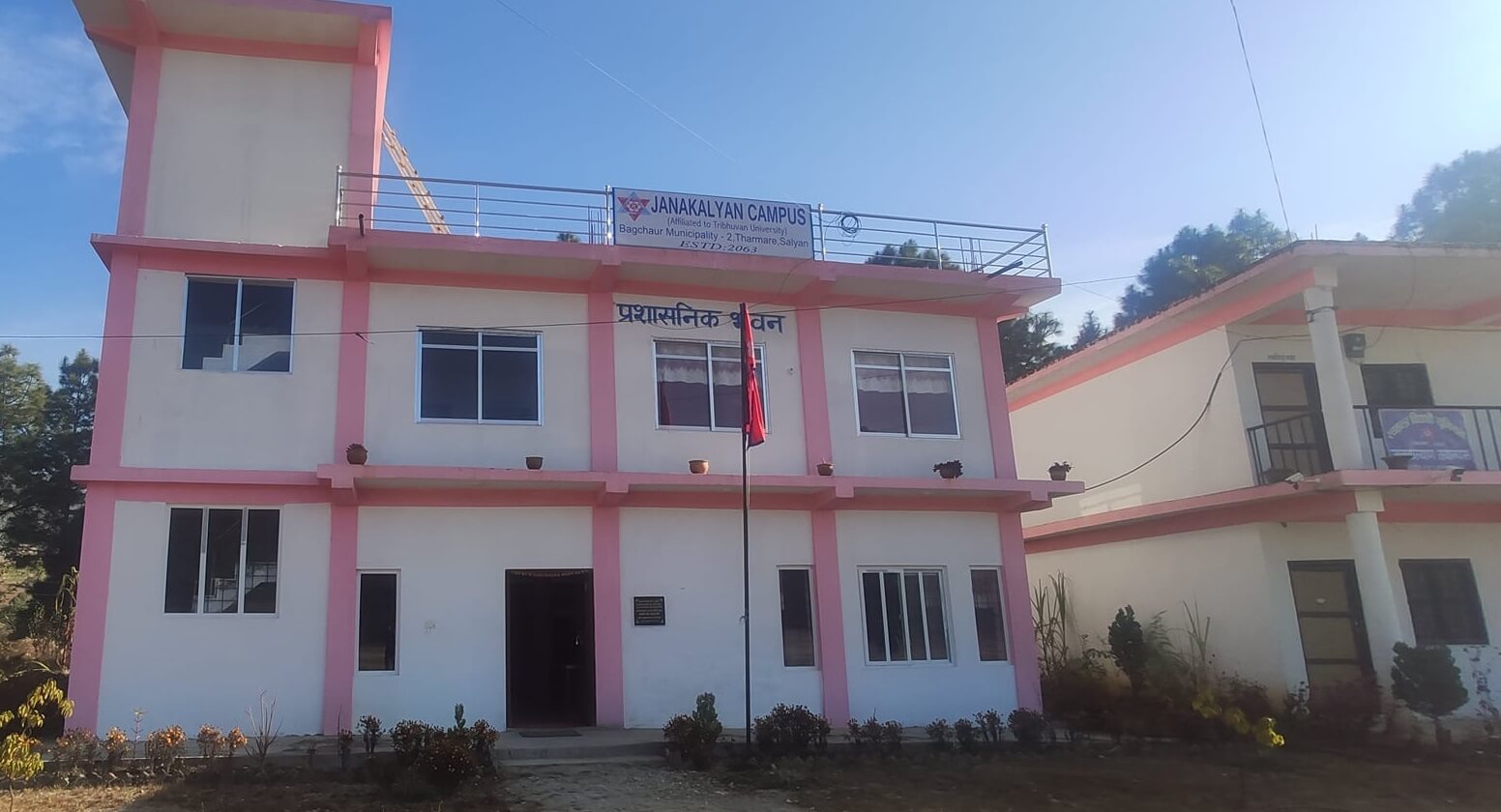
Janakalyan Campus (जनकल्याण क्याम्पस, सल्यान) was established on 27th Bhadra, 2063 B.S. as a non-profit, community-based higher education institution. Its establishment was linked with the need for higher education among local students, including students from disadvantaged groups and Janajati communities.
The campus was initiated through the involvement of Janakalyan Higher Secondary School, educationists, social workers, political figures, businesspeople, intellectuals, and community members. Dilli Raj Sharma served as the founding chairperson during the establishment process.
The campus is located in Tharmare, Ward No. 2 of Bagchaur Municipality, in the central part of the Rapti Highway. Latikhola lies to the north, Thinwang Khola to the southwest, and the Sharada River to the east. The campus is about 33 km north of the district headquarters.
Janakalyan Campus has a formal governance structure. Its legislative body includes life members, donors, social workers, administrators, professionals, businesspeople, representatives from community groups, municipal bodies, and the District Coordination Committee. The Campus Management Committee functions as the executive body formed by the campus assembly.
Academic, administrative, and financial activities are guided by campus legislation, academic and administrative bylaws, and economic administration bylaws approved through the campus assembly.
Janakalyan Campus offers programs at bachelor’s and master’s levels under Tribhuvan University affiliation.
Bachelor of Education (B.Ed.) – 4 Years
Bachelor of Business Studies (BBS) – 4 Years
Bachelor of Arts (BA) – 4 Years
The bachelor’s level is organized through the faculties of Education, Management, and Humanities and Social Sciences.
The Faculty of Education includes Nepali, English, Mathematics, Population, and Health and Physical Education. Its departmental structure includes English Education, Nepali Education, Mathematics Education, Health, Physical and Population Education, and Teaching Practice.
The Faculty of Management conducts the BBS program with Accountancy and Finance.
The Faculty of Humanities and Social Sciences conducts BA-level study in Nepali, Economics, and Sociology.
Master of Education (M.Ed.) in Nepali – 2 Years, 4 Semesters
Master of Education (M.Ed.) in Curriculum and Evaluation – 2 Years, 4 Semesters
The M.Ed. program is conducted under the Faculty of Education and follows the semester system.
Admission to bachelor-level programs under Tribhuvan University generally follows the regulations of the concerned faculty, Dean’s Office, and campus.
Applicants submit the prescribed application form with required academic documents after the admission notice.
Depending on the program or campus policy, admission may include an entrance examination, merit-based selection, or both.
Selected candidates complete admission by submitting documents and paying the prescribed fees.
Academic registration, examinations, and results follow TU rules, guidelines, and the applicable academic calendar.
For master’s level programs, applicants submit the prescribed application form according to the notice issued by the concerned campus, department, institute, or Dean’s Office.
Master’s level admission may include an entrance examination depending on the program.
Final enrollment is completed according to TU rules and the schedule of the concerned academic authority.
Academic Transcript or Grade Sheet of Class 12 / +2 or equivalent
Character Certificate from the previous institution
Migration Certificate, if the previous board or university is different
Transfer Certificate from the previous school or college
Citizenship Certificate or Birth Certificate copy
Passport-size photographs
Entrance Examination Scorecard, if required by the program or campus
Completed Admission/Application Form of the campus
Admission Fee Payment Receipt
Equivalence Certificate, only if the qualification is from a foreign board or university
Bachelor’s Degree Transcript / Marksheet
Bachelor’s Degree Certificate or Provisional Certificate
Character Certificate from the bachelor-level institution
Migration Certificate, if the bachelor’s degree is from another university
Transfer Certificate from the previous campus or college
Citizenship Certificate or Birth Certificate copy
Passport-size photographs
Entrance Examination Scorecard, if required by the program or faculty
Completed Admission/Application Form
Admission Fee Payment Receipt
Equivalence Certificate, if the bachelor’s degree is from a foreign university
Janakalyan Campus organizes academic work through separate faculties and subject areas. The Faculty of Education has full-time and part-time faculty members. The Faculty of Management also has full-time and part-time teaching staff, while the Faculty of Humanities and Social Sciences is supported by part-time faculty members.
Teaching and learning at the campus are linked with classroom study, subject-based teaching, teaching practice, fieldwork, project work, and curriculum-based social work. The campus also uses an internal examination system as part of its academic process.
Learning resources include classrooms, library resources, computers, projectors, an interactive whiteboard, and other educational materials used according to program needs.
Land: 23.5 ropani
Buildings: 6
Teaching rooms: 18
Administrative rooms: 4
Staff room
Library resources
Campus Management Committee room
Free Student Union room
Store room
Toilets: 2 units with 7 rooms
Drinking water tap: 1 unit with 4 taps
Books: 6,378
Computers: 12 sets
Laptops: 2
Photocopy machines: 2
Telephones: 2
Projector sets: 2
Projector screen: 1
Interactive whiteboard: 1
Routers: 4
Sound system: 1
Generator: 1
Solar and inverter sets: 100-watt and 200-watt systems
Benches and desks: 353 units each
Boards: 14
Sports materials and other utility materials
Student life at Janakalyan Campus is connected with classroom learning, field-based academic work, curriculum-related social work, and community participation. The campus involves students in fieldwork and project work as part of academic activities.
The presence of a Free Student Union room reflects student representation within the campus infrastructure. The campus setting in Bagchaur Municipality also connects students with a local community environment where higher education is linked with nearby social and educational needs.
Local community participation has been part of the campus’s development. Community members contributed to land, infrastructure development, management work, planning, and campus-level participation through the Campus Management Committee and related institutional structures.
Curriculum-based social work
Fieldwork and project work
Sanitation programs
Blood donation programs
Relief fund and material collection during natural events and local problems
Public awareness programs
Social participation through student and community involvement
Sports materials available at the campus
Established on 27th Bhadra, 2063 B.S. as a community-based higher education institution
Began from the premises of Janakalyan Secondary School
Started with the B.Ed. program
Operating from its own building since Ashoj 15, B.S. 2065
Added BBS under the Faculty of Management
Added BA under the Faculty of Humanities and Social Sciences
Offers M.Ed. in Nepali and Curriculum and Evaluation
Developed campus infrastructure through community support, grants, internal resources, and institutional planning
Operates through campus legislation, bylaws, campus assembly, and management committee
Janakalyan Campus serves students in Tharmare, Bagchaur Municipality, and surrounding areas of Salyan through TU-affiliated programs in Education, Management, and Humanities and Social Sciences.
The campus has developed from a community-led beginning into an institution with its own buildings, classrooms, academic materials, governance structure, and bachelor’s and master’s level programs. Its role is closely connected with local participation, community support, and access to higher education in Salyan.
College Name: Janakalyan Campus
Location: Bagchaur Municipality-2, Tharmare, Salyan, Karnali Province, Nepal
Affiliation: Tribhuvan University
Approval: University Grants Commission of Nepal
Phone: +977-88-412060, 9857832765
Email: jkncts@gmail.com
Website: janakalyancampus.edu.np
Janakalyan Campus offers BA, B.Ed., BBS, and M.Ed. programs.
Janakalyan Campus is located in Bagchaur Municipality-2, Tharmare, Salyan, Karnali Province, Nepal.
Yes. Janakalyan Campus is affiliated with Tribhuvan University.
Yes. Janakalyan Campus is approved by the University Grants Commission of Nepal.
The bachelor’s level is offered through Education, Management, and Humanities and Social Sciences.
The M.Ed. program is available in Nepali and Curriculum and Evaluation.
Yes. The academic programs are conducted in the morning session.
The campus has buildings, teaching rooms, administrative rooms, library resources, computers, projectors, an interactive whiteboard, furniture, drinking water facilities, toilets, and other academic materials.