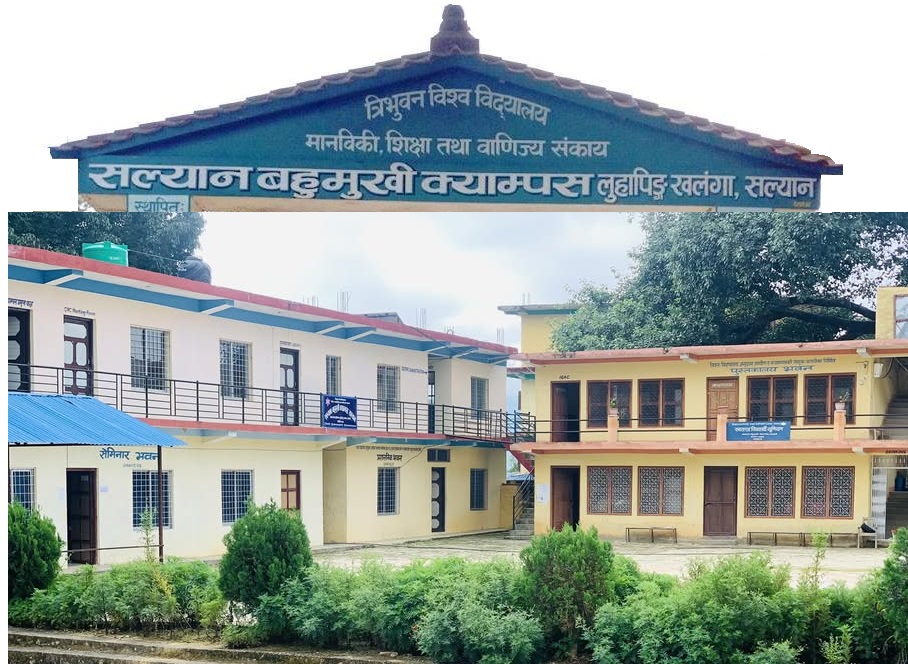
Salyan Campus, also known as Salyan Multiple Campus (सल्यान बहुमुखी क्याम्पस), is a community-based higher education institution located in Sharada Municipality-2, Khalanga, Salyan, Karnali Province, Nepal. The campus was established in 1980 AD, corresponding to 2037 Bhadra 1.
The campus is affiliated with Tribhuvan University and approved by the University Grants Commission of Nepal. It offers bachelor-level programs in Humanities, Management, and Education, along with a master’s-level program in Education.
Community-based higher education institution in Khalanga, Salyan
Established in 1980 AD / 2037 Bhadra 1
Affiliated with Tribhuvan University
Approved by the University Grants Commission of Nepal
Offers BA, BBS, B.Ed., and M.Ed.
Academic areas include Humanities and Social Sciences, Management, and Education
Certificate-level Humanities was started in B.S. 2037/05/01 and is now phased out
Bachelor-level Humanities began in B.S. 2046
Bachelor-level Management began in B.S. 2063
Master’s-level Education began in B.S. 2075
Students mainly come from Salyan and nearby districts
Facilities include library, reading room, seminar hall, computer lab, IQAC building, projectors, internet, drinking water arrangements, and toilet facilities
Scholarship and fee-discount provisions are available for eligible students
Salyan Multiple Campus was formally founded in B.S. 2037 in the district headquarters of Salyan. The institution was established through the effort of local education supporters, social workers, intellectuals, public representatives, and community leaders who identified the need for higher education in Salyan district.
After discussion and consultation, the decision was made to establish Salyan Campus at V.S. Secondary School, Luhaping, Salyan. A statute was prepared for the administrative, financial, and academic operation of the campus, and a Campus Management Committee was formed through public representation.
The campus began its operation after receiving affiliation from Tribhuvan University on B.S. 2037/05/01. Certificate-level Humanities classes were formally conducted from the same date and are currently phased out. Bachelor-level Humanities began in B.S. 2046, bachelor-level Management began in B.S. 2063, and master’s-level Education began in B.S. 2075.
The governance structure has changed over time. After the statute was amended in B.S. 2055, the Campus Management Committee was formed under the chairpersonship of the Chief District Officer. Since B.S. 2066, the statute has included education supporters, social workers, and entrepreneurs from the community as campus members. At present, the Campus Management Committee is formed by the general assembly of those members.
Students mainly come from Salyan and districts including Dang, Rolpa, Surkhet, Jajarkot, Rukum East, Rukum West, Banke, and Bardiya. The campus also serves students from nearby districts such as West Rukum, East Rukum, Jajarkot, Surkhet, Dang, and Rolpa.
The mission of Salyan Multiple Campus is to serve students, communities, the nation, and interested researchers through accessible, affordable, multi-faculty academic programs.
The vision of the campus is connected with intellectual, social, and economic development through a wider academic network.
The campus has set objectives related to access, inclusion, academic development, and institutional strengthening. These include:
Making higher education accessible
Addressing the educational aspirations of marginalized and backward communities
Establishing Salyan Multiple Campus as a center for higher education
Providing higher education through modern teaching technology
Prioritizing the initiation of technical education
Achieving QAA standard
Upgrading the campus by conducting additional master’s-level classes
Salyan Campus offers Tribhuvan University-affiliated academic programs at bachelor and master levels.
At the bachelor level, Humanities includes Political Science, Economics, Population, Nepali, and English. Bachelor-level Education includes Education, Economics, Population, Nepali, English, and Health. Commerce-related subjects are conducted under Commerce.
BA under Tribhuvan University is a four-year bachelor’s program under the Faculty of Humanities and Social Sciences. BBS is a four-year annual-system program under the Faculty of Management. B.Ed. is a four-year annual-system program under the Faculty of Education.
At the master’s level in Education, Nepali and Educational Administration are conducted. M.Ed. under Tribhuvan University follows the semester system and is structured as a two-year, four-semester program.
Admission to bachelor-level programs under Tribhuvan University generally follows the regulations of the respective faculty, Dean’s Office, and campus.
Applicants submit the prescribed application form after the admission notice is published.
Applicants submit required academic documents with the application form.
Depending on the program or campus policy, admission may include an entrance examination, merit-based selection, or both.
Selected candidates complete admission by submitting documents and paying the prescribed fees.
Academic registration, examinations, and results follow TU rules, guidelines, and the applicable academic calendar.
Admission notice is published by the concerned campus, department, institute, or Dean’s Office.
Eligible applicants submit the prescribed application form.
Admission may include an entrance examination depending on the program.
A merit list or selection result may be published by the concerned authority.
Selected students submit the required documents and pay the prescribed admission fee.
Final enrollment is completed according to TU rules and the schedule of the concerned campus, department, institute, or faculty.
Academic Transcript or Grade Sheet of Class 12 / +2 or equivalent
Character Certificate from the previous institution
Migration Certificate, if the previous board or university is different
Transfer Certificate from the previous school or college
Citizenship Certificate or Birth Certificate copy
Passport-size photographs
Entrance Examination Scorecard, if required by the program or campus
Completed admission or application form of the campus
Admission fee payment receipt
Equivalence Certificate, only if the qualification is from a foreign board or university
Bachelor’s Degree Transcript / Marksheet
Bachelor’s Degree Certificate or Provisional Certificate
Character Certificate from the bachelor-level institution
Migration Certificate, if the bachelor’s degree is from another university
Transfer Certificate from the previous campus or college
Citizenship Certificate or Birth Certificate copy
Passport-size photographs
Entrance Examination Scorecard, if required by the program or faculty
Completed admission or application form
Admission fee payment receipt
Equivalence Certificate, if the bachelor’s degree is from a foreign university
Salyan Campus conducts academic programs through Humanities and Social Sciences, Management, and Education. The campus has academic arrangements for bachelor-level Humanities, Education, Management, and master’s-level Education.
Teaching and learning are supported by projectors, computers, internet, software, internal examinations, and academic administration structures. The campus also has an Academic Committee, Examination Section, Library, Student Welfare and Health Care Centre, and departmental committees.
Internal examinations are planned to evaluate students’ academic level. These examinations are conducted by assigning responsibility to subject teachers. External examinations follow Tribhuvan University rules and the academic calendar.
For M.Ed., the academic development plan includes additional programs at the master’s level and teaching practice activities. Teaching practice is conducted through internal and external examiners according to the TU academic calendar.
6 buildings
1 library building
1 administrative building
2 hostel buildings
18 classrooms for operation
Library
Reading room
Seminar hall
Computer lab
IQAC building
8 computers
1 laptop
5 projectors
1 camera
4 photocopy machines
4 drinking water tanks
260 pairs of bench desks
32 office chairs
21 plastic chairs
17 computer tables
17 fans
15 library racks
18 steel cupboards
3 wooden cupboards
70 Hawai Tama chairs
6 sofa sets
21 office tables
11 CCTV cameras
1 generator
Saraswati temple / waiting area
7,701 books
Solar installation
Telephone
Internet
Software
Clean drinking water and toilet arrangements
Salyan Campus serves students from Salyan and nearby districts in a community-based academic setting at Khalanga. The campus structure includes a Student Welfare and Health Care Centre, Free Student Union, library, reading room, seminar hall, and examination section.
The campus has sports arrangements, internship banking facility, incentives for students from marginalized groups, and scholarship provisions for eligible students. These arrangements support students across Humanities, Management, Education, and master’s-level Education.
Sports facility arrangements
Free Student Union activities
Educational tours
Tree plantation
Publication of literary books
Internal talent-related activities
Seminar hall-based academic activities
25% monthly fee discount for Dalit and disabled students
20% monthly fee discount for bachelor-level students who obtain more than 75% marks in early examination
20% monthly fee discount for master-level students who obtain more than 75% marks in each semester
20% monthly fee discount for bachelor and master-level students who are academically strong, have more than 80% regular attendance, and have poor economic status
20% monthly fee discount for students enrolled after securing more than 70%
Incentives for students from marginalized groups
Scholarship support for bright students
Established in 1980 AD / B.S. 2037
Began operation after receiving Tribhuvan University affiliation on B.S. 2037/05/01
Certificate-level Humanities began on B.S. 2037/05/01 and is currently phased out
Bachelor-level Humanities began in B.S. 2046
Bachelor-level Management began in B.S. 2063
Master’s-level Education began in B.S. 2075
Campus statute was amended in B.S. 2055
Since B.S. 2066, the statute has included education supporters, social workers, and entrepreneurs from the community as campus members
Support has been received from UGC, Karnali Province Government, Sharada Municipality, governmental and non-governmental bodies, and individuals
The Campus Chief’s message highlights the campus’s focus on students and refers to the library, computer lab with internet access, technological teaching devices, internal examinations, sports arrangements, scholarships, incentives for marginalized groups, and internship banking facility.
The Chairperson’s message identifies Salyan Multiple Campus as an academic institution of Salyan district serving students from different backgrounds and calls for support from students, guardians, and stakeholders for institutional development.
Salyan Campus operates through a structure that includes the Campus Assembly, Campus Management Committee, Campus Chief, Assistant Campus Chief, Administration Chief, Accounts Section, Employee Administration Section, General Administration Section, Student Administration Section, Academic Administration, Academic Committee, Library, Examination Section, and Student Welfare and Health Care Centre.
The structure also includes the Physical Infrastructure Construction and Maintenance Sub-Committee, Scholarship Sub-Committee, Procurement Sub-Committee, Construction and Development Sub-Committee, Departmental Committee, Humanities, Education, Management, Master’s Level, Professors’ Association Unit, Employees’ Association Unit, and Free Student Union.
Salyan Campus is a community-based TU-affiliated campus in Sharada Municipality-2, Khalanga, Salyan. Its academic work covers Humanities, Management, and Education at the bachelor level, along with M.Ed. at the master’s level.
The campus has developed through local participation, community representation, academic expansion, and support from public and institutional bodies. Its programs, facilities, scholarship provisions, and governance structure position it as a higher education campus serving Salyan and nearby districts.
College Name: Salyan Multiple Campus, Salyan
Location: Sharada Municipality-2, Khalanga, Salyan, Karnali Province, Nepal
Phone No.: 088-520242
Email: salyancampus@gmail.com
Website: https://salyancampus.edu.np
Affiliation: Tribhuvan University
Approval: University Grants Commission of Nepal
Salyan Campus is located in Sharada Municipality-2, Khalanga, Salyan, Karnali Province, Nepal.
Salyan Campus was established in 1980 AD, corresponding to 2037 Bhadra 1.
Salyan Campus is affiliated with Tribhuvan University.
Yes, Salyan Campus is approved by the University Grants Commission of Nepal.
Salyan Campus offers BA, BBS, B.Ed., and M.Ed. programs.
The campus has facilities such as a library, reading room, seminar hall, computer lab, IQAC building, classrooms, projectors, computers, internet, drinking water arrangements, and toilet facilities.
Yes, the campus provides monthly fee discounts for eligible Dalit and disabled students, academically strong students, students with regular attendance and poor economic status, and students meeting specified academic performance criteria.
Students mainly come from Salyan and districts including Dang, Rolpa, Surkhet, Jajarkot, Rukum East, Rukum West, Banke, and Bardiya.