Kabhre Multiple Campus (काभ्रे बहुमुखी क्याम्पस) is a community public campus in Budol, Banepa Municipality Ward No. 06, Kavrepalanchok, Bagmati, Nepal. Established in 1980 AD (2037 BS), the campus operates on a non-profit-oriented model and runs academic programs under Tribhuvan University (TU) and the National Examinations Board (NEB). It is QAA-accredited by UGC Nepal.
Kabhre Campus offers +2 streams alongside bachelor’s and master’s level programs in Management, Humanities and Social Sciences, Education, and information technology-related fields.
The campus outlines a learning environment supported by classrooms, library and e-library services, computer labs, and student services. It also describes a system of continuous academic monitoring through internal assessments, project work, practical evaluation, and internal examinations aligned with TU and NEB examination systems. Scholarships and awards are presented as a key student-support feature, including need-based and performance-based schemes.
Established: 1980 AD (2037 BS)
Campus type: Community public campus (non-profit-oriented)
Affiliation: Tribhuvan University (TU) and National Examinations Board (NEB)
Location: Budol, Banepa Municipality Ward No. 06, Kavrepalanchok, Bagmati, Nepal
Programs (TU): BA, BBS, B.Ed., BSW, BCA, BICTE, MBS, MA Sociology
Programs (NEB +2): Humanities, Management, Education, Computer Science
Infrastructure: 18-10-3-3 ropani of land; four buildings; over 42 rooms; library/e-library; computer labs; cafeteria/canteen
Campus hours:
+2 programs: 6:10 – 10:50 (Morning)
Bachelor’s programs: 6:10 – 10:15 (Morning)
Master’s programs: 6:05 – 8:45 (Morning)
Contact: kmcbanepa@gmail.com | +977-11-661133 | http://kavrecampus.edu.np
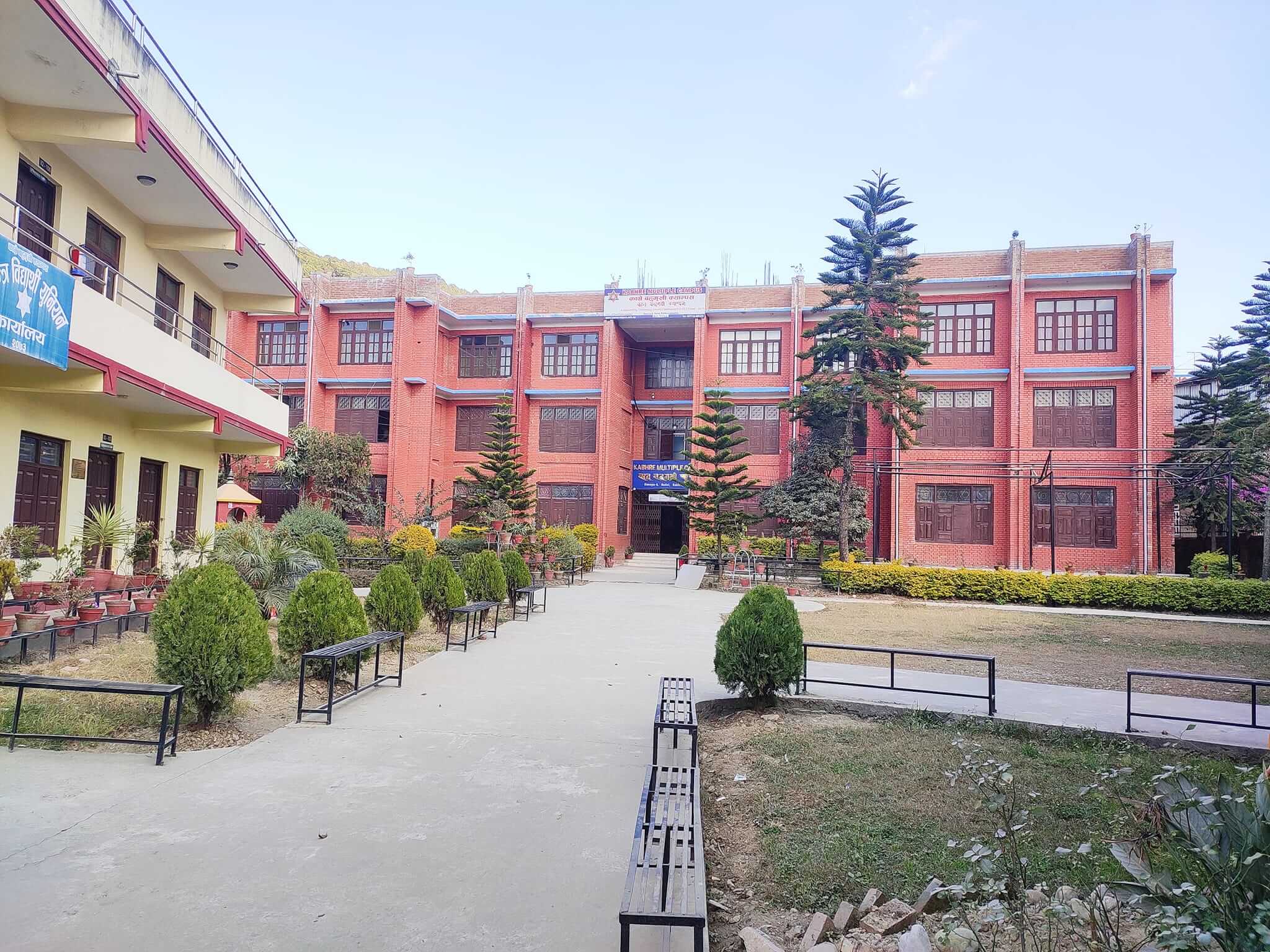
Kabhre Multiple Campus (KMC Banepa) is described as one of the older campuses in Kavrepalanchok district. It provides education at the +2 level under NEB and at bachelor’s and master’s levels under TU. The campus presents its academic focus across multiple disciplines and highlights regular evaluation practices and student support mechanisms, including scholarships for deserving and disadvantaged learners.
The campus is located in Budol, Banepa Municipality Ward No. 06, Kavrepalanchok, Bagmati, Nepal. Accessibility through public transport is highlighted, along with a quiet setting intended to support learning.
KMC reports 18-10-3-3 ropani of land and four buildings with more than 42 rooms. Academic and student facilities mentioned include a library with e-library services, computer labs, and cafeteria/canteen services.
KMC runs programs under:
Tribhuvan University (TU): Bachelor’s and master’s programs follow TU rules, guidelines, curriculum, and the TU annual calendar.
National Examinations Board (NEB): +2 programs follow NEB rules, curriculum, and the NEB annual calendar under the Ministry of Education, Science and Technology.
The campus describes internal academic administration that includes internal examinations and continuous assessment practices alongside the formal evaluation structure of TU and NEB.
KMC lists NEB-affiliated +2 programs with a two-year, full-time structure:
Ten Plus Two (+2) Education – 2 years
Ten Plus Two (+2) Humanities – 2 years
Ten Plus Two (+2) Management – 2 years
+2 Computer Science – 2 years
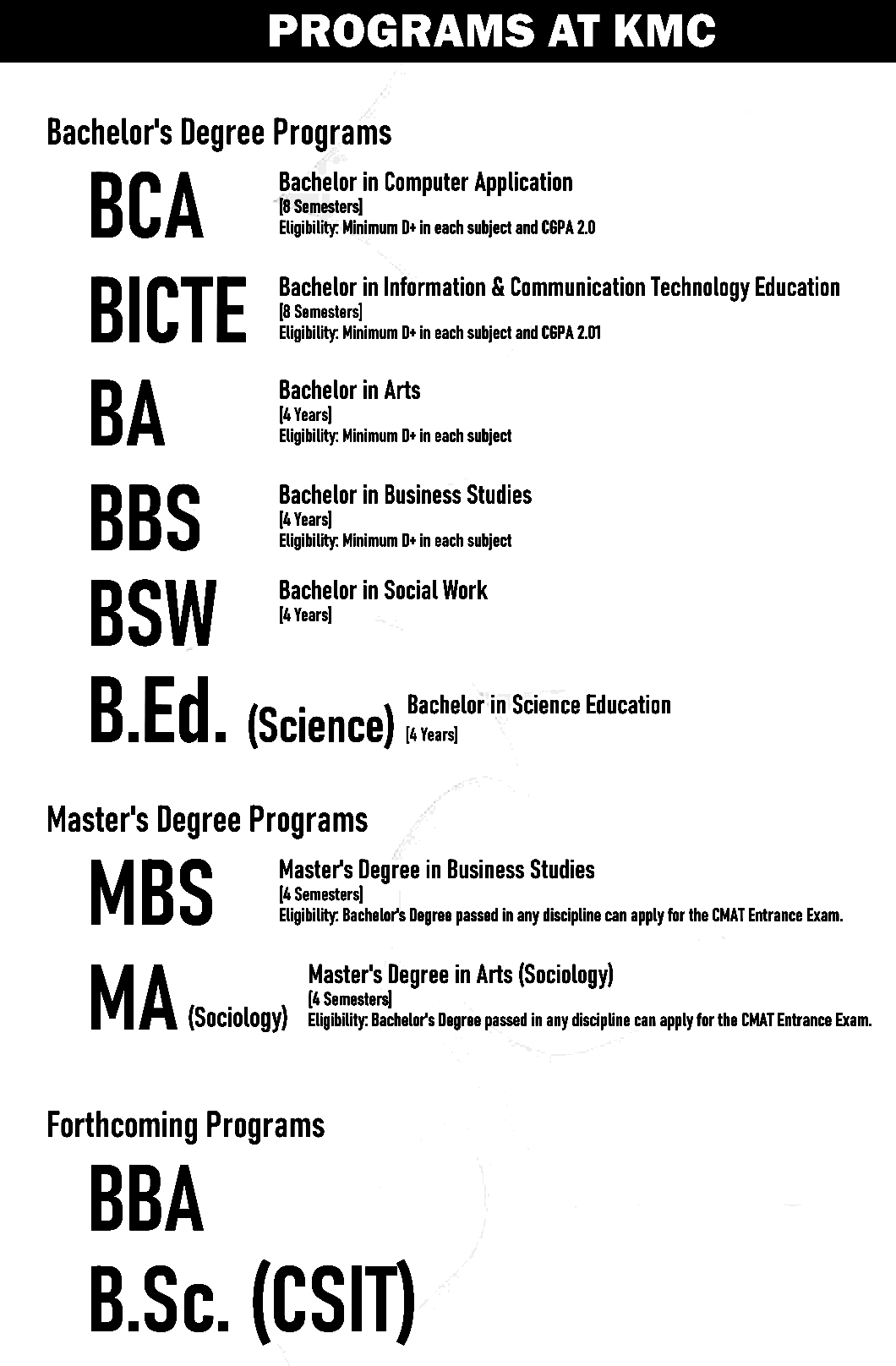
KMC lists the following TU-affiliated bachelor’s programs:
Bachelor of Arts (BA) – 4 years
Bachelor of Business Studies (BBS) – 4 years
Bachelor of Education (B.Ed.) – 4 years
Bachelor of Social Work (BSW) – 4 years
Bachelor of Computer Application (BCA) – 8 semesters
BEd in Information Communication Technology (BICTE) – 9 semesters
KMC lists the following TU-affiliated master’s programs:
Master of Business Studies (MBS) – 4 semesters
MA in Sociology – 4 semesters
KMC presents its teaching approach as student-oriented and participatory, supported by faculty members and visiting lecturers and supervisors. The campus notes the use of presentation-based teaching, digital teaching tools, and internet access support. Practical and applied learning is emphasized through project work, practical assessment, and research-oriented assignments.
Academic monitoring methods mentioned include:
project work and practical assessment
research-oriented assignments
unit tests and monthly tests
internal examinations arranged as needed before core TU and NEB evaluations
KMC lists morning class hours by level:
+2 programs: 6:10 – 10:50
Bachelor’s degree programs: 6:10 – 10:15
Master’s programs: 6:05 – 8:45
KMC mentions a spacious library and e-library services to support reading and coursework.
Computer labs and unlimited internet access are listed as part of campus resources supporting academic needs across programs.
The campus describes well-facilitated classrooms and references presentation-based instruction and digital teaching tools.
Cafeteria/canteen services are listed among student facilities.
The campus highlights access through public transport for commuting students.
KMC presents scholarships and awards as a central student-support feature, including support for underprivileged, marginalized, and deserving students. Scholarship schemes are described across internal examination performance, targeted support categories, and named scholarships with award amounts.
KMC mentions scholarship schemes tied to internal examination results:
scholarships for students ranked in the top 7 in internal examinations at +2 and bachelor’s level
scholarships for students ranked in the top 2 in internal examinations at master’s level
scholarships and awards to students who pass internal examinations
Tuition fee waiver provisions based on internal examination rank are listed:
First position with at least 60% marks: tuition fee waiver equivalent to 4 months
Second position with at least 50% marks: tuition fee waiver equivalent to 3 months
Third position with at least 50% marks: tuition fee waiver equivalent to 2 months
Fourth to Seventh positions with at least 50% marks: tuition fee waiver equivalent to 1 month (each position)
The campus also notes a scholarship equivalent to three months of tuition fees for the student with the highest marks in annual examinations at each level. A student who has already received one type of scholarship is noted as not receiving a duplicate scholarship, and scholarships are awarded during the campus annual celebration program.
KMC mentions:
full scholarship for district topper girls and boys
scholarship for campus toppers in each stream
scholarships for poor and talented students from Indigenous communities, underprivileged communities, and for disabled students
KMC lists scholarship percentages for economically disadvantaged and talented students:
Indigenous (Janajati): 30%
Women: 20%
Dalit: 10%
Poor / Newar: 10%
Poor / Khas Arya: 25%
Madhesi / Tharu / Muslim: 2%
Others (Persons with Disabilities / People’s Movement Injured / Martyrs’ Families): 3%
Scholarship titles mentioned include:
Late Kedar Nath Pradhan Scholarship
Nirmala Upreti Scholarship
Ganesh Maya Dhaubadel Scholarship
Rina Kiran Kayastha Scholarship
Shanta Laxmi Shrestha Scholarship for Dalit girls
Late Asha Kaji Shrestha Scholarship
KMC also lists awards with criteria and amounts:
Chandra Raj / Haridevi Kayastha Scholarship: highest marks in MBS semester examination; Rs. 10,000
Ratnakumari Kayastha Scholarship: highest marks in BICTE semester examination; Rs. 10,000
Reena Kiran Kayastha Scholarship: highest marks in BA annual examination; Rs. 5,000
Shivaram Bhail Scholarship: highest marks in BBS annual examination; Rs. 8,000
Kedarnath Vidvatvritti Scholarship:
MBS and MA Sociology: best research paper writing (one male and one female); Rs. 5,000 each
BBS: best project work report writing (one student); Rs. 3,000
Ashakaji Sevak Scholarship: highest marks in BBS and BA; Rs. 2,500 each
Khil Kumari / Ganeshlal Scholarship: best performance each semester in BCA and BICTE (four students); Rs. 5,000
KMC outlines the following process:
a notice is published inviting claims or objections within 5 days from publication of internal examination results
students submit an application within 30 days to claim the scholarship they have received
The chairperson message is attributed to Lambodar Kayastha. It emphasizes affordable education, community participation, scholarship support for deserving and disadvantaged students, and attention to technical subjects alongside other subjects.
The campus chief's message is attributed to K.G. Baidar. It highlights the campus’s academic schools (including Management, IT Education, and Humanities and Social Sciences), emphasis on information and communication technology, and the presence of research and academic support structures such as a Research Management Cell (RMC), labs, and library resources. It also notes that the campus achieved University Grants Commission (UGC) Quality Assurance and Accreditation (QAA).
KMC’s vision is to develop as a multidisciplinary campus and to expand courses related to Management, IT, and technical subjects, including MIT, MBA, BBA, and BE.
KMC’s mission includes serving the community with quality education and research programs, adopting updated teaching technology, producing technically equipped entrepreneurial human resources, and supporting access to education for the regional community.
The stated goal focuses on academic excellence, establishing the campus as a regional research institution, integrating modern teaching techniques, and maintaining affordable education with attention to educationally disadvantaged groups.
Objectives mentioned include:
providing quality education at affordable cost
producing competent professionals
producing expert entrepreneurs for broader competitive contexts
KMC lists committees and desks to support academic operations, student services, and administration. Committees and structures mentioned include:
Self Assessment Team (SAT)
Research Management Committee (RMC) and Research Committee
Scholarship Committee
Examination Committee
Publication Committee
Library Management Committee
Extra Curricular Activities Committee
Public Information & Counseling Desk
Feedback Committee
Employment Cell
EMIS Committee
Environment/Social Safeguard Desk
Environment Protection and Cleanliness Committee
Discipline Committee
Grievance Redress Mechanism (GRM)
Program heads mentioned include:
MBS Program Head: Mangal Bhakta Shrestha (Associate Professor)
BBS | BA | B.Ed. Science Program Head: Shreeram Shrestha (Lecturer)
Education Faculty Head: Sudan Prasad Adhikari (Lecturer)
MA Program Head: Hari Krishna Bakhunchhe (Lecturer)
Subject committees mentioned include Management; Rural Development, Mass Communication & Nepali; English; Account & Finance; Information Technology & Communication; Economics and Marketing; Science and Math; Sociology and Social Work.
KMC lists teaching staff across ranks including associate professors, lecturers, assistant lecturers, teaching assistants, and instructors. The faculty roster spans disciplines such as business studies, political science, sociology, journalism, education, computer science, and related fields.
KMC lists extracurricular and recreational activities organized through the year. Sports and games mentioned include football, volleyball, badminton, table tennis, and chess. Academic and cultural competitions mentioned include debate, elocution, quiz, poem recitation, essay writing, music, and dance. Educational excursions are also included among student activities.
Contact Kabhre Multiple Campus's administrative office for detailed information on the course, admissions, location, fees, scholarships, facilities, counseling, or eligibility.
Email: kmcbanepa@gmail.com
Phone: +977-11-661133
Website: http://kavrecampus.edu.np
Location: Budol, Banepa Municipality Ward No. 06, Kavrepalanchok, Bagmati, Nepal
Kabhre Multiple Campus was established in 1980 AD (2037 BS).
The campus is located in Budol, Banepa Municipality Ward No. 06, Kavrepalanchok, Bagmati, Nepal.
KMC is affiliated with Tribhuvan University (TU) for higher education programs and the National Examinations Board (NEB) for +2 programs.
KMC lists +2 programs in Education, Humanities, Management, and Computer Science (two-year, full-time).
KMC lists BA, BBS, B.Ed., BSW, BCA (8 semesters), and BICTE (9 semesters).
KMC lists MBS (4 semesters) and MA in Sociology (4 semesters).
KMC mentions internal examination-based tuition fee waivers, category-based scholarship provisions, and multiple named scholarships and awards with specified amounts.
KMC lists morning class hours as 6:10–10:50 for +2, 6:10–10:15 for bachelor’s programs, and 6:05–8:45 for master’s programs.