Malunga Sarbajanik Multiple Campus (मालुङ्गा सर्वजानिक बहुमुखी क्याम्पस) is a community-based, non-profit higher education institution in Galyang Municipality-1, Malunga, Syangja, Gandaki Province, Nepal. Established in 2067 BS (2010 AD), the campus was formed through local initiative to expand access to bachelor-level study for students in and around the area. It is affiliated with Tribhuvan University and has received support from the University Grants Commission (UGC).
The campus offers four-year full-time annual-system bachelor’s programs in Bachelor of Business Studies (BBS) and Bachelor of Education (B.Ed.). Its institutional role is closely tied to the local social and economic context, serving students from financially weaker households and from communities that have had fewer opportunities for nearby higher education.
Established in 2067 BS (2010 AD)
Community-based and non-profit campus
Located in Galyang Municipality-1, Malunga, Syangja, Gandaki Province, Nepal
Affiliated with Tribhuvan University
Supported through grants from the University Grants Commission
Offers four-year full-time bachelor’s programs
Programs: BBS and B.Ed.
Academic system: Annual
BBS affiliation received in 2067 BS
B.Ed. affiliation received in 2069 BS
Runs programs under the Faculty of Management and Faculty of Education
Campus Chief: Krishna Prasad Neupane
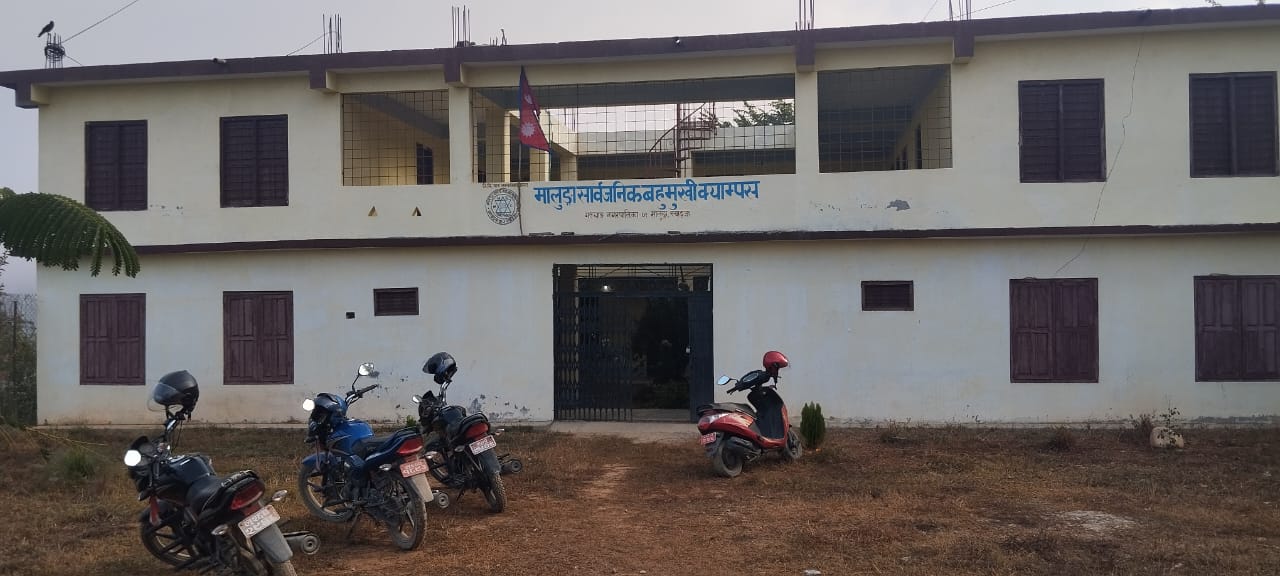
Malunga Sarbajanik Multiple Campus was established through the combined efforts of local social workers, community members, and public representatives. Its development reflects a local response to the cost and difficulty many families face when sending students outside the area for higher education. The campus has focused on undergraduate study in Management and Education and has continued to operate under Tribhuvan University regulations and its own campus statute.
The campus is located at Tunibot Sallahghari, about 1.4 kilometers west of Malunga Station on the Siddhartha Highway in the Kaligandaki Uttarbahini area on the southern side of Ward No. 1 of Galyang Municipality. This location places it within reach of students from nearby wards and neighboring local levels. Enrollment outreach has also extended to students and parents in Wards No. 1 and 2 of Galyang Municipality, as well as in Bagnaskali Rural Municipality and Rambha Rural Municipality.
Institutional development has depended on both community participation and external support. The campus received building construction grants from UGC on two occasions, additional support for furniture construction and procurement and extracurricular structures in Fiscal Year 2077, and a grant for book purchases in 2080. Local participation has remained important in land purchase, building work, drinking water management, and student enrollment efforts. The Campus Management Committee has also sought support from local and provincial levels to meet continuing operational needs, especially as declining student participation has made financial management more difficult.
A four-year full-time bachelor’s program under the Faculty of Management, Tribhuvan University. The program follows the annual system. Under the TU structure, BBS moves from foundation and core business courses to concentration-area study, business research methods, and final project work in the fourth year.
For admission to BBS under TU rules, applicants must have successfully completed 10+2 in business or commerce, or an equivalent qualification recognized by TU, or must have studied Mathematics or Economics as a full paper at the 10+2 level.
A four-year full-time bachelor’s program under the Faculty of Education, Tribhuvan University. The program follows the annual system. Under the TU structure, the four-year B.Ed. includes communication skills, professional core courses, specialization major and minor study, and teaching internship or practicum.
For admission to the four-year B.Ed. program, applicants must have completed Grade 12, Higher Secondary, PCL, or an equivalent qualification. Some subject areas under the TU B.Ed. structure carry subject-based entry requirements, and certain areas may require an entrance test conducted by the respective department of the campus.
The campus currently runs these two undergraduate programs under the Faculty of Management and the Faculty of Education. Both programs are full-time and aligned with TU’s annual academic framework.
Admission notices are published by the campus according to Tribhuvan University faculty procedures and the applicable academic schedule.
Eligible applicants submit the prescribed admission or application form with the required academic and personal documents.
Depending on the program and campus procedure, admission may include an entrance examination, merit-based selection, or both.
Selected applicants complete admission by submitting the required documents and paying the prescribed fees.
Academic registration, examinations, and result processes follow TU rules, guidelines, and the applicable academic calendar.
For annual-system bachelor’s programs, final examinations are conducted by Tribhuvan University through the Office of the Controller of Examinations.
Academic Transcript or Grade Sheet of Class 12, +2, or equivalent
Character Certificate from the previous institution
Migration Certificate, if the previous board or university is different
Transfer Certificate (TC) from the previous school or college
Citizenship Certificate or Birth Certificate copy
Passport-size photographs
Entrance Examination Scorecard, if required by the program or campus
Completed admission or application form of the campus
Admission fee payment receipt
Equivalence Certificate, only if the qualification is from a foreign board or university
The campus has placed emphasis on teaching-learning practices that are timely, achievement-oriented, and suitable for undergraduate students in Education and Management. It has also worked to strengthen information technology-based education as part of improving student learning capacity and helping students connect study with professional and occupational settings.
The teaching methods in regular use include lecture, question-answer, discussion, demonstration, project work, and research and observation. This mix indicates a teaching approach that does not rely only on one-way classroom delivery. In practice, it supports subject explanation, student participation, task-based learning, and applied academic work.
The campus has also linked future academic improvement with stronger technical infrastructure and the management of qualified teachers. This reflects an effort to improve classroom delivery while remaining within the institutional realities of a community-run campus.
One concrete campus building with 14 rooms
First floor with 6 rooms constructed in Fiscal Year 2071/72 with UGC grant support and local contribution
Second floor with 8 rooms added in Fiscal Year 2075/76 with additional UGC grant support and local participation
Classroom rooms with windows and doors designed for ventilation
Library and administrative office furniture in place
More than 2,100 previously collected textbooks and reference materials
More than 1,200 additional textbooks and reference books purchased through a UGC book grant
Library cabinets, chairs, tables, and steel storage support added with local donor contribution
One 2,000-liter hill tank for drinking water management
Water connections from the Chidipani Drinking Water Project and the Bhakbhake Drinking Water Project
Separate toilet facilities for male and female students
Two-room concrete toilet brought into use in 2081/82 with support from Galyang Municipality
Railings and stairs installed on the upper floor
Student life at the campus is shaped by its local and community-run character. The institution has served students from economically weaker backgrounds and has also been a study option for students from marginalized communities, including indigenous groups, Dalit students, backward-class students, and students with physical disabilities. This social role is part of the campus’s identity and affects how it functions within its service area.
The campus experience is also connected to direct community involvement. Local participation has contributed to land purchase, voluntary labor in construction, drinking water management, and efforts to increase student numbers. This creates a setting where campus development is tied closely to local participation rather than being separated from the surrounding community.
The campus has also treated outreach as part of student access. Door-to-door communication and collective interaction programs with students and parents have been carried out in nearby areas to support enrollment and local awareness of higher education opportunities.
Social awareness activities
Participation in religious and cultural programs
Support in health and sanitation work
Study observation tours
Sports programs
Galyang Municipality has been providing scholarships for meritorious and economically weak students for the past three years.
In the current fiscal year mentioned in the campus material, 15 students received scholarships of NPR 8,400 each.
The campus was established with a focus on making bachelor-level study accessible to students from financially weaker households.
Establishment of the campus in 2067 BS (2010 AD)
Affiliation from Tribhuvan University in 2067 BS to run BBS under the Faculty of Management
Affiliation from Tribhuvan University in 2069 BS to run B.Ed. under the Faculty of Education
Construction of a 14-room concrete campus building through UGC support and local contribution
Receipt of UGC support for furniture construction and procurement and extracurricular structures in Fiscal Year 2077
Receipt of UGC grant for textbook and reference book purchases in 2080
Expansion of library holdings through both grant support and local donor contribution
Scholarship support for meritorious and economically weak students through Galyang Municipality
Malunga Sarbajanik Multiple Campus represents a local model of community-supported bachelor-level education in Syangja. Its development has come through local initiative, community participation, municipal support, and UGC grants rather than through large-scale institutional expansion. That background remains visible in its academic focus, physical infrastructure, and social role.
For students seeking annual-system undergraduate study in Education or Management under Tribhuvan University, the campus offers a defined institutional setting with B.Ed. and BBS programs, a functioning library, a developed classroom block, scholarship support for some students, and a campus environment closely connected to the surrounding community.
College Name: Malunga Sarbajanik Multiple Campus
Location: Galyang Municipality-1, Malunga, Syangja, Gandaki Province, Nepal
Phone No.: +977-9846276963, +977-9843434175, +977-9827080921
Email: mmcgalyang@gmail.com
Campus Chief: Krishna Prasad Neupane
Contact Malunga Sarbajanik Multiple Campus's administrative office for detailed information on the course, admissions, location, fees, scholarships, facilities, counseling or eligibility.
Malunga Sarbajanik Multiple Campus is located in Galyang Municipality-1, Malunga, Syangja, Gandaki Province, Nepal.
The campus is affiliated with Tribhuvan University.
The campus offers Bachelor of Business Studies (BBS) and Bachelor of Education (B.Ed.).
Both programs follow the annual system and run as four-year full-time bachelor’s programs.
The campus received affiliation to run BBS in 2067 BS and B.Ed. in 2069 BS.
The campus uses lecture, question-answer, discussion, demonstration, project work, and research and observation methods.
Yes. Galyang Municipality has been providing scholarships for meritorious and economically weak students, and 15 students received NPR 8,400 each in the fiscal year referenced in the campus material.
Applicants generally need their academic transcript, character certificate, migration certificate if applicable, transfer certificate, citizenship or birth certificate copy, passport-size photographs, completed application form, admission fee receipt, and other conditional documents such as an entrance scorecard or equivalence certificate where applicable.
Since the programs follow the TU annual system, final examinations are conducted by Tribhuvan University through the Office of the Controller of Examinations.