



Certificate in Medical Laboratory Technology (CMLT) is a three-year health science program offered at Aarati Technical Institute in Sharada Municipality-02, Shreenagar, Salyan. The institute conducts the program under its affiliation with the Council for Technical Education and Vocational Training (CTEVT).
CMLT prepares middle-level laboratory personnel to collect and process specimens, examine body fluids and tissues, perform laboratory investigations, maintain instruments, prepare reagents, and record diagnostic findings. Laboratory results produced through this work assist healthcare professionals in detecting, diagnosing, and treating diseases.
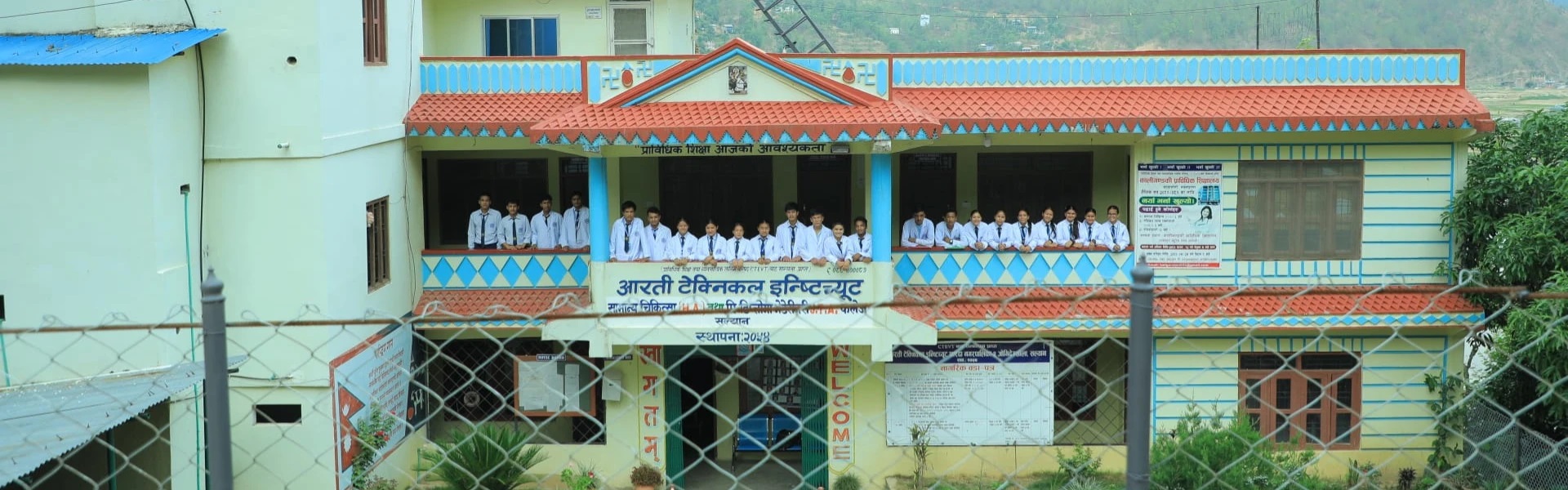
Course: Certificate in Medical Laboratory Technology
Abbreviation: CMLT
Institution: Aarati Technical Institute
Affiliation: CTEVT
Duration: Three academic years
Academic System: Yearly system
Location: Sharada Municipality-02, Shreenagar, Salyan
Medium of Instruction: English and/or Nepali
Attendance: Minimum 90% in each subject
Group Size: Maximum 30 students per batch
The program develops the academic knowledge, laboratory discipline, and practical ability required for routine and special investigations. Students learn to examine clinical and non-clinical samples, interpret results, prepare laboratory reagents, maintain quality-control procedures, manage laboratory activities, prepare reports, and conduct research related to laboratory work.
The course also addresses the procedures involved in establishing and operating a clinical laboratory at the primary healthcare level. Students are expected to follow professional conduct and laboratory safety requirements throughout their academic and clinical training.
Applicants must meet one of the following academic requirements:
SLC, SEE, or equivalent qualification with a minimum GPA of 2.0 and grades in compulsory Mathematics, English, and Science
TSLC in Medical Laboratory Technology with a minimum score of 68.33%
Applicants must also pass the entrance examination administered by CTEVT.
The first year covers basic science and foundational subjects needed for health science education. The second year introduces the principal laboratory disciplines through theory and practical classes:
Clinical Microbiology and Immunology
Hematology and Blood Banking
Clinical Biochemistry
Medical Parasitology
Clinical Pathology
Public Health and First Aid
The third year covers Histopathology and Cytopathology, Instrumentation and Automation, and Clinical Laboratory Management. Students also complete clinical practice in microbiology, parasitology, hematology, blood banking, biochemistry, histopathology, and cytopathology.
Clinical placements take place in hospitals, diagnostic laboratories, and blood banks. Students work under departmental supervision, maintain signed practical logbooks, and complete laboratory procedures associated with their assigned sections.
Assessment includes internal written and practical examinations, continuous evaluation, and final examinations. Students must complete the required theory and practical components across all three years to receive the Certificate in Medical Laboratory Technology.
Graduates may seek laboratory-related roles in hospitals, diagnostic laboratories, clinics, blood banks, research centres, industries, physicians’ offices, and crime investigation laboratories. The curriculum also identifies eligibility for technical positions equivalent to Non-Gazetted First Class or Level 5, subject to the requirements of the concerned authority. Registration with the related health professional council is governed by the applicable council provisions.






