



PCL in General Medicine, commonly associated with the Health Assistant qualification, is a three-year health science program offered by Aarati Technical Institute in Sharada Municipality-02, Shreenagar, Salyan. The institute conducts the program under its affiliation with the Council for Technical Education and Vocational Training (CTEVT).
The course prepares middle-level medical personnel for patient assessment, primary healthcare, basic treatment, clinical procedures, community health activities, and health service management. Its yearly academic structure combines theory, practical instruction, clinical exposure, and community field practice.
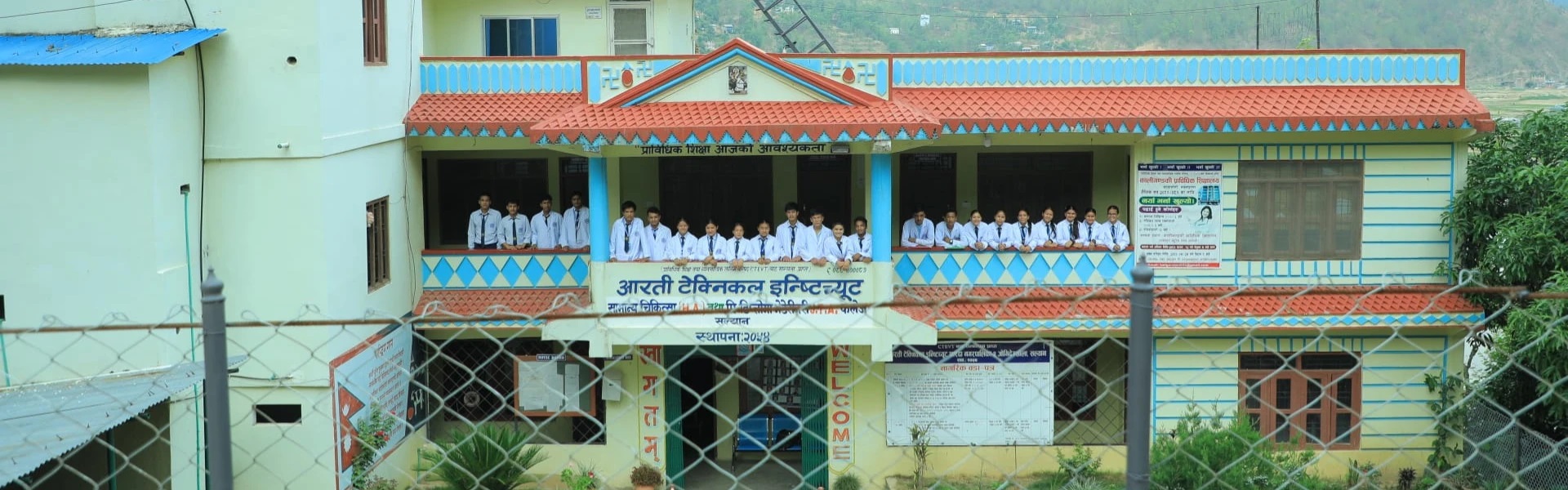
Official Course Title: Proficiency Certificate Level in General Medicine
Common Title: Health Assistant
Institution: Aarati Technical Institute
Affiliation: CTEVT
Duration: Three academic years
Academic System: Yearly system
Location: Sharada Municipality-02, Shreenagar, Salyan
Medium of Instruction: English and/or Nepali
Required Attendance: Minimum 90% in each subject
Maximum Group Size: 40 students
Applicants must have passed SLC, SEE, or an equivalent qualification with a minimum GPA of 2.0 and grades in compulsory Mathematics, English, and Science. Candidates with a CMA-equivalent qualification must have secured at least 68.33%.
Admission also requires applicants to pass the entrance examination administered by CTEVT.
The program covers clinical medicine, basic surgical care, public health, family health, community diagnosis, healthcare administration, and patient referral. Students learn to assess patients, record medical histories, conduct physical examinations, identify common health conditions, administer medication and treatment, maintain medical records, and refer cases requiring higher-level care.
Second-year study includes:
Medicine I
Surgery I
Basic Medical Procedures and First Aid
Clinical Pathology
Pharmacology and Pharmacy
Environmental Health
Health Education
Primary Health Care and Family Health
The family health component covers maternal and child health, family planning, and nutrition.
Third-year subjects include Medicine II, Surgery II, Health Management, Epidemiology, Demography, and Community Diagnosis. Medicine II incorporates areas such as pediatrics, neonatology, psychiatry, and dermatology, while Surgery II includes ENT, dentistry, and ophthalmology.
Clinical practice forms a major part of the third year. Students complete a 16-week clinical and primary healthcare practicum followed by an eight-week community field practicum.
Clinical rotations cover emergency care, medicine, surgery, ENT, eye care, dentistry, clinical pathology observation, pharmacy and dispensing, obstetrics and gynecology, maternity care, family health, basic medical procedures, and physiotherapy. Students practise history-taking, physical examination, identification of clinical findings, selection of laboratory investigations, management of simple conditions, and referral of complex cases.
Community-based work includes home visits, social mapping, community diagnosis, health-data preparation, and the study of local practices affecting health.
The course uses internal assessment, practical evaluation, continuous assessment, and final examinations. Students must complete the required theory and practical components and maintain the prescribed attendance to appear in final examinations.
The program also develops skills related to health-post operations, logistics, supervision, leadership, quality assurance, national health programs, and professional conduct.






