



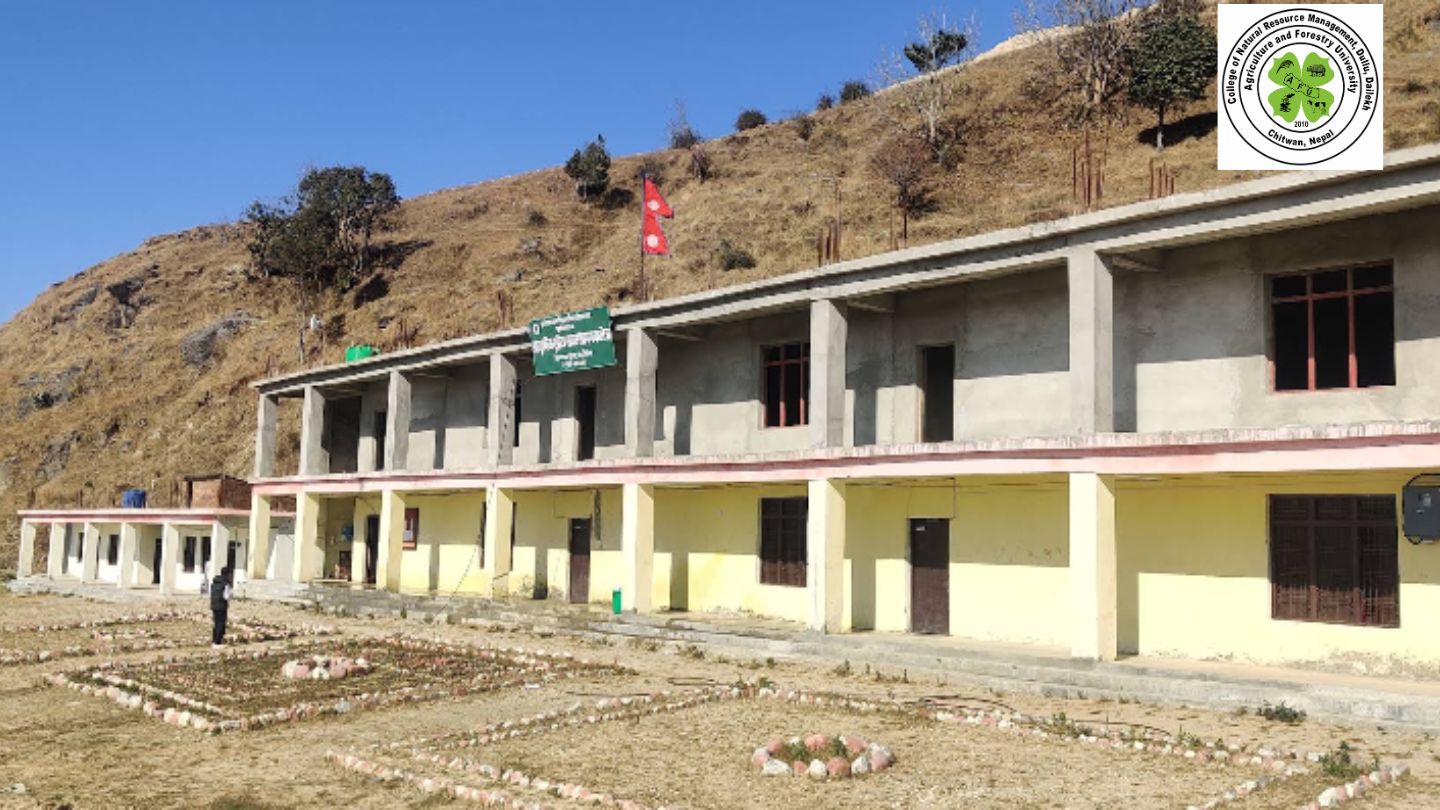
The B.Sc. Ag program at College of Natural Resource Management, Dullu, Dailekh (CNRM) is a four-year undergraduate agriculture program under Agriculture and Forestry University (AFU). CNRM is a constituent college under the Faculty of Agriculture and is located at Dullu Municipality-13, Dailekh, Karnali Province.
The program is organized across eight semesters, with 54 seats in each intake. Admission is based on the Entrance Examination Result published by AFU. Academic delivery follows the AFU Bulletin, while classroom instruction is supported by laboratory facilities, field exercises, and access to cultivable land.
| Particular | Details |
|---|---|
| Course: | B.Sc. Ag |
| College: | College of Natural Resource Management (CNRM) |
| University: | Agriculture and Forestry University (AFU) |
| Faculty: | Faculty of Agriculture |
| Location: | Dullu Municipality-13, Dailekh, Karnali Province |
| Duration: | 4 years |
| Academic Structure: | 8 semesters |
| Seats: | 54 per intake |
| Admission: | Based on the AFU Entrance Examination Result |
| Course Delivery: | According to the AFU Bulletin |
B.Sc. Ag is the undergraduate academic program offered by CNRM. The college operates under the Faculty of Agriculture of Agriculture and Forestry University, Rampur, Chitwan.
The program runs for four years through eight semesters. CNRM has 54 seats for each intake. The college has previously operated with two batches of B.Sc. Ag students, comprising 73 students in total.
Academic delivery is governed by the AFU Bulletin. This places the program within the academic structure followed by Agriculture and Forestry University.
Admission to B.Sc. Ag at CNRM is based on the Entrance Examination Result published by Agriculture and Forestry University.
The entrance result therefore forms the stated basis for admission to the program at the college. Each intake has 54 seats.
The B.Sc. Ag program is delivered through classroom teaching alongside laboratory and field-based activities. CNRM has facilities that support practical academic work connected with agriculture.
Relevant facilities include:
Field Lab
Applied Science Lab
Separate laboratory spaces for field exercises
Fishery ponds and irrigation-related structures
Cultivable land for practical activities
Classrooms
Library
Internet facility
The Field Lab and Applied Science Lab are in operation. The college also uses cultivable land for practical learning activities, allowing field exercises to take place alongside classroom and laboratory work.
CNRM has permanent faculty members and also involves faculty from Agriculture and Forestry University, other universities, and other colleges on a course basis.
The college's staffing includes two permanent faculty members, along with administrative and contract-based personnel. This staffing arrangement supports the academic and administrative operation of the B.Sc. Ag program.
Students also have access to basic campus facilities such as drinking water, power backup, a playground, a library, and internet service.
CNRM is situated at Dullu Municipality-13 in Dailekh district of Karnali Province. The college represents the mid-hill ecology of Nepal and has access to agricultural land used for field-based academic activities.
The college is accessible by road throughout the year. Its location is given as 56 km from the Surkhet-Dailekh Highway and 11 km from Mathillo Dungeshor.
For B.Sc. Ag students, the combination of classrooms, laboratories, field facilities, and cultivable land forms the physical setting in which the program is delivered.
The B.Sc. Ag program has a duration of four years and is organized into eight semesters.
CNRM is a constituent college of Agriculture and Forestry University under the Faculty of Agriculture.
The program has 54 seats in each intake.
Admission is based on the Entrance Examination Result published by Agriculture and Forestry University.
CNRM is located at Dullu Municipality-13, Dailekh, Karnali Province, Nepal.
The college has a Field Lab, Applied Science Lab, laboratory spaces for field exercises, fishery and irrigation-related structures, and cultivable land for practical academic activities.
Course delivery follows the AFU Bulletin, with classroom instruction supported by laboratory and field-based academic activities.






