Good
Good College




BE Software at Gandaki College of Engineering and Science (GCES) is a four-year undergraduate engineering program organized across eight semesters. The program is affiliated with Pokhara University and carries 129 credits.
The curriculum moves from programming, mathematics, digital logic, computer architecture, and web technology into algorithms, databases, software design, operating systems, networks, data science, distributed systems, software testing, project management, projects, and internship. It is structured around software engineering as an engineering discipline, with attention to software analysis, design, construction, verification, validation, teamwork, and professional practice. GCES has 48 seats for BE Software.
| Field | Details |
|---|---|
| Course | BE Software |
| Level | Undergraduate |
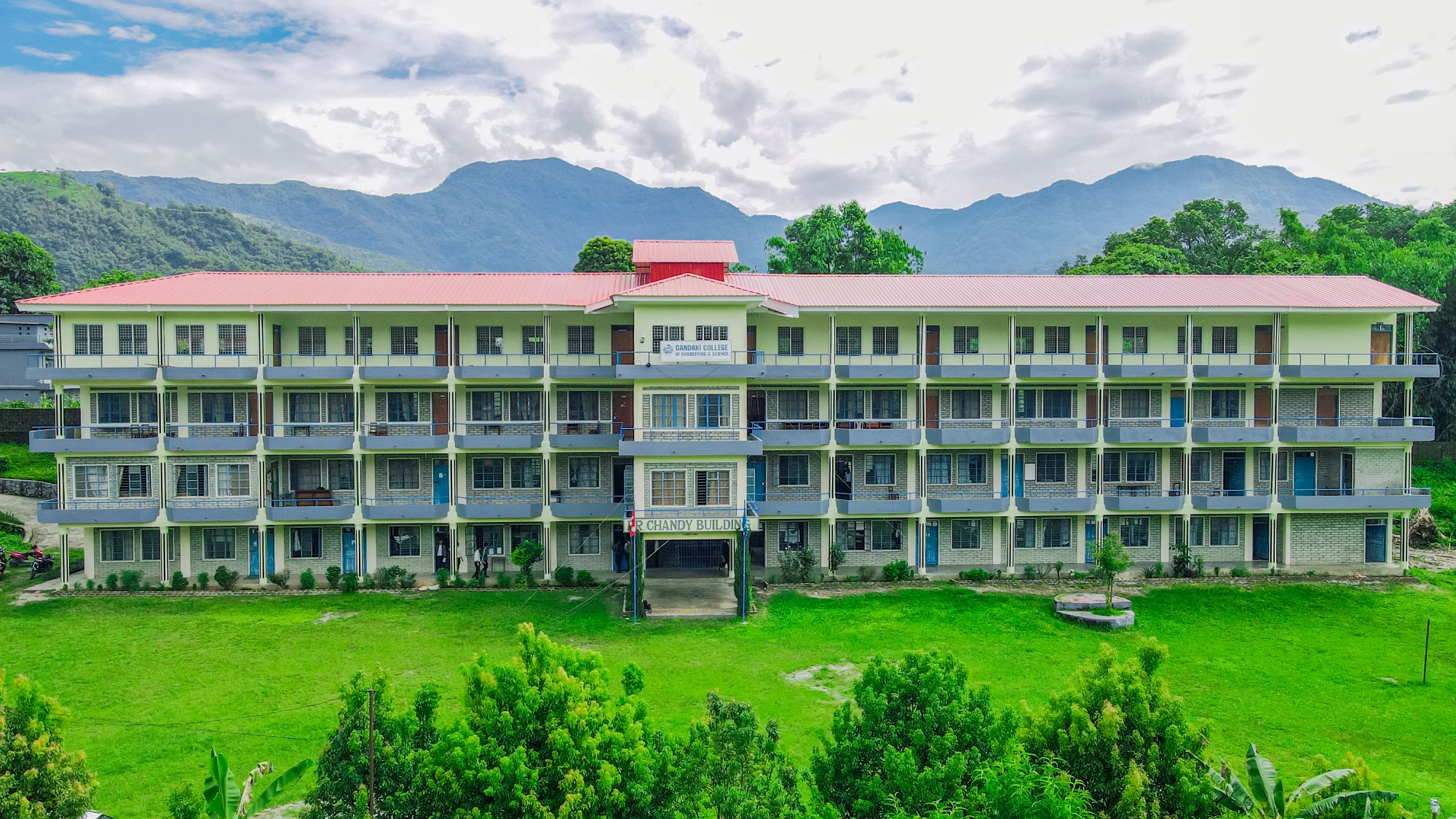
| Institution | Gandaki College of Engineering and Science (GCES) |
| Location | Lamachaur, Pokhara, Nepal |
| Affiliation | Pokhara University |
| Duration | 4 years |
| Academic structure | 8 semesters |
| Total credits | 129 |
| Total seats | 48 |
| College entrance seats | 43 |
| Pokhara University scholarship seats | 5 |
GCES is affiliated with Pokhara University and operates from the Gandaki Boarding School premises in Lamachaur, Pokhara. Along with BE Software, the college offers BE Computer and M.Sc. in Information System Engineering.
BE Software is an engineering program concerned with the systematic analysis, planning, design, construction, and evaluation of software systems. Its curriculum is not limited to learning programming languages. Students study the wider software development process, including requirements, algorithms, architecture, databases, operating systems, networks, testing, quality assurance, project management, and software dependability.
The program follows a project-oriented academic structure. Its stated graduate outcomes include technical competence in software engineering, teamwork and leadership in computing projects, ethical awareness, continued professional learning, and the use of software engineering methods and tools in areas such as security, data science, and systems engineering.
Software design and construction are studied alongside requirements analysis, verification, and validation. This gives the course an engineering focus in which students consider how software is planned, developed, examined, maintained, and managed rather than concentrating only on writing code.
The academic goal of BE Software is to provide an engineering education in software development and related computing areas. The program also identifies industry, government, computing graduate programs, and professional education among the paths for which its academic preparation is intended.
Software Engineering graduates are expected to develop abilities related to:
software development using a broad set of computing and engineering skills;
teamwork and organizational leadership in computing project settings;
ethical application of computing-based solutions to social and organizational problems;
continued development of professional and technical knowledge;
use of current tools and technologies in software engineering practice;
software design and construction;
requirements analysis;
software verification and validation; and
applying software engineering perspectives to areas such as security, data science, and systems engineering.
These outcomes are reflected across the curriculum. Programming subjects appear from the first year, while later semesters introduce software architecture, agile development, distributed systems, software project management, software testing, internship, and major project work.
Applicants for the bachelor's engineering programs at GCES may qualify through Class 12 Science, Diploma in Engineering, GCE A Level, or an equivalent academic route.
The stated eligibility criteria include:
SLC (Class-12) in Science from the Physics or Biology group with Mathematics of at least 100 marks;
minimum C grade in aggregate in Physics, Mathematics, and Chemistry;
Diploma in Engineering with a minimum of 45% marks;
GCE A Level with Grade D in each subject; or
an equivalent degree meeting the stated requirement.
Admission is merit-based through an entrance examination.
The undergraduate entrance examination is based on the +2-level courses in Mathematics, Physics, Chemistry, and English.
| Entrance Subject | Weightage |
|---|---|
| Mathematics | 40% |
| Physics | 30% |
| Chemistry | 20% |
| English | 10% |
Candidates are selected on merit according to their performance in the entrance examination.
GCES has 48 seats for BE Software.
| Admission Category | Seats |
|---|---|
| College Entrance | 43 |
| Pokhara University Scholarship | 5 |
| Total | 48 |
The five Pokhara University scholarship seats are included within the total intake of 48 seats.
The BE Software curriculum is organized across eight semesters. The sequence starts with engineering, mathematics, programming, digital systems, and web foundations before moving into algorithms, software engineering, operating systems, data science, networks, software architecture, distributed systems, project management, testing, projects, and internship.
Basic Engineering Drawing
Calculus-I
Computer Workshop
Digital Logic
Discrete Structure
Problem Solving Technique
Programming in C
The first semester establishes mathematical, programming, digital logic, problem-solving, and basic engineering foundations. Programming in C introduces software development early in the degree, while Discrete Structure supports later work in computing and algorithms.
Algebra and Geometry
Applied Physics
Communication Techniques
Microprocessor and Computer Architecture
Object Oriented Programming in C++
Web Technology
The second semester adds object-oriented programming and web technology while introducing Microprocessor and Computer Architecture. Communication Techniques and Applied Physics remain part of the broader engineering foundation.
Advance Programming with Java
Calculus-II
Data Structure & Algorithms
Database Management System
Probability & Statistics
Software Engineering Fundamental
By the third semester, the course moves more directly into software engineering. Programming continues through Java, while students also study data structures, algorithms, databases, probability and statistics, and the fundamentals of software engineering.
Analysis and Design of Algorithm
Computer Graphics & Multimedia
Numerical Methods
Object Oriented Design & Modeling Through UML
Research Fundamentals
System Programming
This semester combines algorithm design with object-oriented software modeling, system programming, numerical methods, graphics, and introductory research study.
Object Oriented Design & Modeling Through UML gives software modeling an explicit place in the curriculum, while Research Fundamentals begins preparing students for later project and research-oriented work.
Applied Operating Systems
Artificial Intelligence & Neural Networks
Computer Networks
Data Science & Machine Learning
Simulation & Modeling
Software Design & Architecture
Software Dependability
The fifth semester brings together several software and computing areas. Operating systems and networks sit alongside data science, machine learning, simulation, software architecture, and software dependability.
Software Design & Architecture is particularly relevant to the engineering direction of the degree because it moves beyond individual programming tasks into the organization and structure of larger software systems.
Agile Software Development
Cloud Application Development Foundation
Elective-I
Engineering Management
Network Programming
Project-I
Project-I begins the formal project sequence in the sixth semester.
Agile Software Development, Network Programming, and Cloud Application Development Foundation broaden the development environment, while Engineering Management introduces the management dimension of technical work.
Distributed Systems & Cloud Computing
Elective II
Engineering Economics
Entrepreneurship & Professional Practice
Software Project Management
Software Testing, Verification, Validation & Quality Assurance
The seventh semester gives considerable attention to software engineering practice beyond development itself.
Students study Software Project Management together with Software Testing, Verification, Validation & Quality Assurance. Distributed systems, cloud computing, economics, and professional practice are also included.
This stage of the curriculum connects technical software development with software quality, project organization, and professional responsibilities.
Elective-III
Internship
Project-II
The final semester includes an internship and Project-II. These components follow the technical and project preparation developed during the earlier semesters and place applied work at the end of the four-year program.
The course becomes more specialized as students move through the eight semesters. Several academic strands run through the program rather than appearing as isolated subjects.
Programming begins with Programming in C and continues through Object Oriented Programming in C++ and Advance Programming with Java.
Problem Solving Technique, Discrete Structure, Data Structure & Algorithms, and Analysis and Design of Algorithm develop the analytical side of software development.
This progression connects programming practice with the structures and methods used to solve computational problems.
Software Engineering Fundamental provides an early formal introduction to the discipline. Later subjects include:
Object Oriented Design & Modeling Through UML
Software Design & Architecture
Software Dependability
Agile Software Development
Software Project Management
Software Testing, Verification, Validation & Quality Assurance
Together, these subjects cover different stages and concerns of software development, from design and modeling to architecture, project organization, dependability, testing, and quality assurance.
BE Software also includes subjects that explain the computing environment in which software operates.
Microprocessor and Computer Architecture, System Programming, Applied Operating Systems, Computer Networks, Network Programming, and Distributed Systems & Cloud Computing give students exposure to system-level computing alongside software development.
Web Technology appears in the first year. Later study includes Cloud Application Development Foundation and Distributed Systems & Cloud Computing.
This creates a progression from introductory web development into software designed for networked, cloud, and distributed computing environments.
The curriculum includes:
Probability & Statistics
Artificial Intelligence & Neural Networks
Data Science & Machine Learning
Simulation & Modeling
These subjects appear after students have completed earlier programming, mathematics, data structures, algorithms, and database study.
Research Fundamentals appears in the fourth semester. Project-I follows in the sixth semester and Project-II in the eighth semester.
The sequence gives research and project work a defined progression within the degree rather than concentrating both in a single final-semester activity.
The academic process at GCES includes classroom instruction together with practical and participatory forms of study.
Learning activities include:
group work and discussions;
individual and group assignments;
project work;
research-based experiments;
virtual classes;
visiting and guest lectures;
field trips and field-based learning activities;
internal terminal evaluation; and
laboratory-based learning.
For software engineering students, the computer laboratories and ICT facilities provide relevant spaces for programming and computing work. The college also maintains a library, electronics and microprocessor laboratories, electrical laboratories, a mechanical workshop, and physics laboratories as part of its wider engineering infrastructure.
Industrial engagement includes interaction with IT companies and visits by professionals for workshops, training sessions, and seminars. The curriculum itself adds an internship in the eighth semester.
Projects form a visible part of the later curriculum.
Project-I is included in the sixth semester. Students then proceed to Project-II in the eighth semester, where an internship is also required.
The project sequence follows earlier study in programming, databases, algorithms, software engineering, system programming, architecture, operating systems, networks, data science, and software dependability.
By the time students enter the final semester, they have also studied agile software development, engineering management, distributed systems, software project management, and software testing and quality assurance.
Five of the 48 BE Software seats are Pokhara University scholarship seats. Scholarship students under this arrangement are selected by Pokhara University.
GCES also has scholarship provisions for academically strong and financially needy students. These scholarships are reviewed each semester. Entrance examination toppers and semester toppers may receive scholarships according to college rules and regulations.
Academic awards are provided according to semester performance. The first-, second-, and third-position holders receive semester-fee waivers of 50%, 30%, and 20%, respectively.
GCES offers two undergraduate engineering programs in computing.
BE Software centers more directly on software development and engineering processes. Its curriculum includes software design and architecture, agile development, software dependability, software project management, software testing, verification, validation, and quality assurance.
The BE Computer program at GCES combines software study with a stronger computer systems and hardware component, including electrical and electronics foundations, instrumentation, microprocessors, embedded systems, and computer architecture.
Both are four-year engineering programs, but their curriculum emphasis is different. Students comparing the two can look at whether their interest lies more strongly in software engineering processes or in computer systems that combine hardware and software.
Software Engineering graduates are among the engineering graduates eligible to apply for the M.Sc. in Information System Engineering at GCES.
Eligibility for that postgraduate program includes a bachelor's engineering degree in Software Engineering, Computer Engineering, Electronics and Communication Engineering, Information Technology, Electrical and Electronics Engineering, or an equivalent qualification, with a minimum 2.0 CGPA or equivalent.
Selection for M.Sc. in Information System Engineering is through the Pokhara University entrance examination on a merit basis.
BE Software requires sustained work across programming, mathematics, algorithms, software design, computer systems, networks, projects, and engineering subjects over eight semesters.
Students considering the program can pay particular attention to three parts of the curriculum: the programming sequence in the early semesters, the software engineering and system subjects that become more prominent from the second year onward, and the project and internship components in the later semesters.
Admission requires meeting the stated academic eligibility criteria and competing through the entrance examination. The program has 48 seats, including five Pokhara University scholarship seats.
BE Software is a four-year undergraduate engineering program organized across eight semesters.
The program carries 129 credits.
The program is affiliated with Pokhara University.
There are 48 seats. The distribution is 43 college entrance seats and 5 Pokhara University scholarship seats.
The stated routes include Class 12 Science with the required Mathematics and grades in Physics, Mathematics, and Chemistry; Diploma in Engineering with at least 45% marks; GCE A Level with Grade D in each subject; or an equivalent qualification.
The entrance examination is based on Mathematics, Physics, Chemistry, and English. The weightage is Mathematics 40%, Physics 30%, Chemistry 20%, and English 10%.
Yes. Internship is included in the eighth semester.
Yes. Project-I is included in the sixth semester and Project-II in the eighth semester.
Yes. Software Testing, Verification, Validation & Quality Assurance is included in the seventh semester.
Yes. Software Design & Architecture is included in the fifth semester.
Yes. Software Engineering is one of the bachelor's engineering backgrounds included in the eligibility criteria for M.Sc. in Information System Engineering, subject to the stated CGPA and entrance requirements.
Good College