The M.Sc. in Information System Engineering at Gandaki College of Engineering and Science (GCES) is a two-year graduate engineering program under the Faculty of Science and Technology of Pokhara University. It is organized across four semesters and carries 60 credits.
The program combines information systems, knowledge engineering, enterprise architecture, data management, information retrieval, security, project management, and research. Its academic scope also addresses the technical, social, legal, and moral dimensions of Information System Engineering practice. The final stages of the degree place particular weight on research through Research Methodology, an Information System Research Proposal, and a Thesis. GCES has 15 seats for M.Sc. ISE.
| Field | Details |
|---|---|
| Course | M.Sc. in Information System Engineering |
| Short form | M.Sc. ISE |
| Level | Graduate / Master's |
| Institution | Gandaki College of Engineering and Science (GCES) |
| Location | Lamachaur, Pokhara, Nepal |
| University | Pokhara University |
| Faculty | Faculty of Science and Technology |
| Duration | 2 years |
| Academic structure | 4 semesters |
| Total credits | 60 |
| Total seats | 15 |
| Entrance seats | 13 |
| Pokhara University scholarship seats | 2 |
| Final research component | Thesis |
M.Sc. in Information System Engineering is a postgraduate engineering program built around the study, design, development, management, and research of information and knowledge-based systems.
The program approaches Information System Engineering from more than a technical angle. Its stated purpose includes preparing engineers to deal with technical, social, legal, and moral aspects connected with professional practice in Nepal.
Students study subjects that cover information systems themselves as well as the architecture, storage, retrieval, security, management, and research processes surrounding them. Information Systems and Knowledge Engineering appear at the start of the degree, followed by Enterprise Architecture, Data Warehousing and Data Mining, Information Retrieval, Information Security, and Information System Project Management.
Research is not confined to the final thesis. Research Methodology appears in the second semester, an Information System Research Proposal is included in the third semester, and the fourth semester contains the Thesis.
The M.Sc. ISE program is intended to serve both academic and industry-related needs through postgraduate study in Information System Engineering.
Its academic objectives focus on four areas:
developing professional competence in Information System Engineering;
strengthening analytical and problem-solving ability for issues involving information and knowledge-based engineering;
building the theoretical grounding needed to analyze, design, develop, and manage information and knowledge-based systems; and
developing the research ability required to conduct structured work in Information System Engineering.
The program also aims to give graduates an understanding of concepts connected with information systems and knowledge and their application in practical contexts.
The program is intended for graduates from specified engineering backgrounds who want postgraduate study centered on information systems, data and knowledge management, enterprise systems, information security, project management, and research.
The eligible engineering backgrounds cover several closely connected computing, electronics, and electrical disciplines. This makes the course relevant to graduates whose previous engineering education has already given them a technical foundation for more advanced information systems study.
Students considering the course should also be prepared for a research component. The curriculum requires Research Methodology, a research proposal, and a thesis rather than ending with coursework alone.
Applicants must have passed a Bachelor's of Engineering degree in one of the specified fields:
Software Engineering
Computer Engineering
Electronics and Communication
Information Technology
Electrical and Electronics Engineering
Equivalent engineering qualification
A minimum of 2.0 CGPA or equivalent is required.
Graduates of the BE Software program at GCES and the BE Computer program at GCES fall within the engineering backgrounds named in the eligibility criteria, subject to the stated CGPA requirement.
Admission to M.Sc. ISE is based on an entrance examination conducted by Pokhara University.
Candidates are selected on merit according to their entrance examination performance. The Student Admission Committee of Pokhara University, Faculty of Science and Technology publishes the admission notice during March each year.
The admission structure differs from the undergraduate engineering admission process at GCES because the postgraduate entrance examination is conducted by Pokhara University.
GCES has 15 seats for the graduate program.
| Admission Category | Seats |
|---|---|
| Entrance | 13 |
| Pokhara University Scholarship | 2 |
| Total | 15 |
The two Pokhara University scholarship seats are included within the total intake of 15 seats.
The 60-credit program runs for two academic years. The four-semester sequence moves from information systems foundations and knowledge engineering into enterprise systems, data and information management, security, project management, and formal research.
Information Systems
Algorithmic Mathematics
Web Engineering
Communication System Engineering
Knowledge Engineering
The opening semester establishes the main information systems and engineering base of the program.
Information Systems and Knowledge Engineering introduce two central areas of the degree, while Algorithmic Mathematics contributes a mathematical component. Web Engineering and Communication System Engineering bring application and communication-system perspectives into the same semester.
Enterprise Architecture
Data Warehousing and Data Mining
Information Retrieval
Operations Research
Research Methodology
The second semester shifts toward organizational information architecture, data, information access, analytical methods, and research preparation.
Enterprise Architecture addresses information systems in a broader organizational structure. Data Warehousing and Data Mining deals with stored data and its analysis, while Information Retrieval addresses methods connected with finding and accessing information.
Research Methodology begins the formal research sequence that continues through the remaining semesters.
Advance Database
Information System Project Management
Information Security
Information System Research Proposal
Elective I
The third semester combines advanced database study, security, management, and research planning.
Information System Project Management places management within the technical program, while Information Security addresses the protection and security dimension of information systems.
The Information System Research Proposal is particularly important to the academic progression of the degree. It follows Research Methodology from the second semester and comes before the final Thesis.
Elective II
Thesis
The fourth semester has a compact structure centered on an elective and the Thesis.
By this point, students have completed the program's information systems, knowledge, architecture, data, retrieval, research, database, security, and project-management subjects. The thesis provides the final research component of the master's degree.
The subjects can be read as several connected academic strands rather than a collection of unrelated courses.
Information Systems and Knowledge Engineering establish two of the core areas in the first semester.
The program later adds Information Retrieval, Advance Database, and Information Security. Together, these subjects address how information is structured, stored, accessed, protected, and used within information-based systems.
Enterprise Architecture and Information System Project Management bring organizational and management concerns into the curriculum.
This matters because Information System Engineering is not studied only as a matter of individual technical components. The program also considers how information systems are organized and managed within larger structures.
Data Warehousing and Data Mining, Information Retrieval, and Advance Database form a distinct data-oriented part of the program.
These subjects are positioned across the second and third semesters, after students have completed the introductory Information Systems course.
Algorithmic Mathematics, Communication System Engineering, Web Engineering, and Operations Research add mathematical, communication, web, and analytical dimensions to the degree.
This mix reflects the engineering character of the program while keeping information systems as its central subject.
Research has a defined sequence within M.Sc. ISE.
The second semester introduces Research Methodology. Students then proceed to Information System Research Proposal in the third semester. The fourth semester contains the Thesis.
The sequence can be viewed as three stages:
learning the principles and methods used in structured research;
preparing a research proposal in Information System Engineering; and
completing thesis work in the final semester.
This progression is consistent with the program objective of developing students' ability to carry out research in Information System Engineering.
GCES has a Research Management Committee that coordinates research and capacity-building activities for faculty members and students.
Its work includes activities connected with:
research;
publication;
conferences;
workshops;
training;
project activities;
institutional research policies and guidelines;
research records and databases; and
coordination connected with research development.
The committee also has a role in setting research priorities and aligning institutional research activities with broader institutional and national goals.
This research structure is relevant to M.Sc. ISE because the course itself contains a research methodology subject, a formal research proposal, and a thesis.
The wider GCES learning process combines classroom instruction with several forms of academic activity, including:
group work and discussion;
individual and group assignments;
project work;
research-based experiments;
virtual classes;
visiting and guest lectures;
field-based learning activities;
internal terminal evaluation; and
laboratory-based learning.
The college also has computer laboratories and an ICT Centre. The ICT Centre is used for activities such as virtual classes, seminars, video conferences, and workshops.
Library resources include textbooks, reference materials, journals, newspapers, magazines, electronic resources, and a computerized library information system.
For a postgraduate course that includes research and thesis work, these facilities form part of the broader academic setting in which the program operates.
The course works across several connected dimensions of Information System Engineering.
Students encounter the conceptual side through Information Systems and Knowledge Engineering. Enterprise Architecture and Information System Project Management introduce organizational and management concerns. Data Warehousing and Data Mining, Information Retrieval, and Advance Database address the handling and organization of data and information.
Information Security introduces a security dimension, while Research Methodology, the Information System Research Proposal, and Thesis establish a formal postgraduate research pathway.
The program also includes two electives, allowing part of the later study structure to extend beyond the named compulsory subjects.
The program objectives and subject structure support the development of abilities in areas such as:
analyzing information and knowledge-based engineering problems;
applying engineering concepts to information systems;
examining information-system requirements and structures;
working with enterprise architecture concepts;
approaching data warehousing, data mining, databases, and information retrieval at postgraduate level;
considering information security within information systems;
managing information system projects;
planning formal research;
preparing a research proposal; and
carrying out thesis-based research.
These areas follow directly from the stated program objectives and curriculum rather than representing guaranteed professional outcomes.
The program is designed with both academia and industry in view. Its objectives refer to preparing human resources with advanced Information System Engineering knowledge while developing analytical, problem-solving, technical, and research capability.
The academic side is especially visible in Research Methodology, the research proposal, and thesis sequence. The industry-related side appears through subjects such as Enterprise Architecture, Information System Project Management, Information Security, Data Warehousing and Data Mining, and Advance Database.
The course does not separate these two directions sharply. Technical coursework, management-oriented study, and research are included within the same master's structure.
Two of the 15 M.Sc. ISE seats are Pokhara University scholarship seats. Scholarship students under the university scholarship arrangement are selected by Pokhara University.
GCES also has scholarship provisions at graduate level. Its scholarship arrangements include financial assistance for academically strong and economically disadvantaged students, with awards reviewed each semester.
Entrance examination toppers and semester toppers may also receive scholarships according to college rules and regulations.
The college's academic award structure provides semester-fee waivers to top-performing students based on the previous semester's results:
First position: 50% semester-fee waiver
Second position: 30% semester-fee waiver
Third position: 20% semester-fee waiver
GCES concentrates its academic offerings within computer, software, and information systems engineering. M.Sc. ISE is its graduate-level program, while BE Computer and BE Software are offered at undergraduate level.
The master's degree therefore sits within an institutional setting already centered on computing and engineering education.
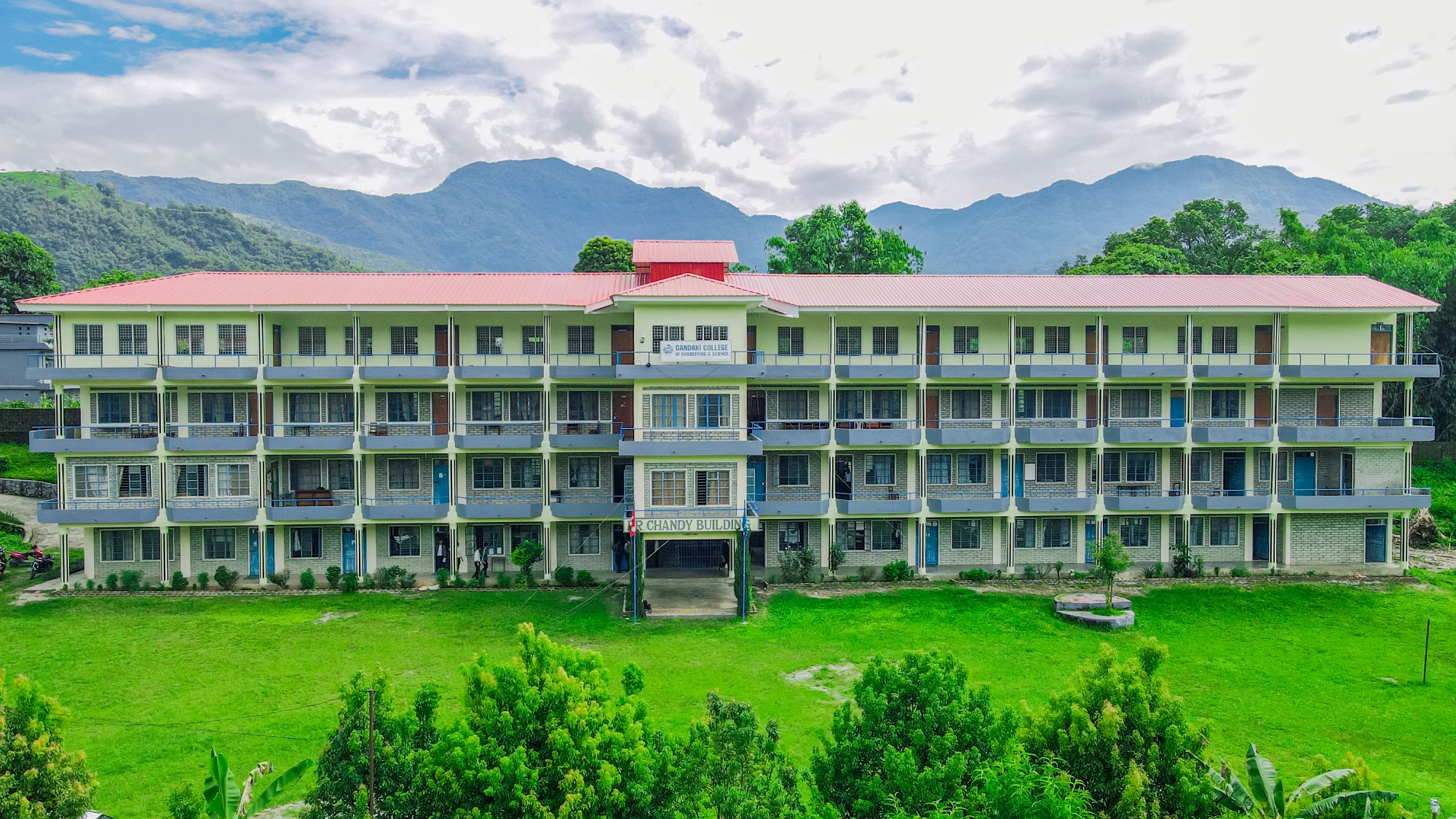
GCES is located in Lamachaur, Pokhara, within the Gandaki Boarding School premises. The college operates under the Gandaki Public Education Trust and is affiliated with Pokhara University.
M.Sc. ISE is structured for engineering graduates who want to continue into advanced work involving information systems and knowledge, enterprise architecture, databases, data warehousing, information retrieval, security, project management, and research.
The course requires more than technical coursework. Research Methodology, a research proposal, and the final thesis make independent academic research part of the degree.
Students whose interests lie in information systems together with research, data and knowledge management, enterprise systems, security, or information-system project work may find the curriculum relevant to their postgraduate study plans. Admission still depends on meeting the listed engineering-degree and CGPA requirements and securing a place through the Pokhara University entrance examination.
The program takes two years and is organized across four semesters.
M.Sc. in Information System Engineering carries 60 credits.
The program is under the Faculty of Science and Technology of Pokhara University.
There are 15 seats in total: 13 entrance seats and 2 Pokhara University scholarship seats.
Applicants need a minimum of 2.0 CGPA or equivalent in an eligible engineering bachelor's degree.
The eligible backgrounds are Software Engineering, Computer Engineering, Electronics and Communication, Information Technology, Electrical and Electronics Engineering, or an equivalent engineering qualification.
Candidates are selected on merit through an entrance examination conducted by Pokhara University.
Yes. Thesis is included in the fourth semester.
Yes. Research Methodology is studied in the second semester, followed by an Information System Research Proposal in the third semester and Thesis in the fourth semester.
Yes. Information Security is included in the third semester.
Yes. Two of the 15 seats are Pokhara University scholarship seats. GCES also has graduate-level scholarship provisions and academic awards under its stated rules.