The BE Computer program at Gandaki College of Engineering and Science (GCES) is a four-year undergraduate engineering program organized across eight semesters under Pokhara University. The program studies computer systems from both hardware and software perspectives, with emphasis on computer organization and architecture, programming, operating systems, digital hardware, networks, embedded systems, data, and related engineering subjects.
The curriculum moves from mathematics, science, electrical and electronics foundations into computer architecture, operating systems, artificial intelligence, networking, machine learning, security, projects, and internship. GCES has 48 seats for BE Computer, including 43 college-entrance seats and 5 Pokhara University scholarship seats.
| Field | Details |
|---|---|
| Course | BE Computer |
| Level | Undergraduate |
| Institution | Gandaki College of Engineering and Science (GCES) |
| Location | Lamachaur, Pokhara, Nepal |
| Affiliation | Pokhara University |
| Duration | 4 years |
| Academic structure | 8 semesters |
| Total seats | 48 |
| College entrance seats | 43 |
| Pokhara University scholarship seats | 5 |
| Study area | Computer Engineering |
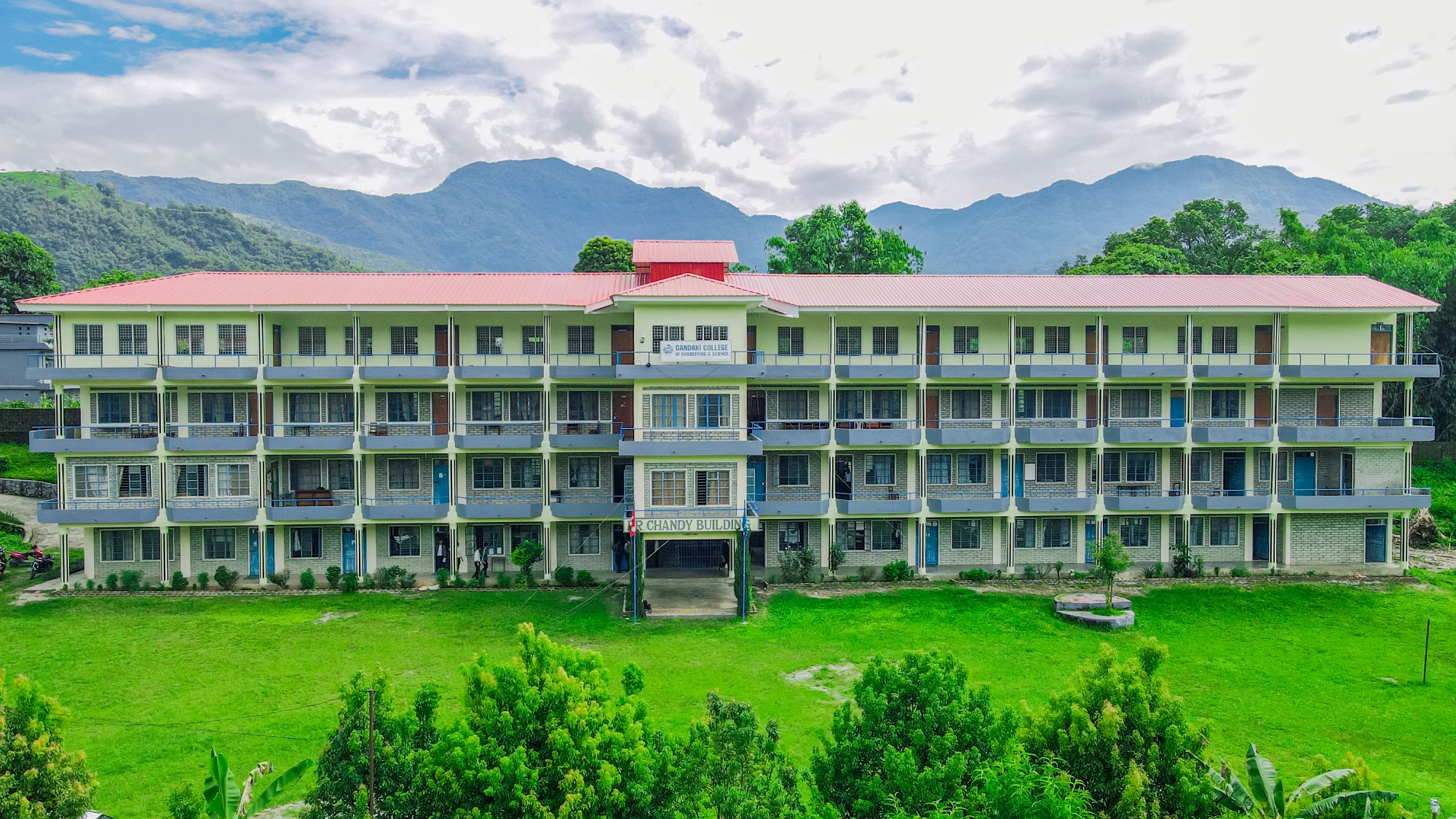
GCES is affiliated with Pokhara University and operates from the Gandaki Boarding School premises at Lamachaur, Pokhara. The college's academic work covers Computer Engineering, Software Engineering, and Information System Engineering.
BE Computer is concerned with the analysis, design, and evaluation of computer systems. It does not treat hardware and software as completely separate areas; the program studies how both work together within computer systems.
Its stated academic emphasis includes computer organization and architecture, systems programming, operating systems, and digital hardware design. The curriculum extends this foundation through programming, databases, microprocessors, communication, networks, embedded systems, data analysis, security, and project work.
Students begin with subjects such as calculus, electrical engineering, physics, chemistry, digital logic, programming, computer workshop, and engineering drawing. Later semesters move into computer architecture, operating systems, data communication, artificial intelligence, networks, machine learning, image processing, cloud computing, cyber security, and engineering management.
This progression makes the course relevant to students who want to understand both how computer systems are built and how software operates within those systems.
BE Computer may suit students whose interests extend across programming and computer hardware rather than only one side of computing.
The curriculum requires engagement with mathematics, physics, programming, electronics, system design, algorithms, communication, and engineering problem-solving. Students also encounter laboratory work, assignments, research-related study, projects, and an internship during the program.
A student considering the course should be comfortable with a four-year engineering study commitment and interested in subjects that connect software, electronics, computer architecture, networks, and computational problem-solving.
Applicants may qualify through the Class 12 Science, engineering diploma, GCE A Level, or equivalent route specified for the bachelor's engineering programs.
The eligibility criteria include:
SLC (Class-12) in Science, from the Physics or Biology group, with Mathematics of at least 100 marks.
A minimum C grade in aggregate in Physics, Mathematics, and Chemistry.
Diploma in Engineering with a minimum of 45% marks.
GCE A Level with Grade D in each subject.
An equivalent degree meeting the stated requirement.
The entrance requirement applies to candidates seeking admission to the bachelor's engineering programs.
Admission is based on merit through an entrance examination.
The entrance examination uses the following subject weightage:
| Subject | Weightage |
|---|---|
| Mathematics | 40% |
| Physics | 30% |
| Chemistry | 20% |
| English | 10% |
The entrance syllabus is drawn from the +2-level course in these subject areas. Candidates are selected on merit according to their entrance examination performance.
GCES has 48 seats for BE Computer.
| Admission Category | Seats |
|---|---|
| College Entrance | 43 |
| Pokhara University Scholarship | 5 |
| Total | 48 |
The five Pokhara University scholarship seats form part of the total intake rather than additional seats beyond the 48-seat capacity.
The curriculum is organized over eight semesters. It starts with scientific, mathematical, electrical, electronics, and programming foundations before moving into computer systems and more specialized computing subjects.
Basic Electrical Engineering
Calculus-I
Communication Techniques
Computer Workshop
Digital Logic
Electronic Devices and Circuits
Programming in C
The opening semester combines basic engineering and mathematical study with programming, electronics, digital logic, and workshop-based learning.
Algebra and Geometry
Applied Chemistry
Applied Physics
Basic Engineering Drawing
Data Structure and Algorithms
Instrumentation
Object Oriented Programming in C++
The second semester adds science and mathematical foundations while moving programming into data structures, algorithms, and object-oriented programming.
Calculus-II
Computer Graphics
Data Communication
Database Management System
Microprocessor and ALP
Operating Systems
By the third semester, the curriculum moves more directly into computer systems. Students study data communication, databases, microprocessors, operating systems, and computer graphics alongside mathematics.
Advanced Programming with Java
Applied Mathematics
Computer Architecture
Numerical Methods
Research Fundamentals
Theory of Computation
Computer Architecture introduces a system-level view of computing, while Theory of Computation and Numerical Methods add theoretical and mathematical depth. Research Fundamentals introduces students to research-related academic work.
Artificial Intelligence
Digital Signal Analysis and Processing
Embedded System
Engineering Management
Probability and Statistics
Software Engineering
Elective-I
The fifth semester brings together artificial intelligence, embedded systems, signal processing, software engineering, statistics, and management.
Computer Networks
Compiler Design
Image Processing and Pattern Recognition
Machine Learning
Project-I
Simulation and Modeling
Project-I appears at this stage of the degree alongside networks, compiler study, image processing, machine learning, and simulation.
Cloud Computing and Virtualization
Data Science and Analytics
Engineering Economics
Entrepreneurship and Professional Practice
Network and Cyber Security
Elective-II
The seventh semester adds security, cloud computing, data analysis, economics, and professional-practice subjects.
Internship
Project-II
Elective-III
The final semester places significant attention on applied work through an internship and Project-II, together with an elective subject.
The four-year sequence can be understood through the way its subject areas develop.
Calculus-I, Algebra and Geometry, Applied Chemistry, Applied Physics, Calculus-II, Applied Mathematics, Numerical Methods, and Probability and Statistics provide mathematical and scientific preparation for engineering study.
These subjects support later work involving computer systems, signals, data, algorithms, simulation, and analytical problem-solving.
Programming begins with C and continues through Object Oriented Programming in C++ and Advanced Programming with Java.
Students also encounter Data Structure and Algorithms, Database Management System, Software Engineering, Operating Systems, Compiler Design, and related computing subjects.
Basic Electrical Engineering, Digital Logic, Electronic Devices and Circuits, Instrumentation, Microprocessor and ALP, Computer Architecture, and Embedded System address the hardware and system side of the degree.
This part of the curriculum reflects the program's stated emphasis on understanding computer systems across hardware and software.
Data Communication is followed later by Computer Networks and Network and Cyber Security.
These subjects give networking and communication systems a defined place in the academic sequence rather than treating them as isolated elective topics.
Artificial Intelligence, Machine Learning, Image Processing and Pattern Recognition, Data Science and Analytics, Simulation and Modeling, and Digital Signal Analysis and Processing appear in the later years.
Their placement follows earlier work in programming, mathematics, statistics, algorithms, databases, and system fundamentals.
Project-I appears in the sixth semester, followed by Project-II and an internship in the eighth semester.
This structure gives students opportunities to apply course knowledge through project-based and workplace-oriented academic components before completing the degree.
The broader learning process at GCES includes several formats beyond regular classroom instruction:
Group work and discussion
Individual and group assignments
Project work
Research-based experiments
Virtual classes
Visiting and guest lectures
Field trips and field-based learning activities
Internal terminal evaluation
Laboratory-based learning
For Computer Engineering students, laboratory and workshop resources include computer laboratories, electronics and microprocessor laboratories, electrical laboratories, a mechanical workshop, and physics laboratories. The college also has an ICT Centre and library facilities.
These resources support a curriculum in which programming, electronics, microprocessors, networks, laboratory work, and projects appear at different stages of the degree.
The expected graduate abilities cover technical work as well as communication, teamwork, professional judgment, and continued learning.
Students are expected to develop the ability to:
identify, formulate, and solve complex engineering problems using engineering, science, and mathematics;
apply engineering design to specified needs while considering health, safety, welfare, environmental, economic, social, and cultural factors;
communicate with different audiences;
recognize ethical and professional responsibilities in engineering situations;
make informed judgments about the wider effects of engineering solutions;
work within teams, contribute to shared objectives, and take part in planning and leadership; and
acquire and apply new knowledge through appropriate learning strategies.
These outcomes match the mixed technical structure of the course, where mathematical work, computing, electronics, projects, communication, and professional practice are studied within the same degree.
Five of the 48 BE Computer seats are allocated as Pokhara University scholarship seats. Scholarship students under the university scholarship arrangement are selected by Pokhara University.
GCES also has its own scholarship arrangements for academically strong and financially needy students. These scholarships are reviewed each semester. Entrance examination toppers and semester toppers may also receive scholarships according to college rules and regulations.
Academic awards are tied to semester results. First-, second-, and third-position holders receive semester-fee waivers of 50%, 30%, and 20%, respectively.
BE Computer includes practical and project-based work at different stages rather than placing all applied work at the end of the degree.
Computer Workshop appears in the first year. Electronics, microprocessor, instrumentation, operating systems, networks, embedded systems, and other technical areas are supported by laboratory-oriented study.
Project-I is included before the final year is completed, while the eighth semester contains both Project-II and an internship.
The wider GCES learning structure also includes laboratory-based learning, assignments, research-based experiments, guest lectures, and field-based activities.
The stated goal of the Computer Engineering program is to prepare graduates who are technically grounded, practical, participatory, and professional.
The program also expects graduates to communicate effectively in engineering settings, contribute within teams, exercise professional and ethical judgment, and continue developing their technical knowledge after graduation.
The curriculum itself spans programming, hardware, databases, operating systems, networks, embedded systems, machine learning, data analysis, cyber security, engineering economics, and professional practice. The combination gives graduates an academic foundation across multiple parts of computer engineering without limiting the degree to a single computing area.
BE Computer graduates are among the engineering graduates eligible to apply for GCES's M.Sc. in Information System Engineering.
For that postgraduate program, applicants with a bachelor's degree in Computer Engineering are included among the eligible engineering backgrounds, with a minimum requirement of 2.0 CGPA or equivalent. Selection is through the Pokhara University entrance examination on a merit basis.
Students whose main academic interest is software design and development can also review the BE Software program at GCES, which follows a separate curriculum focused on software engineering.
BE Computer at GCES combines mathematical and scientific foundations with programming, electronics, hardware, operating systems, architecture, networks, data-related subjects, security, projects, and internship.
It is suited to students who want an engineering course that examines computing from both hardware and software perspectives. The four-year structure also requires sustained work in mathematics, programming, laboratory study, projects, and technical subjects across eight semesters.
Admission depends on meeting the academic eligibility criteria and performing in the entrance examination, with selection made on merit.
BE Computer is a four-year undergraduate engineering program organized across eight semesters.
The program is affiliated with Pokhara University.
There are 48 seats. The intake is divided into 43 college-entrance seats and 5 Pokhara University scholarship seats.
The entrance examination uses Mathematics 40%, Physics 30%, Chemistry 20%, and English 10%.
Yes. The eligibility criteria include Diploma in Engineering applicants with a minimum of 45% marks.
Yes. GCE A Level applicants with Grade D in each subject are included in the eligibility criteria.
Yes. Project-I and Project-II are included in the curriculum.
Yes. Internship is included in the eighth semester.
The curriculum includes mathematics, physics, chemistry, programming, digital logic, electronics, databases, microprocessors, operating systems, computer architecture, artificial intelligence, computer networks, embedded systems, machine learning, image processing, cloud computing, data science, cyber security, projects, and other engineering subjects.
Yes. Computer Engineering is one of the bachelor's engineering backgrounds eligible for the M.Sc. in Information System Engineering program, subject to its stated CGPA and entrance requirements.