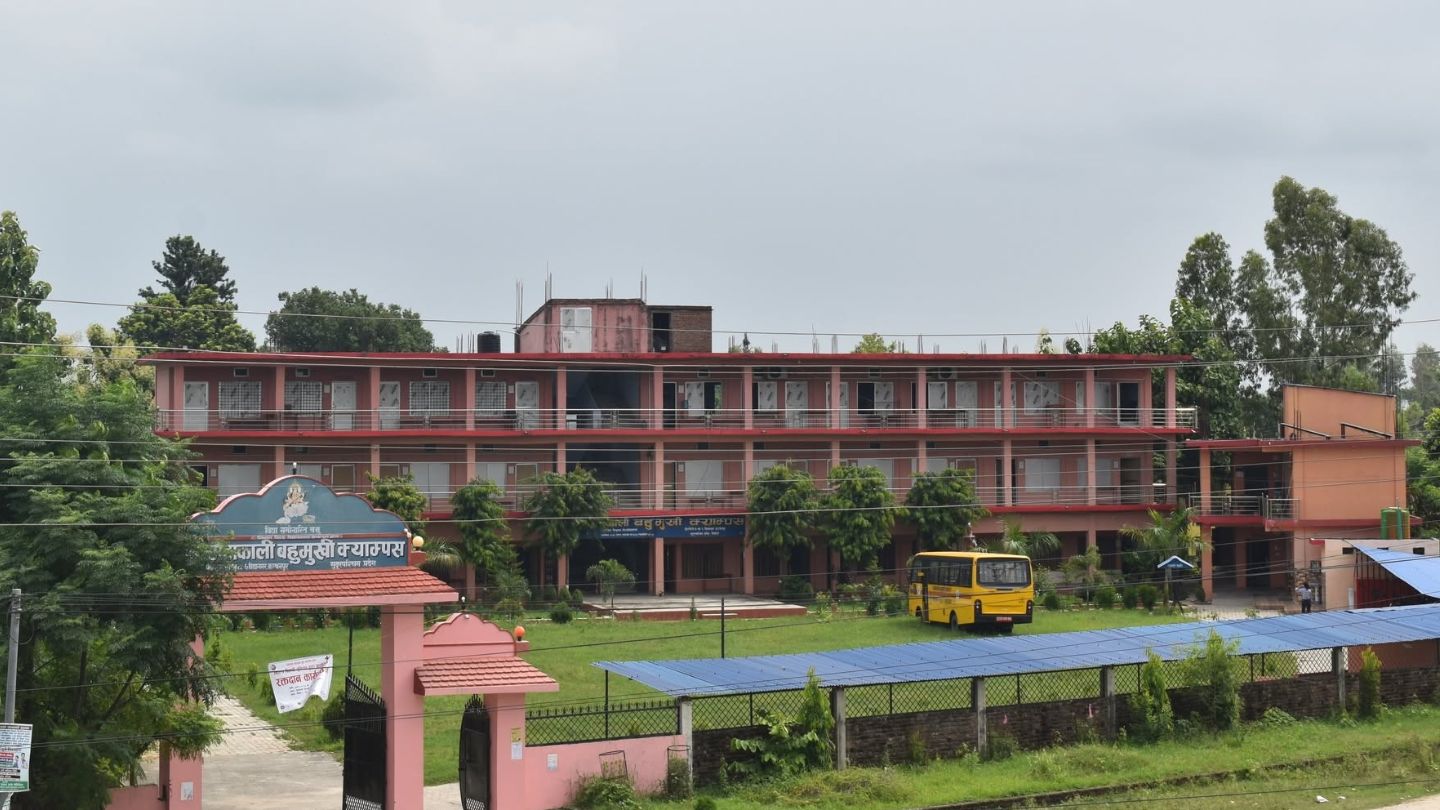
The Master of Education (M.Ed.) at Mahakali Multiple Campus is a postgraduate program under the Faculty of Education, Tribhuvan University. The campus conducts the program at Belauri Municipality–06, Kanchanpur, as part of its bachelor’s and master’s-level academic provision in Education.
The M.Ed. curriculum combines professional education courses, specialization study, educational research, teaching practice and thesis writing. It follows the semester system and is structured for graduates seeking advanced academic preparation in teaching, educational planning, administration, supervision and research.
Course: Master of Education (M.Ed.)
Level: Master’s degree
Duration: 24 months
Academic system: Four semesters
Maximum completion period: Five years
Faculty: Faculty of Education
Affiliation: Tribhuvan University
Institution: Mahakali Multiple Campus
Location: Belauri Municipality–06, Kanchanpur
Total credit hours: 69
Teaching Practice or Practicum: 3 credit hours
Thesis Writing: 6 credit hours
The M.Ed. program develops advanced knowledge of education systems, educational policy, pedagogy, assessment and research. It connects professional education with a subject specialization selected according to the student’s previous academic background.
Its academic objectives include preparing:
Teachers for upper secondary education
Educational planners and administrators
Education managers and supervisors
Researchers and other education professionals
Educators able to connect theory, research and professional practice
The normal duration is two years, divided into four semesters. Students complete 69 credit hours through core education courses, specialization courses, teaching practice or practicum and thesis writing.
| Semester | Main academic components | Credits |
|---|---|---|
| First | Two core and four specialization courses | 18 |
| Second | Two core and four specialization courses | 18 |
| Third | Two core and four specialization courses | 18 |
| Fourth | Core course, specialization elective, teaching practice or practicum, and thesis | 15 |
The complete structure carries:
21 credit hours of core professional courses
39 credit hours of specialization courses
3 credit hours of Teaching Practice or Practicum
6 credit hours of Thesis Writing
Every M.Ed. student completes seven compulsory core courses:
Ed. 511: Foundations of Education
Ed. 513: Advanced Educational Psychology
Ed. 521: Curriculum Practices
Ed. 522: Education and Development
Ed. 532: Research Methodology in Education
Ed. 533: Measurement and Evaluation in Education
Ed. 545: Contemporary Educational Issues
These courses address educational foundations, learner psychology, curriculum, development, research, assessment and current issues affecting education.
Students select one specialization linked to their previous education. Within the Tribhuvan University curriculum, specialization areas include:
Curriculum and Evaluation
Educational Planning and Management
English Education
Nepali Education
Mathematics Education
Science Education
Health Education
Physical Education
Economics Education
Geography Education
History Education
Political Science Education
Information and Communication Technology Education
Special Needs or Inclusive Education
Specialization study accounts for 39 credit hours. Four specialization courses are completed in each of the first three semesters, followed by a three-credit elective in the fourth semester.
Applicants must have completed either:
Bachelor of Education from Tribhuvan University or another recognized university, or
Post-Graduate Diploma in Education from Tribhuvan University or another recognized university
Eligibility also depends on the selected specialization.
For Nepali Education, applicants may qualify with B.Ed. major or minor Nepali Education, or a BA major in Nepali followed by one-year B.Ed.
For English Education, applicants may qualify with B.Ed. major or minor English Education, or a BA major in English followed by one-year B.Ed.
Health Education accepts specified academic backgrounds that include Health Education, Physical Education, Population Education, Public Health, Nursing or science combined with the required education qualification.
Applicants complete an application containing personal details and previous academic records. Selection is based on marks obtained in the entrance examination.
The entrance examination assesses:
Educational aptitude
Knowledge related to the selected specialization
The program uses several forms of academic engagement in addition to classroom lectures:
Assignments
Project work
Seminars
Case studies
Field studies
Research activities
Teaching Practice or Practicum
Thesis preparation
These activities allow students to apply educational concepts to classroom, institutional and research settings.
Students normally undertake six weeks of Teaching Practice in schools or campuses near the end of the fourth semester. The concerned department organizes and supervises the placement under Faculty of Education rules.
Students specializing in Educational Planning and Management or Special Needs Education complete a practicum in place of regular teaching practice.
Thesis Writing carries six credit hours and is completed in the fourth semester. It has two connected parts.
Part A develops academic writing, proposal preparation and data-collection planning. Students prepare a research proposal and present it for academic evaluation.
Part B involves conducting the study and writing the thesis under an assigned supervisor. Students present and defend their findings before the departmental research committee and revise the thesis according to the evaluation process.
In-semester assignments and assessment activities carry 40 percent of the evaluation for each taught course. Students also sit a semester-end examination conducted by the Office of the Dean, Faculty of Education.
B– or GPA 2.7, equivalent to 55 percent, is required to pass an individual paper.
Grade B or CGPA 3.0, equivalent to 60 percent, is required to pass the semester.
Teaching Practice or Practicum and Thesis are practical courses evaluated through their respective academic procedures.
Mahakali Multiple Campus provides facilities and academic support that include:
Library
Laboratory
Multimedia facilities
Internet access in classrooms
Counselling
Conference facilities
Scholarships
Digitized academic record management
Campus: Mahakali Multiple Campus
Address: Belauri Municipality–06, Kanchanpur
Telephone: 099-580197
Mobile: 9865936425
Additional contact: 9868896112
Email: mmcbelauri@gmail.com
Website: https://mahakalicampus.edu.np