Krishna Baijanath Multiple Campus (कृण्ण बैजनाथ बुमुखी क्याम्पस) is a community campus located in Jhalari, Shuklaphanta Municipality-10, Kanchanpur, Sudurpashchim Province. Established in 2009 AD (2066 BS), the campus was created through a local effort to make higher education more accessible to families living in Shuklaphanta Municipality and the surrounding rural areas.
The campus is affiliated with Tribhuvan University and conducts bachelor’s and master’s programs under the Faculties of Management and Education. Its academic program list includes Bachelor of Business Studies, Bachelor of Education, Master of Business Studies, and Master of Education.
Community campus established in 2009 AD (2066 BS)
Located in Jhalari, Shuklaphanta Municipality-10, Kanchanpur
Affiliated with Tribhuvan University
Provides bachelor’s and master’s education under the Faculties of Management and Education
Operates three buildings with 24 classrooms
Maintains a library with 7,602 books, a separate study room, and digital reading access
Has computers, laptops, multimedia projectors, internet connections, and printing facilities
Conducts orientation programs, seminars, workshops, coaching classes, and stakeholder interactions
Supports scholarships, academic assistance, computer training, counselling, and competitive examination preparation
Developed through the participation of local residents, parents, educators, public bodies, and community stakeholders
The establishment of Krishna Baijanath Multiple Campus grew from concerns about access to higher education in rural Kanchanpur. Students who wished to continue their studies often had to travel or relocate, creating additional difficulties for families with limited financial resources. Distance also placed particular constraints on women who could not easily move away from home for higher education.
Local intellectuals, parents, community members, and education supporters worked together to establish a community campus in Jhalari. Krishna Secondary School, Jhalari, provided important physical and financial support during the campus’s early stage.
The campus received its initial Tribhuvan University affiliation for the Bachelor of Arts program in 2066 BS. Affiliation for the Bachelor of Business Studies followed in 2067 BS, while the Bachelor of Education was added in 2069 BS. The academic scope later reached the master’s level with MBS in 2078 BS and M.Ed. in 2079 BS.
The campus began with four teachers and 31 students. Its academic community later grew to 21 teachers, three staff members, and 529 students. Graduates have entered areas including civil service, banking, the military, police, health services, and other fields.
The campus is situated in Ward No. 10 of Shuklaphanta Municipality, in the central part of Kanchanpur District. Its location serves students from Shuklaphanta Municipality, Krishnapur Municipality, Laljhadi Rural Municipality, and other parts of Kanchanpur.
Its establishment was closely connected with the educational needs of rural families. The founding objective was to allow local sons, daughters, and daughters-in-law to pursue higher education without having to travel far from home. The community-campus structure also reflects the involvement of parents, educators, local institutions, and public bodies in its development.
Krishna Baijanath Multiple Campus runs its academic programs under Tribhuvan University. Management programs operate under the Faculty of Management, while education programs operate under the Faculty of Education.
The sequence of program affiliation shows a gradual expansion from bachelor’s education to postgraduate study:
BBS affiliation was obtained in 2067 BS.
B.Ed. affiliation was obtained in 2069 BS.
MBS affiliation was obtained in 2078 BS.
M.Ed. affiliation was obtained in 2079 BS.
| Faculty | Program | Duration |
|---|---|---|
| Management | Bachelor of Business Studies (BBS) | Four years |
| Education | Bachelor of Education (B.Ed.) | Four years |
| Management | Master of Business Studies (MBS) | Four semesters |
| Education | Master of Education (M.Ed.) | Four semesters |
The Bachelor of Business Studies is a four-year program under the Faculty of Management. The Tribhuvan University curriculum combines foundation and allied business subjects, core management courses, concentration-area study, research methods, and final project work.
Students study subjects connected with business communication, statistics, economics, accounting, management, finance, marketing, business law, taxation, entrepreneurship, organizational behavior, and the business environment. Fourth-year study includes three courses from a selected concentration area, Business Research Methods, and a final project.
The complete academic requirement consists of 19 courses carrying 1,950 marks and a final project carrying 50 marks. The project component involves field-based study, preparation of a report, and evaluation through the concerned campus or college.
The Bachelor of Education follows a four-year annual system under the Faculty of Education. It is an academic and professional teacher-education program structured around communication skills, professional education courses, specialization study, and teaching practice.
The curriculum contains 22 courses carrying 2,200 marks. These are grouped into communication skills, professional core areas, specialization-major courses, specialization-minor courses, and teaching internship or practicum.
Students study General Nepali and General English alongside subjects such as educational psychology, curriculum and evaluation, and the philosophical and sociological foundations of education. The structure also requires a major specialization, a different minor specialization, and practical teaching experience.
The Master of Business Studies is conducted as a four-semester program under the Faculty of Management. It provides postgraduate study in management concepts, analytical methods, organizational processes, communication, and decision-making.
First-semester study includes Marketing Management, Managerial Economics, Statistical Methods, Organizational Behavior, and Managerial Communication. These courses carry three credit hours each and cover areas such as market analysis, economic tools for managerial decisions, statistical applications, workplace behavior, and professional communication.
The Master of Education is a four-semester postgraduate program under the Faculty of Education. The TU curriculum carries 69 credit hours, comprising 21 credits of core professional courses, 39 credits of specialization study, three credits of teaching practice or practicum, and six credits of thesis writing.
Core areas include foundations of education, advanced educational psychology, curriculum practices, education and development, research methodology, measurement and evaluation, and contemporary educational issues. The program also requires specialization-based study and the practical application of educational knowledge through teaching practice or practicum.
Thesis work is included in the fourth semester and covers proposal development, data collection, supervised research, and preparation of the final thesis.
The campus has been working to move beyond an entirely teacher-centred classroom approach. Multimedia projectors have been installed in selected classrooms, allowing teachers to use presentations and visual learning materials during instruction.
Academic activities include orientation sessions, seminars, workshops, meetings, and interaction programs. These activities involve the Campus General Assembly, Campus Management Committee, teachers, non-teaching staff, students, the Free Student Union, and other stakeholders.
Special coaching classes may also be arranged according to student demand. The campus has placed attention on internal academic monitoring, regular attendance, timely completion of courses, and additional classes when the normal teaching schedule is disrupted.
The Campus Management Committee functions as the executive body responsible for decisions concerning the campus’s overall operation. Its work is carried out within the provisions of the campus statute.
Campus governance also involves consultation among the General Assembly, management representatives, teaching and non-teaching staff, students, the Free Student Union, and community stakeholders. During one reported year, the Campus Management Committee held approximately 23 meetings and made a range of institutional decisions through consensus.
The campus is a member of the Nepal Public Campus Association. Its development has received contributions or grant support from bodies including the University Grants Commission, the Embassy of India, local governments, Shuklaphanta Municipality, the former District Development Committee, the Constituency Development Fund, and the Ministry of Social Development of the Sudurpashchim Province Government.
The campus initially operated without land registered in its own name. In 2072 BS, the Campus Management Committee completed the purchase of 5 kattha and 14 dhur of land and secured the land ownership certificate.
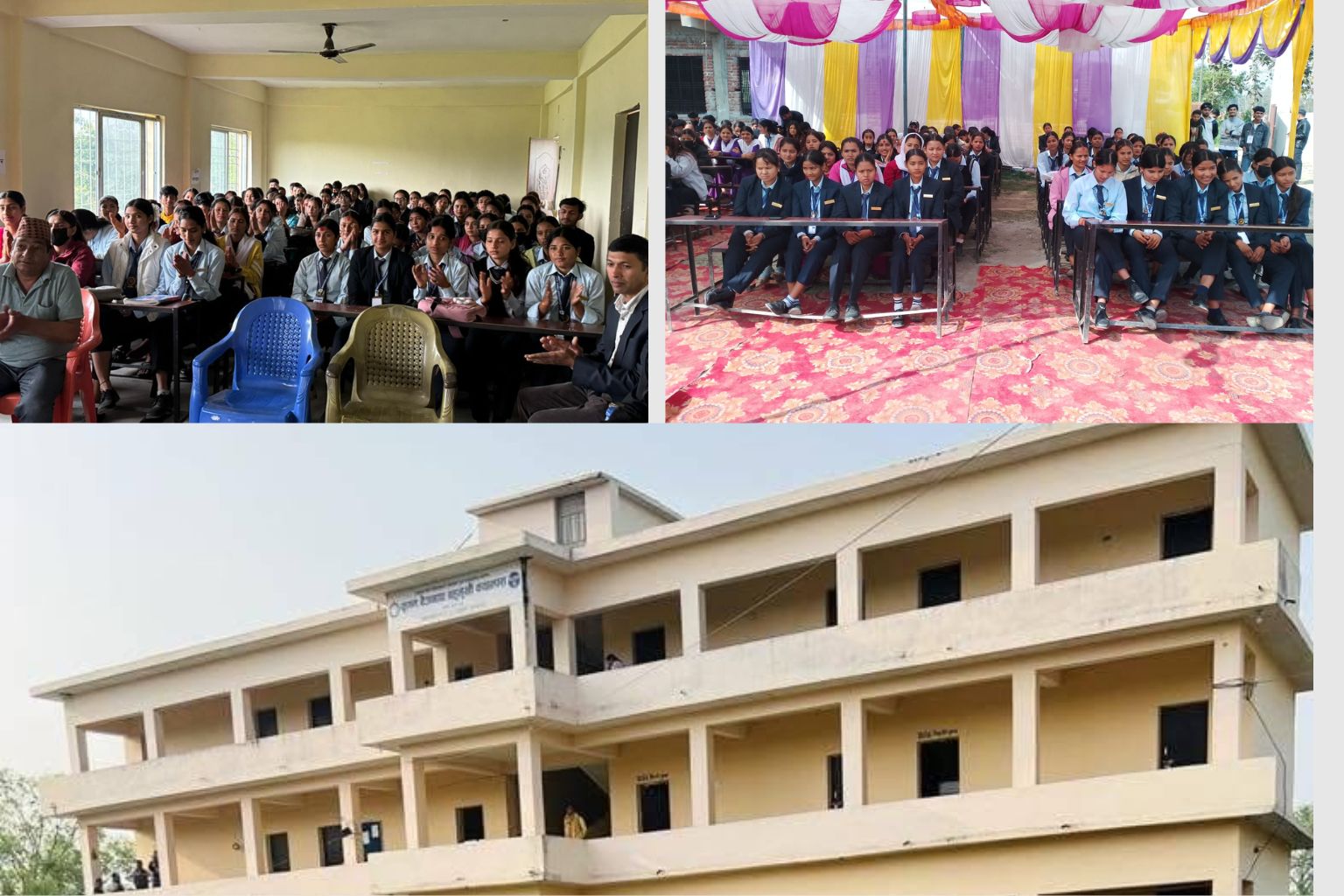
A 15-room building was later completed with grant support from the University Grants Commission and the Ministry of Social Development. Additional funding was used for educational equipment and library books.
The physical infrastructure includes:
Three buildings
24 classrooms
A building area of 6,564 square feet
One computer room
Eight toilets for male and female students
Two drinking-water facilities
Classrooms are supported by iron desk-benches, whiteboards, tables, chairs, cabinets, computer tables, noticeboards, and other administrative and instructional furniture.
The campus library contains 7,602 books and has a separate library room and study room. Course books, reference materials, academic journals, newspapers, and periodicals are available for students and teachers.
Three local newspapers and periodicals are supplied to the library daily. A library computer allows users to read and download digital books. This provides a basic link between the physical collection and electronic learning materials.
The campus has adopted policies for the regular purchase and supply of books, internet access, and the development of an e-library. Digitisation support is also intended to connect library, administrative, accounting, and classroom work with appropriate technology.
The campus has acquired equipment for classroom teaching, administration, printing, and computer-based learning. Available items include:
16 desktop computers with monitors
10 laptops
Eight overhead or multimedia projectors
Five photocopiers and printers
Two internet service connections
Two telephone sets
Multimedia equipment supports presentation-based teaching in selected classrooms. The computer room also provides a basis for computer training and technology-related student activities.
Student support priorities cover academic assistance, scholarships, counselling, technology skills, and preparation for competitive examinations.
The campus seeks to include economically disadvantaged and academically capable students in scholarship selection processes. It also aims to connect eligible students with scholarship opportunities offered by other bodies.
Other student-focused priorities include:
Additional and special classes for students who need academic support
Counselling for employment-oriented and competitive examinations
Computer training according to laboratory capacity
English-language, information technology, and leadership-development activities
Preparatory classes connected with the Public Service Commission, Teachers Service Commission, and banking services
Greater student participation in monthly academic and campus activities
A system for receiving and addressing student suggestions and grievances
Community participation has remained closely connected with the campus’s identity. Teachers, staff members, students, parents, and local residents take part in educational awareness, construction, environmental work, and other activities of public concern.
The campus also seeks cooperation with local bodies and governmental and non-governmental organisations. Its community priorities include widening access to higher education, supporting economically disadvantaged students, building local ownership, and involving former students in institutional development.
Plans for broader participation include representation from civil society, business, industry, the legal profession, social services, and other community sectors. The president of the students’ union is also identified for involvement in the Campus Management Committee as an ex officio member.
The campus has identified several areas for continued physical and academic development. These include an administrative building, boundary wall, protective construction along the stream east of the campus, and a multipurpose sports ground intended for volleyball, tennis, badminton, basketball, and related activities.
Institutional capacity priorities also cover electronic attendance, additional multimedia equipment, academic calendars, departmental research, student involvement in research activities, faculty development, and preparation for the Quality Assurance and Accreditation process.
Digitisation measures are intended to support administration, accounts, the library, classrooms, and other areas of campus operation.
Prospective students can contact the campus administration regarding admission schedules, program entry requirements, fees, available seats, and required documents.
Address: Shuklaphanta Municipality-10, Jhalari, Kanchanpur, Sudurpashchim Province, Nepal
Contact: +977-99-540187, +977-9858071765, +977-9848834752
Email: info@kbmc.edu.np
Website: www.kbmc.edu.np
Krishna Baijanath Multiple Campus provides a local route to Tribhuvan University education in management and education at bachelor’s and master’s levels. Its institutional character is shaped by community participation, local access, gradual academic expansion, and practical learning resources that include classrooms, a library, computers, internet services, and multimedia equipment.