All documents
All documents




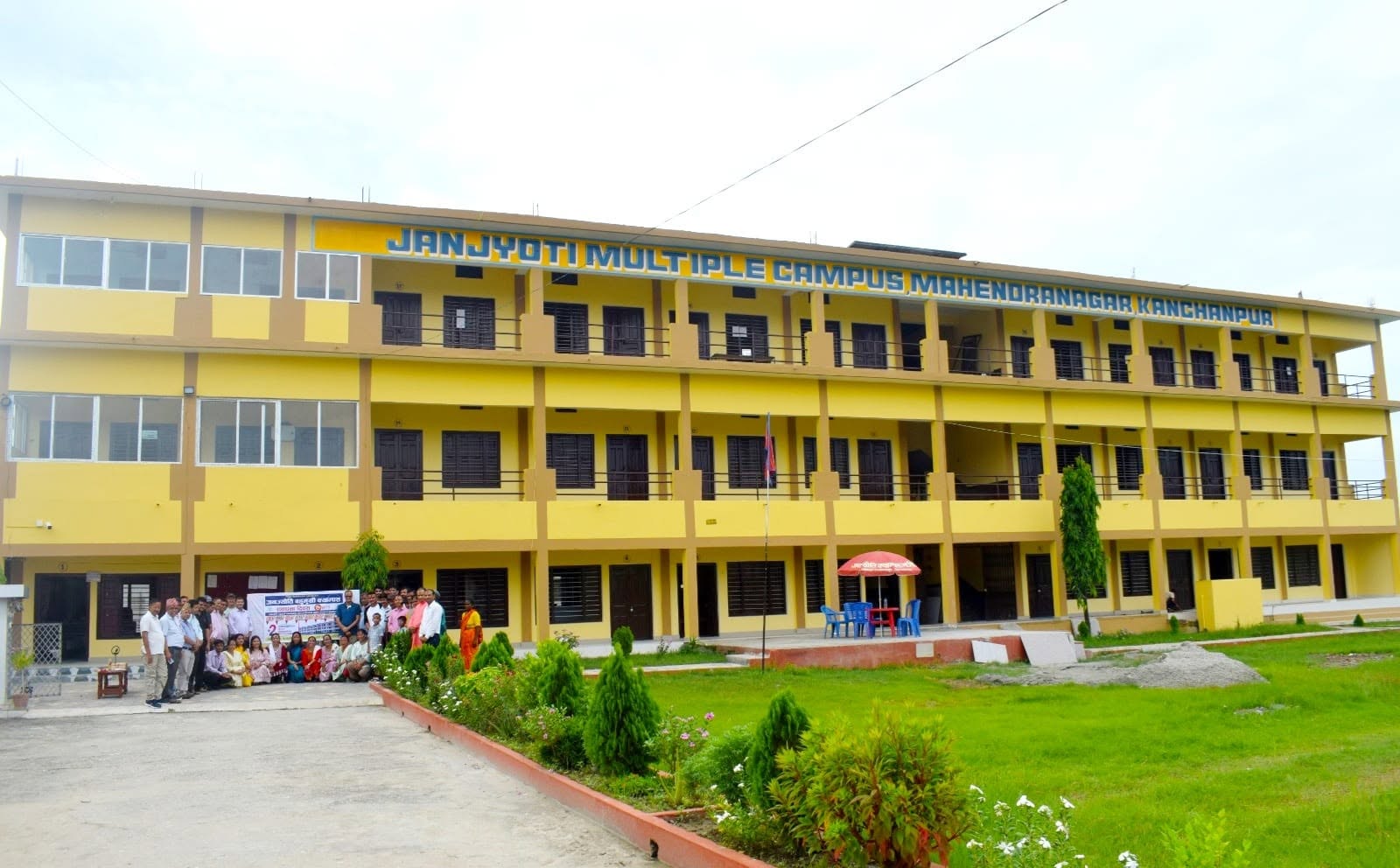
Janjyoti Multiple Campus Mahendranagar (जनज्योती बहुमुखी क्याम्पस, महेन्द्रनगर, कन्चनपुर) is a privately established academic institution located in Bhimdattnagar-18, Mahendranagar, Kanchanpur, Sudurpashchim Province. It was founded in 2001 AD (2058 BS) by a group of education enthusiasts seeking to expand access to secondary and higher education in Nepal’s Far-Western region.
The campus conducts Class 11 and 12 programs under the National Examinations Board (NEB) and offers bachelor’s and master’s programs affiliated with Tribhuvan University (TU). Its academic areas cover education, management, humanities, social work, computer application, law, and Nepali studies.
Established: 2001 AD (2058 BS)
Location: Bhimdattnagar-18, Mahendranagar, Kanchanpur
Province: Sudurpashchim Province
Institution type: Privately established multiple campus
University affiliation: Tribhuvan University
Secondary-level affiliation: National Examinations Board
Academic levels: Class 11 and 12, bachelor’s, and master’s
Main academic areas: Education, management, humanities, law, social work, computer application, and Nepali
Janjyoti Multiple Campus was established through private investment in response to the demand for broader educational opportunities in Mahendranagar and the surrounding Far-Western region.
The campus combines higher-secondary and university education within one institution. Students can begin with an NEB program in Class 11 and continue into undergraduate or postgraduate study in selected disciplines.
Its academic direction places emphasis on disciplined study, responsible citizenship, and a positive approach to teaching and learning. The range of courses allows students to choose between general academic study, teacher education, business studies, social sciences, social work, law, and computer application.
The campus operates under two academic bodies:
The National Examinations Board for Class 11 and Class 12 programs
Tribhuvan University for bachelor’s and master’s programs
Tribhuvan University courses are conducted through the relevant faculties, including:
Faculty of Education
Faculty of Humanities and Social Sciences
Faculty of Management
The curriculum, examination system, academic structure, and completion requirements of each course follow the applicable university or board framework.
| Level | Program | Academic structure |
|---|---|---|
| Secondary | Ten Plus Two in Education | NEB, Classes 11 and 12 |
| Secondary | Ten Plus Two in Management | NEB, Classes 11 and 12 |
| Secondary | Ten Plus Two in Humanities | NEB, Classes 11 and 12 |
| Secondary | Ten Plus Two in Law | NEB, Classes 11 and 12 |
| Undergraduate | Bachelor of Computer Application | 4 years, 8 semesters |
| Undergraduate | Bachelor of Education | 4 years, annual system |
| Undergraduate | One-Year Bachelor of Education | 1 year, annual system |
| Undergraduate | Bachelor of Social Work | 4 years |
| Undergraduate | Bachelor of Arts | 4 years |
| Undergraduate | Bachelor of Business Studies | 4 years, annual system |
| Postgraduate | Master of Business Studies | 2 years, 4 semesters |
| Postgraduate | Master of Education General | 2 years, 4 semesters |
| Postgraduate | Master of Arts in Nepali | Tribhuvan University program |
Janjyoti Multiple Campus offers four higher-secondary options under the National Examinations Board.
The Education program introduces students to educational principles, curriculum, administration, guidance, counselling, and the development of education in Nepal. It provides a foundation for students considering further study in education and related social fields.
The Management program covers foundational areas of business and administration. It supports further study in management, business studies, accounting, finance, and related undergraduate disciplines.
The Humanities program provides a foundation in language, society, communication, and social-science subjects. It can support further study in humanities, social work, sociology, language, communication, and related fields.
The Law program introduces students to legal principles, constitutional studies, procedural law, jurisprudence, legal drafting, and the Nepalese legal system. It is intended as a foundation for further academic study in law and legal studies.
The Bachelor of Computer Application is a four-year program conducted over eight semesters. It combines computer application studies with programming, mathematics, software-related learning, project work, and supporting academic subjects.
The program uses classroom instruction and laboratory practice to help students work with computer applications, software, and hardware. Students also participate in project-based activities, presentations, seminars, and supervised technical work.
BCA-related academic support includes:
Computer laboratory sessions
Hardware-related practical work
Project supervision
Presentations and seminars
Workshops and IT Club activities
Internship facilitation
Leadership-oriented activities
Visits connected with software companies
Guest lectures
The four-year Bachelor of Education operates under the Faculty of Education through the annual examination system.
The campus offers specialization areas in:
Nepali
Major English
Major Mathematics
Health Education
The program combines communication courses, professional education subjects, specialization courses, and teaching practice. It is structured for students preparing for academic and professional roles in education.
The One-Year Bachelor of Education is offered under the Faculty of Education through the annual examination system. It forms part of the campus’s teacher-education programs at the undergraduate level.
The four-year Bachelor of Social Work is conducted under the Faculty of Humanities and Social Sciences.
Its academic components include:
Social-work theories and methods
Community-based practical learning
Fieldwork
Research activities
Academic writing
Report preparation
The campus also provides career counselling and guidance connected with the BSW program. Multimedia-supported teaching is used alongside classroom and practical learning.
The Bachelor of Arts is a four-year interdisciplinary program under the Faculty of Humanities and Social Sciences. It includes compulsory, major, and elective components within the Tribhuvan University academic structure.
The program provides a route into humanities and social-science study and supports further academic work in the selected subject areas.
The Bachelor of Business Studies is a four-year annual-system program under the Faculty of Management.
It forms part of the campus’s management education pathway and allows students to continue from higher-secondary management education into a university-level business studies program.
The Master of Business Studies is a two-year postgraduate program divided into four semesters under the Faculty of Management.
The campus identifies specialization areas in:
Marketing
Accounting
Finance
Management
The program includes coursework related to management, economics, communication, statistics, accounting, finance, organizational studies, and marketing.
The Master of Education General program is conducted over two years and four semesters under the Faculty of Education.
Its academic structure combines:
Professional education courses
Specialization study
Teaching practice
Research work
Thesis preparation
The program is intended for advanced study in education and related professional areas.
The Master of Arts in Nepali is offered under the Faculty of Humanities and Social Sciences.
The program extends postgraduate study into areas such as:
Nepali language
Nepali literature
Literary criticism
Linguistics
Research
Related academic study
The campus maintains computer facilities for BCA students and higher-secondary learners studying computer-related subjects.
Available technical learning support includes:
Computer laboratory
Branded computer systems
Internet access
Hardware-related practical facilities
Additional laboratory sessions
Project-based technical work
Multimedia-supported instruction
The laboratory environment supports programming practice, software work, project preparation, presentations, and supervised technical activities.
The campus library contains textbooks and reference materials related to its academic programs. Students also have access to additional learning resources for classroom study, assignments, projects, and independent reading.
Library support includes:
Course-related textbooks
Reference books
Journals
Magazines
Bulletins
Audio-visual materials
E-library access
Digital learning resources complement the physical library, particularly for students completing technical projects, research work, presentations, and academic assignments.
A science laboratory is available for practical learning connected with relevant higher-secondary subjects.
The campus also has spacious classrooms, including rooms equipped for multimedia-supported teaching. These facilities support lectures, presentations, group work, demonstrations, practical sessions, and technology-assisted instruction.
Teaching methods vary according to the requirements of each program.
BCA uses computer laboratories, technical projects, presentations, seminars, workshops, and internship-related support.
BSW combines classroom study with fieldwork, community-based practical learning, research, and report writing.
Education programs include professional education subjects and teaching practice.
Postgraduate programs include assignments, research work, seminar activities, and thesis-related study.
This approach allows each course to use classroom, laboratory, field, project, or practicum-based learning according to its academic structure.
Janjyoti Multiple Campus provides scholarship opportunities for deserving students and learners from economically disadvantaged backgrounds.
Student support also includes:
Academic guidance
Career counselling for BSW students
Project supervision
Laboratory support
Internship facilitation for BCA students
Access to library and e-library resources
Participation in seminars and workshops
Scholarship availability and selection procedures depend on the arrangements applied by the campus for the relevant academic intake.
Students applying for the Bachelor of Computer Application can obtain the application form from the campus front desk or access the prospectus and application form through the campus website.
The general process includes:
Obtaining the application form
Completing the required personal and academic details
Submitting the form with the necessary documents
Appearing in the campus entrance examination
Completing admission according to seat availability and selection requirements
Campus: Janjyoti Multiple Campus
Address: Bhimdattnagar-18, Mahendranagar, Kanchanpur, Nepal
Phone: 099-418131
Additional phone numbers: +977-9858775085, +977-9858775096, +977-9858775083
Email: info@janjyoticampus.edu.np
Website: www.janjyoticampus.edu.np
Janjyoti Multiple Campus is located in Bhimdattnagar-18, Mahendranagar, Kanchanpur, Sudurpashchim Province, Nepal.
The campus was established in 2001 AD, corresponding to 2058 BS.
The campus is affiliated with Tribhuvan University for bachelor’s and master’s programs. Its Class 11 and Class 12 programs are conducted under the National Examinations Board.
The campus offers Ten Plus Two programs in Education, Management, Humanities, and Law.
Yes. The campus offers the four-year Bachelor of Computer Application program, which is divided into eight semesters.
The campus offers Master of Business Studies, Master of Education General, and Master of Arts in Nepali.
The campus has computer and science laboratories, a library, e-library access, multimedia-supported classrooms, internet facilities, and resources for practical and project-based learning.
Scholarship opportunities are available for deserving students and students from economically disadvantaged backgrounds. Selection depends on the arrangements for the applicable academic intake.
Applicants can obtain the application form from the campus front desk or through the campus website. They must submit the required documents and appear in the campus entrance examination.
The main contact number is 099-418131. Additional contact numbers include +977-9858775085, +977-9858775096, and +977-9858775083.
All documents