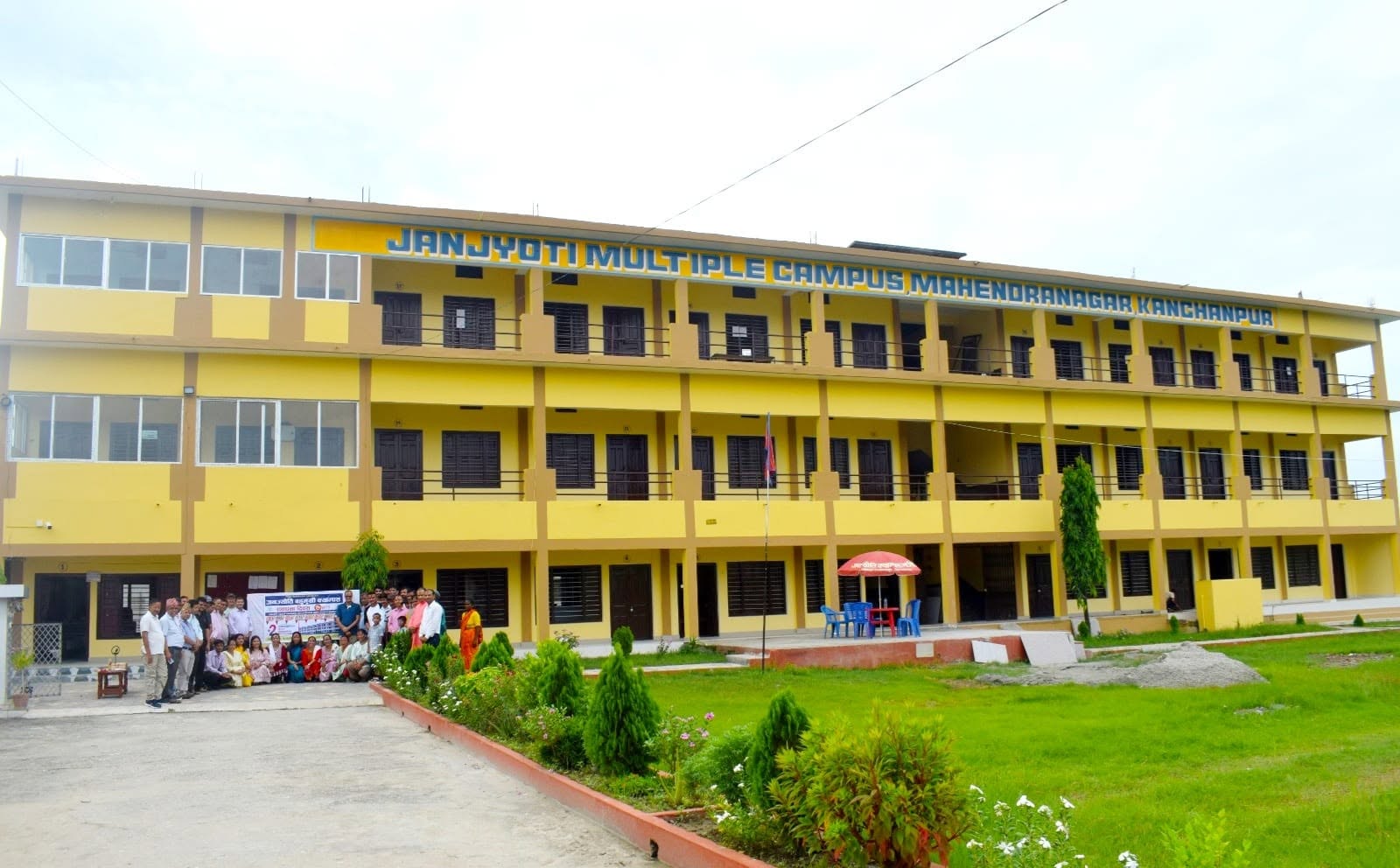
Ten Plus Two in Law at Janjyoti Multiple Campus is a two-year higher-secondary program covering Class 11 and Class 12. It is affiliated with the National Examinations Board and introduces students to constitutional law, legal theories, procedural law, Nepal’s legal system, civil and criminal justice, and legal drafting.
The course provides an academic foundation for students interested in law, justice, rights, public administration, or further legal education. Janjyoti Multiple Campus is located in Bhimdattnagar-18, Bhansi, Mahendranagar, Kanchanpur, Sudurpashchim Province.
| Course detail | Information |
|---|---|
| Course | Ten Plus Two in Law |
| Academic level | Class 11 and Class 12 |
| Institution | Janjyoti Multiple Campus |
| Affiliation | National Examinations Board |
| Duration | Two years |
| Entry point | After Grade 10 and SEE |
| Main field | Legal studies |
| Location | Bhimdattnagar-18, Mahendranagar, Kanchanpur |
The program introduces the principles, institutions, and processes that shape Nepal’s legal system. Students examine how laws are formed, interpreted, and applied while developing an understanding of justice, rights, duties, and legal responsibilities.
The main areas of study include:
Constitutional law
Jurisprudence and legal theories
Procedural law
Nepalese legal system
Civil and criminal law
Justice and legal processes
Legal drafting
Social studies
Language and communication
The course connects legal study with social and civic issues. It can help students understand the relationship between citizens, government institutions, courts, legal rules, and public responsibilities.
| Academic year | Compulsory subjects | Law-focused subjects |
|---|---|---|
| Class 11 | English, Nepali, and Social Studies | Constitutional Law; Procedural Law; Jurisprudence and Legal Theories |
| Class 12 | English, Nepali, and Social Studies | Nepalese Legal System; Civil and Criminal Law and Justice; Legal Drafting |
The first year establishes basic legal concepts and theories. The second year gives greater attention to Nepal’s legal institutions, civil and criminal justice, and the preparation of legal documents.
Constitutional Law introduces the principles that govern the state, public institutions, constitutional authority, rights, and responsibilities. It helps students understand the legal relationship between citizens and government.
Jurisprudence examines the meaning, purpose, and nature of law. Students are introduced to legal ideas and theories that explain how law develops and functions within society.
Procedural Law focuses on the processes followed when legal matters move through formal institutions. It introduces students to the role of rules and procedures in administering justice.
This subject examines the development and structure of Nepal’s legal and judicial system. It helps students understand the institutions, laws, and processes operating within the country.
Students are introduced to the distinction between civil and criminal matters. The subject also examines how justice is considered within different types of legal disputes and offences.
Legal Drafting introduces the organized preparation of legal documents. It can develop careful writing, structured presentation, appropriate terminology, and attention to legal meaning.
Students who have completed Grade 10 and participated in the Secondary Education Examination may seek admission to Class 11.
The program begins after SEE and continues for two academic years. Applicants should be prepared for subjects that require regular reading, written analysis, interpretation, and classroom discussion.
Study of law at the higher-secondary level may help students develop introductory abilities in:
Reading and interpreting legal concepts
Identifying legal and social issues
Structured writing
Logical reasoning
Argument development
Academic presentation
Understanding rights and responsibilities
Comparing different legal principles
Organizing information
Using legal terminology
Preparing basic legal drafts
These abilities depend on regular study, classroom participation, reading practice, and written coursework.
Janjyoti Multiple Campus provides academic facilities that support higher-secondary study, including:
Library with course-related materials
Spacious classrooms
Computer laboratory
Science laboratory
Multimedia-supported classrooms
Internet and computer access
Scholarship provisions
Library resources can support reading in law, social studies, language, history, and related subjects. Scholarships are available for deserving students and learners from economically disadvantaged backgrounds.
Ten Plus Two in Law is a higher-secondary foundation rather than a professional law degree. After Class 12, students may continue into bachelor-level legal education or another field permitted by the admission requirements of the concerned institution.
Further law education may lead toward areas such as:
Litigation and advocacy
Civil service
Public prosecution
Judiciary-related work
Legal research
Academic study
Negotiation and conflict resolution
Legal and administrative work
Work connected with financial institutions
Development-sector organizations
Entry into these fields depends on further qualifications, academic performance, professional requirements, experience, and available positions.
The program may suit students who:
Are interested in law, justice, and constitutional issues
Want to understand Nepal’s legal system
Enjoy reading, writing, discussion, and interpretation
Are interested in rights and public responsibilities
Plan to continue into bachelor-level law study
Want an academic base for legal or administrative education
Are comfortable examining social issues from different viewpoints
Students should consider their interest in detailed reading, analytical writing, legal terminology, and long-term study before selecting the course.
The course takes two years and covers Class 11 and Class 12.
Ten Plus Two in Law at Janjyoti Multiple Campus is affiliated with the National Examinations Board.
Students who have completed Grade 10 and participated in SEE may seek admission to Class 11.
Class 11 includes Constitutional Law, Procedural Law, and Jurisprudence and Legal Theories.
Class 12 includes Nepalese Legal System, Civil and Criminal Law and Justice, and Legal Drafting.
The program provides higher-secondary preparation for further legal education. Professional legal work requires additional education and the applicable professional requirements.
Students may continue into bachelor-level law education or another undergraduate program for which they meet the admission conditions.
The campus has scholarship provisions for deserving students and students from economically disadvantaged backgrounds.
The campus is located in Bhimdattnagar-18, Bhansi, Mahendranagar, Kanchanpur, Sudurpashchim Province, Nepal.
Campus: Janjyoti Multiple Campus
Address: Bhimdattnagar-18, Bhansi, Mahendranagar, Kanchanpur, Nepal
Phone: 099-418131
Additional Contact Numbers: +977-99-418131, +977-9858775085, +977-9858775096, +977-9858775083
Email: info@janjyoticampus.edu.np
Website: www.janjyoticampus.edu.np