The Master of Education (M.Ed.) General at Janjyoti Multiple Campus is a two-year postgraduate program affiliated with Tribhuvan University under the Faculty of Education. It follows a four-semester system and carries 69 credit hours. The curriculum combines professional education courses, specialization study, teaching practice or practicum, and thesis writing.
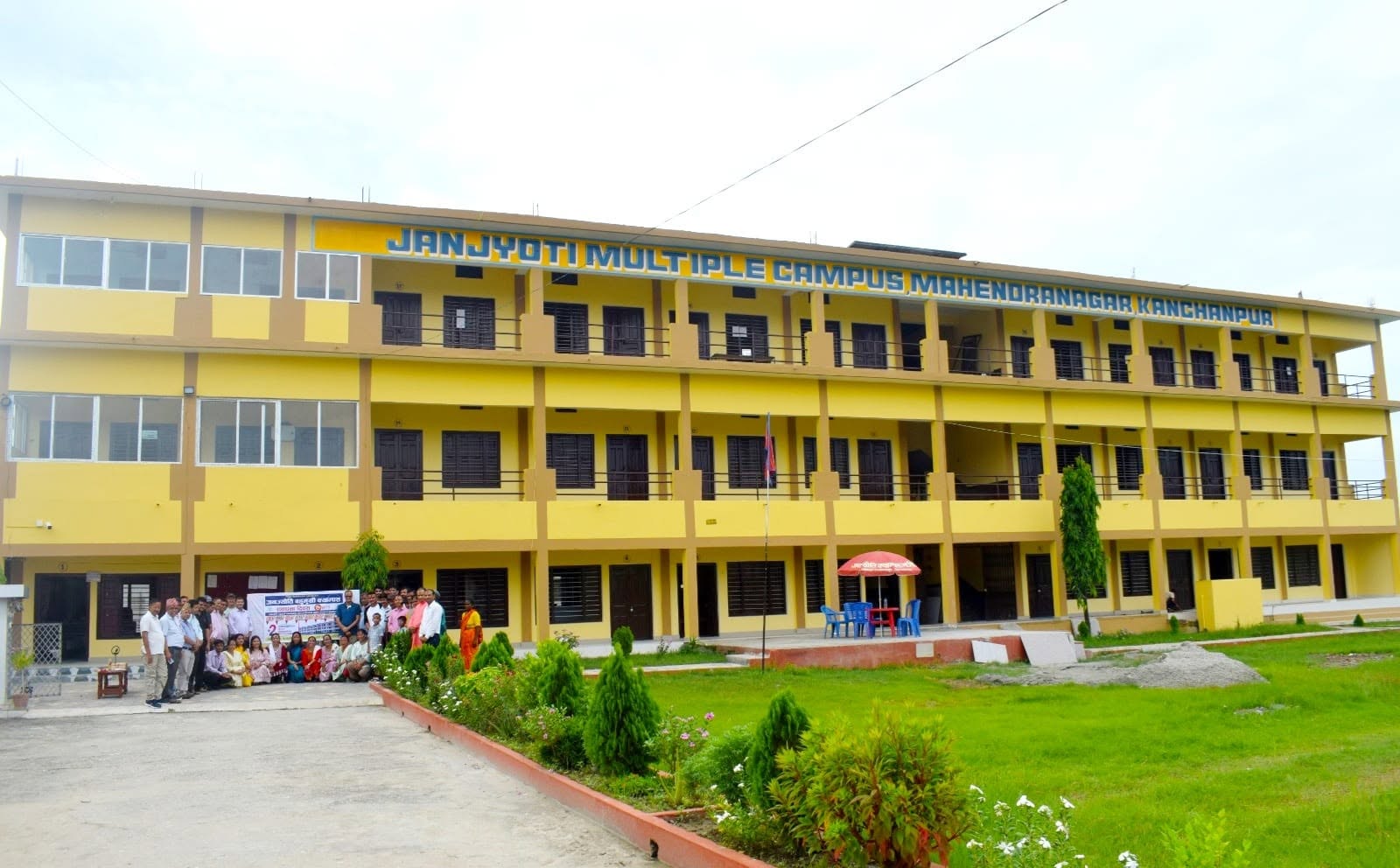
Students work with educational theory, psychology, assessment, research, policy, pedagogy, and subject-based education. Janjyoti Multiple Campus is located in Bhimdattnagar-18, Mahendranagar, Kanchanpur, Sudurpashchim Province.
| Course detail | Information |
|---|---|
| Course | Master of Education General |
| Abbreviation | M.Ed. |
| Institution | Janjyoti Multiple Campus |
| Affiliation | Tribhuvan University |
| Faculty | Faculty of Education |
| Academic level | Master’s degree |
| Duration | Two years |
| Academic structure | Four semesters |
| Total credits | 69 credit hours |
| Major components | Core courses, specialization, practicum, and thesis |
| Location | Bhimdattnagar-18, Mahendranagar, Kanchanpur |
The M.Ed. program combines advanced study in education with professional and research-based preparation. It covers education systems, educational policy, pedagogy, subject knowledge, leadership, planning, management, assessment, and research.
The program is structured to prepare graduates for academic and professional responsibilities connected with:
Secondary-level teaching
Teacher education
Educational planning
Academic administration
Educational supervision
Education management
Curriculum-related work
Educational research
The course also connects theory and research with classroom and institutional practice.
Applicants must have completed one of the following qualifications from Tribhuvan University or another recognized university:
Bachelor of Education
Post-Graduate Diploma in Education
Students must also meet the subject-specific entry requirement for their selected specialization. The specialization normally corresponds with the subject studied during the applicant’s previous education degree.
The normal duration of the M.Ed. program is 24 months, divided into four semesters. The maximum period allowed to complete the program is five years.
| Academic component | Credits | Academic role |
|---|---|---|
| Core professional courses | 21 | Common education courses |
| Specialization courses | 39 | Subject-based advanced study |
| Teaching Practice/Practicum | 3 | Workplace-based practical study |
| Thesis Writing | 6 | Supervised academic research |
| Total | 69 | Full program requirement |
The first three semesters each carry 18 credits. The fourth semester carries 15 credits and includes a core course, specialization study, teaching practice or practicum, and thesis writing.
| Semester | Main components | Credits |
|---|---|---|
| First | Core and specialization courses | 18 |
| Second | Core and specialization courses | 18 |
| Third | Core and specialization courses | 18 |
| Fourth | Core course, specialization, practicum, and thesis | 15 |
| Total | Four-semester curriculum | 69 |
The core courses are compulsory for students across specialization areas. Specialization courses provide advanced study connected with the student’s subject background and selected education field.
The professional education component covers areas such as:
Foundations of education
Advanced educational psychology
Measurement and evaluation
Education and development
Research methodology
Contemporary issues in education
Education policy and practice
These subjects help students examine how educational institutions, learners, curricula, policies, assessment systems, and research processes interact.
The wider Tribhuvan University M.Ed. framework contains specialization routes in language education, mathematics and science education, health and physical education, curriculum and evaluation, educational planning and management, social-science education, inclusive education, and information and communication technology education. Each student studies one specialization according to the applicable academic background.
Teaching Practice is a three-credit fourth-semester component. It requires students to apply subject knowledge and pedagogical skills in an actual classroom setting.
Students in Educational Planning and Management complete a practicum instead of classroom teaching practice. Special Needs Education or Inclusive Education students complete the practicum assigned to their specialization.
Practical work may involve:
Lesson planning and classroom instruction
Observation and reflective study
Application of teaching methods
Professional reporting
Institutional or educational field activities
Demonstration of subject-based pedagogical skills
Thesis Writing carries six credits and is completed during the fourth semester. It contains two linked stages.
The first stage develops academic writing, proposal preparation, and planning for data collection. In the second stage, students conduct research and prepare a master’s thesis under the guidance of a thesis supervisor.
The thesis process may develop experience in:
Selecting an education research problem
Reviewing academic literature
Preparing a research proposal
Choosing research methods
Collecting and analysing information
Organising findings
Writing and presenting an academic thesis
M.Ed. courses use lectures alongside academic and field-based activities. Learning methods include:
Project work
Individual and group assignments
Seminars
Case studies
Field studies
Classroom discussion
Research activities
Presentations
This structure requires students to take an active role in reading, writing, analysis, discussion, practical work, and research.
Student performance is evaluated through in-semester assessment and the semester-end examination.
| Assessment component | Weightage |
|---|---|
| In-semester assessment | 40% |
| Semester-end examination | 60% |
The course teacher conducts the in-semester assessment through learning activities and assignments. The Office of the Dean, Faculty of Education, conducts the semester-end examination. Teaching Practice, Practicum, and Thesis are fully practical courses evaluated through the Faculty of Education’s examination system.
Students must obtain at least Grade B−, equivalent to a GPA of 2.7 or 55 percent, in the semester-end examination of an individual paper. To pass the semester, a student must secure at least Grade B or a CGPA of 3.0, equivalent to 60 percent.
Through coursework, practical study, and thesis research, students may develop abilities in:
Educational research and academic writing
Curriculum and assessment analysis
Classroom teaching and pedagogical planning
Education policy interpretation
Educational leadership and administration
Project and seminar presentation
Critical reading of education research
Data collection and analysis
Professional reporting
Subject-based teaching practice
Skill development depends on academic participation, independent study, practical performance, and the quality of research work.
Janjyoti Multiple Campus has a library, spacious classrooms, a science laboratory, computer facilities, and scholarship provisions for deserving and economically disadvantaged students. Multimedia-supported classrooms and technology-supported teaching are also part of the campus learning environment.
These resources support postgraduate reading, classroom presentations, assignments, seminar work, research preparation, and thesis writing.
M.Ed. graduates may explore work connected with:
School teaching
Teacher education and training
Educational planning
School or academic administration
Educational supervision
Curriculum and assessment work
Education-related research
Project and program management
Academic support services
Career options depend on the graduate’s specialization, academic performance, practical preparation, experience, institutional requirements, and available positions.
The degree can also support advanced academic study and research in education and the student’s specialization area.
The program may suit students who:
Have completed B.Ed. or a Post-Graduate Diploma in Education
Want advanced study in teaching and education
Are interested in educational research
Plan to work with curriculum, assessment, policy, or administration
Can complete teaching practice or specialization-based practicum
Are prepared to undertake supervised thesis research
Prefer a semester-based postgraduate course
The program takes two years and is divided into four semesters. The normal completion period is 24 months.
The M.Ed. General program is affiliated with Tribhuvan University and operates under the Faculty of Education.
The program carries 69 credit hours: 21 core-course credits, 39 specialization credits, three teaching-practice or practicum credits, and six thesis credits.
Applicants with a Bachelor of Education or Post-Graduate Diploma in Education from Tribhuvan University or another recognized university may apply. Subject-specific requirements apply to specialization selection.
Yes. Teaching Practice is a three-credit component in the fourth semester. Students in specified specialization areas complete the corresponding practicum.
Yes. Thesis Writing is a six-credit fourth-semester requirement involving proposal development, research, data work, and supervised thesis preparation.
Each subject normally carries 40 percent in-semester assessment and 60 percent semester-end examination.
Students must obtain at least Grade B− or GPA 2.7 in the semester-end examination of an individual paper. A minimum Grade B or CGPA 3.0 is required to pass the semester.
The campus is located in Bhimdattnagar-18, Mahendranagar, Kanchanpur, Sudurpashchim Province, Nepal.
Campus: Janjyoti Multiple Campus
Address: Bhimdattnagar-18, Mahendranagar, Kanchanpur, Nepal
Phone: 099-418131
Additional Contact Numbers: +977-99-418131, +977-9858775085, +977-9858775096, +977-9858775083
Email: info@janjyoticampus.edu.np
Website: www.janjyoticampus.edu.np