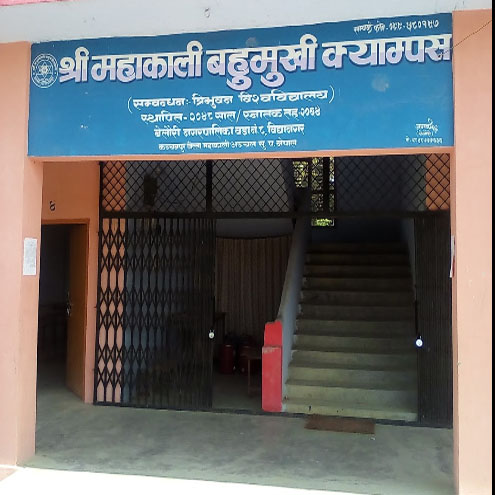
Mahakali Multiple Campus (महाकाली बहुमुखी क्याम्पस) is a community campus located in Belauri Municipality–06, Kanchanpur District, Sudurpashchim Province. Established in 1991 AD (2048 BS), the campus is affiliated with Tribhuvan University and conducts bachelor’s and master’s programs in Education and Management.
| Institutional detail | Information |
|---|---|
| Campus name | Mahakali Multiple Campus |
| Nepali name | महाकाली बहुमुखी क्याम्पस |
| Institution type | Community campus |
| Established | 1991 AD (2048 BS) |
| Location | Belauri Municipality–06, Kanchanpur |
| Province | Sudurpashchim Province |
| Affiliation | Tribhuvan University |
| Academic levels | Bachelor’s and Master’s |
| Faculties | Education and Management |
The campus began with Intermediate programs in Arts and Commerce. Its academic scope later expanded from intermediate-level study to undergraduate and postgraduate education.
Bachelor of Education was introduced in 2007 AD (2064 BS), followed by Bachelor of Business Studies in 2009 AD (2066 BS). The campus subsequently added the Master of Education program, extending its academic provision to the master’s level.
Mahakali Multiple Campus has also been selected as a Model Institution by the Ministry of Social Development of Sudurpashchim Province. It is participating in the Quality Assurance and Accreditation process and has identified institutional quality management, internal audit, self-study work and academic administration as areas of continuing development.
The campus operates academic programs under the Faculty of Education and Faculty of Management.
| Program | Level | Faculty |
|---|---|---|
| Bachelor of Education (B.Ed.) | Bachelor’s | Education |
| Bachelor of Business Studies (BBS) | Bachelor’s | Management |
| Master of Education (M.Ed.) | Master’s | Education |
The B.Ed. subject areas named for the campus are:
Health Education
Nepali Education
English Education
The campus therefore serves students seeking teacher education, education-focused postgraduate study and undergraduate management education within the Tribhuvan University system.
The Bachelor of Education is a four-year program under the annual examination system of Tribhuvan University. Its academic structure combines communication courses, professional education courses, specialization study and teaching practicum.
Students complete courses from the following areas:
General Nepali and General English
Philosophical and Sociological Foundations of Education
Educational Psychology
Curriculum and Evaluation
Instructional Technology or ICT-related education
Specialization major courses
Specialization minor courses
Teaching internship or practicum
The complete B.Ed. structure comprises 22 courses carrying 2,200 marks. Teaching internship or practicum is included in the fourth year.
At Mahakali Multiple Campus, the named B.Ed. areas are Health, Nepali and English. These options connect subject study with professional education and classroom preparation.
The Bachelor of Business Studies is a four-year annual-system program of Tribhuvan University. It combines language, economics, accounting, management, finance, law, marketing, taxation, research and concentration-based study.
Its academic progression includes:
Business English, Business Statistics and Microeconomics for Business
Financial Accounting and Analysis
Principles of Management
Business Communication and Macroeconomics for Business
Cost and Management Accounting
Organizational Behavior and Human Resource Management
Fundamentals of Financial Management
Business Law, Taxation and Marketing
Entrepreneurship
Business Research Methods
Concentration courses
Final project work
The fourth year includes concentration study and a final project. The concentration areas identified in the TU structure are Accounting, Finance, Management and Marketing.
The Master of Education follows the semester system of Tribhuvan University. The program extends over two years and four semesters, carrying 69 credit hours.
Its curriculum is organized around:
Core professional education courses
Specialization courses
Teaching practice
Thesis writing
Project work and assignments
Seminars, case studies and field studies
The core area covers subjects such as foundations of education, advanced educational psychology, measurement and evaluation, education and development, research methodology and contemporary issues in education.
The addition of M.Ed. allows the campus to provide postgraduate study in Education alongside its undergraduate programs.
Campus enrolment is recorded at 456 students.
| Academic area | Students |
|---|---|
| Business Studies | 242 |
| Education | 214 |
| Total | 456 |
The gender distribution in the same enrolment record is:
Female students: 332
Male students: 124
Education and Business Studies therefore account for the full recorded student population, with Business Studies having 28 more students than Education.
Facilities and support available at the campus include:
Library
Laboratory
Multimedia facilities
Counselling
Conference facilities
Scholarships
Internet access in classrooms
Digitized record management
The library and laboratory support academic study, while multimedia and internet access are used in the campus’s move toward technology-supported teaching. Counselling and scholarship provisions form part of its student-support arrangements.
Scholarship categories, amounts and selection conditions are handled through the campus administration.
Mahakali Multiple Campus has established an Education Management Information System unit for institutional data management. The unit collects, compiles, analyses and publishes academic and administrative information.
Its record-management responsibilities cover:
Student registration and personal information
Enrolment records
Examination information
Library use
Administration
Finance
Infrastructure
Land, equipment and institutional assets
The centralized information system is used for data processing, storage and reporting. It also supports institutional planning, resource distribution and budget monitoring.
The campus publishes EMIS information using the Higher Education Management Information System framework developed by University Grants Commission Nepal.
The campus has identified the following priorities for its academic and administrative development:
Expanding applied and career-related academic programs
Producing graduates with subject knowledge, professional skills and ethical awareness
Supporting progression to higher education
Increasing the use of technology in teaching and administration
Establishing a formal quality-management system
Conducting internal quality audits
Completing institutional self-study work
Defining departmental objectives, duties and responsibilities
Including communication and numerical-skill training in the academic calendar
Encouraging faculty participation in research and pedagogical development
These priorities connect academic expansion with institutional quality, technology use and structured administration.
| Position | Name |
|---|---|
| Chairperson | Harendra Singh Bist |
| Campus Chief and contact person | Dharmraj Joshi |
The Campus Chief oversees the campus administration, while the chairperson leads the institutional governing structure.
Campus: Mahakali Multiple Campus
Address: Belauri Municipality–06, Belauri, Kanchanpur District, Sudurpashchim Province, Nepal
Telephone: 099-580197
Mobile: 9865936425
Additional contact: 9868896112
Email: mmcbelauri@gmail.com
Website: https://mahakalicampus.edu.np
Mahakali Multiple Campus provides Tribhuvan University programs in Education and Management from Belauri, with B.Ed., BBS and M.Ed. representing its present academic scope. Its campus operations also include classroom internet access, multimedia use, student counselling, scholarships and an EMIS-based institutional record system.