



The Bachelor of Business Administration (BBA) program at Mahakavi Devkota Campus, Parasi, is offered under Tribhuvan University’s Faculty of Management.
This eight-semester undergraduate degree is designed for students aiming to build a future in business, management, or entrepreneurship. With a balance of theory and practice, the program equips students to assume managerial responsibilities in both national and global contexts.
The BBA program spans four academic years, comprising eight semesters and 120 credit hours. The curriculum includes foundation courses in management, economics, and communication, alongside specialized training in finance, marketing, human resource management, operations, and business technology.
In the final year, students complete a summer project and an internship, which allows them to apply what they’ve learned in real organizational settings.
Core Management and Allied Courses – 84 credit hours
Computer and Information System Courses – 12 credit hours
Specialization Courses – 18 credit hours
Summer Project – 3 credit hours
Internship – 3 credit hours
The BBA program aims to:
Prepare students for mid-level management roles in business and administration
Strengthen students’ ability to approach real business problems with practical solutions
Introduce students to both theoretical and applied aspects of management and technology
Provide a strong base for further study in business-related postgraduate programs
Throughout the eight semesters, students study a variety of subjects, including:
Financial Accounting
Marketing Principles
Business Economics
Human Resource Management
Cost and Tax Accounting
E-Commerce and Information Systems
Strategic Management
Research Methods and Business Ethics
Students also choose a specialization in areas such as:
Banking and Finance
Sales and Marketing
Industry and Services Management
Micro Enterprise Management
Accounting
In addition to classroom lectures, the BBA program includes:
Group discussions and presentations
Case studies and business simulations
Fieldwork and industry visits
Project writing and seminars
During the eighth semester, students take part in an internship, typically lasting eight weeks, at a company or organization. This provides valuable experience, helping students bridge the gap between academic learning and the workplace.
Applicants must have:
Completed 10+2 or equivalent from a recognized board
Secured a minimum D+ in all subjects of Grade 11 and 12 with CGPA 1.80 or higher, or second division
Appeared and passed the CMAT entrance exam conducted by the Faculty of Management
Shortlisted candidates are further evaluated through an interview process.
The program follows a semester system with internal and external assessments
40% internal evaluation (assignments, tests, participation)
60% external examination (end-of-semester exams)
Students must maintain a minimum CGPA of 3.00 to graduate
Grading follows Tribhuvan University’s official system, where grades range from B to A with distinctions based on overall performance.
Graduates of the BBA program are prepared to step into various professional roles such as:
Business Executive
Marketing Coordinator
Banking Officer
Sales Manager
Operations Analyst
Entrepreneur
Finance Associate
The degree also provides a solid academic foundation for those planning to pursue an MBA or other postgraduate programs.
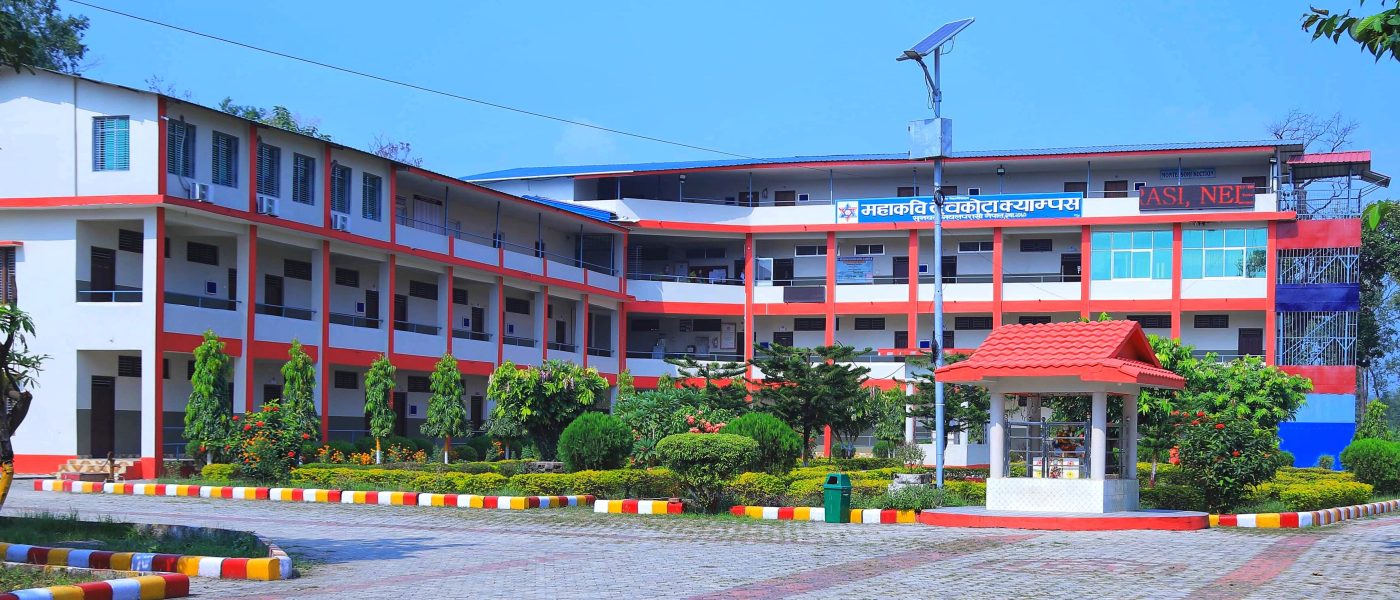
Located in Parasi, Mahakavi Devkota Campus offers a disciplined academic environment, experienced faculty, and access to both practical learning and community engagement.
The BBA program is guided by TU’s standards and supported by a curriculum that meets the needs of today’s evolving business landscape.
The BBA program at Mahakavi Devkota Campus is ideal for students looking to grow in the field of management. With a strong emphasis on both academic learning and real-world application, the program helps students build the confidence and competence to succeed in diverse business roles.
Contact Mahakavi Devkota Campus's administrative office for detailed information on the BBA course, including fees, scholarships, facilities, counseling, eligibility criteria, etc.






