



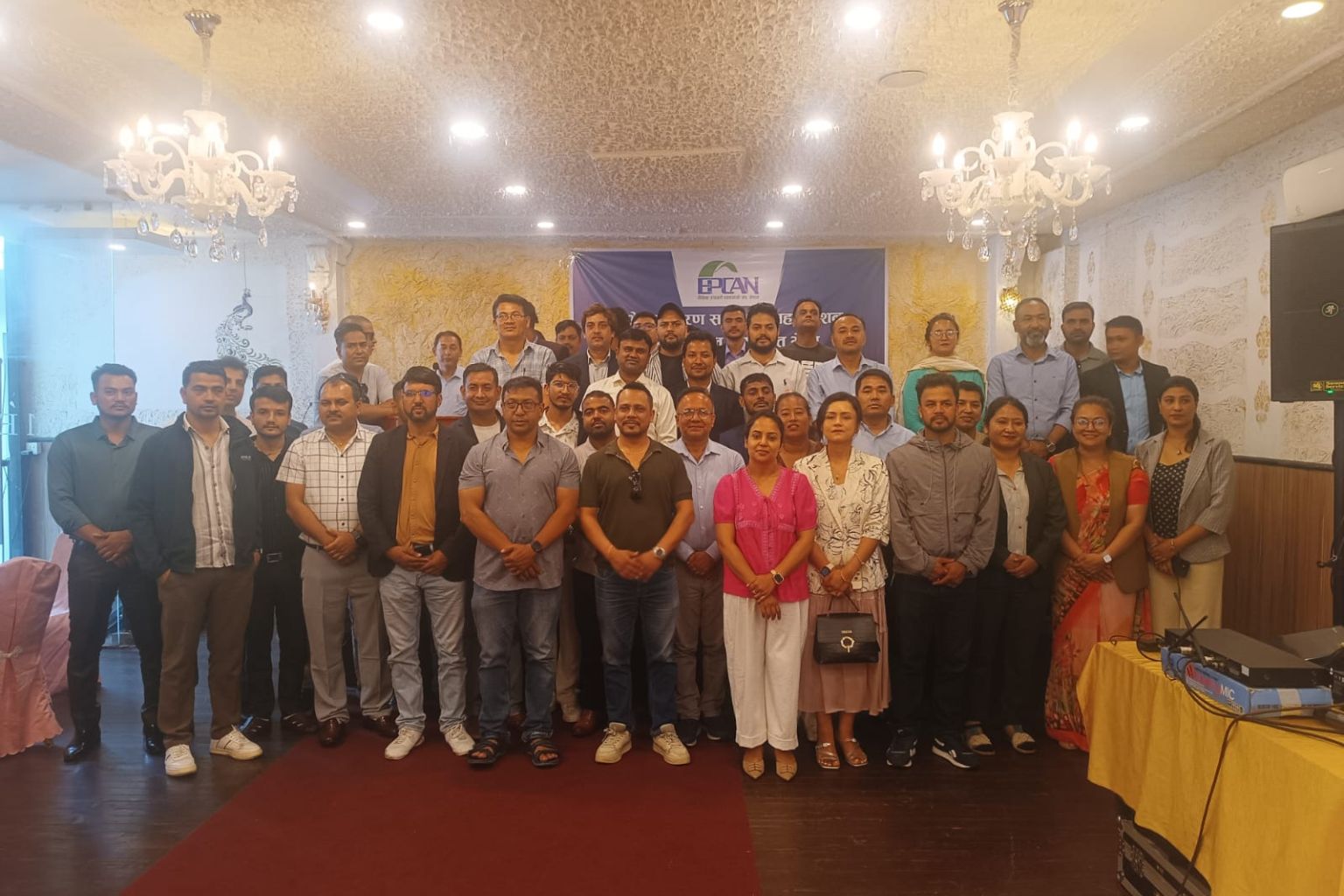
EPCAN Broad Gathering: Demand for Special General Assembly and New Leadership, Saying Current Leadership Has Completely Failed
Kathmandu - 3rd July, 2026.
Former office bearers, founding members, and general members of the Educational Professional Consultancy Association of Nepal (EPCAN) have concluded that the current executive committee has completely failed to protect the rights and interests of business operators and provide leadership to the organization.
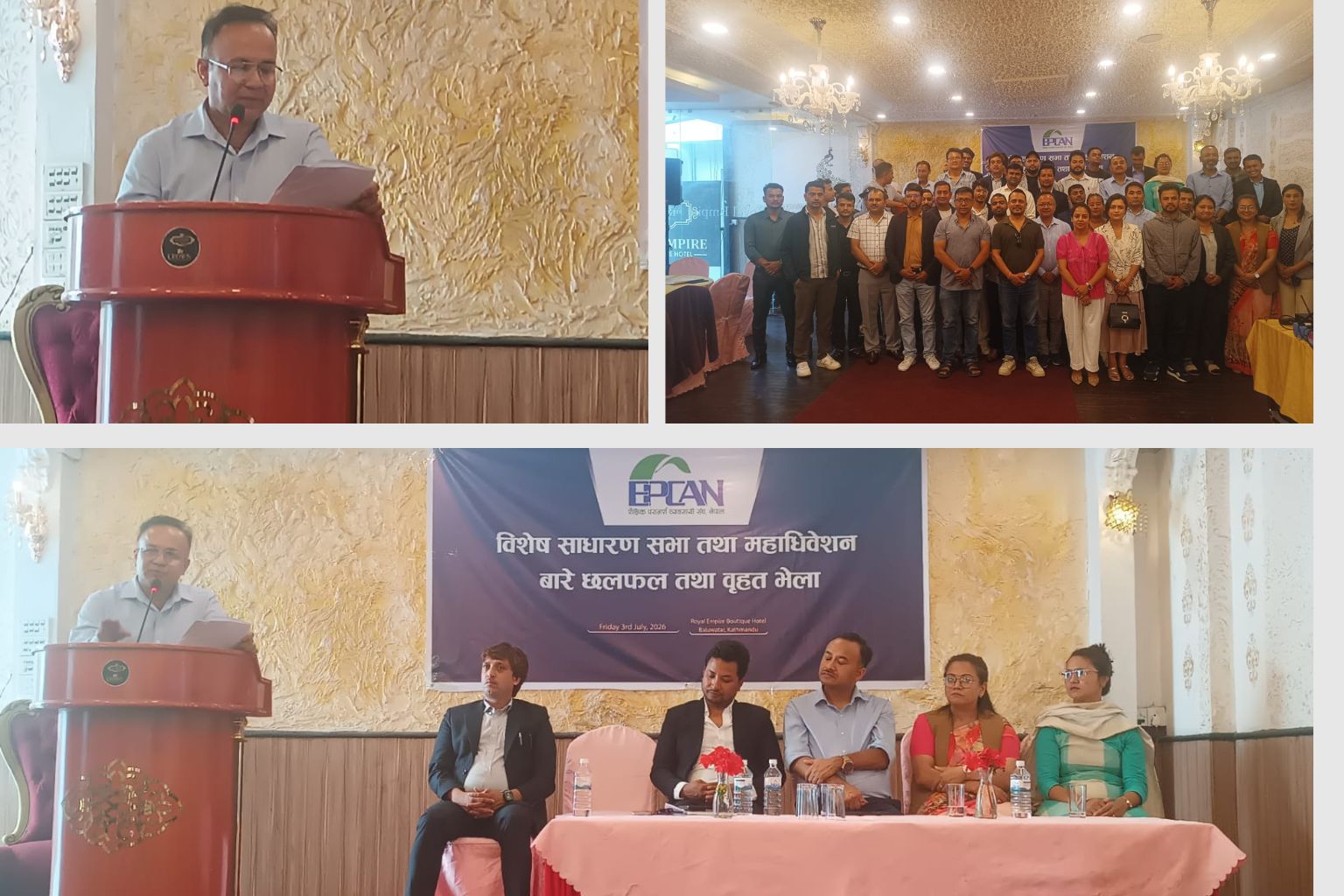
Speakers present at the “Discussion and Broad Gathering on Special General Assembly and General Convention,” held from 1:00 PM on Friday, 3 July 2026 (2083 Ashad 19), pointed out that the organization has reached a serious crisis and that an immediate special general assembly and new leadership are needed to save it.
The program was conducted by Maheshwar. At the gathering, the founding president, former general secretary, former treasurer, former secretary, and former central member of the organization presented their views in detail on the weaknesses of the current executive committee, the crackdown being carried out by the state, the new policies of the Ministry of Education, Science and Technology, and the way forward.
“I Resigned Because There Was No Respectful Treatment or Performance from the Leadership”
Speaking at the beginning of the program, former central member Jyoti Shahi said she had joined EPCAN thinking of it as a home and had expected that even minor problems could be raised directly. Shahi, who was speaking at a public program for the first time, said that although good work had been done during the first term, she saw many shortcomings while serving as a member of the executive team during the second term.
She said she felt that the current committee had become a complete “failure.” She especially complained that women members were not treated respectfully and that there was no environment to facilitate their progress and work. “Even for small matters within the committee, no solution came from our committee or the current president,” Shahi said. “Even for minor issues, we had to contact the former president and ask him to do this or that.”
Stating that she resigned and became a former member because there was no working environment within the executive committee, she expressed hope that the new EPCAN to be formed would move forward with great effort, remain positive, and create an environment where all new members could grow their corporate business with respectful treatment.
“The Organization and Business Are at the Most Sensitive Point in History, and I Am Ready to Work on the Front Line”
Addressing the gathering, former treasurer Dipa Lamichhane recalled the struggle since the establishment of the organization. Presenting a written statement, she said the organization had been brought to a proud height through continuous coordination with colleagues and day-and-night effort from the registration process onward, and that even the fund had been made strong and secure before being handed over to the current leadership. However, she expressed sadness that a serious and discouraging situation had now been created in which the organization’s own members felt as if they would no longer remain in the organization.
Lamichhane said that, at present, business operators have become fearful due to the complicated security deposit-related policies introduced by the Ministry of Education and the crackdown being carried out on various pretexts, creating an uncomfortable situation in which they cannot even put forward their concerns. She said she could not remain a silent spectator in such a situation.
Recalling that she had directly communicated and coordinated with the Ministry of Education and education ministers in the past, she said, “We have continuously raised the issue of how the state views the consultancy business. This sector is one of the state’s main taxpayer businesses, a remittance-bringing sector, and a career-oriented and future-builder sector.” Saying that the voices of grassroots people should also be heard, instead of listening only to two or four stakeholders, she revealed that she had been in continuous contact with the minister’s secretariat yesterday and today as well.
Stating that a compulsory situation had arisen for old colleagues to come forward once again to protect the organization built with blood and sweat in the past, she announced that, as demanded and desired by colleagues, she was ready to build a strong, capable, and transparent team under her coordination and work on the front line for the rights and interests of business operators.
“When There Is a Problem at Home, We Do Not Leave the House; We Strengthen It from Within”
Former secretary Sudhir Raj Khadka, who has been active in this business for the past 15 years, discussed his long experience and the background of institution-building. He recalled that EPCAN was formed under the leadership of founding president Prajyol Basnet to jointly face the problems encountered while working in various destination countries, including Korea and Japan.
Khadka said that forming EPCAN itself was a challenge and that although the necessary work was completed in a short time and the organization was handed over to colleagues, the current leadership had not worked as expected. Complaining that there was a lack of cooperation when he tried to organize programs while serving as secretary, he said, “During Prajyol sir’s tenure, many programs, including vaccination programs during the COVID period, were held. There was no such thing as ‘no’ from him in any matter. But now, even a small program has not been possible.”
He said he felt sad to see country-specific organizations bringing more programs than EPCAN and providing facilities to their members, even though EPCAN is a multi-destination organization. “We have very capable colleagues; there was no need to outsource. But the work did not happen due to the personal ego or lack of cooperation of some colleagues,” he added.
Saying that he felt most saddened when he heard members talking about going to other organizations because EPCAN was not working, Khadka said, “EPCAN is my home. Where should I go? I will not go to any other organization. If there is a problem at home, we do not leave home and go to someone else’s house; we strengthen the home from within.” At a time when daily news of crackdowns has caused fear, he appealed to everyone to openly express what was in their hearts and move new leadership forward to protect the industry.
“The Leadership Could Not Protect Members; the Organization Was Not Prioritized”
Former general secretary Naresh Sedai explained in detail why today’s gathering and the need for a special general assembly and general convention had arisen. Saying that such a gathering would not have been necessary if there had been no problems within the organization, he clarified that he had to resign even while serving as general secretary because there was no working environment and no cooperation.
Sedai recalled that the programs conducted during the first term were very dynamic and that even the parallel organization ECAN had praised EPCAN after seeing its height. However, he said that during the second term, the organization moved as if a brake had been applied to a vehicle. “Why could we not deliver? Did we come into the organization only for personal business? Certainly not,” he said.
He said that many members left the organization one after another as the executive committee changed, but the leadership could not address why they were dissatisfied and why they did not want to stay. He said it was most unfortunate that the leadership failed when members were distancing themselves.
He said that, under any circumstance, when the government carried out crackdowns, the leadership should have played a guardian’s role, but that did not happen, weakening members’ sense of security and trust. He mentioned that during the recent government crackdown, many felt that the leadership had run away or stayed distant while members were seeking help. “At that time, all the phone calls were coming only to me. Colleagues used to ask why the president was not answering the phone, but I also had no communication with them,” he said.
Recalling the history of EPCAN’s establishment, Sedai said founding president Prajyol Basnet had played the main role in bringing the membership close to 200 when they came after rebelling against another organization. However, he accused the current leadership of trying to cut the very root of a tree, meaning that it had ignored the relationship with the founding president.
“If a part of a vehicle does not work, we do not throw away the vehicle; we change the part. If the gear is damaged, it must be repaired,” Sedai said. He stressed that leadership should be smart and business-oriented, EPCAN should be involved in policy-making, and the practice of reacting only after seeing news about parallel organizations should end. Saying that leadership unable to work should allow new people to work and should not occupy the place without delivering, he said EPCAN must now be made a truly strong organization.
“The Leadership Did Not Even Make One Phone Call When Colleagues Were Arrested; the Organization Must Be Reborn”
Addressing the gathering as the main speaker, founding president and Immediate Past President Prajyol Basnet said a compulsory situation had arisen in which a general convention had to be held against the very executive committee he had formed. He informed that, after several rounds of discussion, the conclusion was reached that the current executive committee had done no work and that member colleagues were in serious pain.
Raising serious questions over the current president’s working capacity, Basnet said, “The current president was not even aware of how many members we have. He also did not know how many colleagues were arrested in the recent crackdown. When colleagues were arrested, the leadership did not make even one phone call. This is extremely sad.”
Recalling that he had also been afraid during the crackdown and had closed his office for two days, he said, “Will the tiger that eats my friends not eat me? I was also afraid. But after colleagues including Sudhir Khadka pushed me, I gathered courage and went to the police. Our organization’s name was not there, but 5–7 of our member colleagues had already gone inside. As an immediate past president, I could do nothing except give suggestions.” He said the leadership did not care even during such a serious time and did not take any initiative in the renewal process of members at the Ministry of Social Development.
Although the security deposit issue that the Education Ministry is preparing to introduce has become a major concern, he urged colleagues not to panic. “The state’s way of looking at us is different, but if we all move forward together, there will be a hearing. There is talk that the government will provide an interest-free amount of 10 to 20 lakh to those who have companies; we may use that money for the security deposit and find one idea or another,” Basnet said. “But one should not become discouraged and say they will leave the business. For 21 years, this is the only work I have known. I can no longer go to the village and plough the field; even the oxen in the village are gone, and I do not know how to drive a tractor. So, we must stand firm and fight.”
Clarifying that he had not come out of revenge against any particular person or to demand a post, he said he was compelled to speak because he was concerned about the organization’s future. “To build this organization, I sacrificed my family’s happiness, time, and important relationships. When I separated from another organization, I lost many friends, earned enemies, and my character was questioned, but I never regretted it,” he said.
He accused the current leadership of not even trying to stop old members from leaving in disappointment and instead adopting an attitude like “the wind blew away the dust that the broom was supposed to sweep.” He said that, as founding president, he had remained silent many times and had not gone even when a parallel organization invited him, but his silence had been considered weakness and fear. “Leadership does not mean running away from criticism; it means having the capacity to listen. It does not mean dividing members; it means respecting them. We did not establish this organization so that it would become the influence and private property of a few limited individuals,” he said.
Seven-Day Ultimatum for Special General Assembly
Founding president Basnet informed that members’ signatures demanding a special general assembly had already been submitted last Monday. According to the organization’s statute, the leadership must provide information about the special general assembly within 7 days from the date the signatures were submitted, meaning by the coming Monday. He said there is a clear legal provision that if the current leadership does not provide the information, a committee with a majority number will be formed and a new executive committee will be selected on the basis of that committee.
He clarified that, according to the statute, experience of having worked for one term is required to contest the post of president, but anyone can file candidacy for other posts. Calling on youths to come into leadership and run the organization, he expressed commitment that he was ready to provide continuous support from behind.
Finally, Basnet said it was unfortunate that even after such a large crackdown and suppression by the state, not even a simple statement was issued by the organization. “Today’s change is not the defeat of any individual; it is the rebirth of the organization. Let us not allow this organization to die,” he said.
All members participating in the gathering expressed commitment to work together to move the organization forward in the institutional interest rather than making it person-centered, select new leadership, and make EPCAN once again a shared and safe home for all.




.png)

Comments 0
No comments yet. Be the first to start the conversation.