




How the World Celebrates the English New Year: A Cultural and Historical Study
Every year, at midnight on December 31, when the clock hand touches 12, one part of the world is filled with the feeling of farewell, while another part is swept up in the excitement of a new beginning. The English New Year, considered the first day of the Gregorian calendar, is no longer just a change of date.
Today, it has become a global cultural celebration.
Although the way people celebrate New Year differs from country to country, one shared element remains at its core: hope. For young readers who want to understand the depth of this widely observed occasion, it matters to see how this celebration connects geography, the economy, and human psychology.
Historical Background: Why January 1?
To understand the history of the New Year, we must go back to ancient Rome. In 46 BC, when Julius Caesar introduced the Julian calendar, he established the tradition of treating January 1 as the start of the year. The month of January is named after the Roman god Janus, who had two faces: one looked back toward the past, and the other looked forward toward the future.
In medieval Europe, for a period of time, Christian influence led some places to treat March 25 or December 25 as the New Year. However, in 1582, after Pope Gregory XIII introduced the Gregorian calendar, January 1 was again officially recognized as New Year.
Scientifically, this change was more relevant to the time the Earth takes to orbit the Sun.
The Time Zone Factor: The Earliest and the Latest
Because of geography, the New Year does not arrive everywhere at the same moment. The International Date Line in the middle of the Pacific Ocean determines this.
Kiribati: Among the First
Kiribati: This small island nation in Oceania is among the first places in the world to welcome the New Year. People there begin celebrations many hours before much of the rest of the world.
New Zealand and Australia: Globally Known Fireworks
New Zealand and Australia: The fireworks at Auckland’s Sky Tower and Sydney’s Harbour Bridge are widely known around the world. Millions prepare for months to watch Sydney’s fireworks. Research states that this event contributes billions of dollars each year to Australia’s tourism.
The Last Places: Uninhabited and Inhabited
The last places: New Year arrives last at Baker Island and Howland Island in the United States, although these places are mostly uninhabited. Among inhabited areas, American Samoa celebrates the New Year the latest.
Continental Diversity: Where and How It Is Celebrated
Asia: A Mix of Tradition and Modernity
In Asia, local New Years carry strong significance, but the January 1 celebration is becoming more popular among young people.
Japan (Oshogatsu)
In Japan, the New Year is called Oshogatsu. The tradition is somewhat different. Buddhist temples ring bells 108 times at night (Joya no Kane). It is believed this removes 108 worldly sins. Japanese people often go to hills or seashores to watch the first sunrise of the New Year (Hatsuhinode).
Thailand
Large music events are held during the English New Year. The gathering in front of Bangkok’s CentralWorld is grand, similar to New York’s Times Square.
Philippines
Round objects are seen as symbols of prosperity. There is a distinctive tradition of eating 12 kinds of round fruits at midnight and wearing clothing with dots.
Europe: Where History Meets Celebration
In Europe, New Year is also called Saint Sylvester’s Eve.
Spain (The 12 Grapes)
People eat one grape with each chime of the clock at midnight. If you can eat 12 grapes in 12 seconds, it is believed you will be lucky for the next 12 months.
Scotland (Hogmanay)
Here, the New Year is called Hogmanay. First-footing is a well-known tradition. It is believed that if the first person to knock on the door after midnight (especially a tall, dark-haired man) brings coal, bread, and money, the household will have happiness throughout the year.
Denmark
An unusual custom involves breaking old dishes at a neighbor’s or friend’s door. The more broken dishes at your door, the more friends you are believed to have.
North and South America: Grandeur and Belief
United States
The Ball Drop at New York’s Times Square has continued without interruption since 1907. It is the most watched New Year program on television in the world.
Brazil (Rio de Janeiro)
On Rio’s Copacabana Beach, millions gather wearing white clothes. They jump over ocean waves seven times and offer flowers to the goddess Yemanjá. White clothing is considered a symbol of peace.
New Year Resolutions
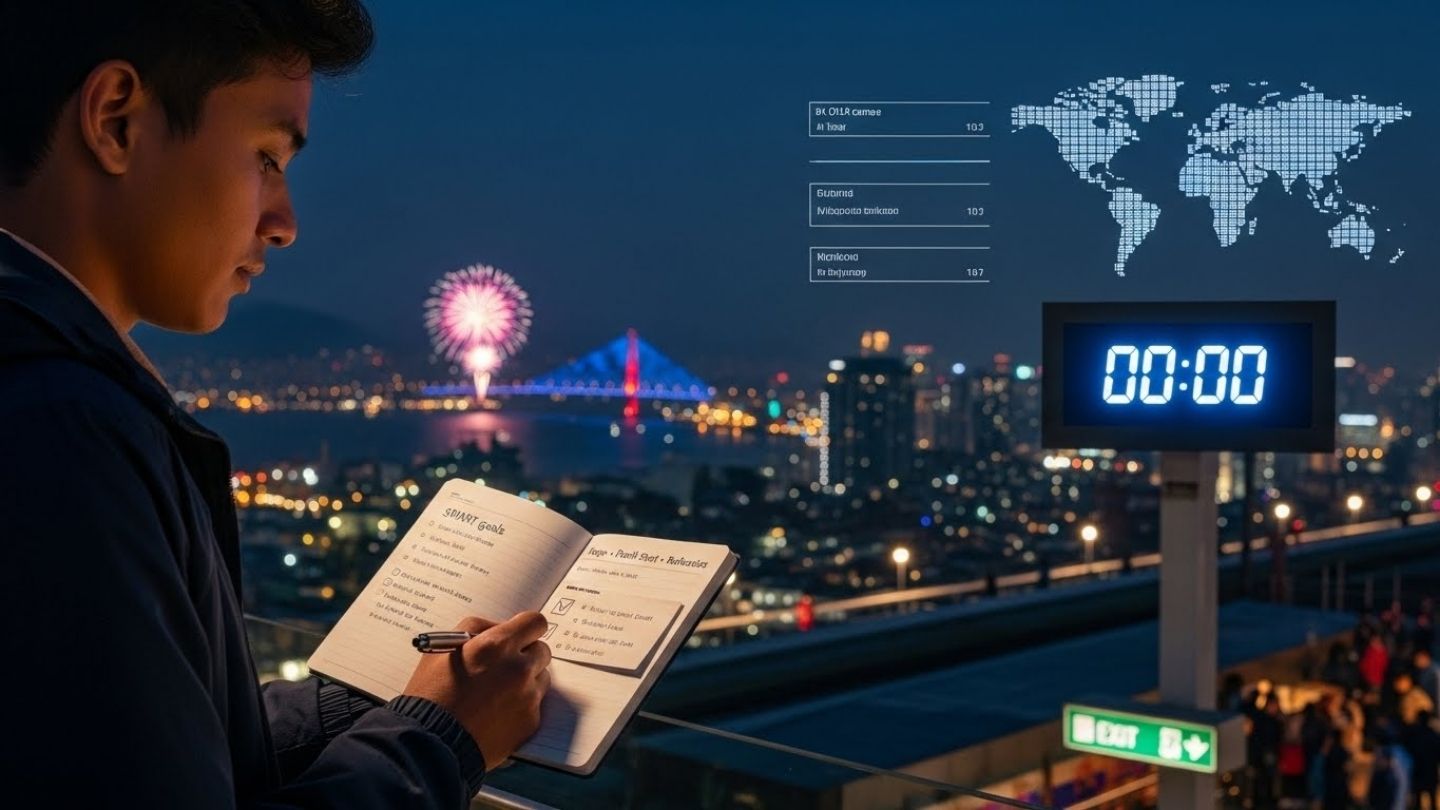
Every New Year, people make “New Year resolutions.” In my 20 years of experience, what I have seen is that around 80 percent of resolutions are broken by February.
People set overly ambitious goals (for example, losing 10 kg in a single month, or quitting cigarettes suddenly).
When setting goals, follow the SMART rule.
-
S (Specific): A clear goal (example: I will read 20 minutes a day).
-
M (Measurable): Something you can measure.
-
A (Achievable): Something you can realistically reach.
-
R (Relevant): Connected to your real needs.
-
T (Time-bound): With a time limit.
Psychologically, the New Year gives people a “Fresh Start Effect,” which provides energy to correct past mistakes.
Safety and Health During the New Year
During the New Year, accidents and health problems also increase. As a responsible writer, these aspects cannot be ignored.
-
Crowd management: If you are going to a public place, learn about exit points in advance.
-
Mental health: Some people may feel “New Year Blues” or loneliness. Do not compare your life with others by looking at their photos on social media. The way of celebrating is personal.
-
Sustainable celebration: Fireworks increase air and noise pollution. Nowadays, many cities have started prioritizing drone shows, which are more environmentally friendly.
What This Celebration Means for Young People
Today’s youth do not only want entertainment. They want meaningful involvement. The New Year is not only a time for parties, but also a time for self-reflection.
What did you learn this year? What stopped you from moving forward? And which skill will you develop in the coming year? Searching for answers to these questions is what it means to truly celebrate the New Year.
Interesting and Less-Heard New Year Facts
Here are some facts found during research.
-
Italy: There is a custom of wearing red underwear on New Year, believed to increase love and fertility.
-
Estonia: On New Year’s Day, people eat 7, 9, or 12 times. These numbers are considered auspicious and are believed to signal plenty of food in the coming year.
-
Netherlands: The New Year’s Dive is well known. Thousands of people go to swim in the cold sea.
Conclusion
The English New Year ties the world into a single time cycle. Whether it is Sydney’s fireworks, Madrid’s grape-eating tradition, or musical evenings in Nepal’s cities, the purpose is the same: wishing for a better future.
What we must understand is that a New Year is not only a change of calendar. Real New Year is the arrival of positive change in thinking and behavior. I believe this article has helped you understand the global rhythm of the New Year.
In closing, while celebrating the New Year, we must not forget our culture and originality. The ways of celebration may differ, but the spirit of humanity and mutual harmony should be universal.


.png)

Comments 0
No comments yet. Be the first to start the conversation.